International travel before globalization

Vienna, Austria (photo: DY, 2015)
My visits with long-time friends Sharon and Don Driscoll inevitably include good conversations, and some of them revolve around our shared status as members of Generation Jones. During their recent trip to Boston, Sharon observed that Gen Jonesers were the last generational cohort to discover international travel before the current mega-era of globalization, and it struck me as a very apt point.
Generally speaking, those among our age group who have traveled abroad started doing so in the 1980s through early 1990s. Starting around the end of that stretch, the globalization of goods and cultural tastes significantly impacted the look and feel of major cities, soon to be fueled by the ubiquitous presence of the Internet.
I didn’t have this blog post in mind when I snapped the photo above over the summer, but it sure fits the bill. In July I was in Vienna, Austria, for a conference on law and mental health. While the city has retained much of its Old World ambience, a quick turn of a corner might reveal (drum roll) a Starbucks and a T Mobile store.
Given my usual international travel destinations, these changes are most apparent to me in Europe, where many American retailers and fast food vendors have staked their claims. For those of us with adventurous spirits that stretch only so far, it can be reassuring to find a known quality in an unfamiliar place.
But such discoveries are good only on occasion if we are to reap the benefits of travel. All things being equal, when traveling abroad, or even to a different part of one’s own country, ’tis better to try out new places unique to those locales than to be searching around for the same brand of mocha latte.
During my 1981 collegiate semester abroad in England, we weren’t surrounded by American fast food outlets and retail stores. Oh, I confess that I was thrilled to discover a McDonald’s during a brief visit to Paris, but the real benefits of those five months involved exposure to new places, ideas, and cultures, mixed in with the maturing experience of being much more on our own as we traipsed around the U.K. and the European Continent.
Return trips to England in the early 1990s brought more of the same. While I definitely noticed the presence of more American franchises in London, they didn’t dominate the city storefronts. (Yeah, I was kinda happy to see Pizza Hut there…)
Today, the great European cities I’ve visited in recent years — London, Cardiff, Amsterdam, Berlin, and Vienna — still retain much of their historic flavor, but a more homogeneous and familiar array of shops and retailers is definitely present in each of them.
I know that Burger King, KFC, and smartphone vendors are unlikely to disappear from the global cityscapes. If anything, we’re likely to see more of them. But it’s worth noting that these developments have changed the experience of international travel to make it feel less, well, international.
The day the House Minority Leader took my photo in the Luxembourg Gardens of Paris

The Hon. Richard Gephardt (Photo: Wikipedia)
Back in the summer of 1998, I was attending a continuing legal education seminar in Oxford, England. The two-week program had a built-in extended weekend break, so I decided to hop on the Eurostar train for a quick visit to Paris.
One of my first sightseeing stops was the Luxembourg Gardens, truly one of the most beautiful places on urban earth. I was so taken by my surroundings that I wanted to get a picture of me with some of the foliage in the background. I figured I’d ask someone to take my photo.
Given my, umm, distinctly limited command of French, I hoped to approach someone who spoke English. Well, it was my good fortune that I heard a gentleman talking to someone in English with a slight Midwestern drawl. I asked him if he would take my picture and he kindly agreed.
As he stood up and faced me, I realized that I was looking at Richard Gephardt, the well-known Member of Congress, then-House Minority Leader, and one-time Presidential candidate!
He quickly snapped my picture, I thanked him, and we went on our respective ways. (Alas, I cannot get my hands on the photo itself. It’s no doubt buried in a pile of other mementoes somewhere in my condo storage area.)
Here’s the backstory: That very week, President Clinton was facing a deposition about his affair with a former White House intern, and apparently a lot of leading Congressional Democrats smartly decided to get out of town to avoid the ensuing media frenzy. I’d say that Dick Gephardt made a good choice by going to Paris!
Well, I’ve always told myself that in the very unlikely event that I bumped into the good Congressman, I would share the story with him. It so happened that I got my chance last Wednesday.
I was in Washington D.C. for the annual awards banquet of Americans for Democratic Action, a political and policy advocacy group whose board I’ve served on for many years. At the pre-dinner reception, Dick Gephardt — now retired from Congress — put in a cameo appearance to say hello to the banquet attendees, and I waited for my chance to chat with him. He understandably didn’t recall taking the photo, but he definitely remembered being in Paris and the political circumstances of the time, and he got a kick out of my little story.
As I said, I don’t have the snapshot handy, so this photo of the Gardens from Wikipedia will have to do:

Luxembourg Gardens (Photo: aconcagua, via Wikipedia)
Too many road warrior gadgets?

….and add my iPhone, which took this photo
This week I took a super quick, one night trip to Washington D.C. for an awards banquet, and I found myself chuckling over how much gadgetry I was packing for my short sojourn: My MacBook, iPad, Kindle, and iPhone. (Yeah, I’m mostly Apple these days.) That means four charging cables as well.
That’s a lot of gear for a 24-hour trip!
Curiously, on balance, I’m a light traveler. For all but the lengthiest of trips, I will travel with a backpack and a roll aboard bag that fits comfortably into even a small overhead aircraft bin.
So why all the gadgets?
For starters, the laptop is a work machine. The tablet is my most-used device when I’m en route anywhere…the subway, a short pitstop on a walk somewhere, and certainly out-of-town trips. The cellphone, while perhaps my least used hardware, is invaluable at times and takes pretty good photos. And although I much prefer printed books to an e-reader, the latter allows me to travel with the equivalent of a small library.
A pain in the ash
Maybe I now err on the side of taking all these devices with me because five years ago, I was stranded in Germany for several days without them and felt quite disconnected as a result. In packing, I had decided that for a short international trip, I could leave my laptop at home. Dumb move.
You see, I was participating in a conference at the University of Augsburg, and it so happened that during that time, the big volcano in Iceland was spewing out ash clouds that swept across Europe and shut down the airspace.
Now, there are worse places to be stuck than the beautiful medieval city of Augsburg, but I had not planned on an extended stay. Because my hotel had only one guest computer and the proprietor looked sternly at anyone spending too much time on it (i.e., me), I made multiple treks to the local Internet cafe in order to catch up on e-mails and keep track of the news.
After all, in a pinch, you can do some laundry in the sink or the tub, but you can’t turn your scrubbed out socks into a computer.
Next Gen???
Perhaps the march of technology will allow me to consolidate functions into fewer devices. My current gadgets are of slightly “older” vintage — iPad 2, iPhone 4, etc. — so I’m thinking it’s time to be on the lookout for an upgrade. I was looking covetously at the newly announced iPad Pro, but I’ll wait to see the reviews.
In the meantime, I’ll continue to pack all my toys whenever I’m about to hop on a plane or a train.
***
Related post
Have our gadgets sapped some of the adventure out of travel? (2014)
Fall, fantasy football, and a song or two

Thursday night kicked off the NFL season, which for several million fans also meant the beginning of fantasy football. Somehow I find myself in three fantasy leagues this fall, which means that I’ll be managing the fortunes of three fake football teams: The JP (Jamaica Plain) Storm, the JP Blizzard, and the JP Nor’easters.
Fantasy football offers an added element of fandom. In addition to following your favorite pro team(s) (in my case, primarily the Chicago Bears, and secondarily the New England Patriots), you follow the individual statistical performances of players you’ve drafted for your fake teams.
Sometimes the scoring systems are simple, such as that in the league I organized, where points are awarded almost exclusively on actual scoring. This means that when one of your players scores a touchdown, that six points goes to your team. Easy peasy! Other scoring systems are much more complex, using a longer list of statistical measures.
For me, the start of the NFL season also signifies the “real” start of fall, even if the official seasonal change doesn’t occur until later this month. And here in the Boston area, it just so happened that an early September heat wave cooled off markedly for Thursday’s first Patriots home game in nearby Foxborough.

But there are healthy limits to this fandom. On Wednesday evening, for example, I missed the real-time player draft for one of my fantasy football leagues in order to sing at an open mic cabaret night at a club here in Boston. (The Yahoo! fantasy football platform made my picks for me, based on a player ranking list I compiled.)
I wrote previously that I’ve been taking a weekly singing class for many years, and more recently I’ve been joining friends from that class at open mic nights. Over the weekend I had practiced a duet number with one of my friends, “Somewhere Out There” from An American Tail. We performed it on Wednesday night and did a fine job! (Actually, she did great with it, but I felt a little shaky in parts.)
Singing is very therapeutic for me, a form of mindfulness that allows me to be in the moment in a very good way. Performing favorite songs and listening to others do the same is a genuine treat. Following my fake football teams online is fun, but live singing with good company is much, much better.
The awesomeness of “Hill Street Blues”
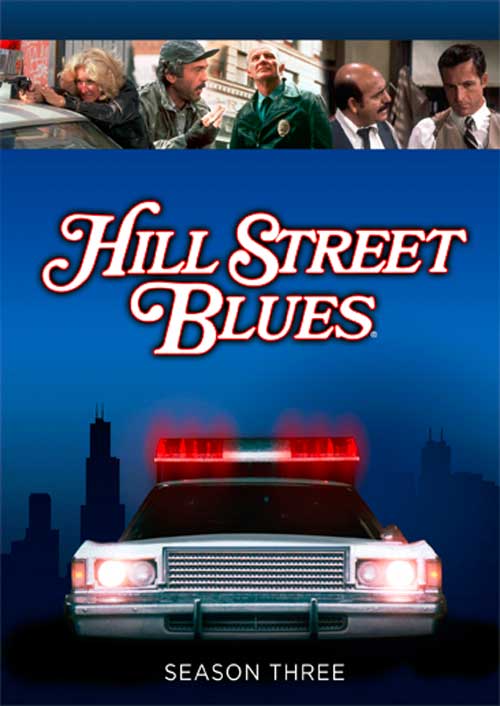
My current binge view is season 3 of “Hill Street Blues,” the gritty police drama that ran from 1981 to 1987. A four-time Emmy Award winner for outstanding drama series, it still holds up very well today. I happen to think that it’s simply awesome.
Steven Bochco created this compelling drama series, set in an unknown American city. The gifted cast was largely made up of actors and actresses considered lesser knowns at the time. From the show’s Wikipedia entry, here are the main stars of the first three seasons:
- Captain Francis Xavier “Frank” Furillo (Daniel J. Travanti)
- Joyce Davenport (Veronica Hamel)
- Sgt. Phil Freemason Esterhaus (Michael Conrad)
- Detective Mick Belker (Bruce Weitz)
- Sgt. Henry Goldblume (Joe Spano)
- Officer Bobby Hill (Michael Warren)
- Officer Andy Renko (Charles Haid)
- Sergeant Howard Hunter (James B. Sikking)
- Officer, later Sgt. Lucille Bates (Betty Thomas)
- Detective J.D. LaRue (Kiel Martin)
- Detective Neal Washington (Taurean Blacque)
- Lt. Ray Calletano (Rene Enriquez)
- Officer Joe Coffey (Ed Marinaro)
- Fay Furillo (Barbara Bosson)
The calms in the storm of this rough urban precinct are Capt. Furillo and public defender Davenport, who happen to be a couple. Both Travanti and Hamel were brilliant at staying within the emotional boundaries of their characters. In fact, the same could be said of the rest of the cast, whether they played straight arrows or eccentrics. It was the mix that provided the sparks.
Over time, the characters develop, and key story lines continue from week-to-week, a breaking contrast to the scripts of many of the popular one-and-done cop shows of previous decades. Personal relationships evolve, as well, but not to the point of causing us to forget that this is about an urban police precinct. The show’s treatment of issues of race, gender, and sexual orientation made for cutting-edge television during its time.
Hill Street Blues also gave us one of the best-ever themes for a television show. Click below and enjoy Mike Post’s work:
The show presses my personal nostalgia buttons. I discovered it during my first year of law school. Hayden Hall, formerly NYU’s law school residence hall on Washington Square, had a big TV room, where dozens of folks from our first-year class gathered each week to watch new episodes, before heading back to our rooms or the library to study. Now, I’d never want to repeat my first year of law school, but it produced some good memories nonetheless! Among those were study breaks to follow the lives and doings of the denizens of the Hill Street precinct.
Geek fantasy: Doing college all over again, but only on terms that defy reality

“Umm, professor, you’re expecting me to actually read these?” (Photo: DY, 2013)
On Facebook yesterday, one of my long-time college friends posted a photo of her son’s residence hall room. She added that this made her want to go back to college, which prompted a short chorus of me too‘s from several of us who went to school together, including yours truly.
Yup, for geeky types like me, it’s a midlife fantasy: Going back to school again.
For me, the wished-for do-over has a high maintenance quality, as it comes with at least ten conditions:
- I don’t want any required classes.
- I only want to write papers that I want to write.
- I don’t want any in-class exams; this should be a minimal stress experience.
- I’ll pass on any classes before 10 a.m. as well.
- I want to do college over again with my current gifts of wisdom and hindsight.
- I’d like to have a bit more money than the first time around, but without taking on more student loans, as I spent almost 20 years paying off the first batch.
- I’ll pass on the immaturity, angst, anxiety, and insecurity that characterized my first go-around of college.
- I want to do another semester abroad in England with the exact same group I was a part of in 1981.
- I want my own dorm room with a bathroom, thank you.
- I want extracurricular and co-curricular activities to count for credit.
Basically, I’d love to luxuriate in the life of being a student — thinking big thoughts, taking part in extracurricular activities, reading and watching what I want when I want, going to movies, sporting events, and cultural activities, and enjoying the company of fellow students.
Alright, some of you in the Peanut Gallery may be chuckling that I basically have this life as a professor! Well, although I appreciate very much the opportunities and flexibility provided by academic life, a carefree sense is not always among its main qualities. Even for tenured profs, academic life balances its genuine blessings against its share of anxieties, pettiness, and bureaucratic cluelessness.
In any event, there’s a much bigger picture here. Why don’t we have more opportunities for adults to do the kind of reflective, life-enhancing learning that is afforded to some folks during their earlier years? You know the phrase, it’s a shame that college is wasted on the young? It does have some truth in it. Great books and important ideas passed over at age 20 may have real meaning to the same person at age 50.
In Modern Man in Search of a Soul (1933), psychologist Carl Jung asked, “Or are there perhaps colleges for forty-year-olds which prepare them for their coming life and its demands as the ordinary colleges introduce our young people to a knowledge of the world and of life?” He answered:
No, there are none. Thoroughly unprepared we take the step into the afternoon of life; worse still, we take this step with the false presupposition that our truths and ideals will serve us hitherto. But we cannot live the afternoon of life according to the programme of life’s morning – for what was great in the morning will be little at evening, and what in the morning was true will at evening have become a lie. I have given psychological treatment to too many people of advancing years, and have looked too often into the secret chambers of their souls, not to be moved by this fundamental truth.
For what it’s worth, I think that we, as a society, have a lot of hard thinking to do about the world we want to see during the coming decades. This will include assessing the role of lifelong learning.
Going to college under the utopian conditions as I have stipulated above is darn near impossible for most, but the world we choose to create could be enriched by adult education opportunities for virtually everyone, and mostly inexpensive ones at that. This could include nurturing the development of adult education centers; fostering informal, collaborative learning such as discussion groups, book clubs, and movie nights; creating alternative universities; and supporting public library systems.
In other words, a world that allows adults to embrace the life of the mind, to engage in cultural activities, and to share compelling ideas with others is utterly possible.
Through it all, my baseline request stays the same: Please don’t schedule any of the good classes before 10 a.m., okay?
Classic movie report: August 2015

I declared as one of my New Year’s resolutions that I would watch more classic old movies, so each month I’m devoting an entry to how I’m doing with it. This month I dug back to 1976 for a couple of really solid films.
Aces High (1976) (3 stars out of 4)
Although I’m a big fan of historical dramas, I somehow managed to miss Aces High until now. It’s an underrated war movie about British fighter pilots during the First World War. Malcolm McDowell, Christopher Plummer, Peter Firth, and Simon Ward are the stars of an ensemble cast.
The movie features very good aerial scenes (no irritating CGI here) and interesting if sometimes cliched personal dramas. This film was a pleasant surprise, a random streaming discovery from Netflix. It stands well above two more recent WWI aviator movies, Flyboys (2006) and The Red Baron (2008).

The Omen (1976) (3.5 stars)
The Omen is one of my long-time favorites, a movie that first sent chills up my spine back in high school and continues to do so. Gregory Peck and Lee Remick co-star as the U.S. Ambassador to Great Britain and his wife. They have a son, and let’s just say that he’s a young man of Biblical qualities, and not the good kind.
Yup, there are some plot implausibilities that are stretches even for horror film. But it delivers on goosebumps. Suffice it to say that after watching The Omen, you’ll be wary of surprise nannies, little boys with a head of steam, and priests bearing bad news.
Latest binge view: “The Knick” (season one)

Last weekend I plowed through the ten episode first season of The Knick, a Cinemax drama set in a fictitious Manhattan hospital during the early 1900s. It stars Clive Owen as Dr. John Thackeray, a brilliant, driven, and cocaine-addicted surgeon. It has a great ensemble cast playing various doctors, nurses, hospital administrators, ambulance drivers, and board members.
The Knickerbocker hospital serves Manhattan’s poor and working class, and its medical staff attempts to be on the vanguard of treatments, diagnostics, and surgical techniques. It makes for sometimes gruesome scenes, and for this reason some readers might want to avoid it. (Think a turn of the century version of ER and you’ll have some sense of what I mean.)
Perhaps the most fascinating aspect of The Knick is how it portrays the evolution of health care as it moves out of the Victorian Age. Even those generally familiar with the history of medicine will appreciate the sense of drama in storylines about new and experimental approaches to health care.
The Knick also depicts treatments that by today’s standards are wrongheaded and even barbaric. Ambulance drivers are profiteers and body collectors. Issues of race are dealt with bluntly, including the presence of an African American surgeon whose knowledge and experience are completely dismissed when he joins the surgical staff.
And finally — no spoiler alert necessary — the last scene of the final season one episode is simply brilliant.
My cable subscription doesn’t include Cinemax, so I’ll have to wait for the season two DVDs to jump back into the world of the Knickerbocker Hospital. I can’t wait!
A quick visit to Hyde Park, Chicago

Yours truly in Hyde Park (Photo by Sharon Franklin Driscoll, 2012)
During my recent visit to Northwest Indiana, I made a quick side trip to the Hyde Park section of Chicago, largely to browse through some of the bookstores near the University of Chicago.
As venerable universities go, U of C isn’t that old, having first appeared on the scene in 1892. However, its founders wanted to create an immediate impression that this was a place for serious study and research. That goal was partially expressed in buildings that, according to the University’s online history page, “copied the English Gothic style of architecture, complete with towers, spires, cloisters, and gargoyles.”
In other words, Chicago wanted to look more like Cambridge and Oxford, not Harvard and Yale.
And you know something, they pulled it off. Hyde Park has some of the most awesome architecture of any American university neighborhood. While the U of C has some edifice flops from the 60s and 70s (as do Cambridge and Oxford), the overall look and feel of the area is learned, old, and quiet — a sharp contrast to many other parts of brawny Chicago.
The previous site of the Seminary Co-op Bookstore, since moved to roomier digs, is a perfect example. A few years ago I met up with my long-time friends the Driscoll family for a Hyde Park visit, and the bookstore was a primary reason for our gathering there. Sharon Driscoll, who is quite the amateur photographer, took the photo of me above in the Co-op building. It looks like I traveled back in time — and fortunately, my backpack made it there with me!
As for the University of Chicago, even in this era of growing vocationalism in higher education, it has managed to maintain its serious devotion to ideas. I’m sure it has made compromises to incorporate more career preparation, but it still remains a place where learning and scholarship are valued for their own sake. That is an increasing luxury in higher ed today.
“Welcome to first-year orientation” (Gulp)
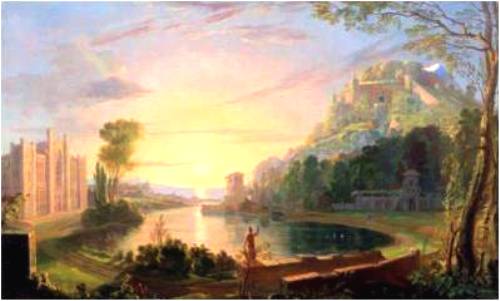
Samuel Morse’s allegorical landscape picturing the university as paradise, placing NYU’s original Gothic style building at left (1835-36)
For many educators, mid-August brings a sort of foreboding: Uh oh, school is starting up again very soon. The endless summer is coming to an end.
Now, this may sound odd coming from someone who enjoys teaching and is grateful for the opportunity to make a living as a professor. But yes, I feel this way, too.
I trace this anxious rumble in my belly to memories of first-year orientations as a college and law student many years ago. I suppose they planted the seeds for how I regard the beginning of an academic year.
Let me go back to August 1977, first-year orientation at Valparaiso University in northwest Indiana. Valpo, as it is colloquially known, was only a 45-minute drive from my parents’ home in Hammond, Indiana. But I was quite unworldly at that early juncture of my life, so that distance felt like a million miles away during those first few days (and the weeks to follow).
In terms of events, I hazily remember a bunch of meetings big and small, a large-group assembly or two, and some type of cookout. VU’s orientation program neither eased nor stirred my anxieties. However, the status quo was about as much as I could’ve asked of it, given my constricted comfort zone. It would take another two years for me to find my social and extracurricular groove at Valparaiso, mainly via my joining the staff of the campus newspaper and eventually spending my final semester in England. A good number of lifetime friendships were forged during those years.
Now let’s quickly jump to August 1982 and law school orientation at New York University. Outwardly I tried to maintain a friendly and upbeat demeanor, but privately I wondered if I was in over my head. I had moved from Indiana to the heart of Manhattan. Lots of my new classmates had gone to elite colleges. Many had done fancy internships. When a fellow 1L mentioned that he had spent the previous year working as an assistant at the U.S. Supreme Court, I decided not to offer that during the same time I was working as a stock clerk at a retail drugstore.
NYU’s law school orientation was the usual mix of welcoming speeches, panel discussions, intro classes, and receptions, but the content and people were such that I came out of it mildly reassured that I would (1) survive law school; and (2) have some good job opportunities at the finish. I was also pleasantly surprised that so many of my super-talented classmates were genuinely nice people, and I started making friends very easily. Overall I had the strong vibe that this was the right place for me, which turned out to be true.
Academic orientation programs are organized with the very best of intentions, and often they convey important information that can set the stage for the remainder of a student’s degree program. As to whether they soothe or stoke individual anxieties, well, that’s a crapshoot. I think it depends more on the specific student than on the content of the program!
Someday, when I’m in an even more nostalgic mode than is my usual state, I’ll have to sift through the memory bank to recall other orientation-type programs during different chapters of my academic and professional lives. Maybe I’ll find some similarities and connections between my reactions to them.
 Musings of a Gen Joneser
Recent Comments