On my nostalgia addiction

Random nostalgia: The Cozy Soup ‘n’ Burger, Broadway & Astor Place, NYC, site of countless downed burgers during law school and thereafter (Photo: DY)
As someone who succumbs easily to nostalgia — supposedly this is common among those of us born under the Cancer sign — this blog permits me to hop into my personal time machine on a regular basis. And Throwback Thursday is a Hallmark card of an invitation to switch that machine into overdrive. Today I’m going to ponder why I find such indulgences so appealing.
It hurts so good?
Last year, John Tierney, writing for the New York Times, served up a fascinating piece on the role of nostalgia in our lives. He featured the research of psychology professor Constantine Sedikides (U. Southampton, U.K.), who challenges the popular notion that nostalgia must be associated with sad melancholy. Here’s a snippet:
Nostalgia has been shown to counteract loneliness, boredom and anxiety. It makes people more generous to strangers and more tolerant of outsiders. Couples feel closer and look happier when they’re sharing nostalgic memories. On cold days, or in cold rooms, people use nostalgia to literally feel warmer.
Nostalgia does have its painful side — it’s a bittersweet emotion — but the net effect is to make life seem more meaningful and death less frightening. When people speak wistfully of the past, they typically become more optimistic and inspired about the future.
He included a thought-provoking perspective from Dr. Sedikides:
“Nostalgia makes us a bit more human,” Dr. Sedikides says. He considers the first great nostalgist to be Odysseus, an itinerant who used memories of his family and home to get through hard times….
Writer and online “salon keeper” Stacy Horn, in her book Waiting for My Cats to Die: a morbid memoir (2001), calls nostalgia “both a self-inflicted wound and the morphine you take for the pain – a perfect reprieve from the cold, cruel light of an untampered-with day. It hurts, but it’s a good hurt.” I tend to agree, seeing nostalgia as a simultaneous pleasure/pain kinda thing.
Nostalgia scale
The online version of the Times article linked to Dr. Sedikides’s webpage. The webpage includes a questionnaire called the “Southampton Nostalgia Scale,” which defines nostalgia as a “sentimental longing for the past.”
I answered the survey questions, and I clearly score off the charts. I think about my past a lot. I think about historical events and eras a lot, and I yearn to experience them, even if they preceded me by decades. I probably could get soggy about the coffee I had with breakfast yesterday if the moment was right.
The weird thing is, I’ve been this way since I was a kid. As a grade schooler, I would get nostalgic about family vacations to visit relatives in Hawaii!
Take my “Yearbook Test”
Here’s my personal test for measuring one’s propensity for nostalgia: I call it the “Yearbook Test.”
Spend some time with a college or high school yearbook, maybe one grabbed from a friend’s bookshelf or rescued from the bargain bin at a used bookstore. Although it can be from a school you attended, it shouldn’t be one from your years there or the years immediately preceding or following them. (In other words, it cannot overlap with anyone you knew from your own student days.)
Do you find yourself feeling like you “know” people in the yearbook? Do you start imagining their lives? Can you guess at the groups and cliques that may have formed up? Do you find yourself wanting to step back into that time and place to experience it personally, just to see what it was really like?
If you’re inclined to answer yes to these questions, then I’d bet a fair amount of change that you’re a nostalgia junkie. I mean, let’s face it, if you can get all sentimental over the student experiences of those from another era, then you’re a goner when it comes to nostalgia.
For the record, I’ve used ebay to obtain a smattering of old yearbooks from my undergraduate alma mater, Valparaiso University, and from my law school alma mater, New York University, dating from the early to mid-20th century. I can get lost in them for hours. On occasion, I’ve Googled names of students in an attempt to see what became of them.
In other words, I’m hopeless.
History buff
I have no doubt that my nostalgic tendencies dovetail with my enjoyment of history. My status as a history buff has a strong emotional component to it. For example, last year I wrote about my affinity for the 1980s mini-series “The Winds of War.” The story starts in 1939, as war clouds are swirling about Europe. It follows the fortunes of the Henry family, headed by U.S. Navy officer Victor “Pug” Henry, along with his wife Rhoda, sons Warren and Byron, and daughter Madeline.
Joining them as major figures are renowned Jewish author and retired professor Aaron Jastrow and his niece, Natalie, who are living in an Italian villa. Also prominent is Pamela Tudsbury, a young British woman who travels the globe helping her father, foreign correspondent “Talky” Tudsbury, as well as foreign service officer Leslie Slote.
“The Winds of War” qualifies as a sweeping epic. It opens with Europe on the brink of another war, and it continues on through the Japanese attack on Pearl Harbor. Throughout the story, the major characters and others cross paths, move apart, face life-threatening danger, and fall in and out of love, in places as disparate as London, Berlin, Italy, Portugal, Washington D.C., Hawaii, the Soviet Union, and the Philippines, among many others.
I find myself caught up in that dramatic sweep, imagining the lives of the characters and the look & feel of the era. I watch the full mini-series roughly once a year, and it has an odd, comforting effect on me.
How “accurate” is our nostalgia?
I understand how we often create memories that make certain times appear a lot rosier in the rear view mirror. I know that the past is rarely what it’s cooked up to be.
When it comes to feeling sentimental about historical eras, I’d love to visit 19th century London or 1920s New York. But would I actually like to live during those times, for the long haul, with no “go back” button in the event I find myself, say, in a Dickensian workhouse or a Lower East Side tenement? And despite my affinity for the Second World War years, for an American of Japanese descent, a time machine return to that period would not be desirable.
As for my own past, there are few times in my life that I’d truly like to live over again, not because I’ve had a bad life, but rather because the “do overs” I yearn for — the ones with the benefits of wisdom, hindsight, and maturity — are impossible. I was reminded of this last week, when a brief Facebook exchange with college chums led to recounting favorite eateries near the campus. Now, if someone today offered me a few years to go back to school, think big thoughts, and enjoy campus life, I’d happily take it. But would I want to return to the post-adolescent anxieties of (in my case barely) early adulthood? No thanks!
So, the bottom line: I’ll continue to indulge my nostalgic tendencies. But at least I know that the rear view mirror often serves up a distorted picture.
***
Related post
Time travel: Some favorite destinations (2013)
***
This post borrows several big chunks from a 2013 piece published on my professional blog, Minding the Workplace.
Throwback Thursday: Where were you when Nixon resigned?
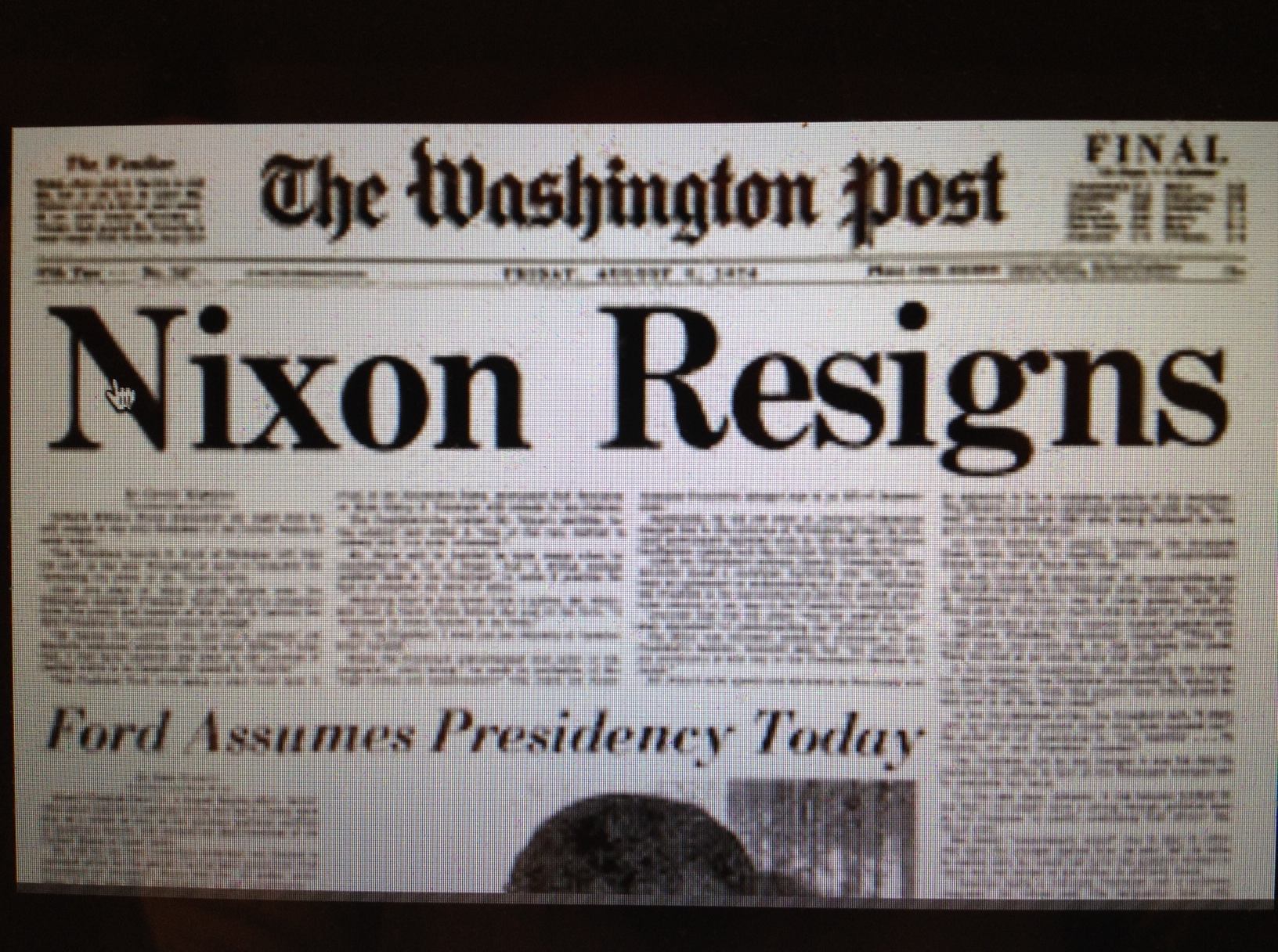
For those of you around during August 1974, where were you during when President Richard Nixon resigned from office in the midst of the Watergate scandal?
At the time, I was in high school, heading into my sophomore year. That night I happened to be watching a football game. The Jacksonville Sharks were playing the Hawaiians, both of the fledgling World Football League, an upstart, ragtag operation that was challenging the established NFL. The game was interrupted by Nixon’s resignation’s speech, which made for an odd return to the televised game action following such a momentous event!
For readers too young to understand the Watergate scandal, or for the sprinkling of international readers thankfully spared the ongoing saga back then, Nixon got in trouble when his Administration was linked to an illegal break-in at the Democratic National Committee headquarters in Washington D.C.’s Watergate Hotel during the 1972 election campaign. As is so often the case, the cover up was worse than the initial sin, and it led right to the Oval Office.
The Washington Post took the lead on investigating the Watergate scandal, and it served to launch the careers of two unknown reporters, Bob Woodward and Carl Bernstein.
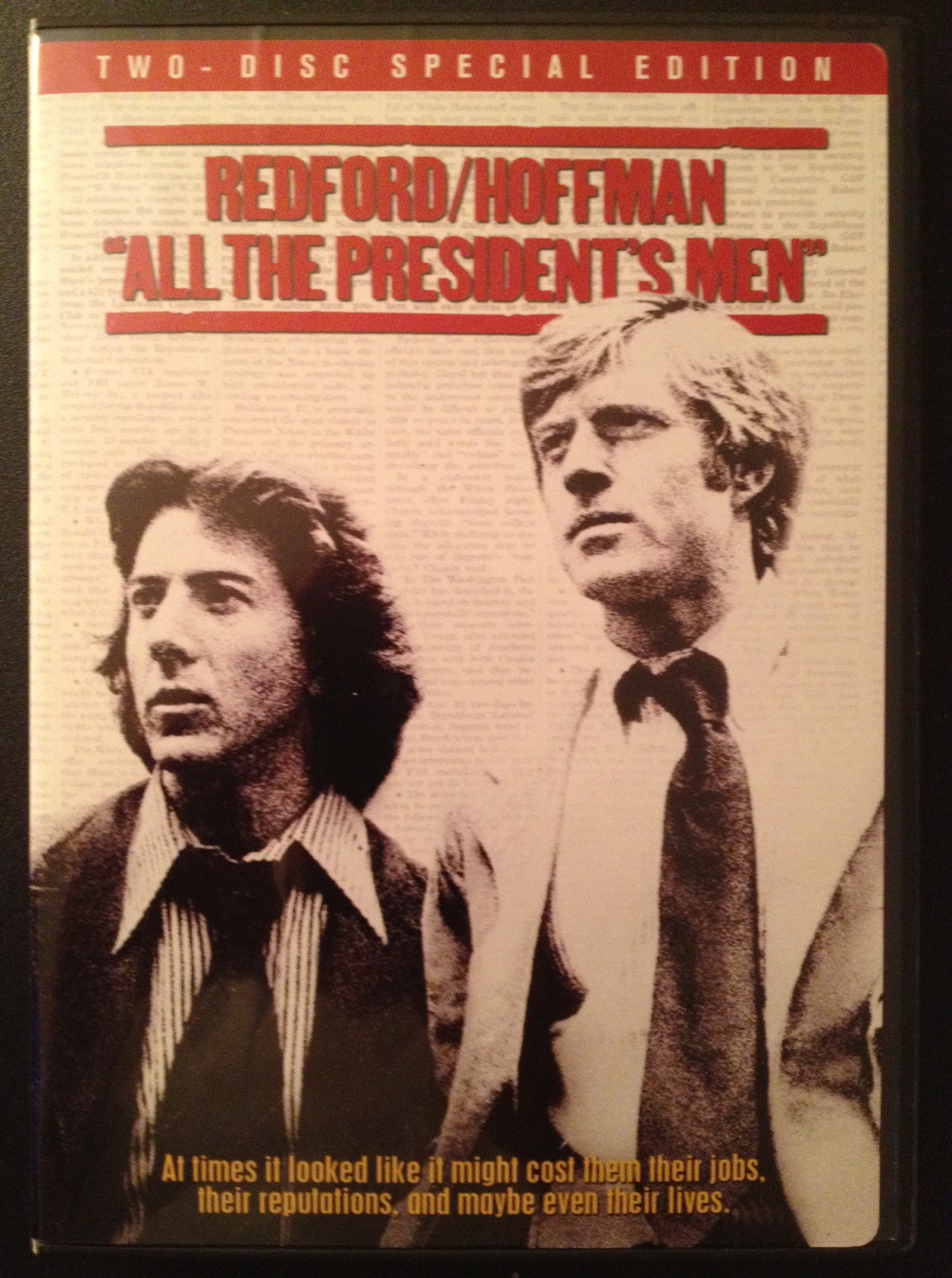
The movie “All the President’s Men,” starring Robert Redford (Woodward) and Dustin Hoffman (Bernstein), manages to tell the story of the Post‘s investigation with a sense of detail and drama that conveys the gravity of this historic event in American government and politics. It still holds up as an excellent movie.
Stories of personal reinvention
The Huffington Post just ran a terrific five-day series, “50 over 50,” profiling 50 individuals who significantly changed their lives after reaching age 50 and beyond. In partnership with the TODAY Show, they’re looking at how people have reinvented themselves later in their lives, often after experiencing major challenges. Here’s a piece of Shelley Emling’s introduction to the feature:
We recently asked readers to submit nominations of people who’ve reinvented themselves for the better after age 50 as part of an initiative launched with the TODAY show called “50 Over 50.” We were overwhelmed with submissions. We heard stories of people who’d changed their lives after losing a partner, getting divorced, or suffering financial hardship or a health concern. We heard from many people who nominated themselves — something they said they never would have done before turning 50.
Here are links to the five main stories posted this week:
The Risk Takers — 10 people who took risks after 50
Career Reinvention — 10 people who reinvented their careers after 50
Following Your Passion — 10 people who followed their passions after 50
Health and Wellness — 10 people who pursued health and wellness after 50
Giving Back — 10 people who gave back to their communities after 50
Whatever your age, you’ll find inspirational stuff here. Especially for those over 50, this may speak directly to you. But even if you’re under 50, perhaps by many years, you may find this valuable, or at least worth tucking away until later.
***
This is drawn from a slightly longer version posted to my professional blog, Minding the Workplace.
Throwback Thursday: Sending away for fun stuff in the daily mail
One of the fun things about being a kid was sending away for stuff and then waiting in anticipation for what would come in the mail. A toy, game, or hobby item. Maybe a magazine subscription or a book.
In the days before U.P.S. and other private companies claimed a larger share of the package delivery business, the U.S. Postal Service was the main show in town. This was still the heyday of mail order. For young boys, especially, the back pages of comic books, ad listings in magazines such as Boy’s Life, and catalogs issued by novelty toy companies like Johnson Smith offered tempting discoveries. Sometimes the products would fall short of expectations, providing youthful lessons in advertising vs. reality!
When I became a postage stamp collector, I’d look forward to periodic deliveries of stamps-on-approval, a quaint service whereby small stamp businesses sent selections of collectible stamps for review and possible purchase, with unwanted items to be returned within roughly a two-week time frame. (Stamps-on-approval services remain popular today.)
When I became a sports fan, I’d eagerly await weekly deliveries of The Sporting News and Sports Illustrated, and then pore over the statistics and feature articles in each issue. The Sporting News was the real deal, packed with updated player statistics, boxscores, and in-depth coverage of the major U.S. pro sports, especially baseball. In the days before the Internet, this was a must-have subscription for serious sports fans.
With an allowance that stretched only so far, and before part-time jobs entered the picture, being able to send away for free stuff was especially tantalizing, and this book was a gateway:

The cover was better than the substance inside. OK, there was a lot of free stuff to send away for, but company promotional items and information from the government predominated the listings. I must’ve sent requests based on dozens of listings, but I cannot recall receiving anything of lasting interest!
Today, of course, the daily mail brings a lot of bills, junk mail, and fundraising pitches. I subscribe to a lot of magazines, so those goodies still await me every week. And yes, I send away for stuff on occasion, though usually via online signups. Indeed, in terms of convenience and speed, the Internet is a consumer marvel.
So, this definitely isn’t a call for a return to the mail order era of the past! Please indulge me, however, while I get a tad nostalgic about the days of sending away for fun stuff and waiting to see what arrives in the mail.
I’m just a 20th century kinda guy
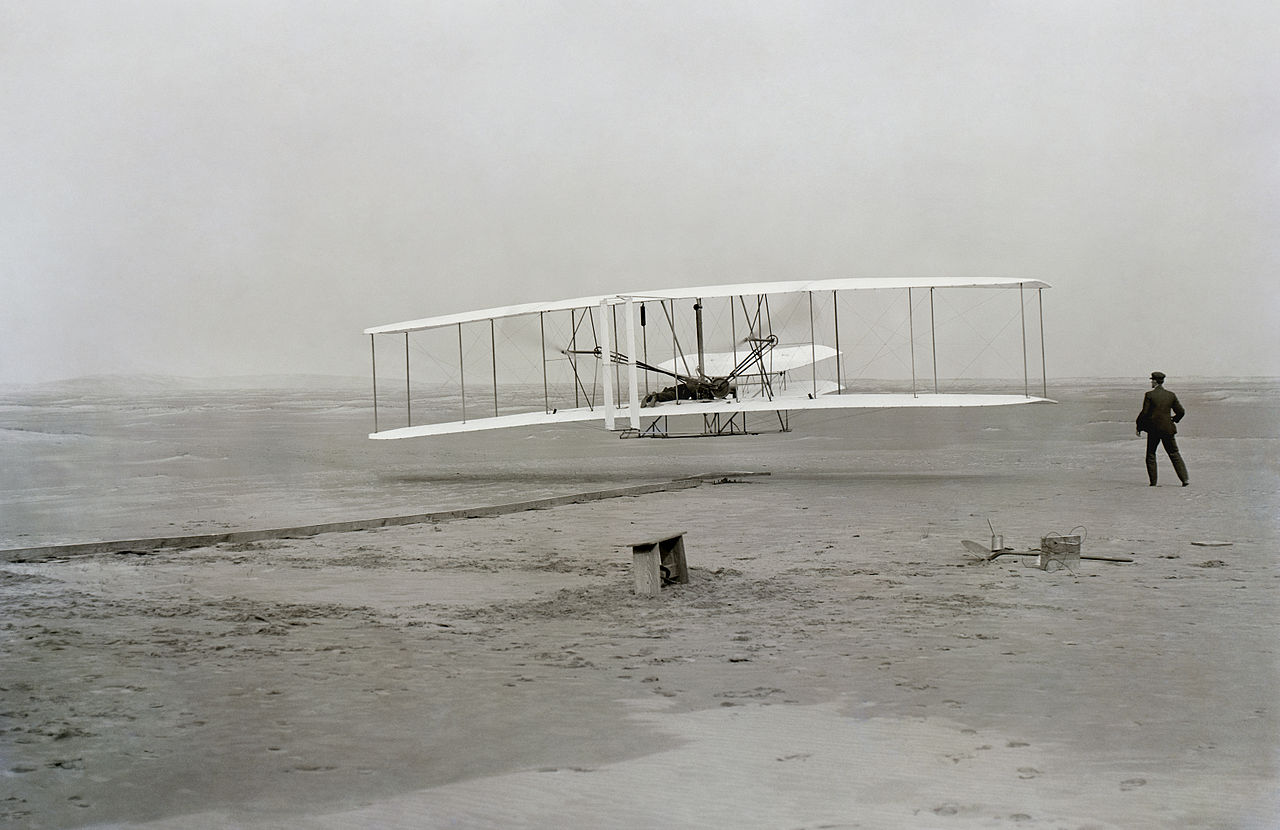
Wright Brothers, 1903, near Kitty Hawk, NC (Photo: Wikipedia)
When I think about the cultural and historical markers in my life, I quickly reach the conclusion that I’m a 20th century kinda guy. Born in 1959, and given my appreciation for history, the last century is my default lens on the world.
My personal culture
My pop culture worldview is still partying like it’s 1999.
If not earlier! For example, when it comes to popular music, my tastes stop somewhere in the mid-80s, and I’m more drawn to composers and performers of the early and middle 20th century — the Gershwins, Cole Porter, Sinatra, the Big Bands, Rodgers & Hammerstein, etc. — than any other era.
And while current television dramas are generally superior to most of their predecessors, I’ll take yesterday’s classic sitcoms — “The Dick Van Dyke Show,” “MASH,” and yes, even “Hogan’s Heroes” — over “Two and Half Men” and other popular shows today. As for the big screen, I’ll gladly opt for a rich array of oldies, while passing on the dreck coming out of Hollywood now.
As far as my Chicago sports fandom goes, give me the 1985 Chicago Bears, the 1990s Chicago Bulls, the 1969 Cubs, the 1984 Cubs, the 1983 White Sox…okay, it’s a mixed bag.
In terms of technology, I’ll take DVDs over streaming, CDs over MP3 (closer call), real books over e-books (though I get the convenience & cost factor), and Word Perfect 5.1 for DOS over anything to do with Microsoft Word. I’m not that crazy about cellphones, and I don’t permit my students to use laptops in my classes. (In a big bow to the 21st century, I believe the iPad is one of the most brilliant devices ever made.)
And what of the bigger picture?
Centuries are marked by the turn of a calendar, but their essence is defined by core events. For me, the 20th century era — at least from an admittedly American perspective — began in 1903, when the Wright Brothers successfully flew their primitive airplane in the dunes near Kitty Hawk, North Carolina. It ended with the attacks of September 11, 2001. (Hmm, both events centered on the use of airplanes…)
When it comes to grasping history and current events, I see how we’re still strongly influenced by decisions and events of the last century. World diplomacy in 2014 has the scary look & feel of Europe in 1914, and the two world wars continue to shape international relations. And if you want a milestone year for understanding the path toward America’s present domestic and international political status, then take a close look at 1980: The election of Ronald Reagan and the Iranian hostage crisis captured the nation’s conservative turn and anticipated its post-Cold War preoccupation with the Middle East.
Somewhere a place for us
I happen to believe there’s still a place in this world for those of us whose outlook on things reaches back into the last century. If not, whatever. I’ll just pop that best-of-the-80s cassette back into my Walkman and try to get over it.
Was the summer of 2004 Boston’s high-water mark?
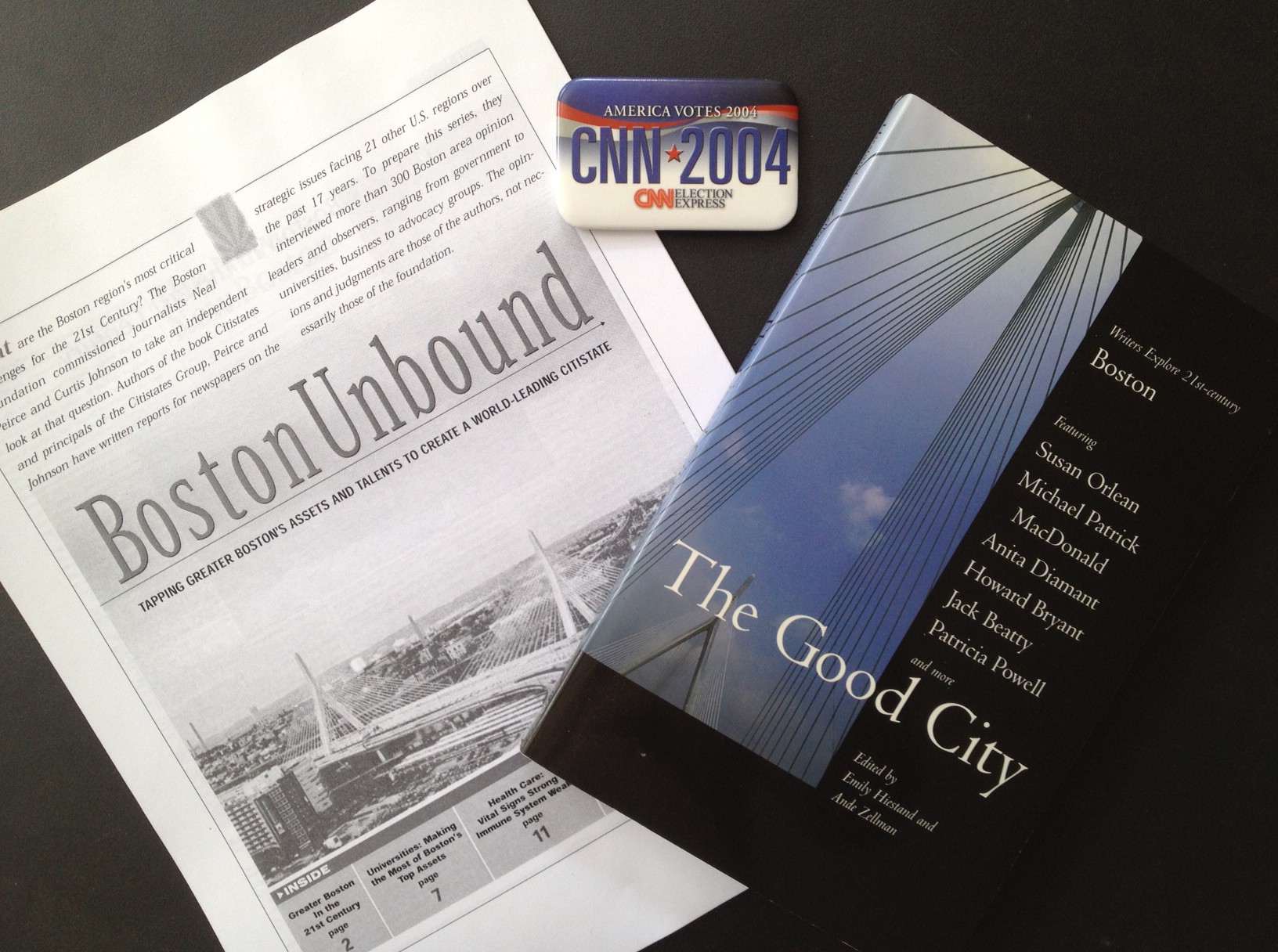
Ten summers ago, Boston was abuzz with energy. The Democratic National Convention (DNC) was held here, and during that week, nationally prominent politicians and media personages could be seen everywhere, walking about the city streets. After years of nursing a big sporting chip on its shoulder, Boston was home to the two-time Super Bowl winning Patriots (with one more to top off the ’04 season!) and to the soon-to-be World Series champion Red Sox. Overall, there was a sense that Boston was shedding some of its parochial past and becoming a more cosmopolitan, inclusive city.
The presence of the DNC was a big boost. John Kerry was the party nominee, and even if he could never approach the popularity of Ted Kennedy, it was still pretty neat to have a native son accepting the party nomination in his own backyard. In the heart of this very walkable city, you could trek from place to place observing the various convention-related events. (I picked up the refrigerator magnet in the photo above while stopping by a CNN outdoor studio at Faneuil Hall.)
That year, the Boston Foundation, a prominent and influential civic organization, released a major report, Boston Unbound, which assessed the city’s strengths and weaknesses. Although the report didn’t dodge the challenges facing Boston, its generally positive outlook captured the potential of a city ready to take its next big step.
Less wonky and more introspective, The Good City, an edited volume of personal essays about Boston’s past, present, and future, appeared on the scene as well. As a sort of literary non-fiction way of taking stock, this book, too, served as a statement that Boston was at a promising crossroads.
Personally speaking
This month marks the beginning of my 21st year in Boston, and I have watched this city change and evolve. I believe that the summer of 2004 was Boston’s modern era high-water mark, at least to date. A vibe of punchy optimism was in the air. Some of the knee-jerk defensiveness grounded in the city’s traditional culture was beginning to recede. Painful, complicated tensions over racial and ethnic diversity, long woven into Boston’s civic fabric, were softening.
As a relative newcomer to Boston (yes, 10 years in Boston still renders one a “newcomer”), I felt that change, and in modest ways I was involved in initiatives that were a part of it. That summer I graduated from a one-year professional fellowship program called Lead Boston, which organized monthly day-long seminars on topics related to city life and community service. I also served on the boards of two new initiatives, the City-Wide Dialogues on Boston’s Racial & Ethnic Diversity, and the Union of Minority Neighborhoods. Through my work as a law professor, I was the founding director of a grant-funded summer fellowship program for law students in the Greater Boston region who were interested in public service and state and local government.
The years since then
Looking back over the past decade, I can’t say that the buoyant civic optimism of 2004 translated into genuine transformation. Boston hasn’t exactly been stuck in place since then, but the advancements have been more incremental than dramatic. In some places, like the Downtown Crossing area in the heart of the city, we have seen a lot of deterioration. While ripple effects of the global economic meltdown have contributed toward this state of consolidation or plateau, so have shortcomings in the city’s civic and business leadership.
My own involvement in Boston community activities has declined, largely because of my immersive involvement in employee relations issues (see my professional blog, Minding the Workplace), and the frequent travel this work has required. If the day comes when I have more time for local activities, I would like to concentrate those efforts within my Boston neighborhood of Jamaica Plain, where I have lived since 2003. “JP,” as we denizens call it, is a great little part of the city, and someday I would enjoy becoming more involved in its goings on.
Throwback Thursday: Being a fish out of water (Summer 1984)

Image courtesy of animalclipart.org
Thirty summers ago, I was a summer associate for a large corporate law firm in Chicago, doing legal research and writing assignments under the supervision of attorneys representing commercial clients. The work was challenging, I was being paid handsomely, and I was working with very good lawyers who happened to be down-to-earth folks.
And yet…it didn’t feel quite right for me.
For those uninitiated in the lingo of the legal profession, “summer associate” is the usual job title for a law student who is working at a law firm for the summer. At large law firms, summer associates are brought on board with the assumption that they will be considered seriously for offers of full-time employment as associate attorneys if their work is of high quality. The pay is very good, approaching the weekly equivalent of a first-year associate’s salary.
I secured one of these jobs for the summer following my second year at NYU Law. Although I went to law school to become a public interest lawyer, I decided to give the corporate legal world a try. Also, having grown up right outside of Chicago, I wanted to see if returning to the Midwest was the right thing for me.
Even before I started, however, I knew in my heart that I was not meant to be a corporate attorney. The night before leaving for Chicago, I went to a classic Broadway musical, “42nd Street,” starring Jerry Orbach:
That show captured it for me. I didn’t want to go to Chicago.
But I went, and I worked very hard at that law firm. I tried to fit in and to be a part of it all. My law student colleagues were smart and friendly, and the firm treated us very well. Nevertheless, within a few weeks, I found myself regretting that I had passed up several offers to work for public interest legal organizations that summer. I also missed New York terribly.
How much did I feel like a fish out of water? Well, as the summer wore on, I found myself dodging the friendly “round ups” of summer associates to treat us to lunch. Instead I would grab a quick bite to eat and spend lunch hour in a bookstore. I also made excuses for not attending some of the firm’s social functions, preferring to visit various historical sites in Chicago or read the books I had purchased during my lunch breaks. (Had I been more self-aware, I also would’ve realized how those patterns revealed an introverted side that only in recent years I have come to acknowledge and value.)
Still, my objective was to secure an offer of full-time employment, as I knew it would be a good thing regardless of whether I accepted it. So I gave a maximum effort.
I got the offer soon after my summer stint ended, and for a few weeks I sat on it. But I knew I had to go a different route and declined. During my third year of law school, I accepted an offer from The Legal Aid Society in Manhattan. It turned out to be the right decision.
Since then, I have tried to be true to myself in terms of vocation. However, with a bit more maturity under my belt, I also now understand that enjoying a span of work and career choices is a huge privilege. “This above all, to thine own self be true,” wrote Shakespeare, but when it comes to earning a living, not everyone has that luxury. It’s something to consider when assessing one’s blessings in this life.
Video gaming now and then

From the Microsoft Store, Prudential Center, Boston (Photo: DY, 2014)
After spending good chunks of my 30s playing video games, I’ve kinda shrugged my shoulders at them since then. But the other day I walked by the Microsoft Store in Boston, replete with a demo of the latest Xbox system on a widescreen TV, and I couldn’t believe how good the whole thing looked.
Two kids were playing the EA Sports FIFA 14 soccer game, and the graphics were jaw dropping…sharp, authentic, and from a distance looking like a World Cup match. And the player movements, at least in the hands of these skilled game players, were incredibly realistic, again almost like watching a televised soccer match.
Back in the day…
Oh my, we’ve come a long way, baby, from the Sega Genesis and Super Nintendo systems that ate up many hours of my 30s!
Not to put down those classic game systems, which were the dominant platforms before the arrival of the Sony PlayStation. Both were powerful machines for their day, and developers squeezed every bit of computing power out of them to produce games that looked great and played deep.
It was on the Genesis, especially, that EA Sports carved out its dominant market share with titles like Madden Football and NBA Live, and I looked forward to every new release. But you didn’t have to be a sports fan to enjoy these gaming systems. Fantasy, adventure, arcade, strategy, and shoot-em-up titles also were in rich supply.
And then there was the original Nintendo Game Boy. Its graphics were primitive even by 1990s standards, but its portability and vast game library made it a hit.
The Genesis, Super Nintendo, and Game Boy systems also broke through to an older, mostly male market. The Game Boy was a favorite of male travelers, and on occasion articles about air travel trends noted how often flight attendants would encounter passengers too engrossed in their video games to notice the beverage cart going by.
And today?
I’m sure the graphics and game play of FIFA 14 are only the tip of the iceberg of today’s video game world. Presumably the library of games available today is even more appealing than back in the 90s, when I would frequent game stores.
As blown away as I was by this demonstration at the Microsoft Store, however, I didn’t find myself weighing a video game system purchase — at least not beyond a minute or two. Right now, video gaming wouldn’t fit into my already busy schedule. To really enjoy these games, it helps to be somewhat devoted to them. After all, the best video games have lots of depth to them, and the occasional player misses out on their richness.
But maybe someday, as other commitments and activities lighten, I’ll look over the popular gaming systems and rediscover the hobby. By then, Madden Football probably will come with virtual refreshments, so I can spare myself the real calories as I’m leading my Chicago Bears to their next (virtual) Super Bowl championship.
Throwback Thursday: Studying for the New York bar exam, Summer 1985

If this gives you chills, then you’re probably a lawyer! (Photo of BarBri bar review book: DY, 2014)
During any given summer, thousands of newly-minted law school graduates are reaping the rewards of their toil with one final “gift” of a test: The bar examination of the state in which they intend to practice. With a few exceptions, one’s ability to practice law in a given state is dependent upon passing a grueling two or three day examination, consisting of batteries of brain-frying multiple-choice questions and essay questions that pose factual scenarios densely packed with legal issues to be analyzed.
To prepare for the bar exam, which most people take during the summer, one typically signs up for a bar review course. This is a crash course that features over a month of lectures and practice exam questions, interspersed with hours of studying legal rules and principles. Most bar review courses start right after graduation season and finish a few weeks before the bar exam itself, with the remaining time spent drilling and memorizing.
Every summer I encounter law students lugging around the thick paperbound law summaries published by bar review courses. As the weeks go by, their faces look more drawn and tired. Many of the men stop shaving and even the more fashion conscious women trudge around in sweatpants. They make for a pretty motley crew by the time exam week hits.
I remember that time oh-so-well. Twenty-nine summers ago, I was studying for the New York bar exam, reputed to be one of the toughest in the nation. The biggest challenge in studying for the NY exam was the vast number of legal subjects potentially covered on it. We had to stuff a lot of law into our heads and hope that it remained there at least through the two days of the actual test. For people like me, who assiduously took classes of intrinsic interest rather than courses that tracked the bar exam subjects, there was added misery in tackling subjects avoided during law school.
Furthermore, earlier that year, I had accepted an offer to work for The Legal Aid Society in Manhattan. I would be handling appellate-level criminal cases, which meant that the areas of law I needed to feel comfortable with boiled down to a handful of subjects. My motivation to learn, say, the rules of New York gift & estate taxation, was practically nil. (Especially with the salary I’d be earning and the people I’d be representing, neither I nor my future clients had much use for the subject.)
I spent the first few weeks dutifully going to the bar review lectures and trying to study each day, but I found the whole deal to be quite excruciating and my attention span wandered. As the weeks ticked down, however, I came to grips with the fact that I didn’t want to take this exam over again, so I’d best buckle down and give it my all. That I did. During the weeks preceding the exam, I basically camped out in the law clinic offices at NYU, where I had spent so much time in my final year of law school.
Of course, I also spent hours on the phone with law school classmates, sharing supposed insights on how to prepare for the exam, as well as gallows humor about our chances of passing. Many of my best friends from NYU were going to other states to practice, so I ran up a much higher phone bill than was prudent for a soon-to-be public interest lawyer.
I was assigned to take the exam in the ballroom of the Roosevelt Hotel in midtown Manhattan. By then I had moved out of NYU housing and was sharing an apartment in Brooklyn. I didn’t want to risk a subway delay, so I rented a room at the Vanderbilt YMCA, a manageable walk from the hotel.
The exam itself was every bit as challenging as I had imagined. My head was spinning throughout the two-day test, and when I finished, I honestly had no clear idea of whether I had passed or not. (One of the essay questions was about New York gift & estate taxation, and had I not spent an hour the night before with a one-page summary prepared by one of my law school classmates, I probably would’ve sat there in a stupor.) But I didn’t feel horrible about it, so I figured my chances were okay.
After the exam, I celebrated by going to Barnes & Noble and buying two books, the titles of which I recall to this day: William Shirer’s The Nightmare Years (the journalist’s account of being in 1930s Nazi Germany) and Tom Clancy’s first thriller, The Hunt for Red October. I treated myself to an extra night at the YMCA to read my new books in solitude. In the weeks that followed the bar exam, I was basically in a haze. Thank goodness I had that time to recoup before reporting for duty at Legal Aid after Labor Day.
***
In November I learned that I had passed the bar exam! It was good news all around in my office; all 12 or so Legal Aid colleagues who sat for the exam that summer also passed. I called the elementary school in Indiana where my mom taught kindergarten, and they gave her the good news over the intercom.
I celebrated by going to Barnes & Noble and buying another book, Mark Girouard’s Cities & People, a beautiful volume about urban social and architectural history — and a perfect complement to the love affair I was experiencing with New York City as a broke-but-happy Legal Aid lawyer.
Heaven is a used bookstore

Brattle Book Shop, downtown Boston, exterior (Photo: DY, 2014)
Over the weekend I made an extended pitstop at the Brattle Book Shop in downtown Boston. I was reminded once again how used bookstores have been a place of happy sanctuary to me, going back to my early adult years.
The Brattle, pictured above, is one of America’s oldest bookstores, and it’s one of my favorites. Inside, you’ll find two floors of used books and review copies, plus a top floor of rare books. Outside, at least when the weather is okay, you’ll find shelves and carts of discounted used books, marked at $5, $3, and $1. Lots of the $5 books are quality volumes that would be a boon to many a personal library, and there are plenty of great bargains among the $3 and $1 offerings as well.
The discounted books outside draw me in. The weekend stop, for example, started with a discovery from one of the $3 carts, The World of Charles Dickens (1997), a colorful, illustrated guide to Dickens’ works and times, by London popular historian and Victorian crime expert Martin Fido.
But then I went inside. Uh oh. Let’s just say that the books I found on adult education and on psychology ran up the bill to considerably beyond three dollars. They may have been real “bargains” as measured by their original prices, but they lightened my wallet nevertheless.
Favorite haunts
Especially with the decline of brick & mortar bookshops, I’m delighted and appreciative that Greater Boston still supports used bookstores. In addition to Brattle, Commonwealth Books, Raven Used Books, and the basement level of Harvard Book Store are among the stores that offer plenty of used book treasures.
Elsewhere in the U.S., the Strand in Manhattan, Powell’s in Chicago, and Moe’s in Berkeley are favorite haunts. (Not surprisingly, all are within close proximity of one or more major universities.) During a recent trip to New Orleans, I was delighted to find several used bookstores in the French Quarter. And on those fortunate occasions when I’ve traveled to England, I’ve always been on the lookout for used bookstores.
New York
New York City’s used bookstores hold a special place in my heart. By the time I moved there, its famous “Book Row” on 4th Avenue was no more. But during my years in New York (1982-94), the Strand was a classic, creaky, and vast used bookshop. I visited regularly as a law student, and during my stretch as a perpetually broke Legal Aid lawyer, I would make pilgrimages there on paydays when I felt (very temporarily) flush. The Strand has done some upscale remodeling in recent years and now sells a lot of new titles along with its storehouse of used books. Nonetheless, it remains a standard stop during my New York visits.
Another favorite was the Barnes & Noble Annex on 5th Ave. and 18th Street, across the street from the original B&N flagship store (which recently closed). The Annex was a multi-floored wonder, full of remaindered and heavily discounted new titles and used books. B&N would shutter the Annex sometime after I moved to Boston. I recall that when I discovered it had closed, I felt like a small piece of my New York life was gone too.
Book sale in a tent
The origins of my enjoyment of rummaging through piles of used books trace back to the summer after my first year of college. I was spending the summer at home in northwest Indiana, and my mom had clipped from the Chicago Tribune a small notice about a big used book sale in Wilmette, Illinois.
Later I would learn that the book sale was an annual, week-long fundraising event organized by the Chicagoland chapter of the Brandeis University women’s committee. It was legendary among many bibliophiles across the country, some of whom would rent camping vehicles to drive there and load up on good books for the year.
Anyway, I did the 90-minute drive to check it out. When I arrived, I could scarcely believe my eyes. The sale — offering some 250,000 used books(!) — was held in a huge tent that covered a big stretch of a mall parking lot. I spent just about every bit of spare change I had to my name. I filled several bags of books, and a few days later I would return to buy even more. Though I felt too silly to call it as such, this marked for me the beginning of a personal library.
Apparently some form of this book sale survives to this day. Hopefully others are deriving the same pleasure of visiting it and loading up on great discoveries. Maybe, like me, it will fuel a lifelong devotion.
 Musings of a Gen Joneser
Recent Comments