Throwback Thursday: First Manhattan visit, Summer 1982
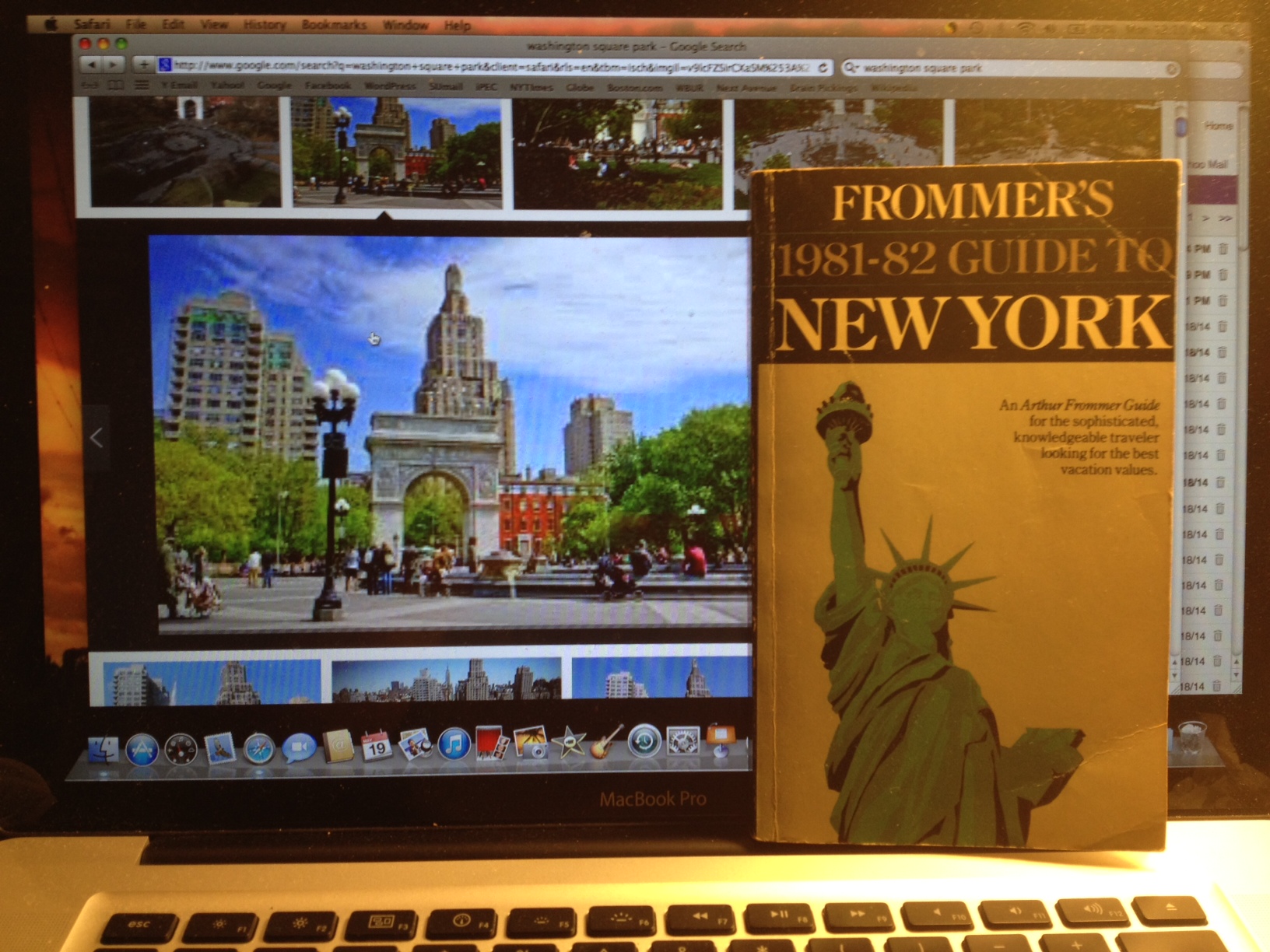
Thirty-two summers ago, I paid my first visit to New York City. The main occasion for my trip was to check out New York University, where I would be starting law school that fall.
While it may sound odd in this day and age for someone to say this, I had accepted NYU’s offer of admission sight unseen, based largely on its overall reputation and strong support for students who wanted to enter public interest law. You see, I also was pretty broke, and I didn’t have the funds to visit the law schools to which I was applying. Having opted happily for NYU from a distance, I wanted to preview the situation firsthand, so I scheduled a late June visit to New York City.
I reserved a room at the Vanderbilt YMCA on 47th Street. It was like staying in a youth hostel, reminiscent of my semester abroad in England the year before. Another adventure begins!, I thought to myself.
During my short trip, I spent a lot of time around NYU and its Greenwich Village surroundings. I discovered some of the cheap local eateries that would get a lot of my business during the years to come, I did some hanging out in Washington Square Park in the heart of the Village, and I paid my first of hundreds of visits to the remarkable Strand bookstore.
Of course, I also checked out NYU, including Vanderbilt Hall, the main law school building, and Hayden Hall, the residence hall where most first-year law students lived, both located right on Washington Square. I could feel the butterflies churning in my stomach in anticipation of what was to come, and a little voice inside me wondered if I was in over my head.
I did standard tourist stuff as well. Going up the Empire State Building. Taking a guided tour of the United Nations. Becoming bewildered by the city’s labyrinth of a subway system. (If you’ve ever been lost in the Dante-esque middle level of the West 4th Street stop in the Village, you know what I mean.)
My NYC recon trip confirmed that in terms of sophistication, I was a babe in the woods. I wasn’t totally unfamiliar with big cities, having grown up in northwest Indiana right outside of Chicago and having spent chunks of time in major European cities during my semester abroad. However, New York seemed overwhelming to me, ranging from its apparent vastness (in actuality, Manhattan is a mere island!) to its exorbitant prices. (Upon my return, I would report breathlessly to friends and family that a fancy ice cream place called Häagen-Dazs was charging one whole dollar for a small cone!)
Nevertheless, I also had a gut feeling that I was making the right choice. I knew that New York would fascinate me, and — nerves notwithstanding — I had a good feeling about my decision to attend NYU. My instincts would prove to be right. New York and NYU were the right places at the right time for me.
I didn’t take any photos of that visit, but I’ve held onto the guidebook I used to traipse around Manhattan. In Frommer’s 1981-82 Guide to New York, author Faye Hammel writes:
You should be advised that there is one dangerous aspect of coming to New York for the first time: not of getting lost, mobbed, or caught in a blackout, but of falling so desperately in love with the city that you may not want to go home again. Or, if you do, it may be just to pack your bags.
That quote captured how I would feel about New York for years. As would this song:
Derby-Pie, baseball bats, and a Gatsby-esque hotel in Louisville
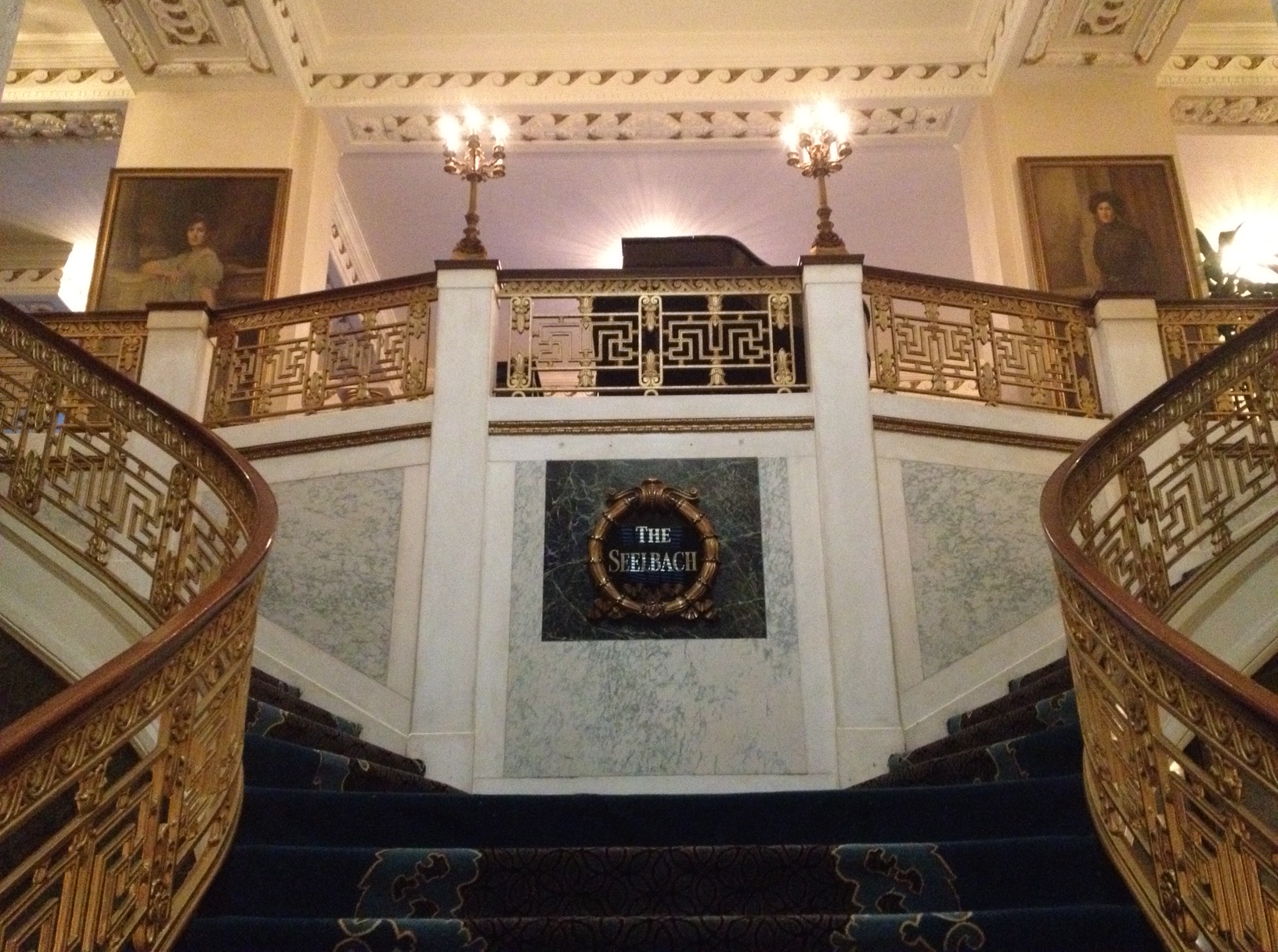
Featuring Scott, Big Al, and maybe a ghost or two (photo: DY, 2014)
I was reminded how travel is one of the benefits of my work when I made a quick trip to Louisville, Kentucky to speak last Friday at a continuing legal education program sponsored by the University of Louisville’s Brandeis School of Law.
It was my first visit to this historic old riverboat city, and I hope that I’ll be able to return for a longer one.
Seelbach Hotel
The conference was held at the Seelbach Hilton Hotel in downtown Louisville. I’m sufficiently clueless about interior aesthetics that I rarely notice much about hotels I stay in, but the Seelbach is a beautiful place with lots of history. F. Scott Fitzgerald spent time there and was so taken by it that he used the hotel as the setting for Tom and Daisy Buchanan’s wedding in The Great Gatsby. Prohibition era gangster Al Capone was a frequent visitor as well.
And as befits any classic old hotel, ghost sightings have been reported at the Seelbach. Local history expert Nicholas Howard writes:
The first ghost sighting was in 1987 when a cook spotted a woman in a blue dress with long dark hair walk into the elevator and disappear; the catch was the doors were closed the whole time. A maid spotted the same woman the same day. With some investigating, it is believed she is the spirit of a woman that died there in 1931. . . .
A guest in 1985 also called the desk saying she felt something rubbing her legs when she got into her bed; nothing was ever found in the room. There are also reports of guests TVs being turned on in the middle of the night, the air conditioners coming on and reports of an old woman roaming the halls.
Baseball bats
I believe the first time I ever heard of Louisville was in connection with baseball bats. You see, “Louisville Slugger” is the name of an iconic brand of baseball bat, and the company still has its headquarters in the city. Walking along Main Street, you’ll see Louisville Slugger plaques and baseball bats making for the “Walk of Fame.” As a baseball fan, I got a big kick out of this!
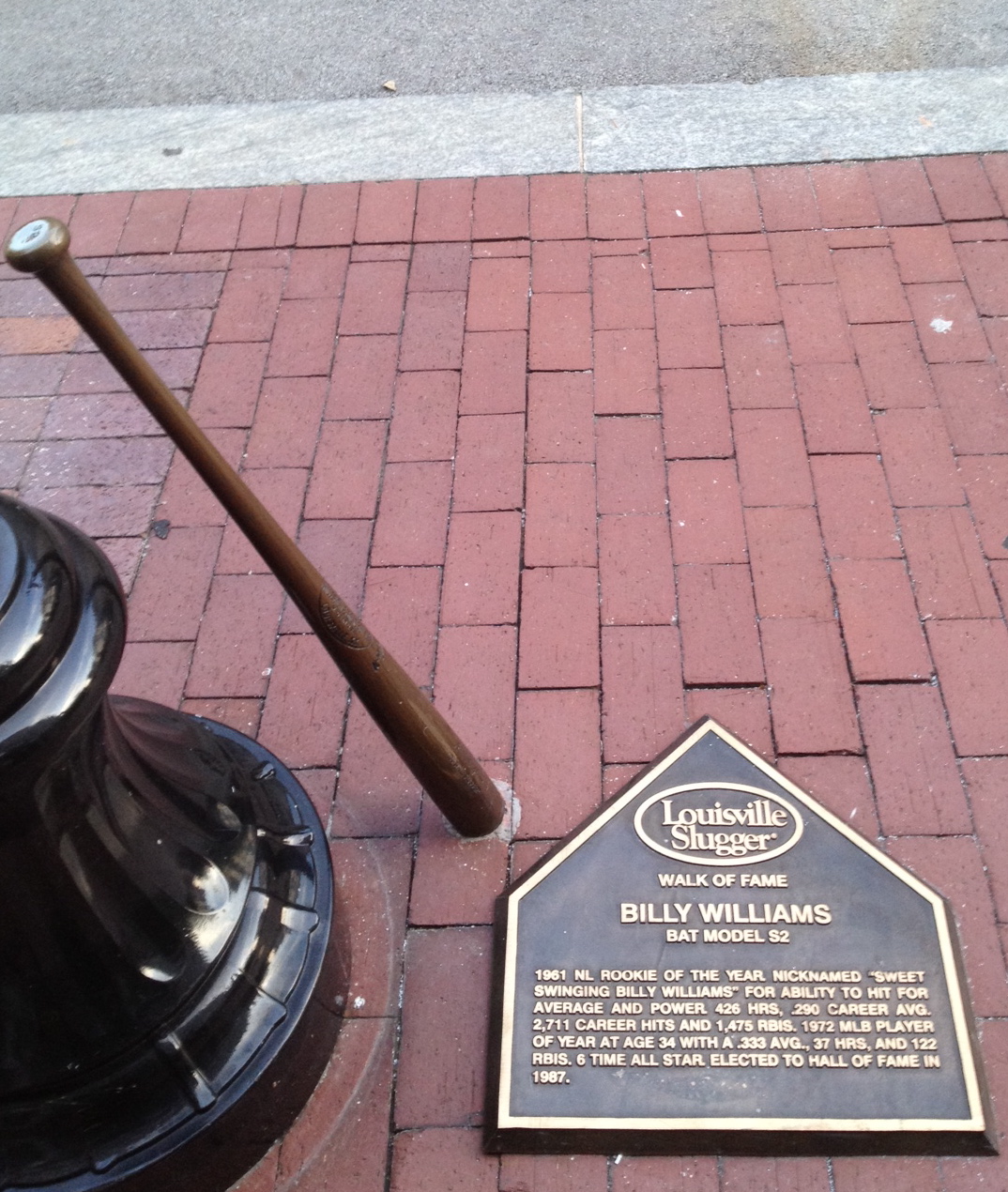
Honoring Hall of Fame outfielder Billy Williams, one of my favorite Chicago Cubs (photo: DY, 2014)
Derby-Pie
The conference organizers hosted a lovely dinner for program speakers at the Bristol Bar & Grill, and the highlight for me was a local dessert known as Derby-Pie, which I can best describe as a sort of walnut & chocolate chip pie with a flaky crust.

From derbypie.com
Derby-Pie is one of the best desserts I’ve ever tasted! On a plate in a dimmed dining room, it looks like just another dessert, but after one bite…
Geek out: A visit to the National Postal Museum
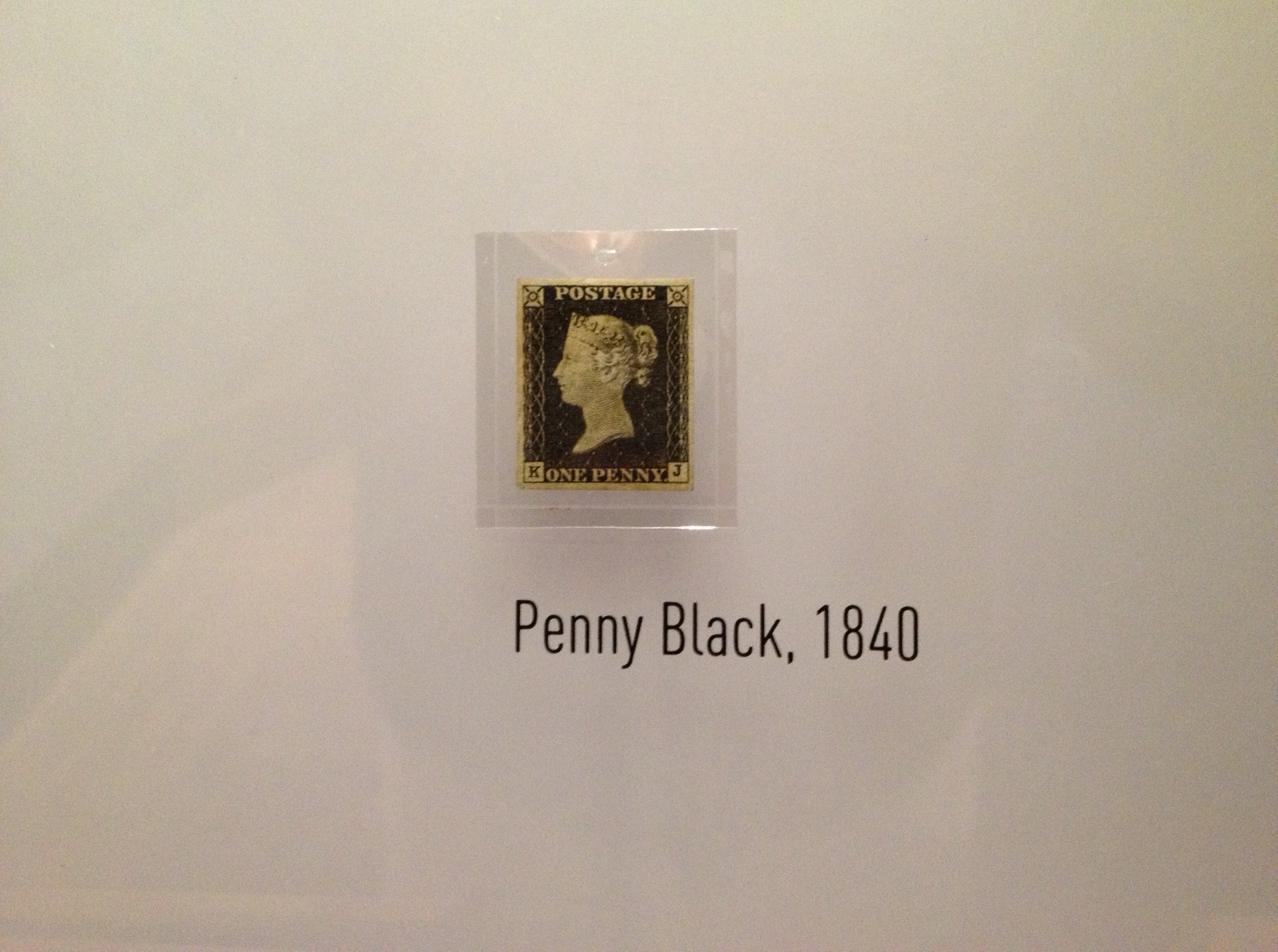
From Great Britain, the first adhesive postage stamp (All photos: DY, 2014)
During a quick trip to Washington, D.C. to speak at a program sponsored by the American Psychological Association’s Center for Organizational Excellence, I proved once again why my nickname should be Mr. Excitement: Given a free afternoon, among all of D.C.’s many cultural and historic attractions, I chose to visit the National Postal Museum, adjacent to Union Station.
In other words, I spent my time looking mainly at old postage stamps.
Now, in my defense, I should explain that the weather was lousy, I didn’t have unlimited time, and both my hotel and the APA program were near Union Station. More importantly, on the merits, this museum is a hidden treasure for history buffs and stamp collectors alike. It’s also free, uncrowded, and can be enjoyed in an hour or two.
During grade school, I was an avid stamp collector. So even today I understood how neat it is to see a specimen of the Penny Black (above), the first modern postage stamp. And as a lifelong student of American history, viewing the Pony Express cover below stoked my imagination about the Old West.

It took blazing saddles to get the mail delivered in the Old West
You see, stamp collecting’s biggest fascinations for me were the stories told by the stamps themselves and the imagined journeys of the letters and parcels to which they were affixed. I learned a lot about history, geography, culture, and famous people of all stripes and colors through stamps.
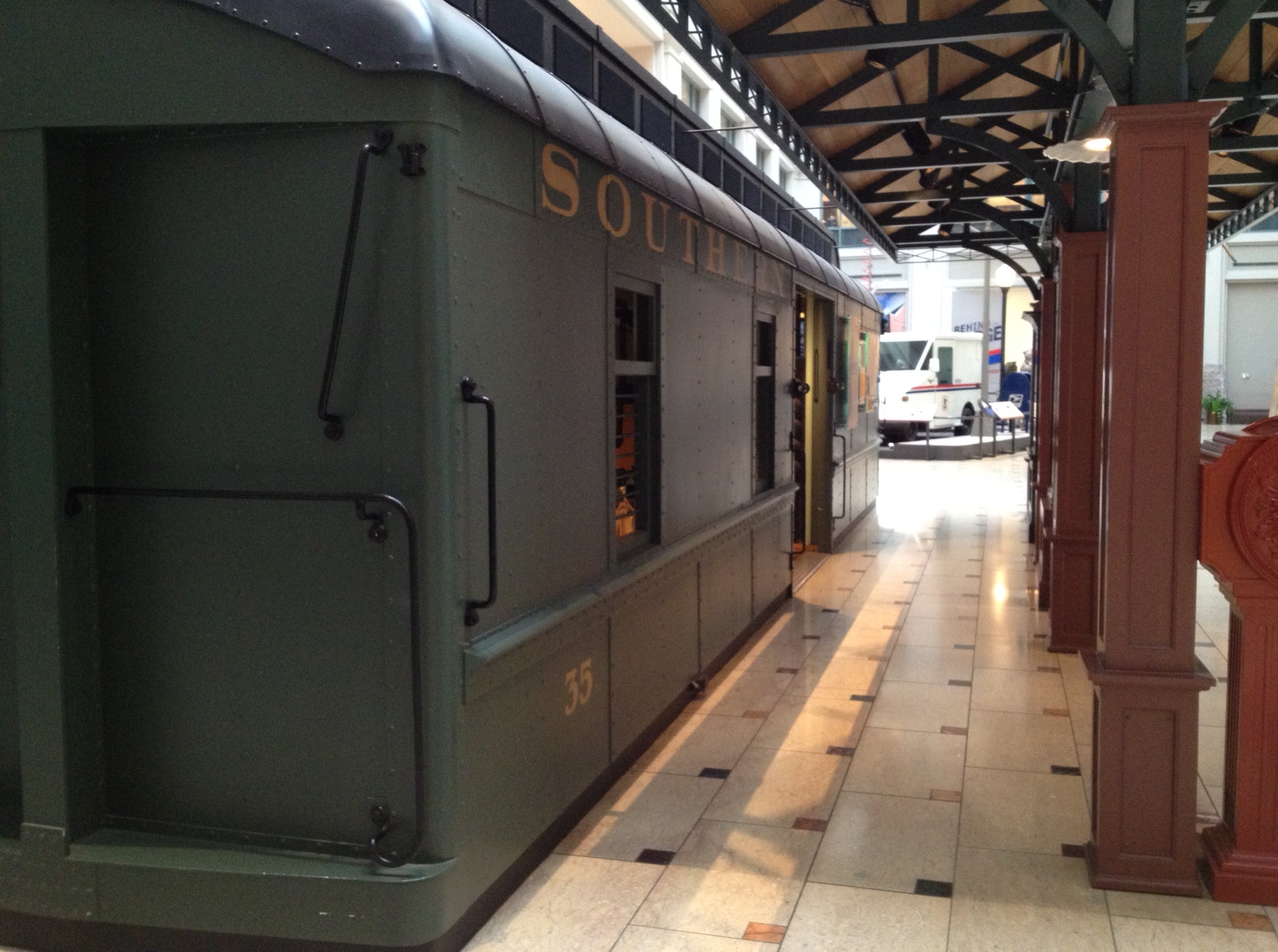
An old railway mail car
As a young boy who loved trains and airplanes, stamp collecting played right into those affinities. At the museum, you can step right into the old mail car pictured above and imagine postal clerks sorting letters and packages as the train zips along the tracks.
You can also gaze at this vintage, post-World War I de Havilland biplane and picture the daring young flyers who pioneered early air mail delivery.

This was air mail, back in the day
The cover below was the only piece of mail carried by the first airplane to cross the Atlantic Ocean from the U.S. to Europe in 1919. I read about this historic flight when I was a kid!

Here’s when early air mail went right…
The letter below also has great historic significance. It was salvaged from the wreckage of the Hindenburg, the famed German airship that caught fire and burned to the ground as it was completing its transatlantic flight at Lakehurst, New Jersey, in 1937. (You can watch a YouTube video of the Hindenburg’s final flight and demise here.)
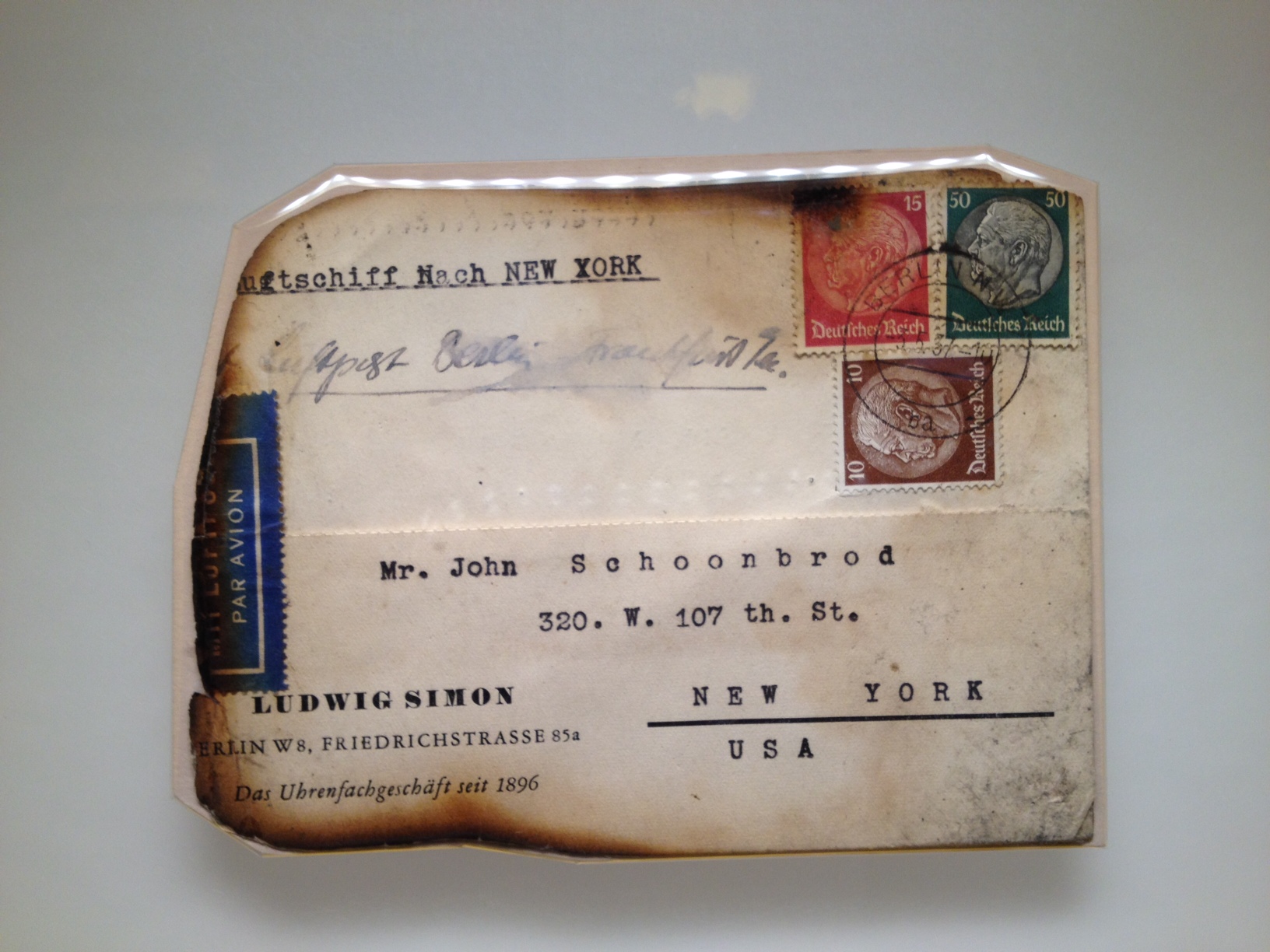
…and here’s when early air mail didn’t go so well
Given that both sides of my family are from Hawaii, I’ve long been fascinated by Hawaiian history. Postage stamps are a part of that story, and some collectors specialize in them.
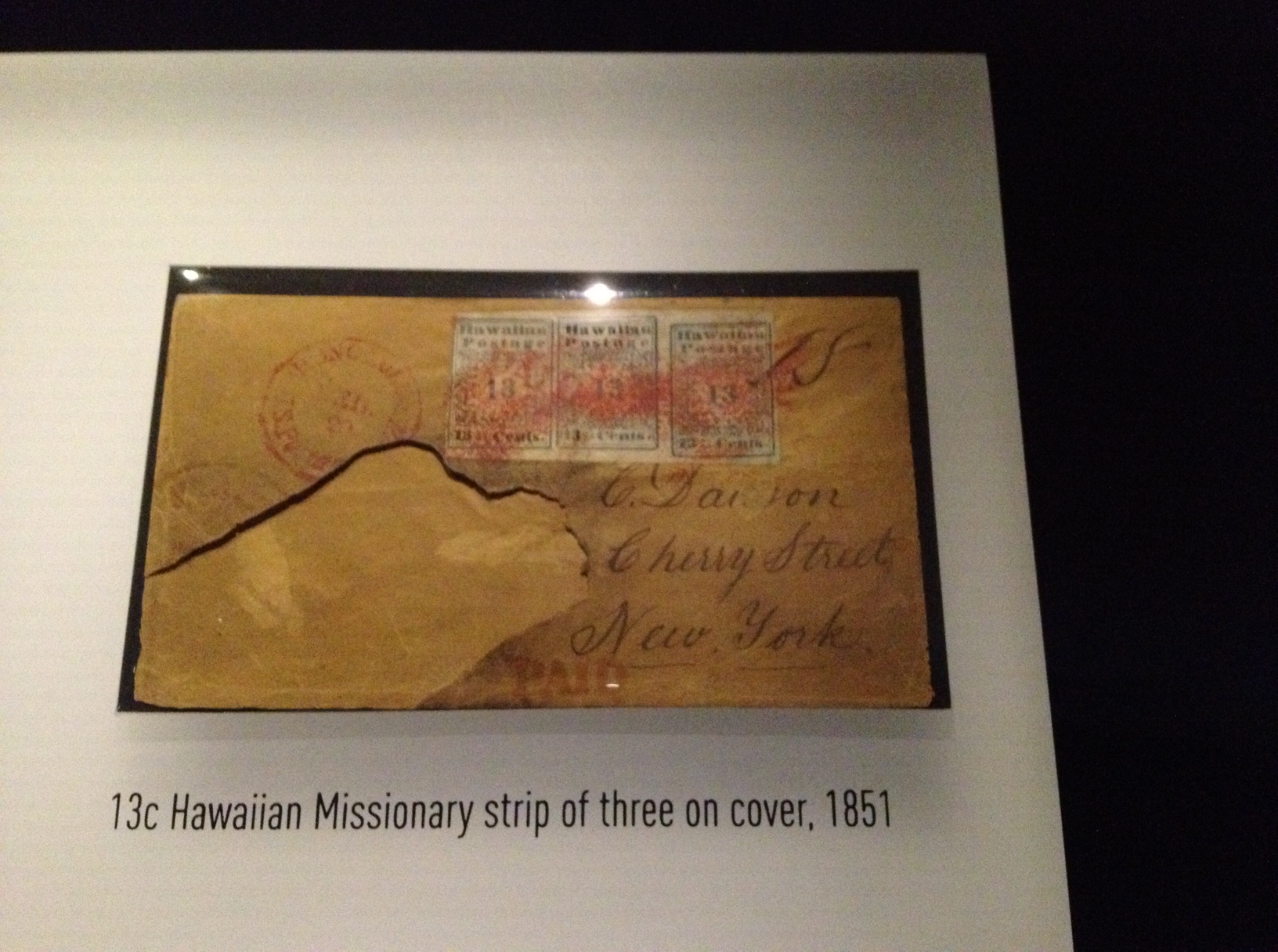
Early Hawaii had its own stamps
In fact, one of my stamp collecting keepsakes is an unused private parcel stamp from the late 1890s, for use on the Kahului (Maui) railroad line. My late Aunty Elaine gave it to me years ago when I was stamp collecting. When our family visited Maui in 1966, we went on the very last train ride of the old Kahului railroad, a treasured memory to this day.

Aww….I wonder how many cats auditioned for this gig?
I shouldn’t dwell solely on the older stamps, so here’s a more recent one that caught my eye. This adorable little critter was one of ten cats and dogs selected for a postal commemorative series celebrating the adoption of rescue animals.
About a decade ago, I attempted to get back into stamp collecting, but I found that work and other activities got in the way of this studious and more reflective hobby. Over the years, however, I’ve continued to pick up stamp issues and covers here and there. Somewhere within me the stamp collector still lurks, and this was proven to me again by my enjoyable visit to the museum.
College graduation day, May 1981: Long ago and far away

Lucerne, Switzerland, May 1981
Over the weekend, one of my college classmates (that’s you, Jon!) posted on Facebook a quick little remembrance of our graduation day from Valparaiso University on May 17, 1981. Of course, the mere mention of that time triggered a bout of nostalgia, a chronic condition that is both my blessing and curse.
Now, I wasn’t actually at our Commencement, which is how the seemingly random inclusion of this grainy snapshot of Lucerne, Switzerland figures into the story. I had finished up my undergraduate career with a spring semester abroad in Cambridge, England, and I was spending three weeks traveling on the European continent with my friends. My graduation day was spent with fellow VU sojourners David, Joanne, and Liana in Lucerne, where we took a boat ride and finished up the day with dinner at a waterside café, from where I snapped this photo.
Study abroad was a very different experience back in the day. No Internet, e-mail, or smartphones. Our primary connection to friends & family back home was the postal service, which made the daily mail delivery an important event. As study abroad sites go, England is about as safe & secure as they come, but we truly felt like we were on a foreign adventure.
My biggest technological novelty was an ATM card from a local British bank. I didn’t own a credit card. In the house designated as the residence for men, our music system was a small portable cassette player that my friend Don had “borrowed” from the office of the school newspaper back at VU, where we both had spent many hours as collegiate news scribes.
As I noted last fall in a remembrance of my years at Valparaiso, that semester abroad was the most formative educational experience of my life. I know I’m not alone with this sentiment. Since 1991, our study abroad group has held reunions every five years, and each time over half of our group has attended. (In addition to the aforementioned study abroad classmates, they have included Anne, Hilda, and Kathy, who also subscribe to this blog!)
Looking at that photo and applying rose-colored glasses, it’s easy to lapse into thinking of those days as being carefree and without anxiety, softened by images of vagabonding around Europe. Truth is, I was full of uncertainties and very much a work in progress. I had sufficient wisdom back then to know that I was very, very fortunate to have that study abroad experience, but my inner focus was impatiently and continually on the future and what it might bring.
I’ve reached the age where the fading old Kodak snapshots from my semester abroad look like something from another era, and for good reason. It really was long ago and far away when I celebrated my college graduation with friends at that Lucerne café. For nostalgic beings like me, I’ll take it as a memory to be treasured.
My first storm chase tour, May 2008
Six years ago this month, I was embarking on one of the great adventures of my life: A week-long storm chase tour, sponsored by Tempest Tours, a professional storm chase tour company.
Okay, so maybe I exaggerate, but not by much. You see, ever since I was a kid growing up in NW Indiana, I had harbored a fascination with tornadoes. When I was very young, a tornado touched down in our town of Griffith, Indiana. Mom had my brother Jeff and me safely huddled in the basement. (I don’t know if we actually were huddled; it just sounds like the thing to do when a tornado is passing over one’s home.) Fortunately our home was not badly damaged, although I remember being bummed that our swing set was blown over!
Ever since then, tornadoes had this draw upon me. Well into my adulthood, I would have dreams about tornadoes (and still do). When I read a newspaper travel section piece about a storm chase tour written by novelist Jenna Blum (a bestselling author and now among my dear friends), I tracked her down and asked her whether this was all legit. She was effusive in her praise of Tempest Tours, so I saved up my money got out my credit card and signed up for their “Memorial Day Week” tour in May.
Our group of 20 or so converged on a “base motel” near the Oklahoma City airport, and we began our tour with an extended orientation on the art and practice of storm chasing, safety issues, and general logistics. Our guides were honest with us in saying that a storm chase tour cannot guarantee a tornado sighting; after all, Mother Nature is not in partnership with them. (Real storm chasing, you see, rarely involves hopping in a car or van and then quickly running into a bunch of tornadoes.) Nevertheless, they promised to do their best to show us some of the best stormy weather during our week together.
For our first tour day, it appeared that our best bet would be to blast into Nebraska, where the forecasts indicated some promising mischief in the skies for the next day. We loaded up our stuff and hopped in the tour vans for the ride north.
Within around 90 minutes of departing OKC, however, the radar picked up a small front in northern Oklahoma that had produced a supercell, a storm capable of spawning a tornado. And so began our first storm chase!
We had no idea that we had hit a surprise jackpot. This supercell would spawn multiple tornadoes. Our first sighting is pictured right below. I was awestruck; my heart was pounding with excitement.
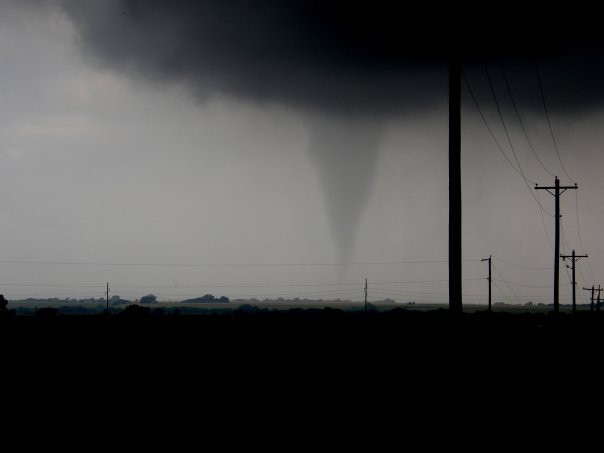
My first tornado sighting, near Hennessey, Oklahoma
We spent the rest of the afternoon and early evening following this storm and watching numerous tornadoes. It was a singularly memorable day. Even writing about it gets my adrenalin going.
The typical chase day is not so dramatic, at least in the morning. Breakfast is followed by a morning weather briefing. Here, Bill Reid, veteran chaser and our lead guide, previews the day’s chase.
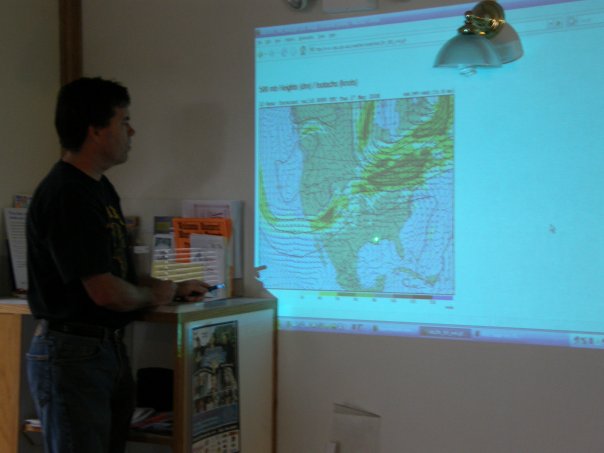
Morning weather briefing (Photo: DY, 2008)
The late morning and early afternoon often involve a lot of driving to position the group for the most promising storm(s) of the day, paying close attention to evolving weather forecasts. Next comes more driving around the targeted area, followed by . . . waiting . . . waiting . . . more driving . . . and more waiting. You spend a lot of time gazing into the sky. It can be a very contemplative experience.
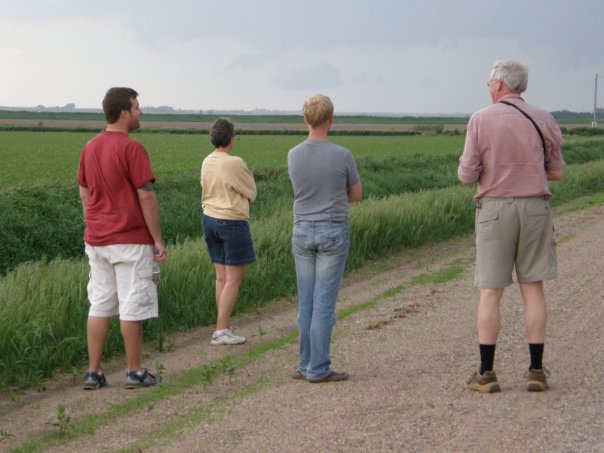
Looking skyward (Photo: DY, 2008)
When you sign up for a storm chase tour, you start rooting for bad weather during your vacation. On days when the weather is nicer, or when your group is driving hundreds of miles to position themselves for a stormier brew the next day, you may stop at tourist-type places to see local sites, like the Monument Rocks in Kansas.

Monument Rocks, Kansas (Photo: DY, 2008)
Tornadoes are not always easy to see, especially if they’re wrapped in heavy precipitation. Here’s a rain-wrapped tornado going through Kearney, Nebraska. Though the photo doesn’t capture it, we could see sparks of electricity from power lines as the tornado made its way through the town.

Rain-wrapped tornado going through Kearney, Nebraska (Photo: DY, 2008)
It’s not all about chasing tornadic storms. Looking into the sky while you’re in wide open spaces can be an awesome experience. Sometimes the views are simply spectacular. As corny as it sounds, it gives you a new appreciation for nature.

Evening in America’s heartland (Photo: DY, 2008)
Storm chasing is not for rank amateurs. It’s why I’ve paid good money to travel with, and learn from, some of the best and most safety-conscious storm chasers around. If we needed any reminder of the deadly power of these storms even for those trained in intercepting them, last May a massive tornado in El Reno, Oklahoma caused the deaths of three experienced, responsible tornado researchers, to the shock and grief of the storm chasing community. The risks posed by these storms must be honored.
I’ve been on four subsequent storm chase tours since 2008. Each has been memorable. While I probably won’t be chasing this spring or summer, I’ll be checking the National Weather Service’s Storm Prediction Center regularly and turning on The Weather Channel when the skies get murky in Tornado Alley.
Earthy, historic, mysterious, delicious New Orleans

New Orleans has a mythology, a personality, a soul, that is large, that has touched people around the world. It has its own music (many of its own musics), its own cuisine, its own way of talking, its own architecture, its own smell, its own look and feel.
-Tom Piazza, Why New Orleans Matters (2005)
At least during those five months of the year when it isn’t unbearably hot and humid, I can’t think of a more fascinating American city to visit than New Orleans.
I’ve been in New Orleans for a conference, and it’s my first trip to the city in 15 years. Obviously NOLA (as they call it) has been through a lot in the post-Katrina years, but it retains the unique look and feel that Tom Piazza wrote about in his eloquent tribute to the city as it struggled to recover from the storm and flooding.
Lately my vacations have been limited to extended weekend trips and add-on days to work-related travel, and thus I tend to explore places I visit in short stretches. Fortunately I can dig into a city like New Orleans, especially its historic French Quarter, even if I have only a couple of days to do so. For starters, I took a great walking tour of the Quarter sponsored by Friends of the Cabildo, a non-profit organization dedicated to preserving Louisiana’s history. From that tour, here’s a shot of the St. Louis Cathedral, the oldest operating cathedral in North America:
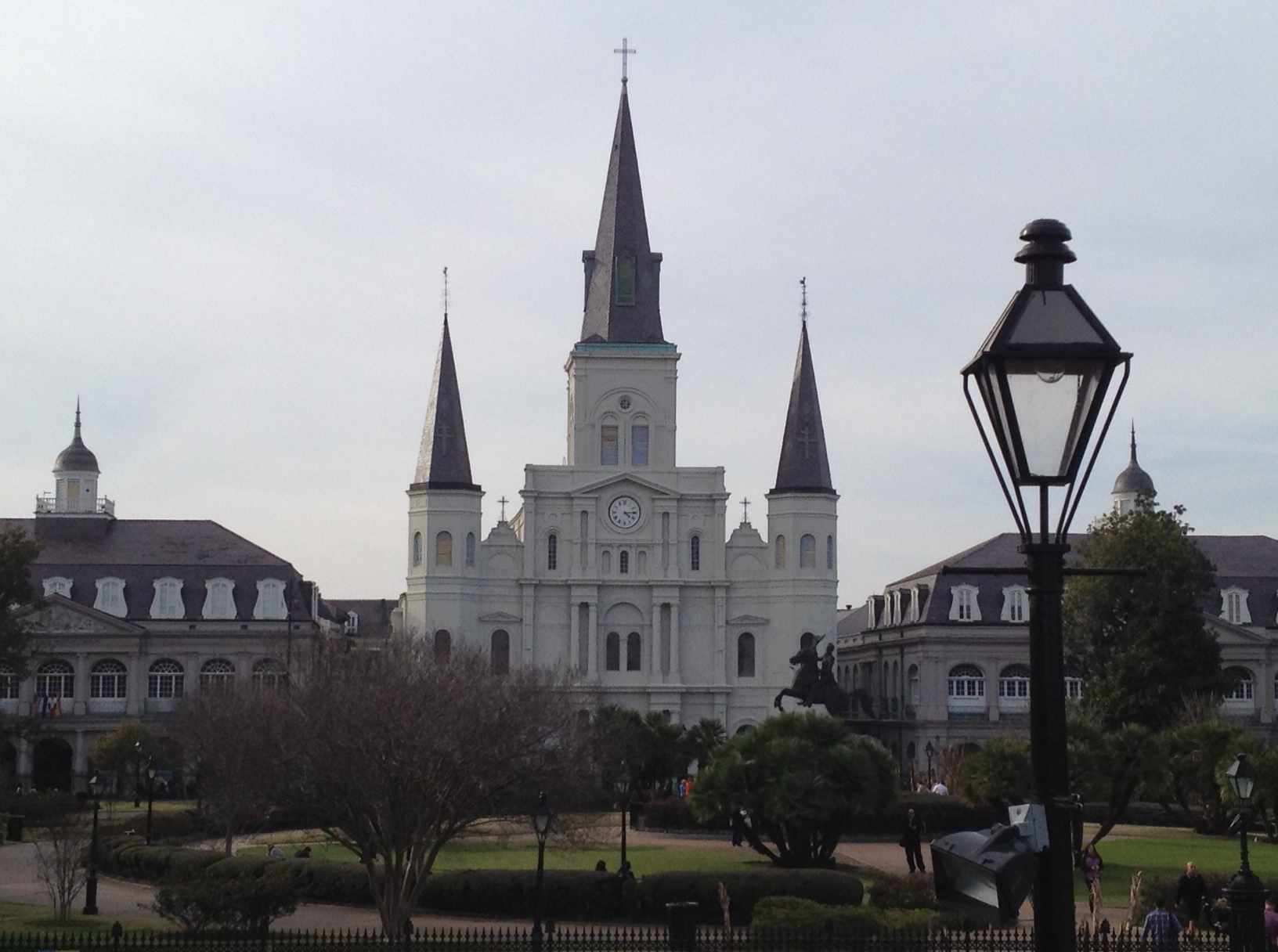
Some of my college pals who read this blog know all-too-well how much our semester abroad in England and accompanying post-semester sojourns imprinted themselves on me. Ever since, I’ve welcomed opportunities to re-experience the adventure of youthful European travel, however briefly, and New Orleans allows me to do just that without need of a passport! Seeing artists displaying their work in Jackson Square reminded me of my first visit to Paris over 30 years ago.

Being the bookstore hound that I am, I had to seek out a few of the city’s bookstores. Here’s Beckham’s Bookstore on Decatur Street, a great used bookstore with piles of books next to filled-up shelves that, well, sorta reminded me of my condo!

Beckham’s comes replete with its own resident cat, who apparently commandeers whatever space is convenient in order to get in a well-earned nap.

NOLA is home to some incredibly talented musicians. Here’s a great jazz band playing on Royal Street.
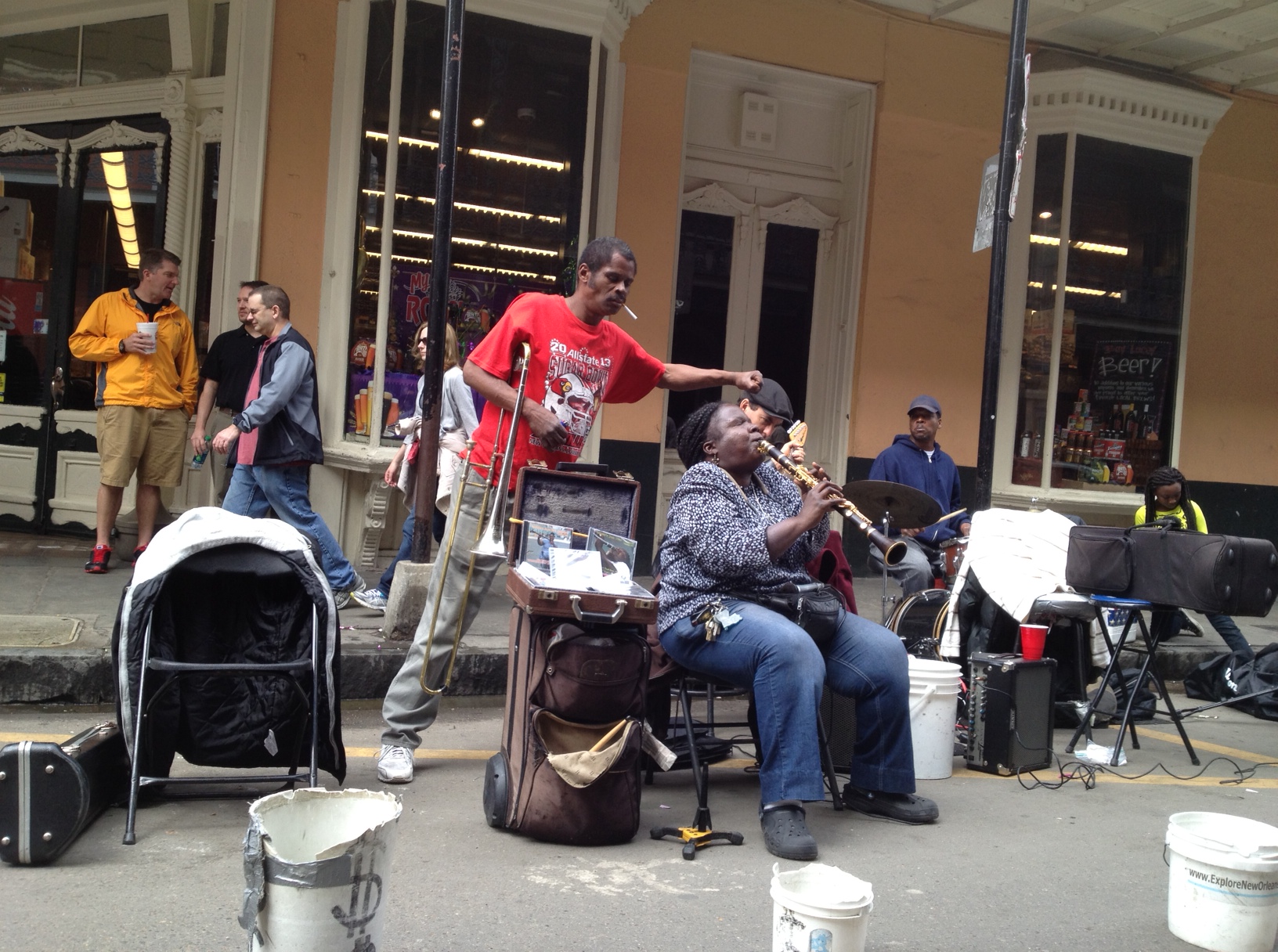
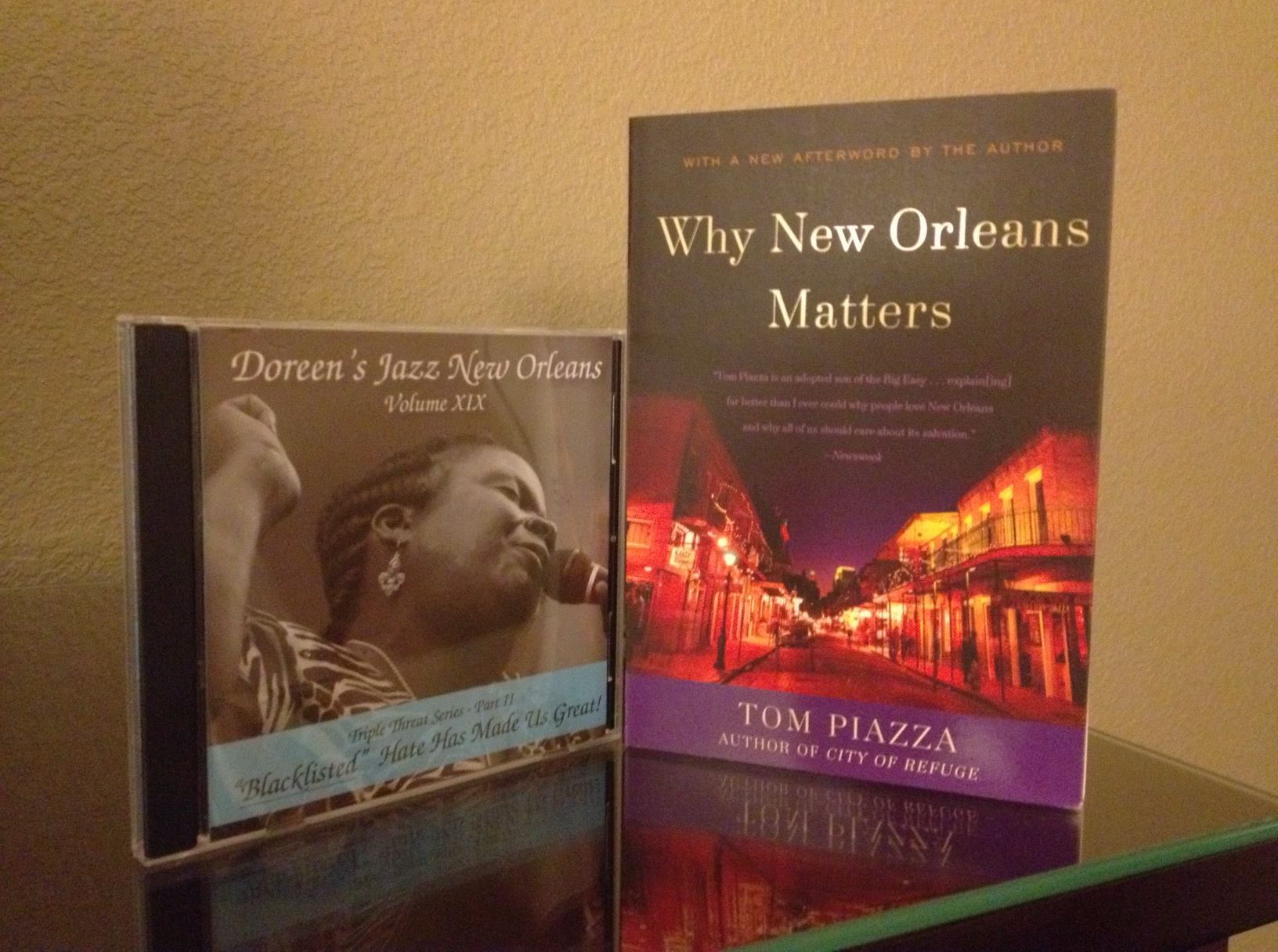
They’re so good, I picked up one of their CDs, pictured here with the Piazza book:
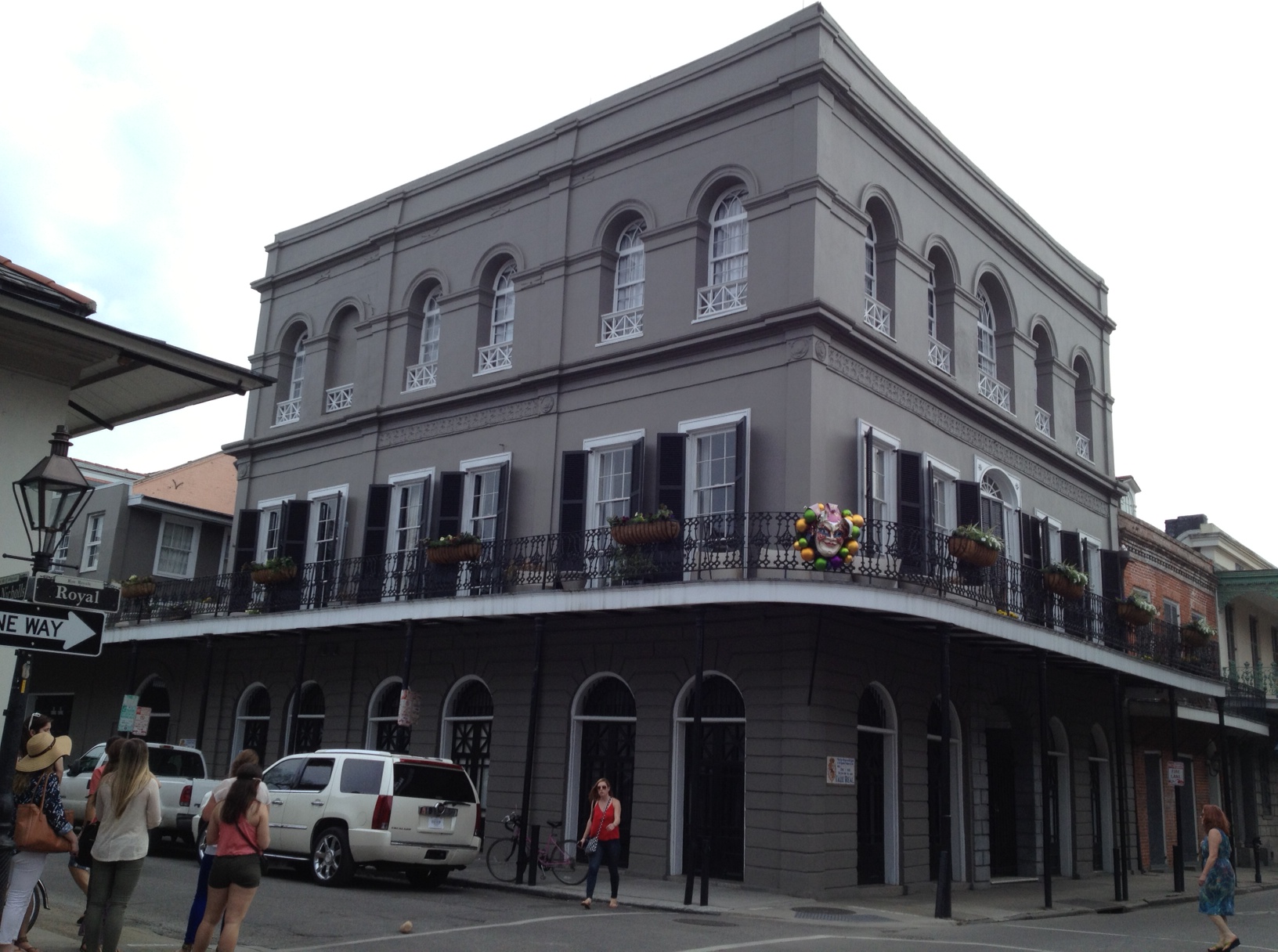
NOLA’s history has its ghastly side that, not surprisingly, sometimes turns ghostly. For example, pictured here is the house of Madame Delphine Lalaurie, who is said to have committed horrific acts of torture on her slaves during the 1830s. Though some claim that she has been unfairly indicted in the court of history, the most authoritative book that I’ve encountered on the topic, Carolyn Morrow Long’s Madame Lalaurie, Mistress of the Haunted House (2012), sides with the accusers. Naturally, the house is a favorite stop on the countless French Quarter ghost tours, and though I didn’t encounter anything supernatural when I was clicking away with my camera, I wouldn’t be eager to spend a night there.
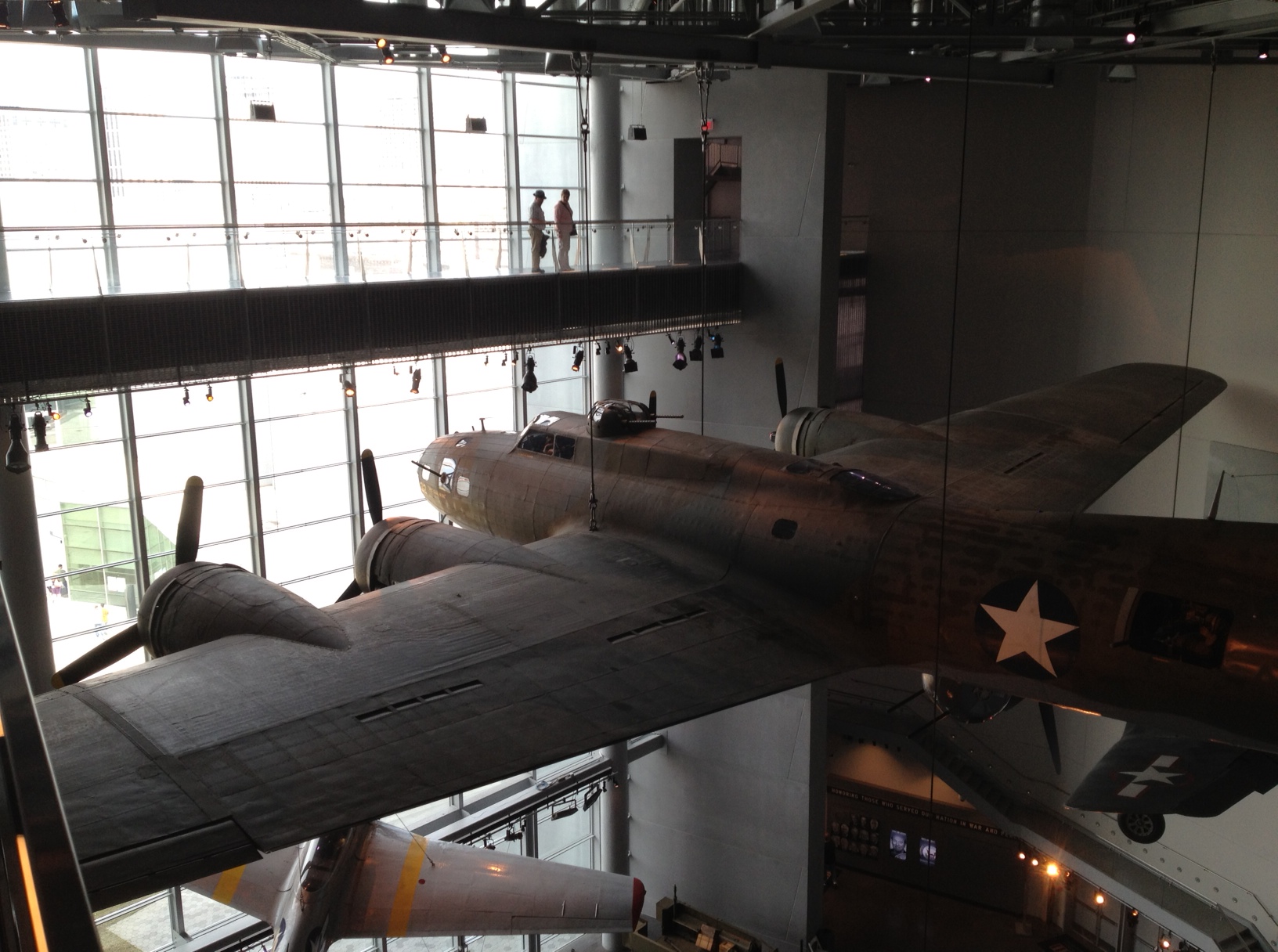
Not all of the historical offerings are uniquely local. New Orleans also is home to the impressive National World War II Museum, co-founded by noted historian Stephen Ambrose, who taught at the University of New Orleans and whose books about D-Day and the European Theatre inspired the HBO series “Band of Brothers.” The museum, which continues to expand, includes a large hall containing vintage aircraft. Here is a B-17 “Flying Fortress,” an iconic U.S. bomber plane of the era.
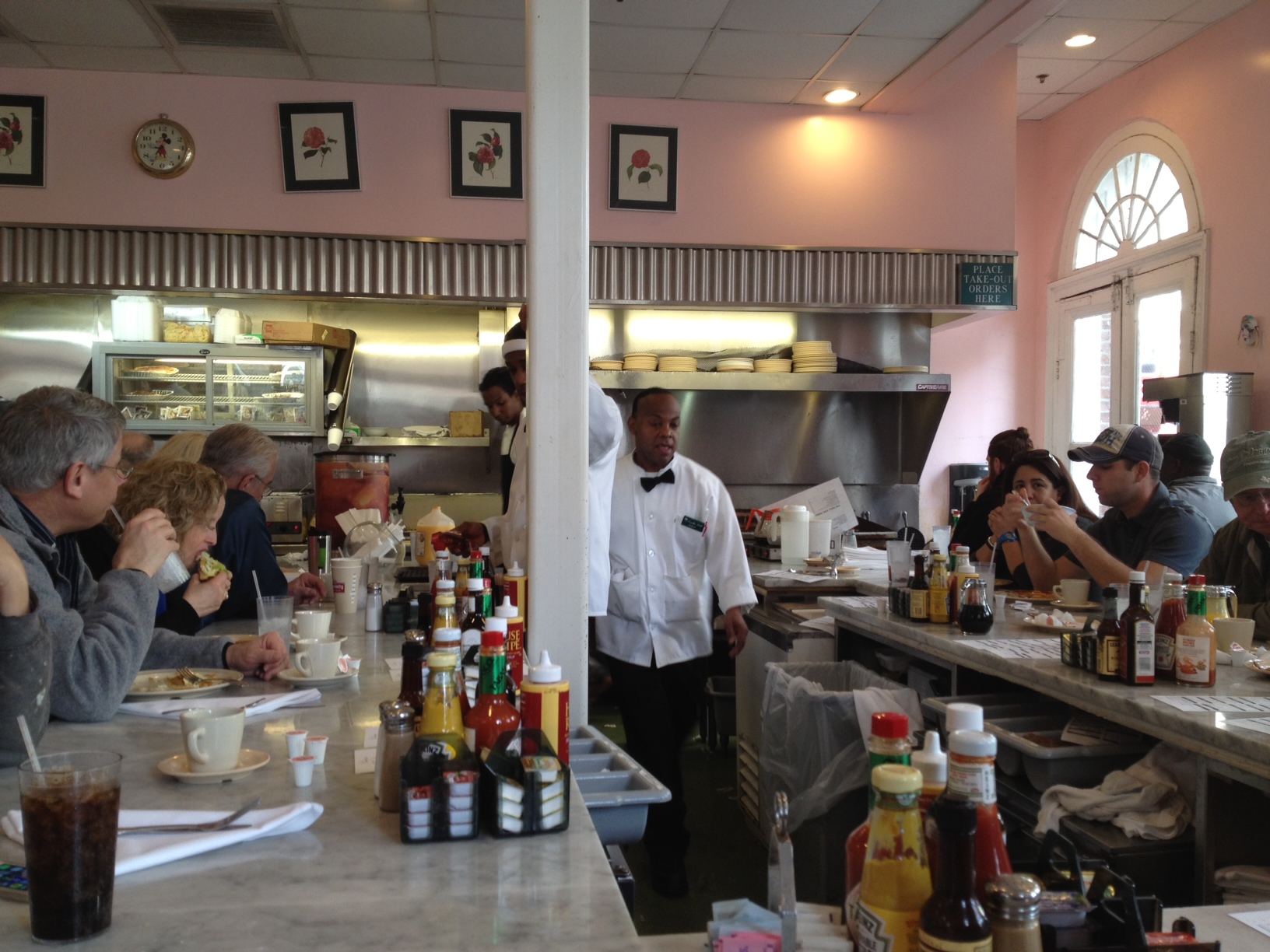
Of course, a visit to New Orleans typically involves good food. The city has a collection of fancy restaurants, but I ended up being a repeat customer at less expensive eateries, including The Grill, pictured here…
…and Jimmy J’s Cafe, whose wonderful cinnamon French toast is pictured here.

I think an order of French toast is a good way to conclude this blog post. Enjoy!
***
For a short piece on the psychology & law conference that brought me to New Orleans, go here.
All photos: DY, 2014
Train stations

NYC’s Grand Central Station (Photo: DY, 2010)
Great train stations capture a gamut of emotions: Reunion, separation, joy, sadness, anticipation, anxiety, romance, you name it. It’s no wonder that so many iconic movie scenes take place in train stations.
In the U.S., my favorite is Washington D.C.’s Union Station. If the Boston-to-D.C. Amtrak ride wasn’t so long (taking the better part of a day), I’d be on it every time I took a trip to the nation’s capital! Union Station is beautiful, busy in a good way, and replete with shops and eateries to pass the time.
New York’s Grand Central Station comes in second for me. It would be tied for first with Union Station but for the fact that it has been relegated to the status of commuter rail terminal. I hope the folks in Westchester County won’t get mad at me when I say that it’s such a waste of a public palace to hear announcements for trains departing to White Plains.
Chicago’s Union Station is a pretty cool place. The Windy City was one of the nation’s most active passenger rail hubs back in the day, and Union Station’s splendor remains evident.
Boston’s South Station is the Little Engine That Could. It’s not super fancy or beautiful on the inside, but it looks nice on the outside and serves as the city’s main intercity and commuter rail station. Not bad for a college town on steroids.
One of the ugliest, most cramped major stations is New York’s Penn Station, which was once an architectural showpiece until certain powers that be knocked down its most beautiful parts and turned it into an underground horror show.
Most of my train travel abroad has been in England and the European continent, and about many of those places I can only say wow. London, Paris, Berlin, you name it, both past and present make themselves known.
During trips to London, I’ve usually stayed at inexpensive B&B hotels near Victoria Station. I just love that train station. It pulsates with life.
Like air travel, a long train ride used to be something of an event. Those days have largely passed, at least in the U.S. Nevertheless, a beautiful train station can still fill one with excitement over journeys starting and ending.
Time travel: Some favorite destinations

Remember “The Time Tunnel,” the short-lived but fascinating television time travel drama from the mid-60s? Every new episode would find scientists Tony Newman and Doug Phillips landing in a different historical setting, usually on the eve of some major event, such as the sinking of the Titanic, the Battle of Little Big Horn (General Custer and Crazy Horse), or the bombing of Pearl Harbor. (Unfortunately, they never could persuade folks that disaster loomed.) To this day, I credit that show for helping to stoke a lifelong interest in history and to fuel my imagination with thoughts of going back in time.
What if time travel was possible? What places and times would I want to visit? Here’s an off-the-top-of-my-head list, not exactly an exotic one, but it sure would be a fascinating set of journeys. Feel free to add yours in the comments!
***
New York City, 1880s — My favorite time travel novel, Jack Finney’s captivating Time and Again (1970), is set in early 1880s Manhattan. There’s a scene in the book when his protagonist, Si Morley, realizes that he made a successful journey back. It remains one of my most favorite reading moments, ever.
New York City, 1920s — I’d be at everything and anything by George Gershwin, Rodgers & Hart, and Cole Porter. I’d be at the jazz clubs of Harlem. I’d be at Yankee Stadium watching Ruth & Gehrig. I’d be hanging out in Greenwich Village. I’d also want to check out student life at New York University, my law school alma mater. The 1920s is one of my favorite decades, and NYC of that time would make for a grand visit.
New York City, post-war 1940s and early 1950s — I can’t imagine a better place to drink in the spirit of America’s post-war optimism. I’d also venture out of Manhattan to Ebbets Field in Brooklyn, where I’d watch Jackie Robinson break baseball’s modern color barrier. I’m sure I’d spend plenty of time and money at the dozens of used bookstores in the city. And yes, I’d hang out in the Village during this period, too.
Chicago, 1893 — Chicago hosted the Columbian Exposition World’s Fair. The photographs of it look stunning, a city bathed in light. It also marked Chicago’s arrival as a major city.
Chicago, 1920s — When I was a kid, one of my favorite books was Albert Harper’s Chicago Crime Book (1969), which told tales of Al Capone and other famous gangsters. Thus was born a fascination with Chicago’s Roaring Twenties.
San Francisco and Berkeley, California, mid-to-late 1960s — I’d like to experience the whole California Dreamin’ thing. I’d be the squarest person in Berkeley’s People’s Park, but at least I’d be able to take good pictures.
London, late 1880s — Yeah, I’d sleuth around the East End to discover the identity of Jack the Ripper. I’d be drawn to the sinister side of Victorian London. I’ve also read about the food carts of the era and would like to give them a try.
London, 1940 — London during the Battle of Britain and the Blitz. It’s such an iconic, defining, dramatic moment in British history. Just thinking about it has me imagining Edward R. Murrow’s radio broadcasts from London as the German bombs were falling around them.
Paris, 1920s — I probably wouldn’t stay long, but I’d want to check out that whole Left Bank scene and the Lost Generation. I’d hang out in Paris cafes and do a bit of writing. (Challenge: No outlets for my laptop.)
Washington D.C., 1861-65 — Washington during the American Civil War. Hot, miserable, and menacing. But fascinating nonetheless. And somehow I’d finagle a way to have a short chat with Abraham Lincoln.
Boston, Revolutionary Era — I live in a city where evidence of the early years of the American Revolution is all around us. How cool it would be to see Boston of that era, perhaps bumping into the likes of John Adams, Samuel Adams, and other remarkable figures of the day.
Salem, Massachusetts, 1600s — Will we ever know the full truth about the events surrounding the Salem Witch Trials? It would be fascinating to find out.
Ancient Athens — I’d follow Socrates as he traipses around the Athenian marketplace. I’d want to get some first hand lessons in how the ancient Greeks lived, and trace some of the origins of Greek mythology and philosophy.
Hawaii, 1920s — Among my treasured Hawaiian collectibles is a February, 1924 National Geographic magazine with 16 pages of incredible color illustrations of the Islands. I can only imagine seeing those sights in person! If I was on Maui during October 1926, I’d go to the hospital in the small town of Paia to say hi to the newborn baby who someday would be my mom. While on Maui, I’d take a train ride on the narrow-gauge Kahului Railroad.
Hawaii, 1950s — After WWII, Hawaii was making its way toward eventual statehood. Large passenger airplanes — still propeller-driven, as the jets wouldn’t arrive in the early 60s — now made air travel to the Islands a safe reality. The idea of Hawaii as America’s Pacific paradise was in full bloom.
Valparaiso, Indiana, early 1910s — Valparaiso University, my collegiate alma mater, was rescued by the Lutherans in the 1920s after a period of decline. Before that, however, it was a thriving, no-frills, secular college known as the “Poor Man’s Harvard” that provided collegiate, professional, and trade courses to young people who aspired to join America’s emerging middle class.
Hammond, Indiana, 1950s — Hammond was my hometown from grade school through high school, from the late 60s through late 70s. By then it was a city in decline, its jobs base shrinking due to the decline of steel mills and manufacturing in Northwest Indiana. But during the 50s it was a thriving small city and an emerging outer suburb of Chicago.
Airplanes — I would love to fly in two legendary, early passenger airplanes, the Ford Trimotor (late 1920s) and the DC-3 (mid 1930s).
Trains — How fun it would be to take the Pioneer Zephyr, one of the first modern diesel passenger trains, on its popular Chicago-to-Denver run during the 1930s.
***
I’m struck by the fact that this list doesn’t have much to do with my current work. Hardly anything about law, the labor movement, politics, and the like. Not much about war, either, despite that I read a lot about the Civil War, WWI, and WWII. I’m not sure quite what that says about my choices, but unless science develops affordable time travel during my lifetime, this is not a pressing matter.
 Musings of a Gen Joneser
Recent Comments