Throwback Thursday: Staying in New York (January 1985)

I saved this magazine cover from Dec. 1984; it’s displayed on a wall of my condo.
Thirty years ago, as I approached my final semester of law school at New York University, I accepted an offer to join the New York Legal Aid Society as a staff attorney after graduation. For me, it brought together two things near and dear to me: First, to work as a public interest lawyer; and second, to stay in New York City.
I had spent the previous summer working at a large commercial law firm in Chicago. Although the firm would extend an offer to return as a full-time associate attorney, I realized that my heart was not in corporate law and kindly declined. I wanted to work in the public interest sector, and so I applied for jobs across the country with legal services organizations, public defender offices, and a variety of other non-profit and public employers. Although NYU was very supportive of students who wanted to do public interest work, these jobs were in heavy demand among young (and not so young) do-gooder types. I knew that I had my work cut out for me.
My job search stretched across the country, but New York was my top destination by a huge margin. I had moved there from northwest Indiana to attend law school, and I fell fast and hard for the city. New York of the early-to-mid 80s was a city in transition, emerging from a previous decade steeped in crime, urban blight, and corruption. It was an awesome, gritty, sometimes overwhelming place to me.
In many ways, going to law school in New York was like a study abroad experience, in that I kept discovering its endless nooks and crannies on a shoestring budget. It was still possible to explore and enjoy many aspects of the city on the cheap, with an occasional splurge or two for a show or a nice dinner.
Anyway, good fortune would smile upon me, and I spent my final semester of law school knowing that my immediate future was set. I graduated in the spring, took the bar exam over the summer, and started at Legal Aid in the fall. Between being ousted from the NYU law dorm and my $20,000 starting salary, I was propelled into the apartment share hinterlands of Brooklyn. It would be many years before my paychecks yielded more disposable income, but at least I was in a city that captured so much of the world. Armed with subway tokens, travel guidebooks, and a credit card that I tried to use judiciously, I took a lot of New York “staycations.”
Yup, this takes me back some 30 years, and that realization does a number on me. Though concededly I was quite clueless about so many things back then, this was a very good chapter of my life. Sometimes, even memories filtered through rose-colored lenses of personal nostalgia can be pretty spot on.
My travel-related bucket list

The term “bucket list,” if you missed its pop culture origins, is drawn from the 2007 motion picture The Bucket List. The movie features Morgan Freeman and Jack Nicholson as two men who, after receiving dire assessments from their doctors, ditch their hospital beds for a whirlwind road trip to places they’ve never visited and to do things they’ve never done.
Very quickly, the term became popularized by comparatively healthier middle-aged adults (among others) to describe their wish lists of to-dos and must-sees, many of which are associated with travel.
Now that I’m well into my fifties, I find a curious twist occurring: My own bucket list, at least when it comes to travel, is narrowing rather than expanding.
What’s on my list? As far as new places outside of the U.S. go, I’d like to see Athens and bear witness to the sites of ancient Greek history. Maybe I could squeeze in a visit to Italy as well. I’d also like to tour some of the famous historical and religious sites in France, ranging from First World War battlefields to ancient cathedrals.
Otherwise, I’d like to revisit a cluster of old haunts. Even traveling, I’m a creature of habit, and once I discover something I like, I’m drawn to go back. London, for example, has long been one of my very favorite cities, so much that I feel very comfortable there without losing that feeling of wondrous discovery. (Someday soon I’ll write about my visits there.)
For a someone with only a modest travel bug, I’ve been fortunate to see a lot of interesting, fascinating places, and I’ve experienced first-hand how travel can expand our minds and worlds. So especially to those whose bucket list dreams have yet to be fulfilled, I wish for you many opportunities to make them a reality.
***
As for The Bucket List, I give it maybe 3 or 2.5 stars out of 4. I’ve long been a fan of Morgan Freeman, but Jack Nicholson — in just about every role he plays — reminds me of too many of the egos I’ve encountered in the legal profession and in academe! Nevertheless, it’s a good movie, and it leaves us with some points worth thinking about.
Throwback TUESDAY: My last camping trip (1984)
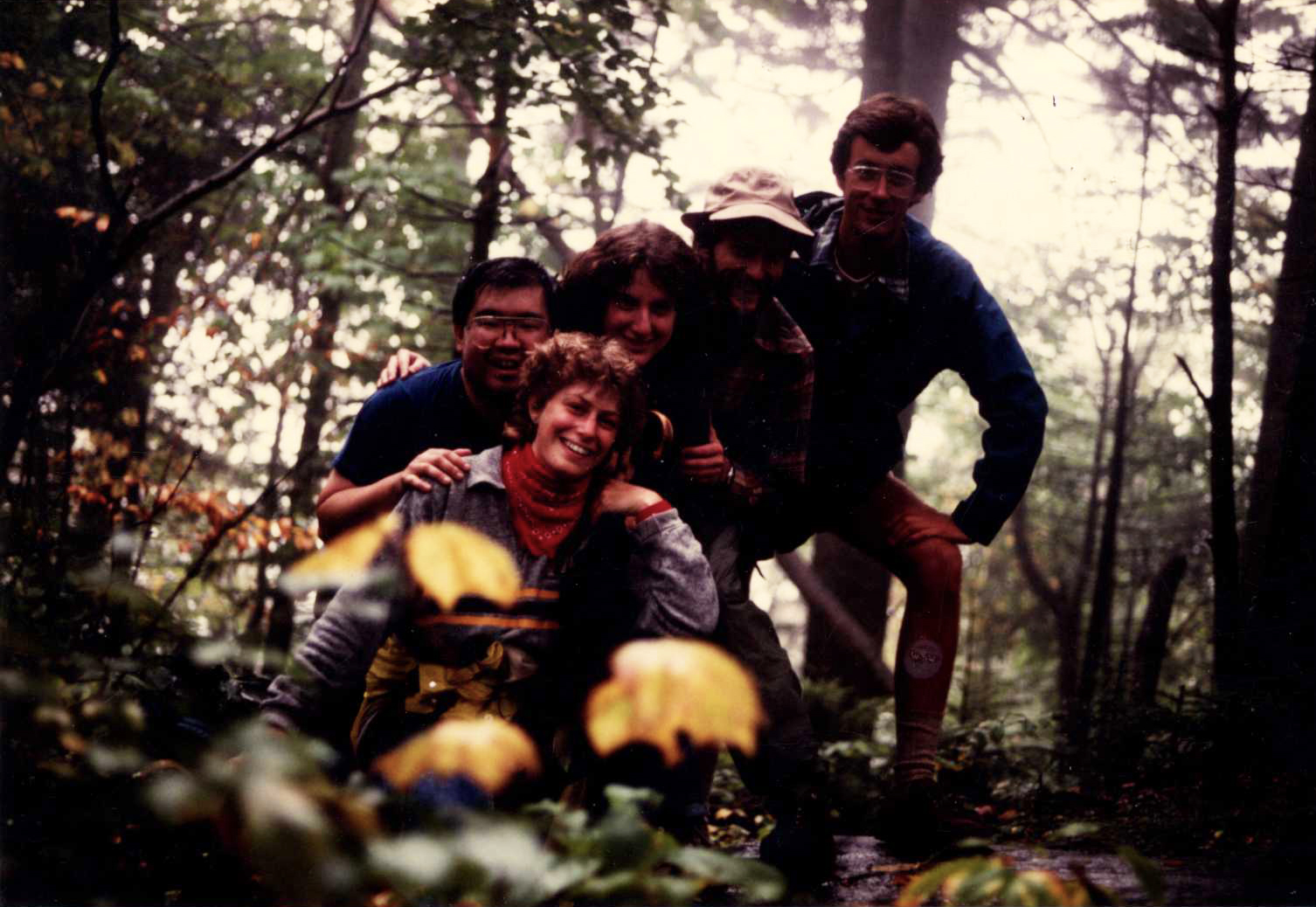
Front to back: Mo, DY, Rochelle, Patrick, and Mark. Talk about roughing it: We had no cell phones back then, so we couldn’t even try to order Chinese delivery. (Photo courtesy of Patrick Long, 1984)
The other day, my long-time friend and law school classmate Patrick sent me a couple of photographs taken thirty years ago, from a camping trip at the start of our third and last year at NYU law school. It was the beginning of the fall semester, and the onset of classes had triggered a bout of cabin fever so intense that five of us piled into Patrick’s car and headed for the Catskills.
This may sound like an odd thing for a law professor to be saying, but my reaction to the start of classes was so acutely resistant that even I — a budding city dweller in the making — was willing to forgo the niceties of the law school dorm in order to escape the world of casebooks and classes.
You see, unlike my outdoorsy law school friends, I was not a regular camper. Actually, I wasn’t a camper, period, and I haven’t been since then. It’s not that I’m a high maintenance traveler. In fact, between summer storm chase tours and countless trips to New York, I’ve stayed in places that won’t be listed in any premium travel guidebooks. But when it comes to accommodations away from home, I do strongly prefer (1) a bed to sleep in; and (2) indoor plumbing.
I don’t remember a lot about the trip itself, though I know that we all got along together just fine. I also seem to recall a couple of loud guys camping in an adjacent plot who had too much to drink on multiple nights, but maybe that’s just a ritual memory of every camping trip, whether it actually happened or not.
Anyway, after a few days in the wilderness, we folded our tents and returned to the urban jungle. Soon I got back into the law school swing of things, and it would prove to be a good and meaningful year, with some fun and laughter mixed in with the work.
Wow, it has been thirty years since my last year of law school. I’m sure the muse of nostalgia will cause me to write more about that time during the months to come.

No cable, so at least we could stare at the flames: Isn’t it wonderful how the discovery of fire made recreational camping possible? (Photo courtesy of Patrick Long, 1984)
My mortifying slip-and-fall near Stonehenge and the stoking of curiosity

College chums helping to accelerate the eventual roping off of Stonehenge from tourists (Photo: DY, 1981)
I can thank a British sheep or two from 1981 for stoking my interest in this story:
In a piece for the Huffington Post, science writer Macrina Cooper-White reports on a potentially significant discovery near Stonehenge in Britain:
Archaeologists studying Stonehenge and its environs say they’ve unearthed the remnants of an untouched, ancient encampment that dates back 6,000 years–a find that could rewrite British prehistory.
“This is the most important discovery at Stonehenge in over 60 years,” Professor Tim Darvill, a Bournemouth University archaeologist and a Stonehenge expert who was not involved in the new discovery, told the Telegraph. And as he told The Huffington Post in an email, the discovery overturns previous theories that “Stonehenge was built in a landscape that was not heavily used before about 3000 B.C.”
It’s pretty cool stuff, yes? But I might’ve passed on the story had Stonehenge not made its own indelible mark on my life decades ago.
During my 1981 semester abroad in England via Valparaiso University, one of our weekend group trips included a visit to Stonehenge. (As the photograph above indicates, we were ultra-serious about these mini-sojourns, giving new meaning to the term “visiting scholars.”)
You see the comely lass waving to me in the photo below? That’s my long-time friend Hilda, now an English teacher and novelist in Northwest Indiana. You can visit her book sites here (Kingdom of the Birds) and here (Plank Road Stories).

Near Stonehenge (Photo: DY, 1981)
Anyway, if memory serves me well, just a few minutes after snapping that picture of Hilda, I would take a short slide down a hill. Although it was damp and cold that day, it wasn’t precipitation that precipitated my fall. No, I had slipped and scooted down on a big pile of sheep droppings.
Yup, really, really gross. And kind of mortifying.
I won’t dwell too much on the odoriferous aftermath, but suffice it to say (1) thank God our bags were packed in the bus nearby, so I could change; and (2) although my wardrobe was sparse — most of us did our best to pack light for our semester abroad — I removed those trousers and quickly threw them away.
Now, you rightly may be asking yourself what the heck this has to do with a potentially significant archeological discovery near Stonehenge, and I agree the connection seems weak.
But here’s one thing I’ve learned about travel and education: Simply being there plants a lot of seeds. (No jokes about fertilizer, please.) I was not anything close to being an Anglophile when I opted to spend my final undergraduate semester abroad. But I got sooo much out of that experience, despite my remarkable immaturity at the time. In fact, I’ve returned to England at least a half dozen times since that collegiate semester, and each visit has been rewarding.
So when I read about this exciting discovery near Stonehenge, I thought to myself, cool, I’ve been there!, and then checked out the article with great interest.
Of course, it’s not necessary to have visited a country in order to appreciate it. I’m fascinated by ancient Greece, for example, but have never visited there. In my case, however, it does help to have walked around a place.
And who knows, maybe that location is close to where I did my slide down the hill!? Talk about deep-seated connections….
Another quick trip to Manhattan

A throwback view — I want to name it “The Naked City” after the old movie and TV show — from my midtown Manhattan hotel room
I’ve been back in New York City this week to participate in a terrific conference, the annual workshop of the Human Dignity and Humiliation Studies network, sponsored and hosted by Teachers College of Columbia University. Among other things, I gave a talk on the quest to advance and nurture dignity at work. I’ll be posting more about that on my professional blog, Minding the Workplace.
During these all-too-brief trips to the city, I try to revisit favorite old haunts from my 12 years there. One of my stops was the famous Strand bookstore. Since my very first visit to New York in the summer of 1982, I’ve been there hundreds of times!
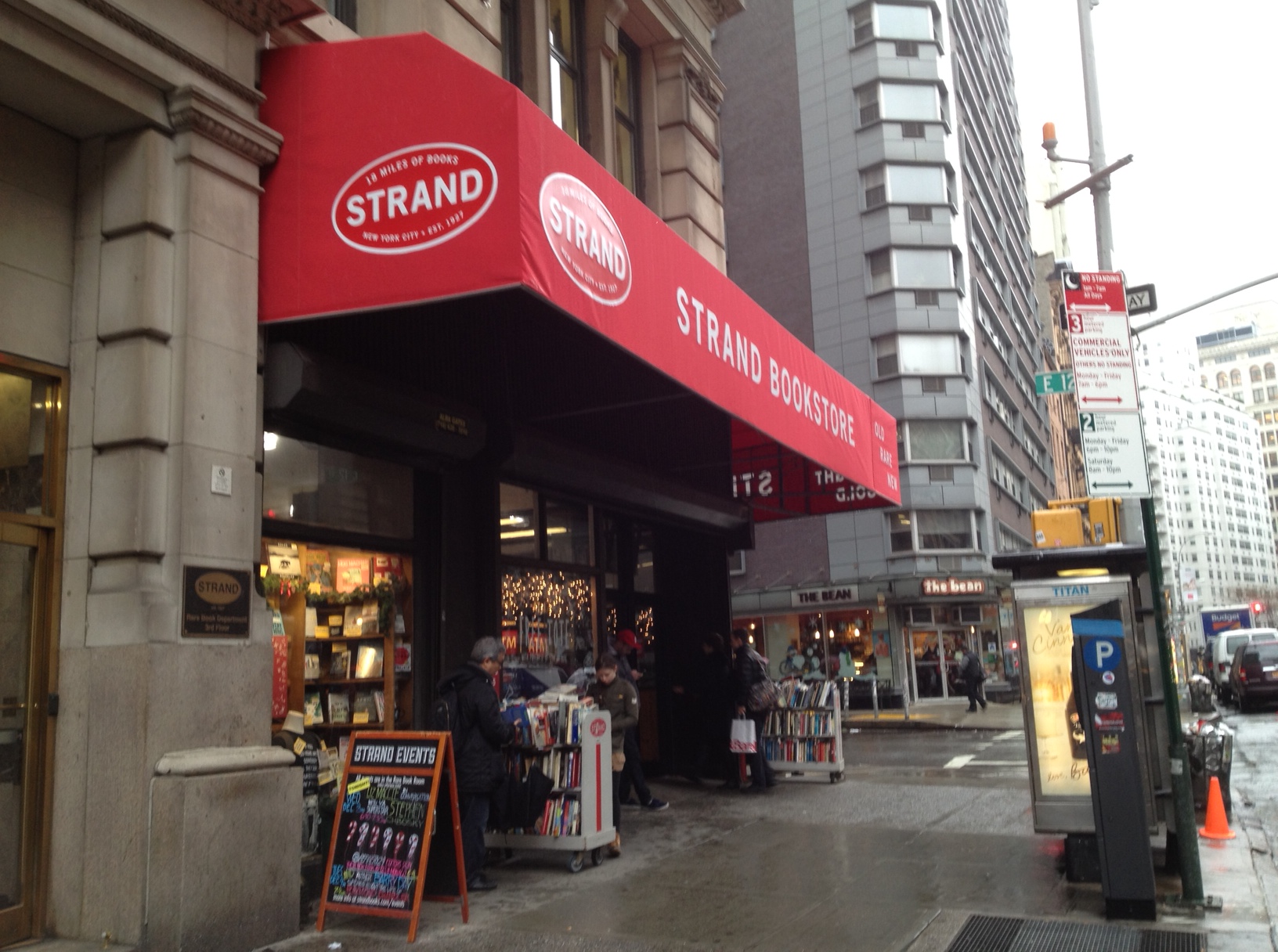
The Strand, my long-time bookstore mecca
When I lived in New York, one of my favorite ways to spend a free afternoon or evening was to go pick up a few discounted treasures at the Strand and then enjoy a hearty meal at the Cozy Soup ‘n’ Burger on Broadway & Astor Place. One of my law school pals (hey Joel!) introduced me to the Cozy some 30 years ago, and I’ve been making pilgrimages there since then. My usual order is a turkey burger (no fries) and a cup of their signature split pea soup. If it’s dinnertime, I also may splurge on an order of rice pudding.
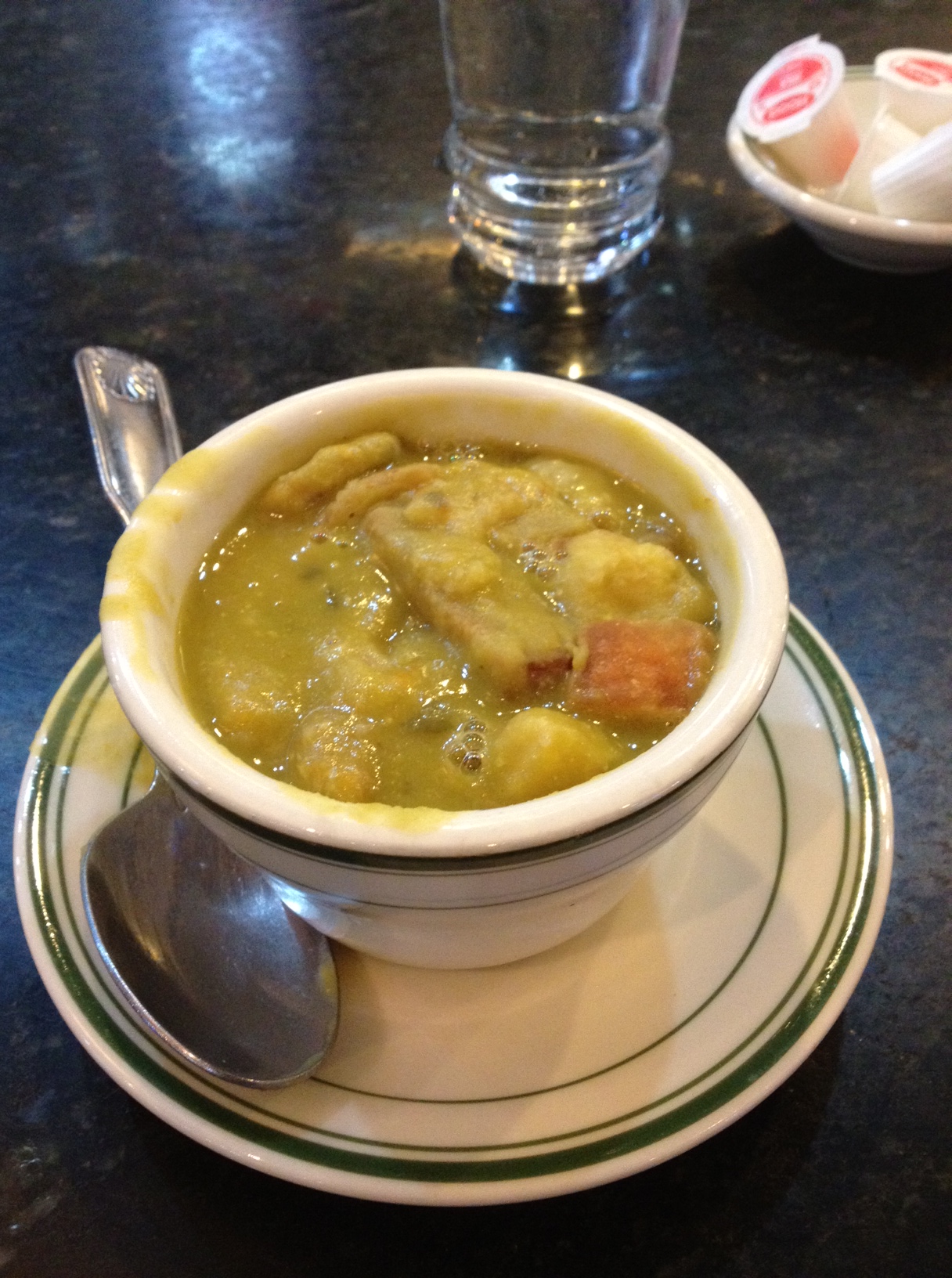
The Cozy’s split pea soup with croutons…as good as soup can get.
Wednesday’s dinner was at La Palapa, a real deal Mexican restaurant on St. Mark’s Place in the East Village. My cousin Judy, a superb restauranteur, is a manager. Fortunately I can champion the food because it’s sooo good, not just because I have a dear family member who works there! Dining with cousins Al, Aaron, and one of their friends, I had this incredible, fall-off-the-bone pork shank dish with rice and plantains.

Tasted even better than it looks!
Cousin Judy and I also went to see a Broadway show, a top-notch performance of “On The Town,” the fresh, funny, and sharp revival of a 1944 musical about three U.S. Navy sailors enjoying a 24-hour leave in New York City.
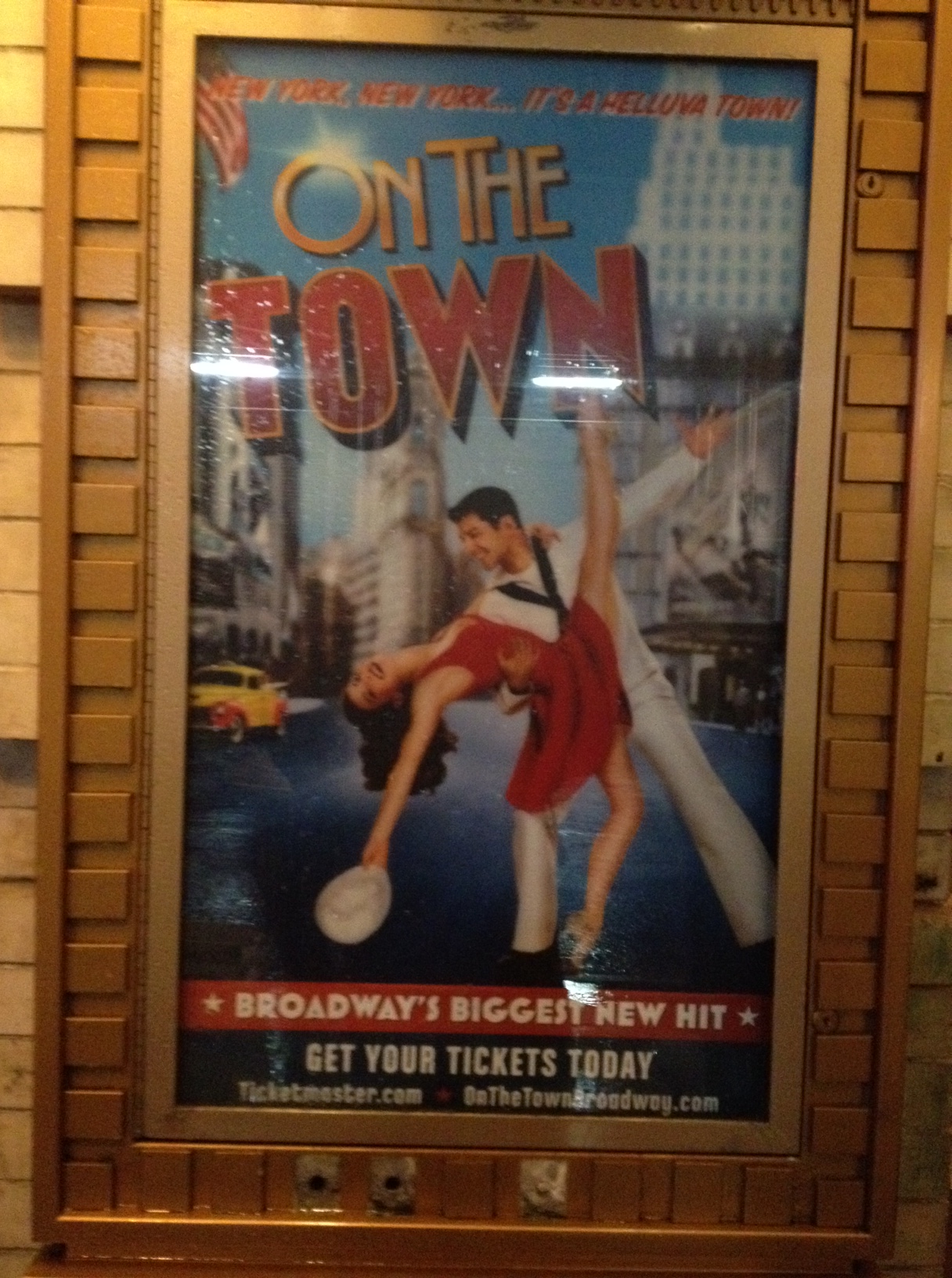
Outside the Lyric Theatre, NYC
This visit also overlapped with serious real-life events in New York. On Wednesday, a Staten Island grand jury opted not to indict a white police officer, Daniel Pantaleo, who had placed an unarmed and secured African American man, Eric Garner, in a fatal chokehold. Especially because the July incident was captured on videotape, the decision has sparked major protests in the city (and elsewhere). Here was the scene Wednesday night in Union Square at 14th Street in Manhattan.
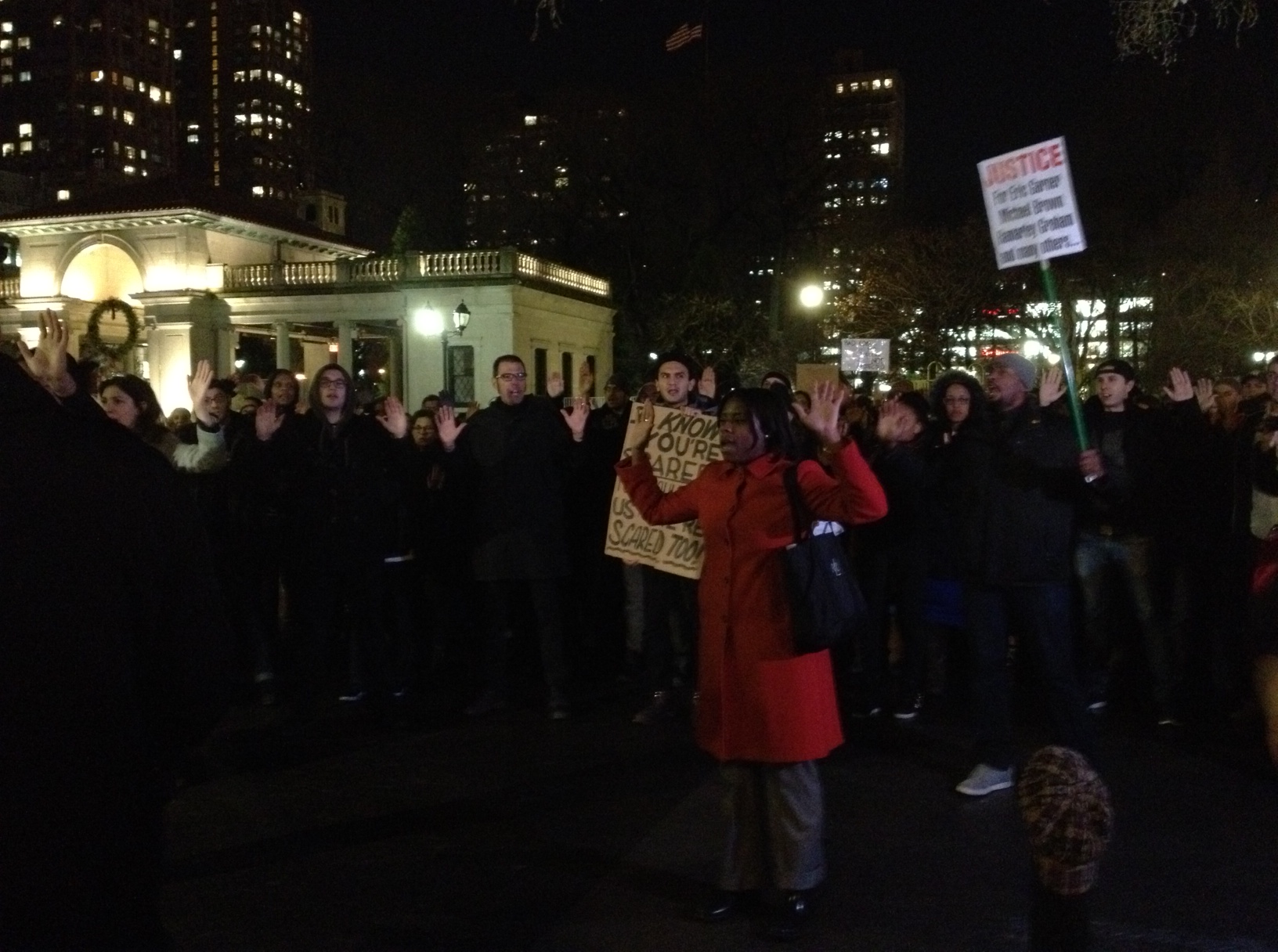
Protesting the grand jury decision in the Eric Garner killing, at Union Square, early Wed evening
Big Apple Thanksgiving
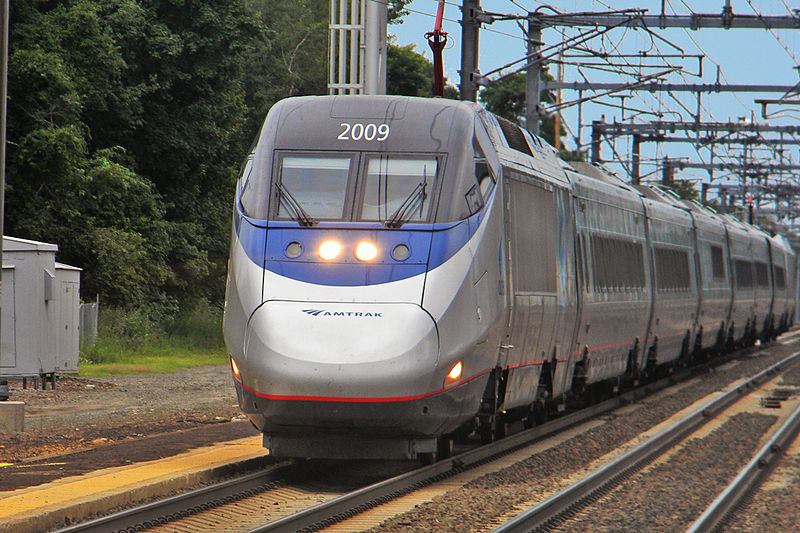
Amtrak Acela Express train between Boston and NYC (Photo courtesy of Shreder 9100 at en.wikipedia)
Later this week, I’ll be hopping on an Amtrak train from Boston to New York City for the welcomed annual ritual of Thanksgiving dinner with family and friends.
What began over a decade ago as an impromptu gathering of cousins and dear friends has become a tradition: The same home in Brooklyn, with a steady cast of about a dozen regulars, a mix of adults and fast-growing kids. A fulsome, traditional Thanksgiving menu (and it’s always amazing). People congregating in the kitchen as the food is prepared. An evening feast — this is New York, after all, we tend to eat later. During dessert, some migrate to another room to play guitars and sing (a lot of 60s and 70s stuff), while others hang out at the dinner table and talk, and the kids go off to do their things.
You know what’s odd? As far as I can recall, we’ve never taken any pictures. That’s why I had to snag a picture of the Amtrak train to illustrate this blog post! Among our group of late Boomers through Millennials, with smartphones abounding, Thanksgiving dinner has never been a photo op. Hey, maybe we don’t need to post photos to our social media pages to remind us about what this gathering means.
Of course, I also enjoy walking around New York City during the holidays. I’m not big on the festivities — during the 12 years I lived there, I never even went to the Macy’s Thanksgiving Day parade(!) — but there is something about New York during this time that activates my nostalgia buttons.
For some reason I have an especially sharp memory of my first Thanksgiving in New York. It was during my first year of law school, and several of us waifs from the Midwest decided that we would make our own Thanksgiving dinner. However, it became clear that no one had actually ever done this before when we learned that you cannot start to defrost a turkey on Thanksgiving morning and expect it to be ready to eat later in the day. So we did what many New Yorkers do and splurged on a nice restaurant for our holiday dinner.
Given that my cooking skills have not dramatically improved over the decades, it remains a good thing that my Thanksgiving role is more about enthusiastic consumption than preparation. Such is my happy place at the table. Here’s wishing a bountiful meal and great company for you, too.
Visiting Berlin during the Cold War

Berlin Wall (Photo: DY, 1981)
Twenty-five years ago, the Berlin Wall fell, marking a symbolic end to the Cold War. This week’s observances of that event have prompted memories of visiting Berlin in May 1981. A few weeks earlier, I had finished my final undergraduate semester at Valparaiso University’s study abroad program in England, and Berlin was among my stops on a whirlwind trip through parts of the European continent.
In 1981 the Cold War very much remained a defining element of international relations, and divided Berlin captured the heart of the era. Although I was but one of millions of tourists to the city during that time, it felt adventurous to be splitting off from my friends for a brief solo trip there.
I’ve included some of my grainy snapshots, temporarily plucked from my study abroad photo album.

Allied Checkpoint Charlie, Berlin (Photo: DY, 1981)
It was possible to get a one-day pass to travel from democratic West Berlin into Communist East Berlin. Via the Allied Checkpoint Charlie, you were processed through to the other side, under the watchful eyes of East German guards. You also had to exchange a minimum amount of money, and what you didn’t spend had to be “donated” to the East German government before crossing back to the west side.

East Berlin (Photo: DY, 1981)
Whereas life in the heart of West Berlin seemed loud and decadent, the streets of East Berlin felt lifeless under Communist rule — as drab and dreary as the photo above suggests.
There also wasn’t a lot to spend one’s money on; the (excellent) museums were free and food options were sparse. As my day in East Berlin drew to a close, I still had a fair amount of money left, and I didn’t want to simply hand it over to the East Germans. I thought I had lucked out when I spotted a bookstore, figuring I’d buy a book as a souvenir. However, the only title in English, displayed prominently for folks like me, was a hardcover edition of the complete works of Lenin. So I bought it! I would spend the rest of my European jaunt lugging around that big volume. Though I did bring it home with me, I cannot recall ever reading it before giving it away many years ago!

Reichstag building, Berlin (Photo: DY, 1981)
The specter of the Second World War was also very much present. I did a quick tour of the Reichstag building that housed the German parliament until 1933, when a fire of unknown origin prompted the Nazi government to suspend most of the individual rights contained in the nation’s constitution. I also visited the Olympic Stadium in which African American track and field star Jesse Owens won his gold medals, achievements said to have undermined the myth of Aryan superiority.

1936 Olympic Stadium, Berlin (Photo: DY, 1981)
I’m very glad that I made Berlin a stop on my European itinerary, but there was something about the city that made me uneasy. I think I felt the energy of so much terrible stuff happening there during the city’s 20th century life. I would return to Berlin in 2011 when I attended a conference at Humboldt University, and I couldn’t shake that disturbing sense even though it had changed dramatically. Some places just have a certain discomforting feel, you know?
Have our gadgets sapped some of the adventure out of travel?
You’ll find a lot of advice about gadget management in today’s leading travel guidebooks
During my recent trip to Chicago, I was talking with one of my friends about how our digital gizmos — cellphones, tablets, laptops, and so forth — have changed the experience of travel. In some ways, they have greatly enhanced travel in terms of access to information, safety & security, and keeping in touch with folks back home. But at the same time, I suggest that they have sapped some of the adventure out of travel by shrinking the world so much that it’s harder to get that sense of exploring the Great Elsewhere.
You could be visiting a wondrous National Park, while talking to a friend back home on your cell. You could be gazing at a beautiful European cathedral, while texting a family member with a reminder to water the plants at home. You could be sitting on a beach with the Pacific Ocean before you, while reading an e-mail about a pending project.
The fact that our electronic gadgets now tend to follow us everywhere is hardly a cutting-edge insight. But I submit that we haven’t fully appreciated the trade-off between the advantages of instantaneous communications and the sense of being away that even the most modest of sojourns once could deliver more easily.
Perhaps you have to be of a certain age to get this. If you are old enough to have experienced travel during the B.C.E. (Before Cellphone Era), then it’s much more likely that you understand where I’m coming from.
My most formative travel experience was a semester abroad in England back in 1981 B.C.E. Now, I would’ve killed to have access to something like the Internet back then, when even long-distance international phone calls were student budget busters. But I also know that the sense of distance I felt, while sometimes a source of homesickness and anxiety, was part of the grandness and personal growth of the experience. It also was a time when the art of letter writing was not lost on us, and daily mail deliveries were filled with anticipation. Quite a different experience than checking your inbox.
Sometimes our gadgets create interesting twists. A few summers ago, I was part of a storm chase tour in the heart of America’s Tornado Alley. While the storm we were on showed promise of developing into something big, the real action was back in Massachusetts, where a freak severe tornado captured the weather headlines for the day. Two of us on the tour were from Boston, and we followed the breaking news with cellphones and iPads. Cool that we could do this, but it distracted our attention from what was right in front of us.
We can’t go back on this one. Oh, I suppose it’s possible that on my next longer trip, I could leave behind anything that has a microchip and requires recharging, but I know darn well that I won’t. And try as I may to ration my time online, I’ll be taking regular looks at my e-mail and favorite Internet sites. Even progress has its compromises.
In praise of the mini-vacation: A weekend jaunt to the Windy City
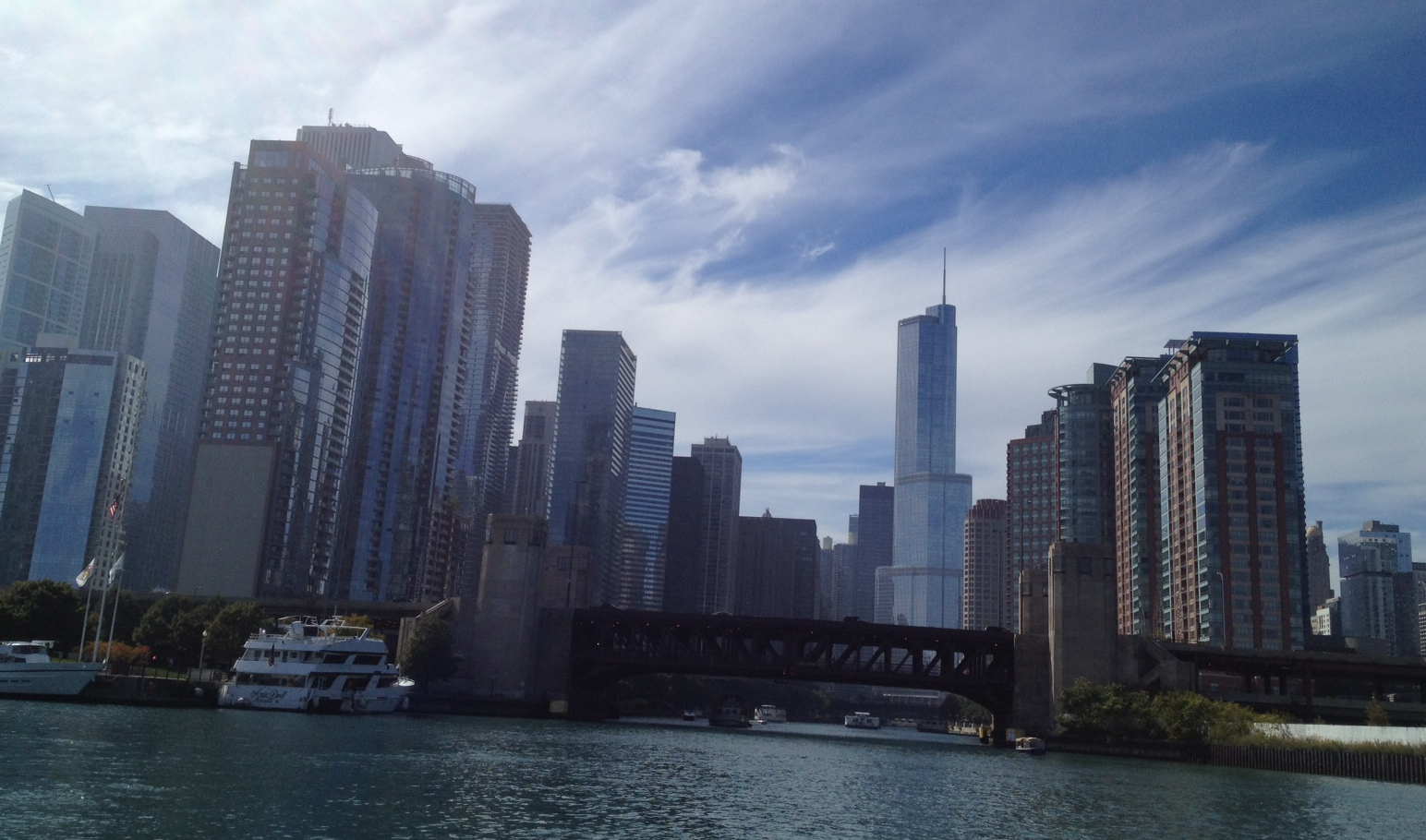
Boat ride, Chicago River (Photo: DY, 2014)
Over the years I have come to especially enjoy short trips to visit friends and family. These brief sojourns often turn out to be pauses that refresh, wonderful little mini-vacations. Such was the case over the weekend with a quick trip to Chicago.
On Friday, however, it appeared that this particular visit might never get off the ground. An unhappy worker allegedly set fire to the Air Traffic Control Center near O’Hare Airport, crippling the nation’s passenger aviation system. After my flight was cancelled, I was able to grab the last seat on the only JetBlue flight going from Boston to Chicago that day, arriving late at night.
By Saturday morning I was at my friends Don and Sharon’s condo in downtown Chicago, enjoying breakfast with them, their youngest son Thomas (a newly minted Eagle Scout — congrats Thomas!), and long-time friends Kathy and Rachelle. Don, Kathy, Rachelle, and I went to college together, including a memorable semester abroad in England, and Sharon has patiently endured our reminiscences for decades.

Sharon treated us to her better-than-gourmet-restaurant Swedish banana pancakes. (Photo: DY, 2014)
Properly fortified, we explored the downtown area, starting with a terrific boat tour on the Chicago River, replete with a very knowledgeable docent who shared stories about the city’s remarkable architecture.

Long-time friends Kathy, Rachelle, Don, and Sharon. (Photo: DY, 2014)
The tour featured lots of memorable vistas. Chicago has long been famous for its architectural history and variety, and over the past few decades its skyline has become truly spectacular.

Wrigley Building, Chicago (Photo: DY, 2014)
After more sightseeing, some shopping, and a lot of healthy walking, we finished our day with a fine dinner at a downtown restaurant.
Sunday started with a short walk around Chicago’s Millennium Park, including a pitstop at the very cool bean sculpture.

Bean sculpture, Millenium Park, Chicago (Photo: DY, 2014)
Our socializing concluded with a visit to a favorite childhood destination, Chicago’s Museum of Science and Industry. I was delighted to see that its famous model train display — my absolute favorite exhibit as a kid — had undergone a thorough upgrade.

Model train exhibit, Museum of Science and Industry, Chicago (Photo: DY, 2014)
And speaking of trains, here’s the real deal, the famous Pioneer Zephyr, which during the 1930s epitomized modern train travel.
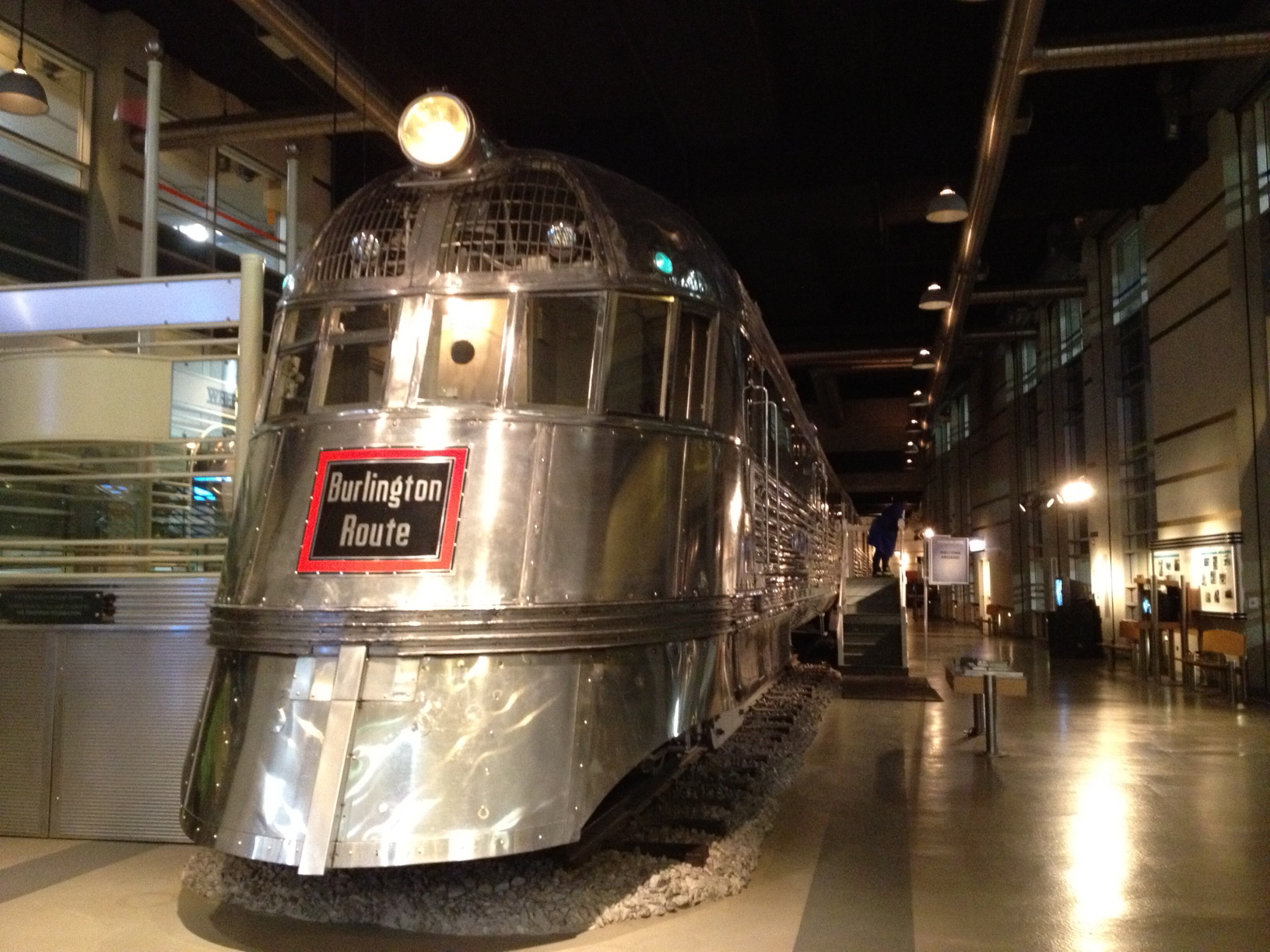
Pioneer Zephyr, Museum of Science and Industry, Chicago (Photo: DY, 2014)
The history geek in me loved checking out the U-505, a German submarine captured by the Americans during the Second World War. There’s an exciting story behind its capture, which you can read about here. The WWII theme of our visit also included a very well done OmniMax film about D-Day.

U-505 submarine, Museum of Science and Industry, Chicago (Photo: DY, 2014)
A side benefit of our museum visit was that I missed the Chicago Bears blowout loss to the Green Bay Packers at nearly Soldier Field. However, later that afternoon, a lot of Bears fans, dressed in their team jerseys, milled about the streets, looking understandably morose.
For dinner, I met up with my brother Jeff, who lives in nearby Glen Ellyn, Illinois, for a deep dish pizza at Medici’s, a popular eatery in Chicago’s Hyde Park neighborhood. Jeff also happens to be a wizard at computers, and he gave me some good advice on how to upgrade my Internet security practices. The pizza was pretty excellent too.

My brother Jeff, polishing off a slice of deep dish pizza at Medici’s in Hyde Park, Chicago (Photo: DY, 2014)
In addition to greatly enjoying the company of my friends and brother, what struck me was the way in which Chicago has become a world-class city, in its very own big and brawny sort of way. When I spent a summer there working for a large law firm in 1984 (here’s the story of that time!), Chicago seemed old and tired. Today, although the city certainly faces its share of challenges, its downtown feels vibrant and alive.
Among American cities, Frank Sinatra performed signature anthems about only two of them, New York and Chicago. Here’s his “Chicago,” as no one else can sing it:
Heaven is a used bookstore

Brattle Book Shop, downtown Boston, exterior (Photo: DY, 2014)
Over the weekend I made an extended pitstop at the Brattle Book Shop in downtown Boston. I was reminded once again how used bookstores have been a place of happy sanctuary to me, going back to my early adult years.
The Brattle, pictured above, is one of America’s oldest bookstores, and it’s one of my favorites. Inside, you’ll find two floors of used books and review copies, plus a top floor of rare books. Outside, at least when the weather is okay, you’ll find shelves and carts of discounted used books, marked at $5, $3, and $1. Lots of the $5 books are quality volumes that would be a boon to many a personal library, and there are plenty of great bargains among the $3 and $1 offerings as well.
The discounted books outside draw me in. The weekend stop, for example, started with a discovery from one of the $3 carts, The World of Charles Dickens (1997), a colorful, illustrated guide to Dickens’ works and times, by London popular historian and Victorian crime expert Martin Fido.
But then I went inside. Uh oh. Let’s just say that the books I found on adult education and on psychology ran up the bill to considerably beyond three dollars. They may have been real “bargains” as measured by their original prices, but they lightened my wallet nevertheless.
Favorite haunts
Especially with the decline of brick & mortar bookshops, I’m delighted and appreciative that Greater Boston still supports used bookstores. In addition to Brattle, Commonwealth Books, Raven Used Books, and the basement level of Harvard Book Store are among the stores that offer plenty of used book treasures.
Elsewhere in the U.S., the Strand in Manhattan, Powell’s in Chicago, and Moe’s in Berkeley are favorite haunts. (Not surprisingly, all are within close proximity of one or more major universities.) During a recent trip to New Orleans, I was delighted to find several used bookstores in the French Quarter. And on those fortunate occasions when I’ve traveled to England, I’ve always been on the lookout for used bookstores.
New York
New York City’s used bookstores hold a special place in my heart. By the time I moved there, its famous “Book Row” on 4th Avenue was no more. But during my years in New York (1982-94), the Strand was a classic, creaky, and vast used bookshop. I visited regularly as a law student, and during my stretch as a perpetually broke Legal Aid lawyer, I would make pilgrimages there on paydays when I felt (very temporarily) flush. The Strand has done some upscale remodeling in recent years and now sells a lot of new titles along with its storehouse of used books. Nonetheless, it remains a standard stop during my New York visits.
Another favorite was the Barnes & Noble Annex on 5th Ave. and 18th Street, across the street from the original B&N flagship store (which recently closed). The Annex was a multi-floored wonder, full of remaindered and heavily discounted new titles and used books. B&N would shutter the Annex sometime after I moved to Boston. I recall that when I discovered it had closed, I felt like a small piece of my New York life was gone too.
Book sale in a tent
The origins of my enjoyment of rummaging through piles of used books trace back to the summer after my first year of college. I was spending the summer at home in northwest Indiana, and my mom had clipped from the Chicago Tribune a small notice about a big used book sale in Wilmette, Illinois.
Later I would learn that the book sale was an annual, week-long fundraising event organized by the Chicagoland chapter of the Brandeis University women’s committee. It was legendary among many bibliophiles across the country, some of whom would rent camping vehicles to drive there and load up on good books for the year.
Anyway, I did the 90-minute drive to check it out. When I arrived, I could scarcely believe my eyes. The sale — offering some 250,000 used books(!) — was held in a huge tent that covered a big stretch of a mall parking lot. I spent just about every bit of spare change I had to my name. I filled several bags of books, and a few days later I would return to buy even more. Though I felt too silly to call it as such, this marked for me the beginning of a personal library.
Apparently some form of this book sale survives to this day. Hopefully others are deriving the same pleasure of visiting it and loading up on great discoveries. Maybe, like me, it will fuel a lifelong devotion.
 Musings of a Gen Joneser
Recent Comments