First-time sojourn across the pond
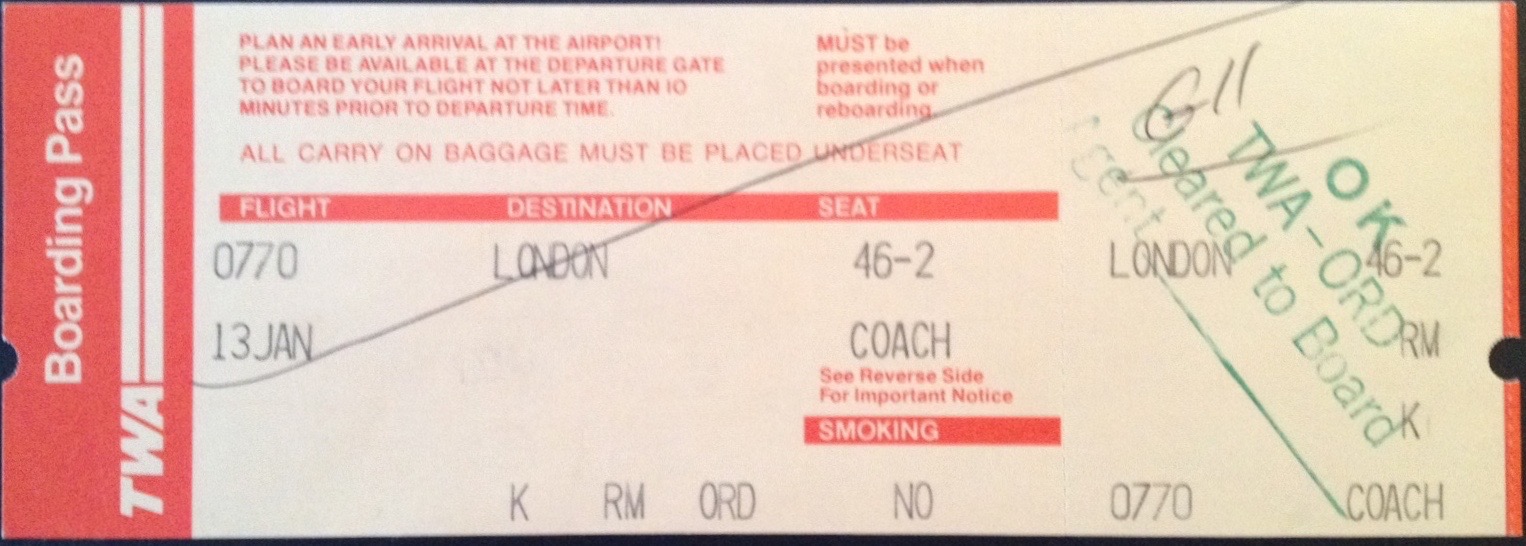
Thirty-five years ago, I joined a group of fellow Valparaiso University students at Chicago’s O’Hare airport, where we would board a TWA flight to London. We were to be the 27th group of VU students to spend a semester at the University’s overseas study centre in Cambridge, England, and the long flight was the first big step of our journey.
We landed in London the next morning and boarded a coach for Cambridge. Later that evening, bleary-eyed but hungry, we would gather for the first of many group dinners, this one featuring American-style pizza at a place called Sweeney Todd’s.

I was embarking on the most formative educational experience of my life. The semester would create enduring memories, new perspectives, and lifelong friendships. The seeds it planted permeate my life today, ranging from the way I live, to my choice of vocation, to how I spend my typical day.
As I have written here before, despite my penchant for nostalgia, there aren’t many times of my life that I’d actually like to relive. But if I could enter a time machine to relive this one, I’d jump in right away and fasten my seatbelt.

Among study abroad offerings, a semester in England spent largely in the company of fellow American students ranks with the gentlest invitations to get beyond one’s comfort zone. Nevertheless, for a young man born and raised in northwest Indiana and not particularly adventurous by nature, those five months away were life changing and world expanding.
Our academic fare was pretty basic, a cluster of survey-type courses in British history, British drama, European geography, and art appreciation designed largely to introduce us to our new surroundings. Group trips, extended weekends, spring break, and the weeks following the end of the semester allowed for travel and exploration. I did a spring break trip through Scotland and Ireland, as well as a brisk three-week, post-semester jaunt through Western Europe (France, Switzerland, Austria, and Germany), traveling alternately with fellow VU students and on my own.
However, I was not a frequent weekend sojourner; I enjoyed the old university city of Cambridge and tended to stay there. When I did travel, London was by far my favorite destination. I felt very much in my element in those two places.

I loved going to movies, plays, bookstores, and lectures in Cambridge. I joined the Cambridge Union Society, a famous debating and cultural activities club run by ambitious University undergraduates, some of whom already had set their sights on election to Parliament! The day I joined, I attended a formal debate on British economic policy. Among the speakers was economist John Kenneth Galbraith, who would become one of my intellectual heroes.

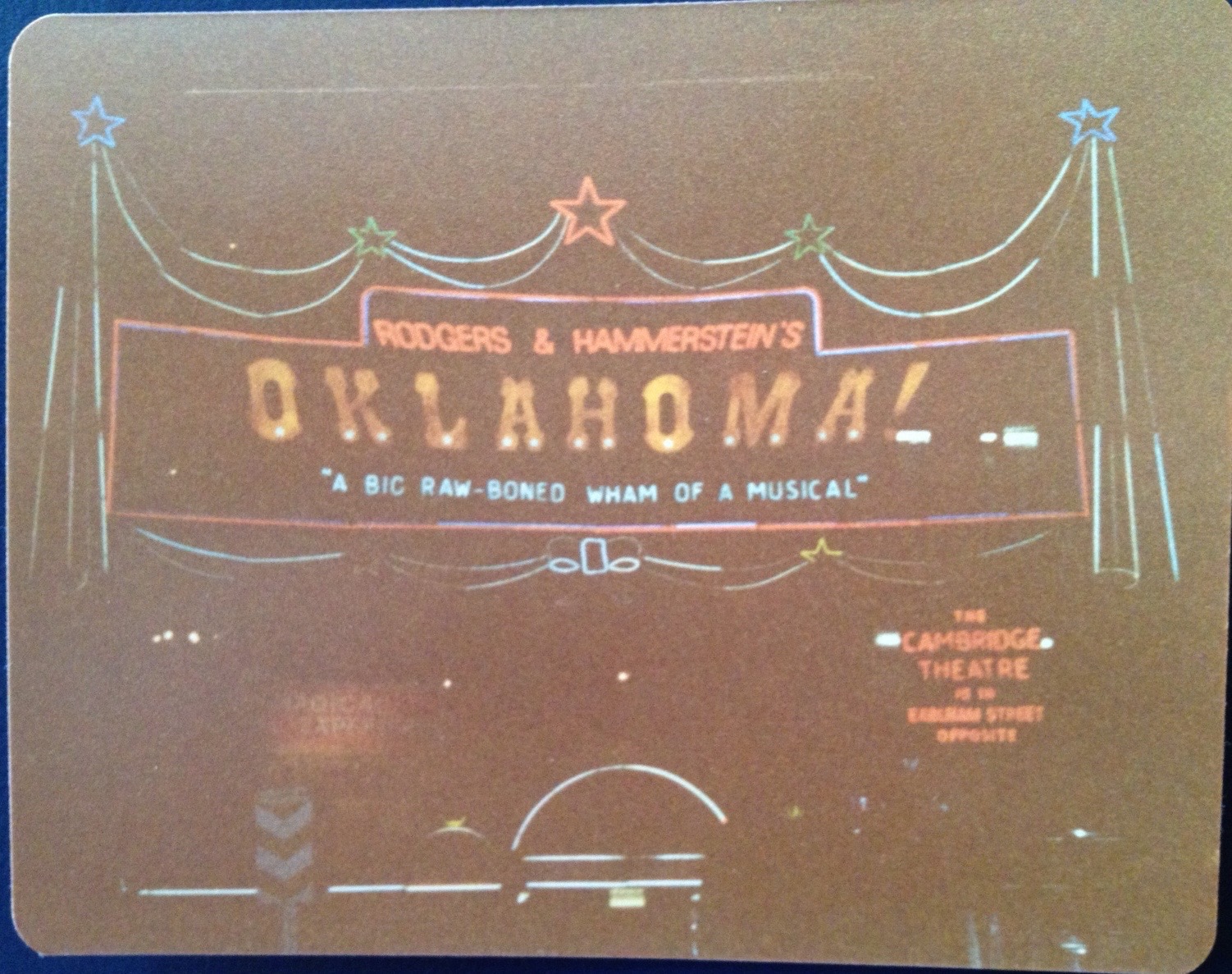
During visits to London, museums and plays were my main focus. Our theatre course required that we write a series of play reviews. It is only fitting, given my parochial outlook, that my first review was of a West End production of “Oklahoma!,” the classic American musical.
Given the personal significance of this experience, one might guess that I had planned to participate in a study abroad program from the time I first stepped on campus. Not so! I signed up mainly because good friends with whom I worked on the campus newspaper were going, and I wanted a change of scenery.
During my interview for admission to the Cambridge semester program, I managed to sling some mildly articulate fertilizer about expanding my intellectual horizons, but truthfully I had no idea what I was talking about. This thin level of cultural depth, matched by a healthy dose of post-adolescent callowness, followed me overseas, where I made most of my plans at the last minute and often tagged along with others who were more informed about what to see and do….

…As in tagged along, went along, or sometimes practically dragged along! On group tours to places like Warwick Castle, York, and Stonehenge, I went because they were on the schedule. During spring break stops in Edinburgh, Loch Lomond, Loch Ness, and other parts of Scotland, I went because five of us rented a car and drove north. (My own choices led to questionable decisions, such as heading over to Belfast, Northern Ireland, during a tumultuous and violent time there.)
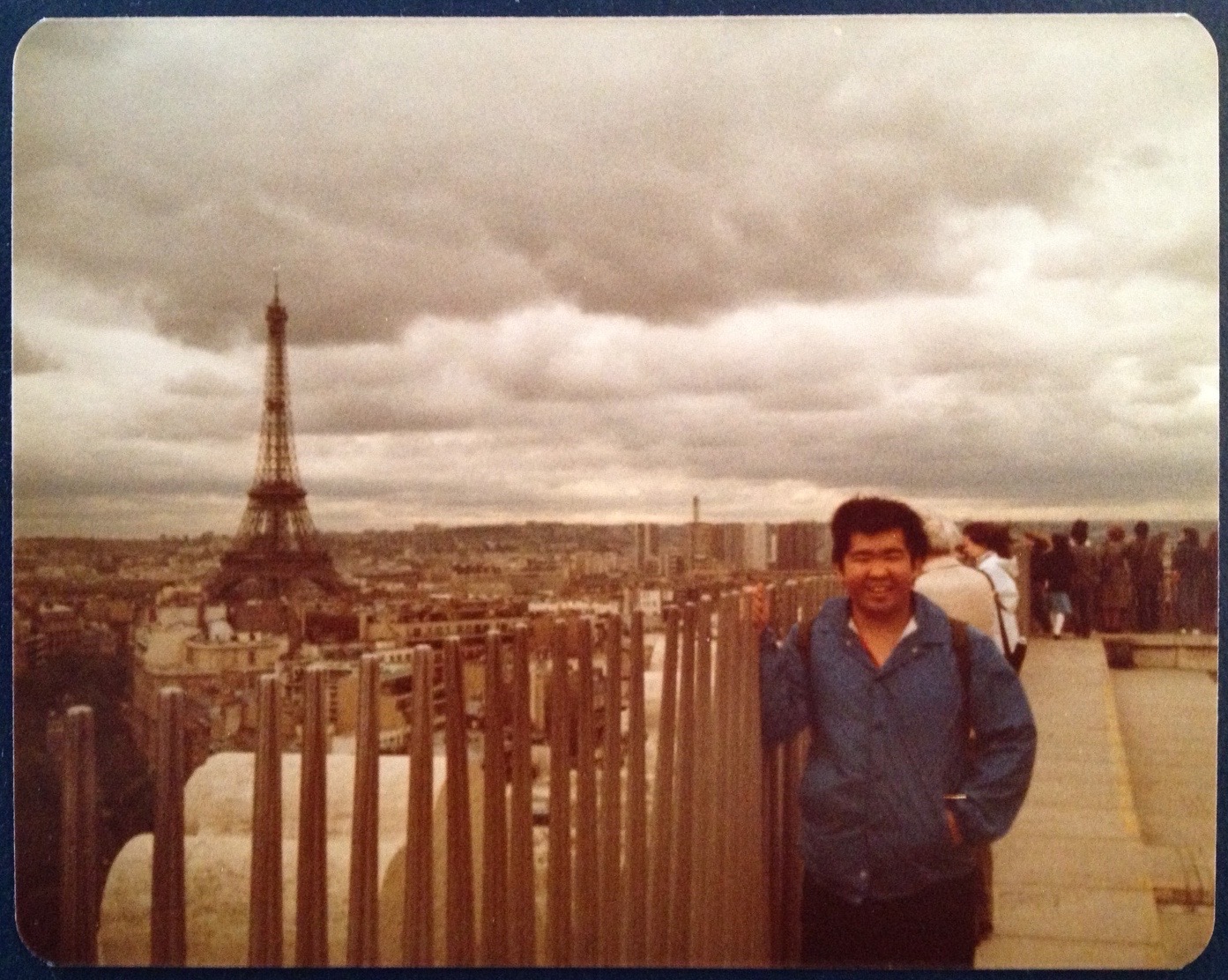
I was hardly more intentional during my post-semester trip to the European continent. I explored the Left Bank of Paris, hiked in the Swiss Alps, and went on “The Sound of Music” guided bus tour in Salzburg mostly because that’s what my friends wanted to do. (I did take a memorable solo trip to Berlin, with the Wall still intact.)
But it all stuck and left deep impressions. I will give my young self credit for understanding this as the semester went on. I knew that I was very, very fortunate to be having that experience.
Of course, I realize that in waxing nostalgic about my semester abroad, I am something of a cliché. The world is full of American collegians who hopped on a plane bound for Europe and returned with a boatload of breathless stories about visits to “amazing,” “incredible,” and “fascinating” sites that, umm, countless millions of others have seen as well.
But I can’t help it. That semester had a fundamental impact on me, and I cannot imagine what my life would be like had the opportunity passed me by. I know that others in our cohort feel the same way, though perhaps with a bit less intensity.
Which leads me to a final, very important point: I had no idea that I would stay in touch with so many people from this group, yet lifetime friendships emerged from our semester together. In fact, every five years we gather for a group reunion, which typically includes sharing many of the same old stories, accompanied by lots of laughter. We’re now planning our next reunion for this summer.
And so, I plead guilty to being among those who look back at such times with great fondness and gratitude. Amazing, incredible, and fascinating, indeed.
The hazards of study abroad

Belfast, Northern Ireland, April 1981 (photo: DY)
The terrorist attacks in Paris last Friday tragically reminded us that when students go abroad, they are not provided with a protective bubble. Among the fatally wounded was Nohemi Gonzalez, a 23-year-old American design student from California State-Long Beach. She was killed in the drive-by gunfire at the La Belle Equipe bistro. News reports tell us that she was an outstanding student, and that the opportunity to study in Paris was a dream come true.
Here in America, we think of study abroad as a wondrous opportunity to explore and learn in a different country. These sentiments are usually spot on. But someone can be in the wrong place at the wrong time, and another may be in harm’s way due to youthful daring or indiscretion.
Nohemi Gonzalez was in the wrong place at the wrong time. She was killed while enjoying a Friday evening with friends over food and drink. She did nothing to provoke what happened to her.
Today Boston.com reported that a young man from Sharon, Massachusetts, Ezra Schwartz, “was one of five people killed in a pair of attacks in Tel Aviv and the West Bank Thursday.” A 2015 high school graduate, he was spending a gap year in Israel. Boston.com further reports:
Police said that a Palestinian man drove by a line of cars sitting in traffic and fired multiple bullets before “intentionally” crashing into a group of people.
. . . Schwartz was on his way back from handing out food to soldiers when he was shot, according to a statement from Camp Yavneh, where Schwartz was a former camper and counselor.
Then there’s the story of Amanda Knox, who was spending an academic year in Italy when she was implicated in the murder of a flatmate, Meredith Kercher. Knox was convicted at trial and spent several years in prison. She ultimately secured an acquittal from the Italian Supreme Court in a case that was riddled with biased proceedings against her and a lack of reliable evidence connecting her to the killing.
My own story of youthful daring stupidity
As for the possibility of a study abroad student taking dumb chances, I can supply a personal story.
During my 1981 semester abroad in England, I spent several days of my spring break in Belfast, Northern Ireland. It was a tumultuous time to be there, for the violence associated with “The Troubles” had escalated mightily. Irish political prisoners were staging well-publicized hunger strikes, and an Irish Republican Army (IRA) leader, Bobby Sands, was among them. (He would die in prison that May.)
I had become interested in the conflict over Northern Ireland, so I figured, what better way to learn more about it than to visit Belfast? After all, I had been an editor of my college newspaper, and so why not be a sort of junior foreign correspondent? Amid bullets flying about or an explosion going off, I would be an observer, not a casualty, right?
I took the photo above as I was walking back to the Belfast youth hostel. Ahead of me was the British army vehicle in the picture. I saw a rush of activity, with soldiers moving quickly, rifles in hand. By the time I reached the vehicle, they were leaning against it, with their weapons pointed across the street. When I asked one of them what was going on, he said tersely, “just keep walking.” I did, briskly. I never learned if anything more significant happened after my hasty exit.
I also would accept an offer from a BBC reporter to take me on a short drive through dicier parts of Belfast where he had conducted some recent interviews with IRA leaders. It was a fascinating impromptu tour, and I would’ve never trekked into those areas of town on my own. But thank goodness he was legit, for this brilliant “foreign correspondent” never thought to ask him for identification.
It all makes for a good story after the fact, but in reality I had taken foolish risks for the sake of feeling adventurous. Such is youthful ignorance.
And so…
What does this mean for a young student pondering whether to see a bit of the world? In light of recent events, I wouldn’t blame students or their parents for reconsidering a decision to study abroad. But someone who passes on such an experience for safety reasons could easily find herself waiting, say, near the finish line of the Boston Marathon. I’m afraid that contemporary life today has this random quality to it.
Appropriate caution and prudence, not absolute isolation and avoidance, should be the governing principles when it comes to study abroad or any other decision that involves stepping outside of our homes. Beyond that, our control over larger events is somewhat limited.
Temporary escapism: NYC teens are discovering “Friends”

New York Times writer Ginia Bellafante reports that New York City teens have discovered the popular 1990s sitcom “Friends.” A big reason for its draw is its portrayal of the relatively carefree lives of its main characters, young Manhattanites Monica, Ross, Rachel, Phoebe, Chandler, and Joey. Bellafante writes:
What’s novel about “Friends,” or what must seem so to a certain subset of New York teenagers of whom so much is expected, is the absence among the six central characters of any quality of corrosive ambition. The show refuses to take professional life or creative aspirations too seriously.
. . . The dreamscape dimension of “Friends” lies in the way schedules are freed up for fun and shenanigans and talking and rehashing, always.
Among Bellafante’s interviewees was a 17-year-old high school girl in Brooklyn who sees “Friends” as a welcomed break from the stressors of school and prepping college applications:
It did not escape her attention that the characters are almost never stressed out about their jobs. “All they do is hang out in a coffee shop or a really nice apartment,” she said. “It’s the ideal situation.”
However, the young woman asked that her name not be used, lest she appear to be frivolous in the eyes of college admissions officers!
It’s wholly understandable why these young strivers might welcome “Friends” as a break from the pressure cooker of jockeying for grades and acceptances from top colleges. But it’s sadly telling that they’re seeking such escapism in a sitcom. One senses the anticipation of an early midlife crisis, grounded in the revelation that the game of obsessive hoop jumping often leads to more of the same, while already yearning for some healthy downtime.
Related post
As the air chills and the days grow short, the semester chugs along
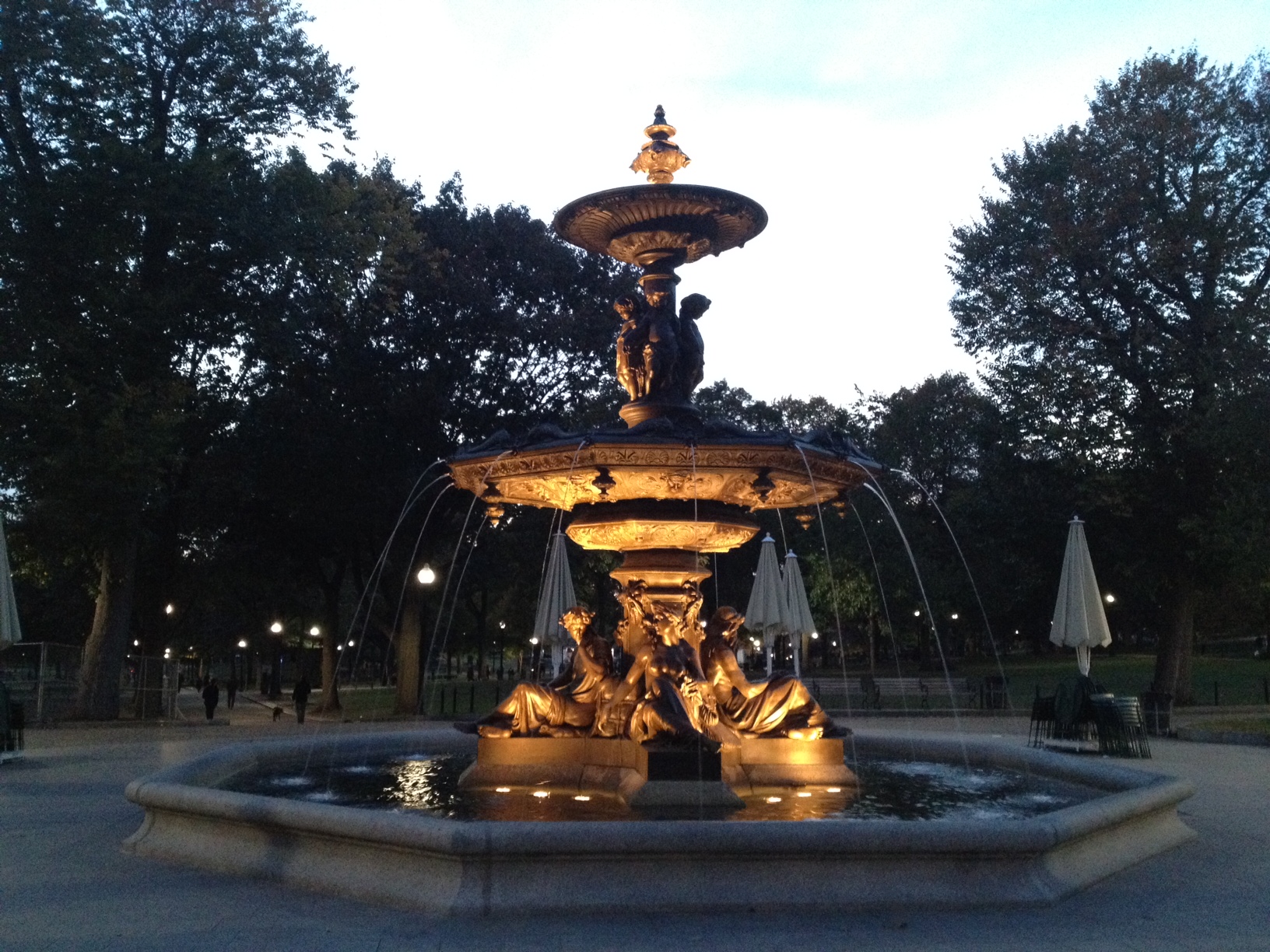
Boston Common, October 2015
As I made tracks to my weekly singing class on Tuesday evening at around 6 p.m., both the chilly air and dusk were part of my brisk walk. I did stop to snap the photo above; I liked the way the lights were playing off the fountain. By the time I got to the adult education center where my singing class is held, it was fairly dark.
At work, the end of October means that the semester is now in full swing. I’ve got a stack of paper drafts and outlines to go through this week, and I’m taking a closer look at my course plans to get a sense of whether I’m on schedule in terms of subject matter coverage.
Many of you took your leave of school calendars some time ago, but those of us still in the business as an educator, administrator, or student know how the rhythms of the semester or quarter define our experience of time. I’ve probably said something along these lines before here, but being an academic is as much a lifestyle as it is a career.
For folks like me, whose lines between work, avocations, and civic involvement easily get blurred, it means that work-life balance is something of an irrelevant concept. A lot of stuff just gets jumbled together. Furthermore, although I work a lot, I am not the most self-disciplined person, which means that something another person might get done during a standard Monday through Friday work week might get pushed into the weekend in my case.
Such is the blessing and curse of a vocation that offers great flexibility in scheduling outside of classes and meetings. I offer this as an observation, not a complaint! I think I am wired to live like an undergraduate, so it’s good that I’ve found a way to earn a living that facilitates this personal quality.
Throwback Thursday: My career as a collegiate journalist
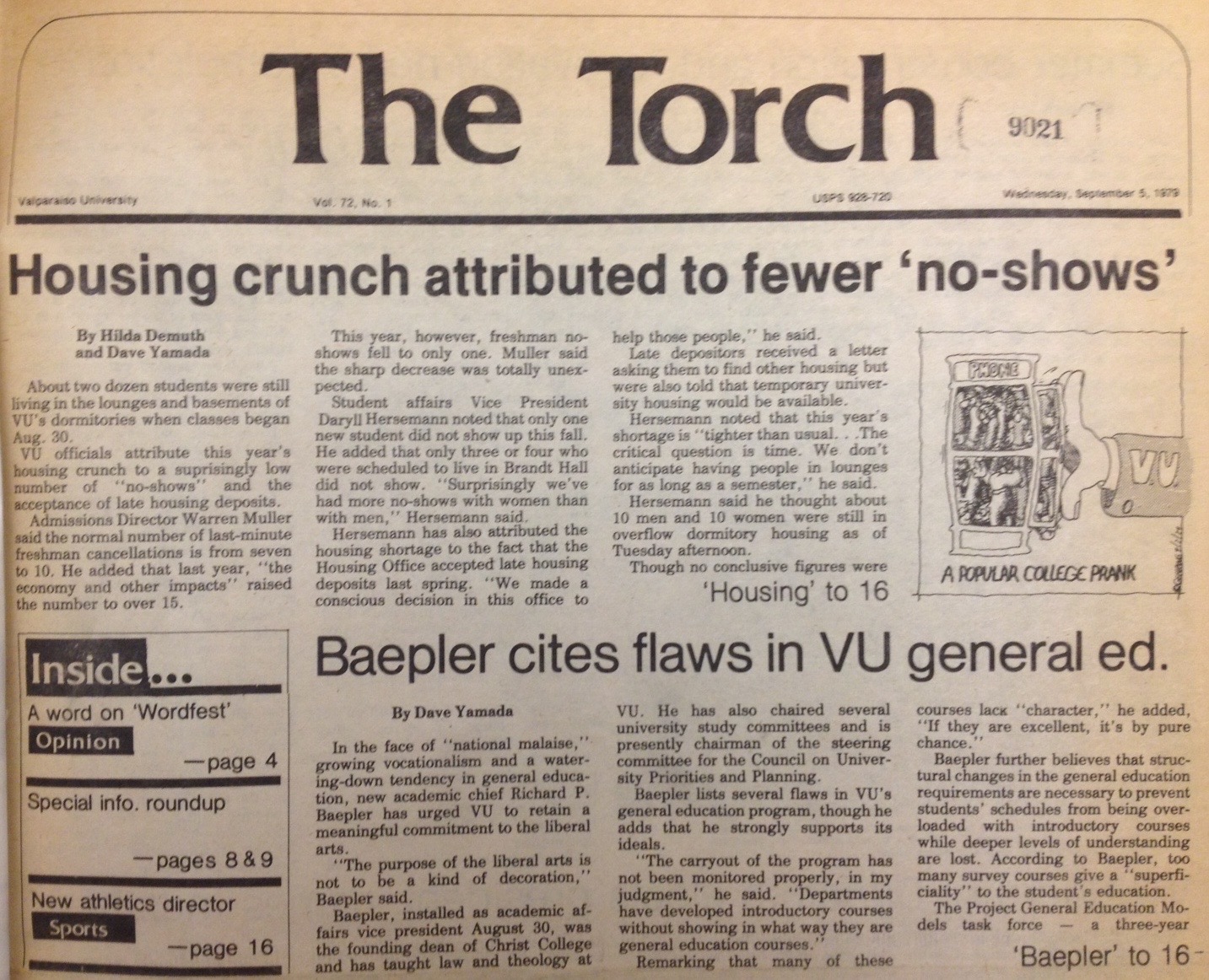
My first-ever published newspaper articles!
Those who ask me about the potential value of extracurricular activities for college students risk being on the receiving end of a verbal serenade about The Torch. Allow me to explain….
My undergraduate alma mater, Valparaiso University in Indiana, recently announced the creation of an online archive of past issues of The Torch, the school’s long-running weekly student newspaper. As a former Torch department editor and reporter (1979-81), the notice catapulted me into a nostalgic state. I even dug out the bound volume from my first year on the paper, photos of which you may peruse here.
I quickly lapse into soggy memories over The Torch because it was the most important extracurricular activity of my college career. The experience of writing and editing articles for publication has paid professional dividends throughout my career, and many of the friendships formed with fellow staffers have endured to this day.

I joined The Torch in my junior year, and I pored myself into working for it. I wrote dozens of articles and columns, mostly on academic affairs topics within the university. I also assigned stories to reporters in my department and edited their work.
It was a heady experience to write pieces for publication with a byline appended. Many members of the VU community read the paper, as our lively letters-to-the-editor section often reflected. (I learned that if you’re going to put your words out there for public consumption, you’d better have or grow a thick skin.)
Some articles demanded special attention to detail, thoroughness, and accuracy. For example, I wrote an investigative piece in which I was able to elicit admissions from campus administrators that a popular political science professor had been denied tenure on grounds beyond the official criteria for tenure evaluation. This meant many hours interviewing university faculty members and deans; our reporting had to be airtight on such an important matter.
I also did a series of articles covering the aftermath of a tragic student-on-student slaying that had racial overtones. Those pieces thrust me well beyond the comfort zone of reporting everyday campus events and activities. For several weeks I was regularly on the phone with sources from police departments, the county prosecutor’s office, and the local hospital, among others.
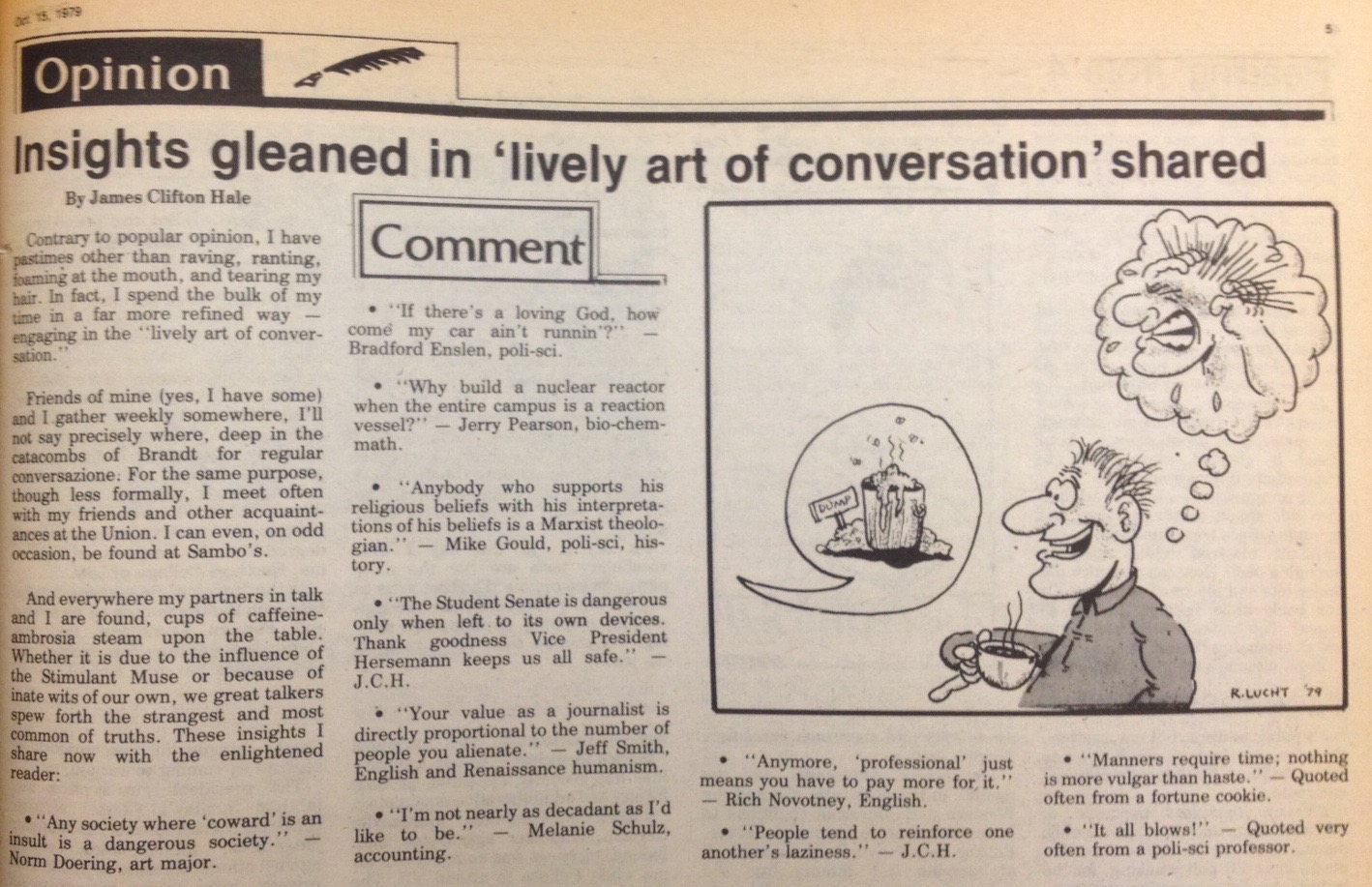
The Torch quickly became the social and intellectual hub that I didn’t previously have at Valparaiso. A former Torch colleague once wrote that it became our own college of sorts, where we wrote and edited our articles and debated issues related to academic and campus life. We spent a lot of time simply hanging out at The Torch offices, even when we didn’t have to be there. Looking back, I now realize that it was an exceptional extracurricular experience.
Our little newspaper was not free of sophomoric writings (some penned by yours truly), and at times we took ourselves too earnestly (ditto). But we produced some quality reporting and thoughtful commentary about collegiate life and academic institutions, as evidenced by multiple awards we earned from the Indiana Collegiate Press Association during those years.

The university’s Greek system was a regular focus for us, and we often took to task the behavioral excesses emerging from fraternity events. This was the age of Animal House, and along with toga parties inspired by the movie came some pretty egregious conduct. In retrospect, it’s clear that we were fully warranted in addressing these issues, many of which anticipated today’s concerns about student conduct at fraternity events.
However, we largely dismissed the positive social bonds facilitated by fraternities and sororities. Our office conversations were laced with regular putdowns of Greek organizations, to the dismay of Torch staffers who belonged to them. At a school with a largely conservative student body that embraced the Greek system, our newspaper was a liberal-ish, independent enclave, sometimes fueled by healthy doses of self-righteousness.

As a group of (mostly) liberal arts majors, we closely reported campus deliberations relating to the place of the social sciences, humanities, and general education in the university curriculum. These topics were frequently invoked in editorials and opinion columns as well. The more callow among us were guided by the work of three senior editors with strong intellectual orientations. Many of us were unaware that we were participating in an emerging national debate on the value of instruction in the liberal arts, but this troika was already marking academic trends by reading The Chronicle of Higher Education.
Only a handful of Torch staffers would build careers in journalism. One of them, Jim Hale (author of the “Insights gleaned” column pictured above), is currently a reporter for the Gettysburg Times in Pennsylvania. Previously Jim was a writer for the Gettysburg College communications office and a reporter for the Chesterton Tribune in Indiana.

As for me, I did some part-time reporting for a couple of local newspapers in northwest Indiana, and later I served as an editor of the law school newspaper at New York University. Though I did not pursue a journalism career, The Torch served as an ongoing tutorial on the importance of tight, clear, well organized writing. In terms of aspirations, at least, these qualities have manifested themselves in virtually everything I write: Scholarly articles, essays, reports, op-ed pieces, and, yes, blog posts.
In fact, I know that my affinity for the blogging medium traces back to my days at The Torch. Writing this blog is an engaging pastime for me, like being a newspaper columnist, albeit with a much smaller readership! Writing my professional blog, Minding the Workplace, requires more analytical smarts, but it, too, has roots in my collegiate newspaper experience.
The old chestnut about understanding your present by comprehending your past certainly applies here. I did not have an academic career in mind when I was a collegian. My intention was to go to law school and eventually to start a career in politics. (I also was active in student government and in political campaigns as a college student.) However, as I flipped through the pages of The Torch, I understood how reporting on the ups and downs of academe planted seeds that keep sprouting in my life today.
Equally important, I remain good friends with everyone whose byline appears in these photographs, as well as others who were part of the mix. Our paths cross regularly through periodic get-togethers, e-mails, phone calls, and social media. Many of these friendships have matured and deepened over the years. This only reinforces my belief that something good was happening at that campus newspaper office some 35 years ago.
***
Portions of this post were adapted from a previous piece on the importance of extracurricular activities, written for Minding the Workplace.
Geek fantasy: Doing college all over again, but only on terms that defy reality

“Umm, professor, you’re expecting me to actually read these?” (Photo: DY, 2013)
On Facebook yesterday, one of my long-time college friends posted a photo of her son’s residence hall room. She added that this made her want to go back to college, which prompted a short chorus of me too‘s from several of us who went to school together, including yours truly.
Yup, for geeky types like me, it’s a midlife fantasy: Going back to school again.
For me, the wished-for do-over has a high maintenance quality, as it comes with at least ten conditions:
- I don’t want any required classes.
- I only want to write papers that I want to write.
- I don’t want any in-class exams; this should be a minimal stress experience.
- I’ll pass on any classes before 10 a.m. as well.
- I want to do college over again with my current gifts of wisdom and hindsight.
- I’d like to have a bit more money than the first time around, but without taking on more student loans, as I spent almost 20 years paying off the first batch.
- I’ll pass on the immaturity, angst, anxiety, and insecurity that characterized my first go-around of college.
- I want to do another semester abroad in England with the exact same group I was a part of in 1981.
- I want my own dorm room with a bathroom, thank you.
- I want extracurricular and co-curricular activities to count for credit.
Basically, I’d love to luxuriate in the life of being a student — thinking big thoughts, taking part in extracurricular activities, reading and watching what I want when I want, going to movies, sporting events, and cultural activities, and enjoying the company of fellow students.
Alright, some of you in the Peanut Gallery may be chuckling that I basically have this life as a professor! Well, although I appreciate very much the opportunities and flexibility provided by academic life, a carefree sense is not always among its main qualities. Even for tenured profs, academic life balances its genuine blessings against its share of anxieties, pettiness, and bureaucratic cluelessness.
In any event, there’s a much bigger picture here. Why don’t we have more opportunities for adults to do the kind of reflective, life-enhancing learning that is afforded to some folks during their earlier years? You know the phrase, it’s a shame that college is wasted on the young? It does have some truth in it. Great books and important ideas passed over at age 20 may have real meaning to the same person at age 50.
In Modern Man in Search of a Soul (1933), psychologist Carl Jung asked, “Or are there perhaps colleges for forty-year-olds which prepare them for their coming life and its demands as the ordinary colleges introduce our young people to a knowledge of the world and of life?” He answered:
No, there are none. Thoroughly unprepared we take the step into the afternoon of life; worse still, we take this step with the false presupposition that our truths and ideals will serve us hitherto. But we cannot live the afternoon of life according to the programme of life’s morning – for what was great in the morning will be little at evening, and what in the morning was true will at evening have become a lie. I have given psychological treatment to too many people of advancing years, and have looked too often into the secret chambers of their souls, not to be moved by this fundamental truth.
For what it’s worth, I think that we, as a society, have a lot of hard thinking to do about the world we want to see during the coming decades. This will include assessing the role of lifelong learning.
Going to college under the utopian conditions as I have stipulated above is darn near impossible for most, but the world we choose to create could be enriched by adult education opportunities for virtually everyone, and mostly inexpensive ones at that. This could include nurturing the development of adult education centers; fostering informal, collaborative learning such as discussion groups, book clubs, and movie nights; creating alternative universities; and supporting public library systems.
In other words, a world that allows adults to embrace the life of the mind, to engage in cultural activities, and to share compelling ideas with others is utterly possible.
Through it all, my baseline request stays the same: Please don’t schedule any of the good classes before 10 a.m., okay?
A quick visit to Hyde Park, Chicago

Yours truly in Hyde Park (Photo by Sharon Franklin Driscoll, 2012)
During my recent visit to Northwest Indiana, I made a quick side trip to the Hyde Park section of Chicago, largely to browse through some of the bookstores near the University of Chicago.
As venerable universities go, U of C isn’t that old, having first appeared on the scene in 1892. However, its founders wanted to create an immediate impression that this was a place for serious study and research. That goal was partially expressed in buildings that, according to the University’s online history page, “copied the English Gothic style of architecture, complete with towers, spires, cloisters, and gargoyles.”
In other words, Chicago wanted to look more like Cambridge and Oxford, not Harvard and Yale.
And you know something, they pulled it off. Hyde Park has some of the most awesome architecture of any American university neighborhood. While the U of C has some edifice flops from the 60s and 70s (as do Cambridge and Oxford), the overall look and feel of the area is learned, old, and quiet — a sharp contrast to many other parts of brawny Chicago.
The previous site of the Seminary Co-op Bookstore, since moved to roomier digs, is a perfect example. A few years ago I met up with my long-time friends the Driscoll family for a Hyde Park visit, and the bookstore was a primary reason for our gathering there. Sharon Driscoll, who is quite the amateur photographer, took the photo of me above in the Co-op building. It looks like I traveled back in time — and fortunately, my backpack made it there with me!
As for the University of Chicago, even in this era of growing vocationalism in higher education, it has managed to maintain its serious devotion to ideas. I’m sure it has made compromises to incorporate more career preparation, but it still remains a place where learning and scholarship are valued for their own sake. That is an increasing luxury in higher ed today.
“Welcome to first-year orientation” (Gulp)
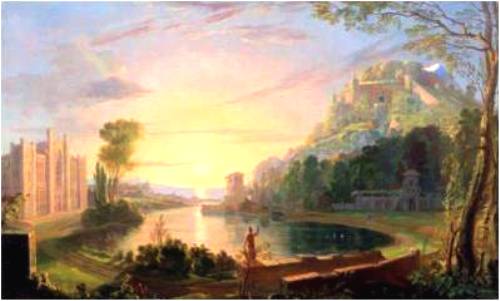
Samuel Morse’s allegorical landscape picturing the university as paradise, placing NYU’s original Gothic style building at left (1835-36)
For many educators, mid-August brings a sort of foreboding: Uh oh, school is starting up again very soon. The endless summer is coming to an end.
Now, this may sound odd coming from someone who enjoys teaching and is grateful for the opportunity to make a living as a professor. But yes, I feel this way, too.
I trace this anxious rumble in my belly to memories of first-year orientations as a college and law student many years ago. I suppose they planted the seeds for how I regard the beginning of an academic year.
Let me go back to August 1977, first-year orientation at Valparaiso University in northwest Indiana. Valpo, as it is colloquially known, was only a 45-minute drive from my parents’ home in Hammond, Indiana. But I was quite unworldly at that early juncture of my life, so that distance felt like a million miles away during those first few days (and the weeks to follow).
In terms of events, I hazily remember a bunch of meetings big and small, a large-group assembly or two, and some type of cookout. VU’s orientation program neither eased nor stirred my anxieties. However, the status quo was about as much as I could’ve asked of it, given my constricted comfort zone. It would take another two years for me to find my social and extracurricular groove at Valparaiso, mainly via my joining the staff of the campus newspaper and eventually spending my final semester in England. A good number of lifetime friendships were forged during those years.
Now let’s quickly jump to August 1982 and law school orientation at New York University. Outwardly I tried to maintain a friendly and upbeat demeanor, but privately I wondered if I was in over my head. I had moved from Indiana to the heart of Manhattan. Lots of my new classmates had gone to elite colleges. Many had done fancy internships. When a fellow 1L mentioned that he had spent the previous year working as an assistant at the U.S. Supreme Court, I decided not to offer that during the same time I was working as a stock clerk at a retail drugstore.
NYU’s law school orientation was the usual mix of welcoming speeches, panel discussions, intro classes, and receptions, but the content and people were such that I came out of it mildly reassured that I would (1) survive law school; and (2) have some good job opportunities at the finish. I was also pleasantly surprised that so many of my super-talented classmates were genuinely nice people, and I started making friends very easily. Overall I had the strong vibe that this was the right place for me, which turned out to be true.
Academic orientation programs are organized with the very best of intentions, and often they convey important information that can set the stage for the remainder of a student’s degree program. As to whether they soothe or stoke individual anxieties, well, that’s a crapshoot. I think it depends more on the specific student than on the content of the program!
Someday, when I’m in an even more nostalgic mode than is my usual state, I’ll have to sift through the memory bank to recall other orientation-type programs during different chapters of my academic and professional lives. Maybe I’ll find some similarities and connections between my reactions to them.
Throwback Thursday: Vienna waits for me

Prater Wheel, Vienna (Photo: DY, 1981)
On Thursday evening, I’ll be hopping on a plane for Vienna, Austria, for the biennial International Congress of Law and Mental Health, a week-long event that draws some 1,000 people from around the world. I’ll be presenting a paper on continuing legal education, attending plenty of panels, and enjoying the company of friends and colleagues who are immersed in research and practice related to law and psychology.
Traveling to Vienna pushes my nostalgia buttons. In May 1981, it was a stop on a brisk trip through parts of western Europe, following completion of a semester abroad in England via my college, Valparaiso University. The grainy photo above was taken from the famous Prater Wheel, a giant Ferris wheel built in 1897. If I recall correctly, I spent three days in Vienna with one of my traveling pals from the VU group.
That European jaunt was one of the most memorable experiences of my life. Traveling alternately on my own and with members of our group, I visited Paris; several towns in Switzerland; Innsbruck, Salzberg, and Vienna; and finally Munich and Berlin.
The semester abroad also happened to be the final term of my senior year, and I was full of excitement and uncertainty as to what would come next. But even with all of my heady aspirations for the road ahead, I had the good sense to drink in a lot of this overseas opportunity. Although my cultural immaturity caused me to pass on some pretty significant sights during this sojourn abroad, those five months made a lifelong imprint on me.
Back to today: As usual, I find myself packing and planning at the last minute. However, I know that I’ll get a lot out of this trip. I’ll do so as a much more grounded person than the anxious young man who first saw Vienna several decades ago. The march of time brings its blessings.
***
As a little sidebar to this post, click and enjoy Billy Joel’s “Vienna” (1977). And to learn how the famous singer/songwriter did his homework about Vienna in writing this number, check out this interesting Wikipedia entry.
As summer approaches, winter has given way to spring in Boston

Boston Common (photo: DY)
The brutal winter that we experienced here in Boston has finally given way to more civilized weather, even if piles of snow collected during January and February and deposited in designated snow removal areas have not fully melted.
Summer beckons, even though the temperature here remains very cool and spring-like. I’m not complaining — I can live with spring and fall weather very happily, thank you. But especially now that my classes are done and I’m finished grading exams and papers, I sort of expect it to be warmer.
Nevertheless, the cool, nice weather has made it comfortable to walk around a bit and take a few snapshots, which I’m happy to share with you.
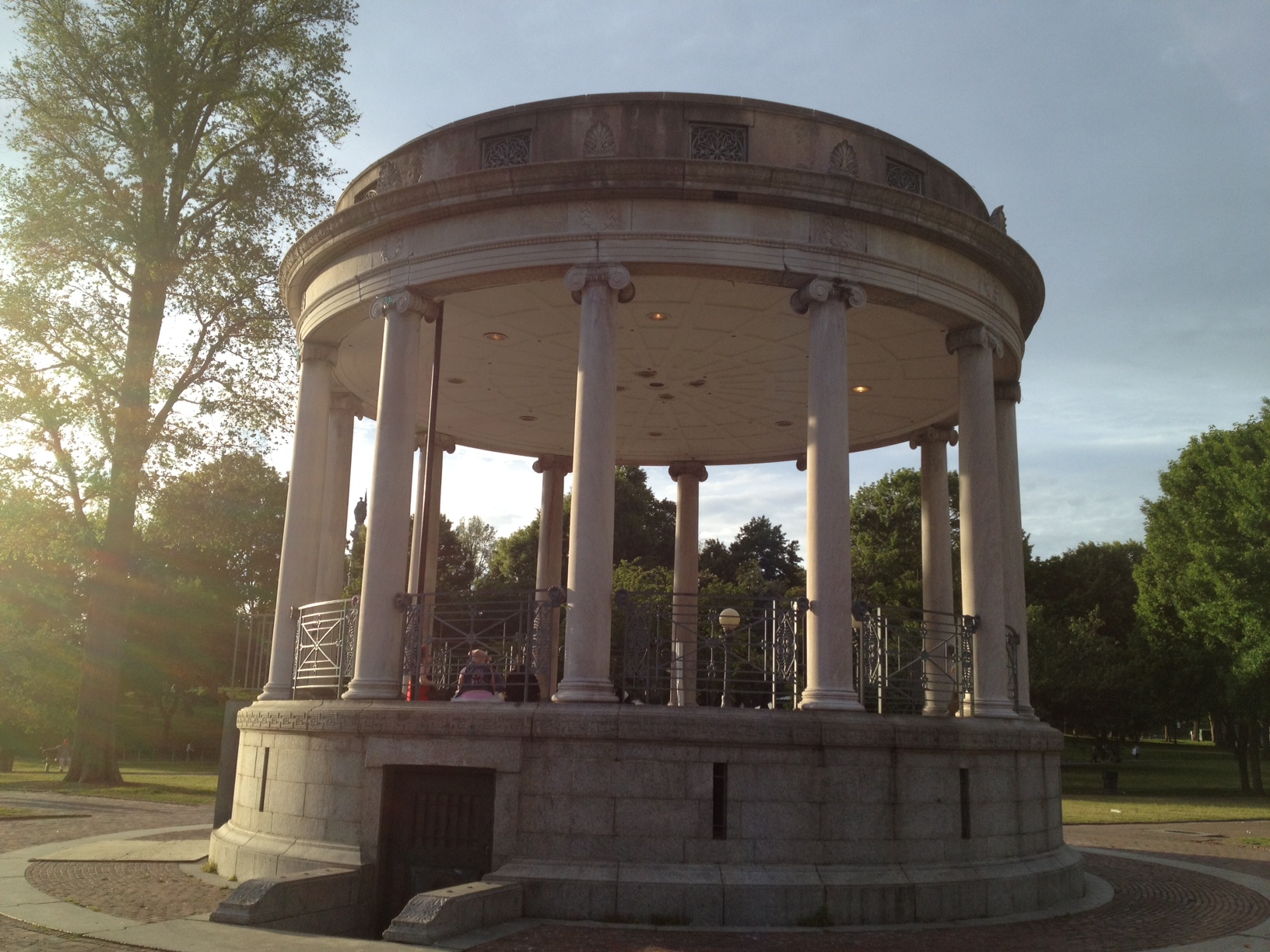
Boston Common (photo: DY)
This time of year triggers bouts of nostalgia for me. Thirty years ago, I graduated from NYU School of Law and began studying for the New York bar exam, a fun little ordeal I wrote about last year.
I had already accepted a position with New York City Legal Aid Society, fulfilling my wish to work as a public interest lawyer. First, however, I had to get through the summer bar study. I managed do to so, but not without feeling sorry for myself an awful lot of that time. In particular, as I wrestled with studying for the exam itself, I badly missed many of my best friends from law school, who took their talents across the country to start their legal careers.

Boston Common (photo: DY)
My previous law school summers were memorable. I spent the summer after my second year working as a summer associate at a large corporate law firm in Chicago, an experience I wrote about in a post last year. It taught me a lesson that I share with many of my students: Sometimes experiences that help you eliminate options are as valuable as those that help you to create choices.
I spent the summer after my first year working at the New Jersey Public Defender’s office, while living in one of the NYU law dorms. Heh, one of the things I remember most about that summer was the opening of Steve’s Ice Cream in the Village. Steve’s was a Boston ice cream brand that popularized the practice of toppings hand mixed into your chosen flavor of ice cream. I was making the princely minimum wage that summer, and a chunk of those meager earnings went to Steve’s.

Robert Gould Shaw Memorial, Boston Common, which calls out the Civil War story told in the movie “Glory” (Photo: DY)
Thirty-five years ago, I had finished my junior year at Valparaiso University. I spent a lot of time serving in a key Indiana volunteer role for the independent Presidential campaign of John B. Anderson, which I wrote about here last June. I also studied hard for the Law School Admissions Test, which I took that summer.
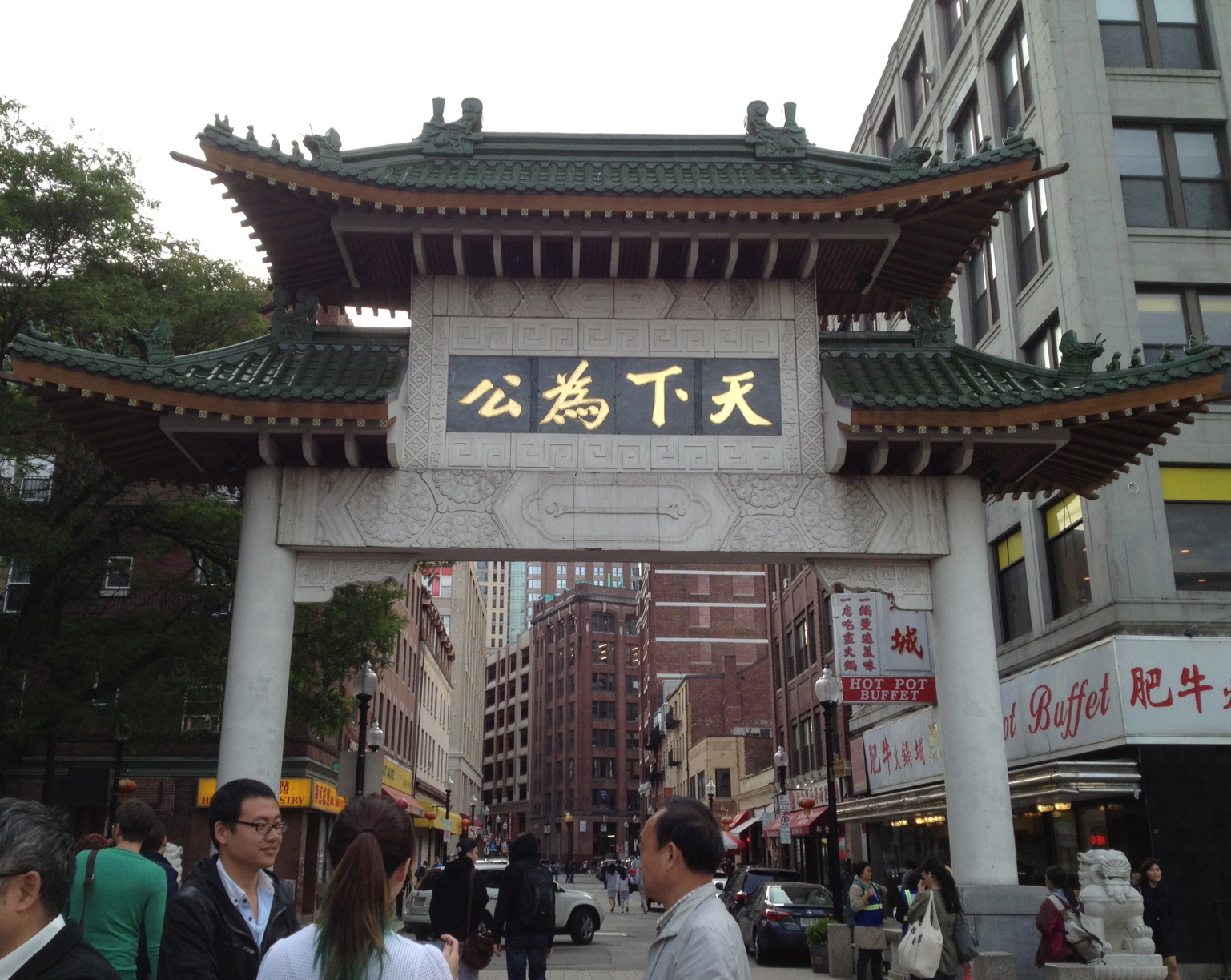
In case you need a marker, you’re entering Chinatown, Boston (Photo: DY)
A few weeks after taking the LSAT, I would learn that I did well enough to have some attractive options for law school. Originally I had every intention of attending law school on the west coast, but NYU was too appealing to turn down.

Cream puffs to die for in Chinatown, Boston (Photo: DY)
Since becoming a professor, most summers have been devoted in large part to various research and writing projects typically leading to the publication of articles in scholarly law journals. During the summer of 1998, for example, I did a lot of the spadework on my first article examining the legal and policy implications of workplace bullying, eventually published in 2000. It would prove to be a groundbreaking piece that helped to plant the seeds for a movement to enact workplace anti-bullying laws.
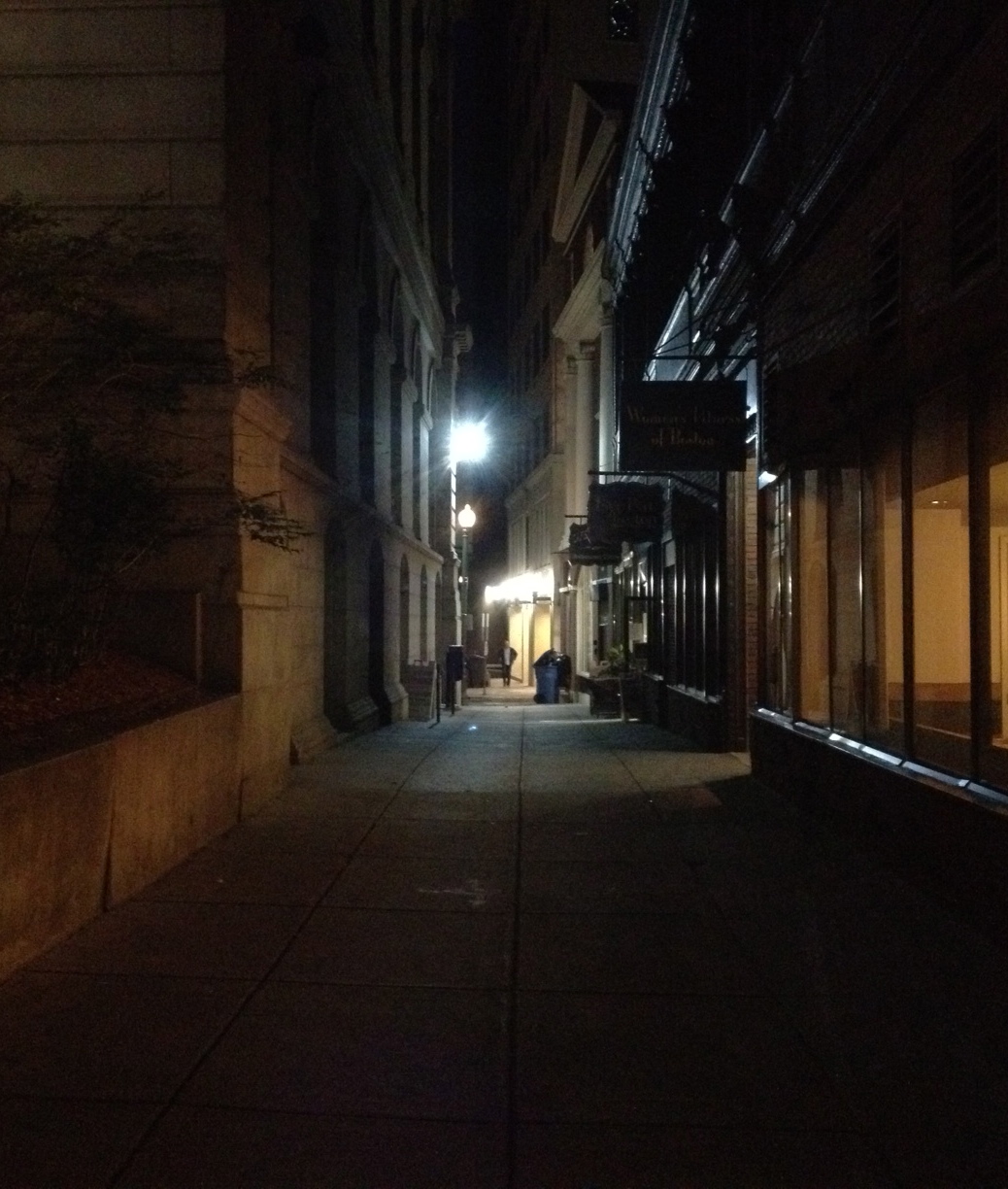
At night, this corridor in Downtown Crossing, Boston, looks like a step back in time (Photo: DY)
This summer I’ve been finishing up a piece on legal scholarship and “intellectual activism,” the latter being a term that I use to describe the process of engaging in research and analysis of a significant legal problem, designing proposed law reform and public policy responses, and then going into a more public mode with those proposals. It harnesses many of the experiences I’ve had and lessons I’ve learned over the past twenty or so years.
Of course, I also am grateful for the flexibility my job affords me to spend the summer working on a largely self-defined schedule. That very flexibility allows me the time to step out the door and take a few photos of this walkable city.
 Musings of a Gen Joneser
Recent Comments