A nostalgic traveler’s dilemma: Explore new vistas or retrace old steps?
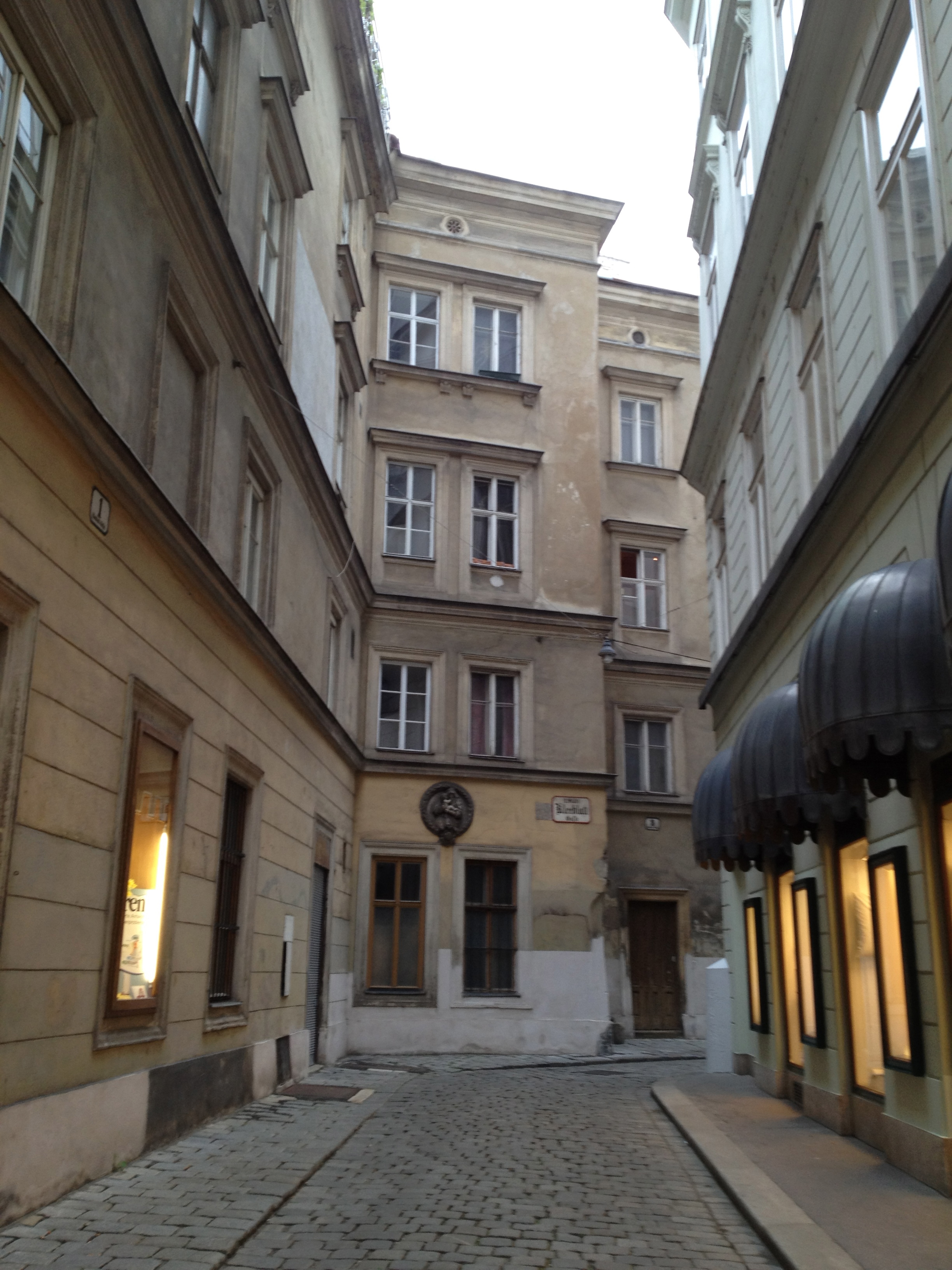
Vienna, Austria: I love turning a corner and finding an old city street
Travelers who suffer from chronic bouts of nostalgia (i.e., me) may face a familiar dilemma: Given a choice, do we explore new vistas or revisit old haunts? Do we step out in search of fresh discoveries, or do we retrace steps from back in the day?
When I booked my July trip to Vienna to attend the week-long International Congress on Law and Mental Health, I added a few days after the conference to do some sightseeing. I assumed that I would spend that extra time outside of the city.

The gardens of Schonbrunn Palace, Vienna
My first and only previous visit to Austria occurred way back in 1981. Vienna, Salzburg, and Innsbruck were part of my whirlwind tour through western Europe after a semester abroad in England.
Of those cities, Salzburg — small, manageable, and with spectacular scenery — was by far my favorite. I even enjoyed “The Sound of Music” bus tour that my friend dragged me on, for it included many of the city’s most beautiful sites. By contrast, while I liked Vienna, it didn’t rank as a highlight of that leg of my sojourn.
So when I planned this current trip, I figured that I would squeeze in a quick visit to Salzburg during my add-on days. Hey, maybe I’d even join the hordes of other American tourists for a redux of “The Sound of Music” tour!
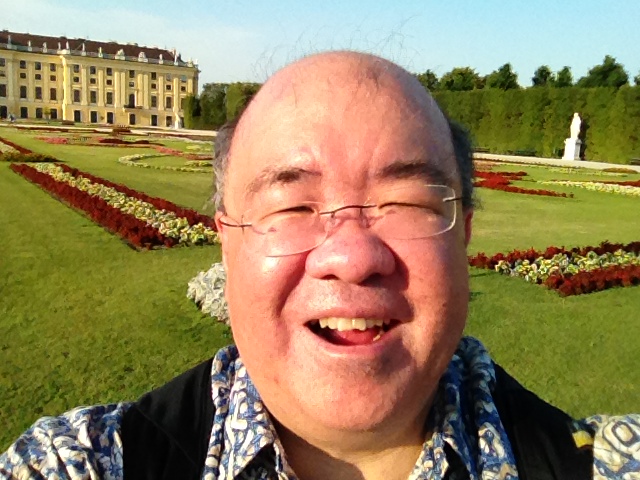
A Schonbrunn Palace grounds selfie
Ultimately, however, I decided to stick to Vienna. To my great delight, Vienna came alive for me this time around. I now understand why it is such a global attraction. The heart of Vienna is simply beautiful, with stunning architecture, public sculptures, and old city streets seemingly at every turn. The city also offers relatively inexpensive eateries and cafes serving up hearty food and beverages.

Hearty (if not healthy) dinner of schnitzel, fries, and salad at a cafe near my hotel
Vienna exudes a sense of cultural and intellectual history. Given that I was attending a law and mental health conference, I considered it semi-obligatory to visit the Sigmund Freud residence and museum. Although little of the original interior decor remains, there were plenty of exhibits and photographs to give you a sense of where he lived and practiced during the early 20th century.

The stairwell leading to Dr. Sigmund Freud’s practice and family residence
An exhibit at the University of Vienna presented an unexpected opportunity to roam around the main building of one of Europe’s oldest universities, founded in 1365! For an urban campus, it was a notably serene academic setting.

Courtyard of the Main Building of the University of Vienna
When I first visited Europe in 1981, I had no idea that many wonderful singers and musicians demonstrated their talents on the streets of great cities.
Since then, I have been drawn to street performers. At first glance, I wondered if this man, with his walking stick, bucket, and visual impairment, was panhandling. But then he turned on his little music player and started to sing…wow…his voice was superb. It was a privilege to tip him a few Euros.
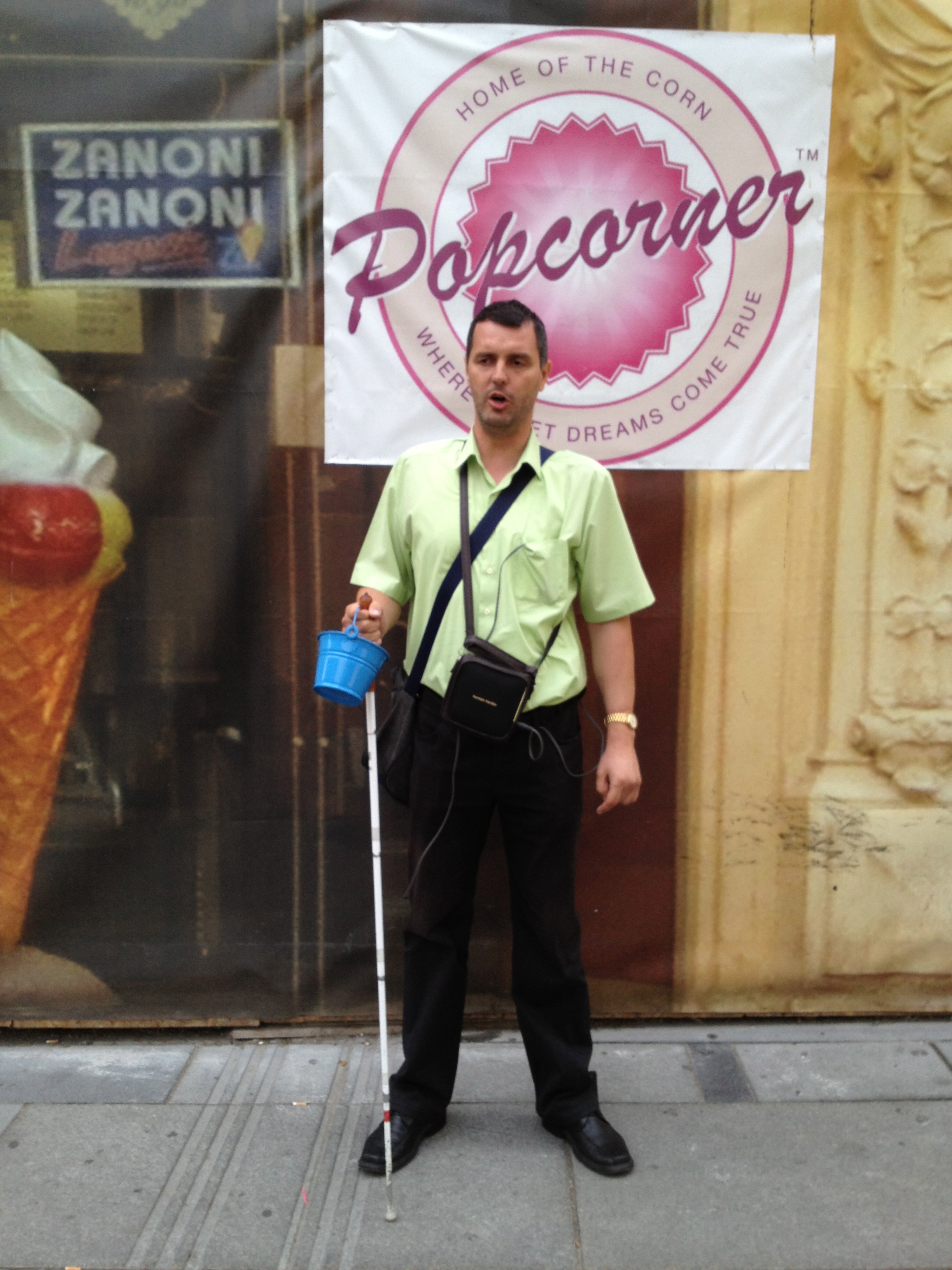
A great singer in one of the city squares
Of course, I also had to hunt down the city’s English language bookstore, Shakespeare and Company, tucked away in a nook of old Vienna that felt like a step back in time.

In the heart of old Vienna is this neat little bookshop
Thanks in part to the conference itself, I experienced a bit of Vienna’s classical music scene. Here are three of my friends and fellow conference participants, Shelley, Carol, and Nicole, in the pews of St. Stephen’s Cathedral, as we awaited the start of a classical music concert organized for our group by the International Academy on Law and Mental Health.

Warm smiles for the camera before the concert begins
And here’s what that stunning cathedral looks like. Listening to a first-rate music performance in such a historic site was a treat.

Inside St. Stephen’s Cathedral
The unsung star of Vienna was its subway system, which proved to be dependable, fast, and easy to navigate. In visiting a big city, I usually find that learning the basics of its subway system early on pays dividends throughout the trip. This was no exception!

Vienna’s U-Bahn system was fast and reliable
Throwback Thursday: High school football benchwarmer

I’m in this photo, the very tanned kid with black hair in the 5th row.
Some forty Augusts ago, I was sweating it out on a blazing hot northwest Indiana practice field, along with 60 or so other guys who wanted to play football. Yes folks, despite my lack of physical prowess and athletic talent, I was on my high school football team for several years.
The caption of the team photo above is a bit misleading. Any sophomore, junior, or senior who tried out for football and survived the grueling two-a-day August practice sessions was on the “varsity.” However, my role was to be practice fodder — a member of what today is called the “scout team” — helping to prepare the starting players and top reserves for the Friday night games. I would get to play in the Saturday morning junior varsity games, and occasionally at the tail end of varsity games when the result was quite settled.
Given that I wasn’t very big, you’d think that my “natural” position was running back and/or defensive back. However, my blinding lack of speed and quickness made that problematic, so the coaches put me on the line. Yup, I was a 150 lb. center, guard, and nose tackle. This was largely for practice purposes only, because unless the phalanx of guys ahead of me on the depth chart all suddenly got sick, hurt, suspended, or quit the team, no one needed to be concerned that I’d be in the lineup during key moments of a game.
At some point I smartened up and realized that this was not the most best use of my extracurricular time. I would get involved in activities such as student government, which proved to be a better match for me.
But looking back, I know the experience of high school football toughened me up in valuable ways. Lining up in practice every day against bigger, stronger, faster players, and getting up when you’re knocked down, may not be fun, but you learn that you can get up and be ready to go again. Plus, I liked being on the team. It planted the seeds for being a lifetime football fan.
Fortunately, my eventual absence from the team was not felt acutely. As one of my former teammates told me, “Dave, we missed you in football this year but managed to suck without you.”
Wanna run for President? You can!

In a piece for the Boston Globe (registration may be necessary), Astead W. Herndon reports that over 500 individuals have registered with the Federal Election Commission (FEC) as Presidential candidates. You see, while it may take lots of political clout and mega-millions in campaign monies to get elected President, it basically requires filing the required FEC paperwork in order to be a candidate. It sounds easier than filing your taxes!
Of course, there’s more to it than that if you actually want to get votes, even those of friends and family. States have their own petition requirements and filing fees to get your name on the ballot, and to do that you’ll need campaign cash, connections, and a host of volunteers.
But if you’re just looking for a personal platform, you can register with the FEC, declare yourself a candidate, and rely on our Digital Age, low-cost options to start campaigning. For example, Herndon reports that one fringe candidate is running his campaign with “a website, a Facebook public figure page, and a similar profile on LinkedIn.”
I first became aware of the plethora of unknown Presidential aspirants back in college, when one of my political science professors shared with me some campaign brochures that he had collected from fringe candidates. I sent away for more, and eventually I wrote a piece on these indie wannabes for my college newspaper. A few were known quantities who had long ago faded into the political woodworks. (If the name “Harold Stassen” rings a bell, then you know what I mean.) Others were earnest citizens from various walks of life, and a good number had single-issue axes to grind. Naturally, some were simply a bit wacko.
Throughout college I was bound and determined to launch a political career and had been very active in local political campaigns and in student government. At a time in my young life when political hype fascinated me more than policy substance, I was drawn to the ease with which someone could become a candidate for America’s highest office.
Now, I’m not about to toss my own hat into this very fringed ring. I long ago jettisoned ambitions of a political career, including quixotic runs for big offices. But there’s enough of a political junkie in me still remaining to have fun thinking about what my platform and message might be. In fact, it’s pretty liberating to think about this without the need for posturing, positioning, fundraising, and currying favor. As long as you don’t care about winning, you can pretty much say what you want. Hmm….
Throwback Thursday: Old haunts and lasting friendships
I made an extended weekend trip to northwest Indiana for a long overdue visit with friends and family, one filled with both nostalgia for the past and appreciation for enduring friendships renewed.
Concededly, I am positively masochistic when it comes to self-inflicted nostalgia. During much of this trip, I had my rental car radio tuned to an oldies station that played songs mostly from the late 70s through early 80s. Like many, I associate old Top 40 songs with memories of earlier days, so I basically had a series of mental videos going through my head, prompted by whatever was on the air.
I put the nostalgia machine on overdrive when I had some time to kill before heading off to O’Hare Airport. I decided to spend a few hours driving around to old haunts.

Here’s our early boyhood home in Grffith, Indiana. When our family moved to the neighboring city of Hammond, our aunt, uncle, and cousins moved from Ohio to Griffith to take our place in this home!
It started with a visit to our early boyhood home in small-town Griffith, Indiana, where my brother Jeff and I spent our early years with our parents. I had not been there in many decades. I was stunned to see a cozy little block with a narrow street. In my memories of being five years old, it is a big, humongous block with a wide street!
I also stopped at the Hammond, Indiana house that was home for most of my childhood through teen years. No real surprises there…it and the surrounding homes were much more as I had remembered them.

Now a Dollar Store in Highland, Indiana, this was the site of the warehouse-style outlet of the drugstore chain I worked for during an interim year between college and law school.
For some odd reason I wanted to revisit the sites of jobs I had worked before moving to New York for law school in 1982. During several college summers and holiday periods, as well as an interim year between finishing college and leaving for law school, I worked for Ribordy Drugs, a local drugstore chain that once had a couple of dozen stores dotting northwest Indiana.
It was standard low-paid retail store work, unloading delivery trucks, tagging merchandise, and stocking shelves. Although I grumbled about it at times, I now look back and realize that those experiences helped me to develop a work ethic.
When I graduated from Valparaiso in 1981, I intended to take an interim year before moving on to law school. Alas, so-called “professional” jobs were not in large supply for new graduates in recession-burdened Northwest Indiana. So I ended up returning to Ribordy Drugs, this time working at its new warehouse-style store, a local precursor of the big box chain stores that now dominate the retail outlets in the area. I worked there more-or-less full-time, while also doing some part-time reporting for a local community newspaper.
It was not the most exciting year of my life, but because I was filing my law school applications, it was filled with anticipation. My original plan was to head to the west coast, but when an acceptance letter from New York University arrived in the mail, I knew that I wanted to go there. In August 1982, I would leave for NYU and the Big Apple.

Mini-reunion of Valparaiso University friends and family members, in Valparaiso (photo by Don Driscoll)
But let me get back to people. The photo above is from a mini-reunion last Friday of college friends from Valparaiso University and assorted family members. The company of Hilda, Mark, Brad, Don, Maggie, Dave, Dorothy, Jim, Elena, Abby, and Matt made for a most enjoyable evening. The many smiling faces in the photo were more than snapshot poses. We were laughing a lot, unearthing stories from back in the day and sharing news of the latest goings-on in our lives.
At my motel, I also bumped into another group of VU alums holding their own little reunion, including friends Sheralynn (and a most articulate contributor to a running e-mail exchange about the suspense series 24 when it aired) and Rachelle (fellow study abroad participant). Their sorority was doing a kind of Chicagoland summer reunion caravan that concluded with a visit to their alma mater. Getting to see them was an unexpected treat.
The next day, I drove to Hammond, where I joined with my brother Jeff and old friends Mark and Karen for a meal at the House of Pizza, a restaurant than enjoys legendary status for its uniquely excellent thin crust pizza. Mark and I have been friends going waaaay back to the 3rd grade. And all four of us have been going to House of Pizza since we were kids. Sharing a meal at one of Chicagoland’s many superb pizza places has become a sort of tradition during visits there.
I then met up for a visit with my long-time friend Katherine (going back to high school), who first took me to the local Community Veteran’s Memorial, featuring some very well done historical exhibits and timelines. We then went to one of the local casinos (none of which were around when I grew up there), where we enjoyed a first-rate meal and won $10 playing the nickel slots. (I cannot recall the last time I was in a casino. What a surreal world onto itself.)
***
So here’s the lesson, especially for us nostalgia freaks: Old haunts are what they are, places of days gone by. It may be meaningful to revisit them, but they are of the past. When it comes to people, however, it’s about the present. The relationships built over the years may have their roots in long ago, but when they remain vibrant, and thankfully stripped of our my early immaturities (er, at least some of them), that is a pretty cool thing.
A delightful book browsing pleasure

I received a terrific gift recently, a copy of the latest edition of Bartlett’s Familiar Quotations. (18th ed., 2012). It’s a behemoth of a book, clocking in at just over 1,500 pages.
It’s also a browser’s delight, a history lesson and time machine, and an exemplar for writers in how to turn a phrase. Here’s a very random sampling:
- “Every human being is an archeological site” (Luc Sante, The Factory of Facts, 1998)
- “A Pretty Girl Is Like A Melody” (Irving Berlin, Ziegfeld Follies, 1919)
- “Books, the children of the brain” (Jonathan Swift, A Tale of the Tub, 1704)
- “Nobody’s as powerful as we make them out to be” (Alice Walker, The Third Life of Grange Copeland, 1970)
- “You will find rest from vain fancies if you perform every act in life as though it were your last” (Marcus Aurelius, Meditations)
- “If we do not lay out ourselves in the service of mankind whom shall we serve?” (Abigail Adams, Letter to John Thaxter, 1778)
- “Uncommon valor was a common virtue” (Chester Nimitz, Of the Marines at Iwo Jima, 1945)
- “It is far, far better and much safer to have a firm anchor in nonsense than to put out on the troubled seas of thought” (John Kenneth Galbraith, The Affluent Society, 1958)
- “Man, if you gotta ask you’ll never know” (Louis Armstrong, Reply when asked what jazz is)
- “O world, I cannot hold thee close enough!” (Edna St. Vincent Millay, God’s World, 1917)
…and so, so much more. Buy, borrow, or be gifted a copy and enjoy.
***
Many thanks to Tom and Phyllis Schaaf for the kind gift that inspired this blog post!
Those eminently re-watchable movies

Here is one of those countless Internet memes posted to Facebook, but it grabbed my attention because I immediately started making my list.
These 25 are pretty much off the top of my head, in no particular order:
- Twister
- Animal House
- Singin’ in the Rain
- In Harm’s Way
- Gettysburg
- Starship Troopers
- The Horse Soldiers
- WarGames
- Von Ryan’s Express
- Manhattan
- The Patriot
- The Producers
- Airplane!
- Sink the Bismarck!
- Vertigo
- Mindwalk
- Grease
- Master and Commander
- The Sound of Music
- The Shift
- Patriot Games
- All the President’s Men
- When Harry Met Sally
- Jaws
- Major League
It’s hardly an exhaustive list, but definitely representative. A mix of genuine classics and others that tend to fall in the good-but-not-great category. It is very short on foreign films and art house releases, reflecting my very middlebrow tastes.
What’s on your list?!?!
Brooklyn, 1985

In a New York Times real estate section piece last week, Alison Gregor spotlighted beautiful Brooklyn Heights. While I enjoyed the photos of this picturesque, historic neighborhood, what caused me to sit up straight were the real estate prices:
Depending on their size and the number of bathrooms they have, studio co-ops go for around $350,000 to $400,000; one-bedrooms for $450,000 to $750,000; two-bedrooms for $950,000 to $1.35 million; and three-bedrooms for $2.3 million to $3.2 million . . . .
. . . Rentals range from $2,000 to $4,000 a month for one-bedroom apartments; $2,500 to $6,500 for two-bedrooms; and $5,000 to $10,000 for three-bedrooms . . . .
Good grief. Brooklyn Heights has long been considered the borough’s jewel in the crown, thanks to its first-rate housing stock, wonderful urban vistas, and close proximity to Manhattan. But those housing numbers are staggering.
The price tags sent me into a nostalgic spin, recalling when I moved to Brooklyn in 1985, days after graduating from law school. . . .
Park Slope, here I come
With law school coming to a close in the spring of 1985, my days in the NYU residence hall were numbered. Late that semester, I was apprised of a possible apartment share in the Park Slope neighborhood of Brooklyn.
The Slope, as it was known (and probably still is), was a neighborhood “in transition” during an early period of gentrification in Brooklyn that seemed inevitable as Manhattan housing prices climbed steeply. I had accepted a position as a Legal Aid lawyer in lower Manhattan, starting at the princely salary of $20,000. Brooklyn was the most viable option in terms of convenience and price.
I agreed to join two others in renting a three-bedroom apartment in the top half of a brownstone owned by a young couple. Our monthly rent, to be split three ways, was $1,000. Yup, $1,000, split three ways.
Of course, the low monthly rent didn’t exactly make me Legal Aid’s version of Donald Trump (who, by the way, was coming into prominence right around then). The overall cost of living was high, and I was paying back student loans to boot.
Rough around the edges, but still good
Today Park Slope is home to well-to-do professionals and a fair share of celebrities, but back then it was a mix of long-time locals, farsighted buyers and speculators, and younger non-profit types priced out of Manhattan.
Overall, the streets closer to Prospect Park (another New York showpiece by Frederick Law Olmstead) were fancier and safer. Away from the park, the dicier things could get. I was mugged twice in Park Slope during my nine years there, and lots of other Slope denizens shared similar tales of criminal victimhood.
But no matter, this was during the heart of my love affair with New York. I enjoyed it on a shoestring, while dealing with its occasional hazards. And after three years of being a Manhattanite during law school, I explored parts of the wondrous Borough of Brooklyn, a place with as rich a history and variety of humanity as any in America.
My neighborhood’s in-transition status also meant that affordable eateries could still be found, albeit varying greatly in quality. I recall one diner on now-fancy Seventh Avenue, doors from the subway station, that served a thoroughly mediocre meatloaf platter, replete with imitation mashed potatoes and canned green beans. Taste aside, it was a filling match for my public interest lawyer’s budget, and so I ate there often after work.
Although the draw of Manhattan remained strong, I spent a fair share of my time in the Slope and its environs. Among other things, the area featured a neat little bookshop, a popular video store, and a dumpy but serviceable movie theatre. Soon after I moved there, I became active in a local reform Democratic club and volunteered for several campaigns.
Of course, the aforementioned Prospect Park was a wonderful draw. From the late spring through the early fall, lawyers and staff from our Legal Aid office would play weekly softball games there. It also was a great place for a walk with a friend or a slow afternoon with a book in hand.
Pictured above
The photo above shows the hardcover edition of Thomas Boyle’s Only the Dead Know Brooklyn (1985). It is the first entry in an entertaining crime trilogy featuring police detective Francis DeSales.
The real star of the book and the series, however, is the changing nature of Brooklyn, circa 1980s. I devoured Only the Dead when it first came out, and it helped me to understand the culture(s) of the borough, wrapped around a well-told story. It was also a fun read that nailed some of the details of living there, such as the view from the F train as it passed over the mega-polluted Gowanus Canal.
It has now been over 20 years since I’ve lived in Brooklyn. That chapter of my life seems like that of another epoch, no small milestone for someone whose nostalgic instincts can make events of decades ago feel like yesterday. Maybe it’s time to pull Only the Dead off the shelf and see how it reads many years later.
Classic movie report: July 2015
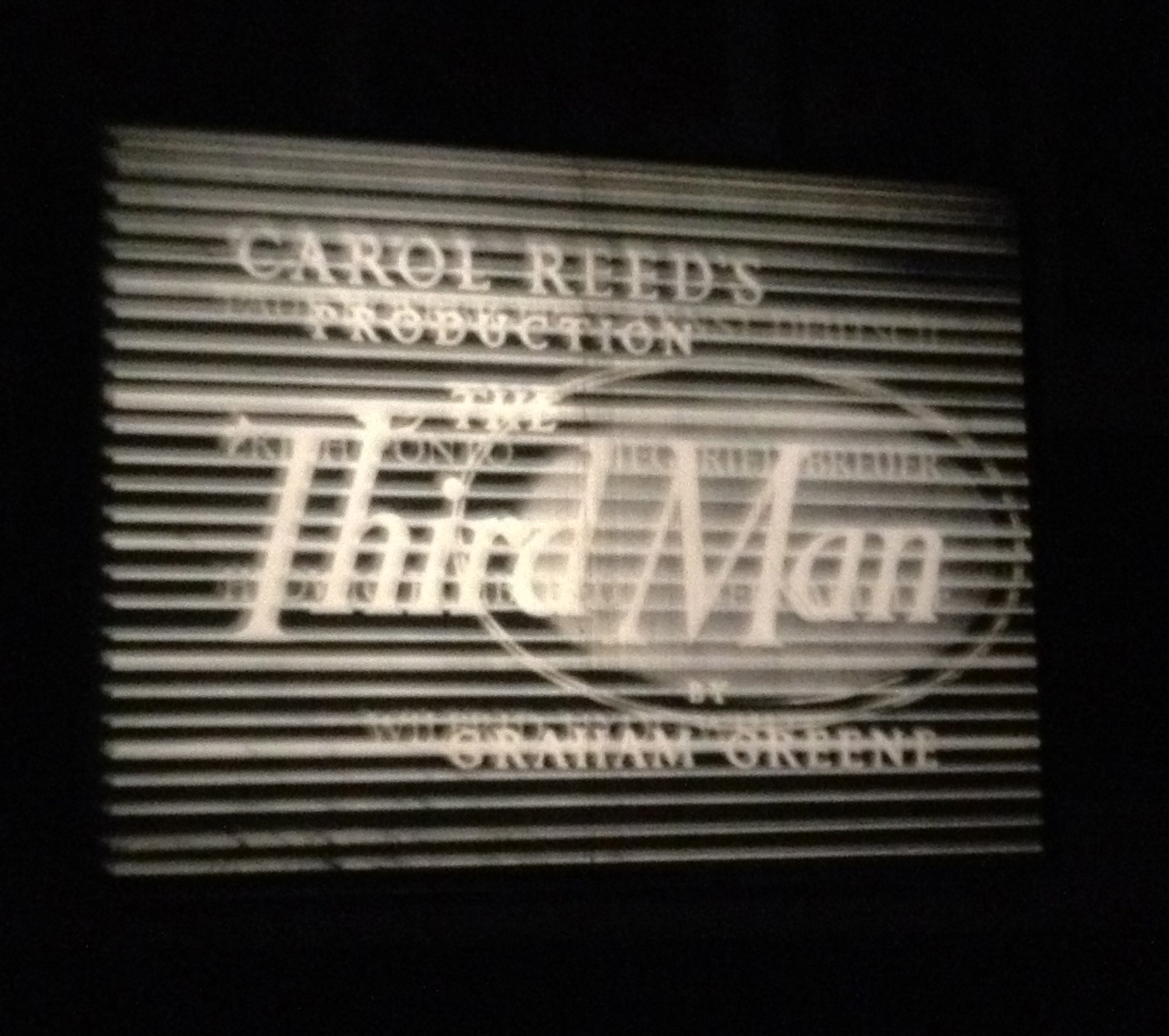
A film clip by the co-founder of the Third Man Museum in Vienna, running on an old-style projector.
I declared as one of my New Year’s resolutions that I would watch more classic old movies, so each month I’m devoting an entry to how I’m doing with it. This month’s selections have a distinctly Austrian flavor to them, inspired by a week-long visit to Vienna this month to participate in a conference on law and mental health.
The Third Man (1949) (4 stars out of 4)
This is widely recognized as one of the all-time best movies, a story set in postwar Vienna, with Orson Welles, Joseph Cotten, Trevor Howard, and Alida Valli in starring roles. IMDb neatly sums up the plot without giving anything away:
Pulp novelist Holly Martins travels to shadowy, postwar Vienna, only to find himself investigating the mysterious death of an old friend, black-market opportunist Harry Lime.
The other star is Vienna itself, largely shorn of its glorious beauty and instead portrayed as city of intrigue and recovery in the years following the Second World War.
My first sightseeing visit in Vienna was not to an art museum or classical music venue, but rather the small Third Man Museum, dedicated to the movie and life in postwar Vienna. It was time very well spent. Here are some photos from the museum:

Still shots and memorabilia from the movie.
If you know the movie, then you know what this is about!

Wonderful zither concert by Viennese musician Cornelia Mayer…again, if you know the movie, then you know this instrument!
The Sound of Music (1965) (4 stars)
This beloved, iconic movie musical, set in pre-war Salzburg, is about as wide a contrast from The Third Man‘s depiction of Austria as one could imagine. Starring Julie Andrews and Christopher Plummer, the renowned classic is celebrating the 50th anniversary of its release. In addition to offering songs that are firmly embedded in our popular culture, the film makes maximum use of the beauties of Salzburg.
Back in 1981, after finishing a semester abroad program in England, I made a quick tour of the European continent, and Salzburg was one of my stops. Even though at the time I had never seen the movie, I allowed myself to get dragged onto The Sound of Music bus tour by one of my traveling companions. While she was thrilled at every recognizable location from the movie, I just kept taking pictures, figuring that someday I’d watch the movie and then flip back to my photos to compare. I’m glad I did.
Here are some of those old snapshots.
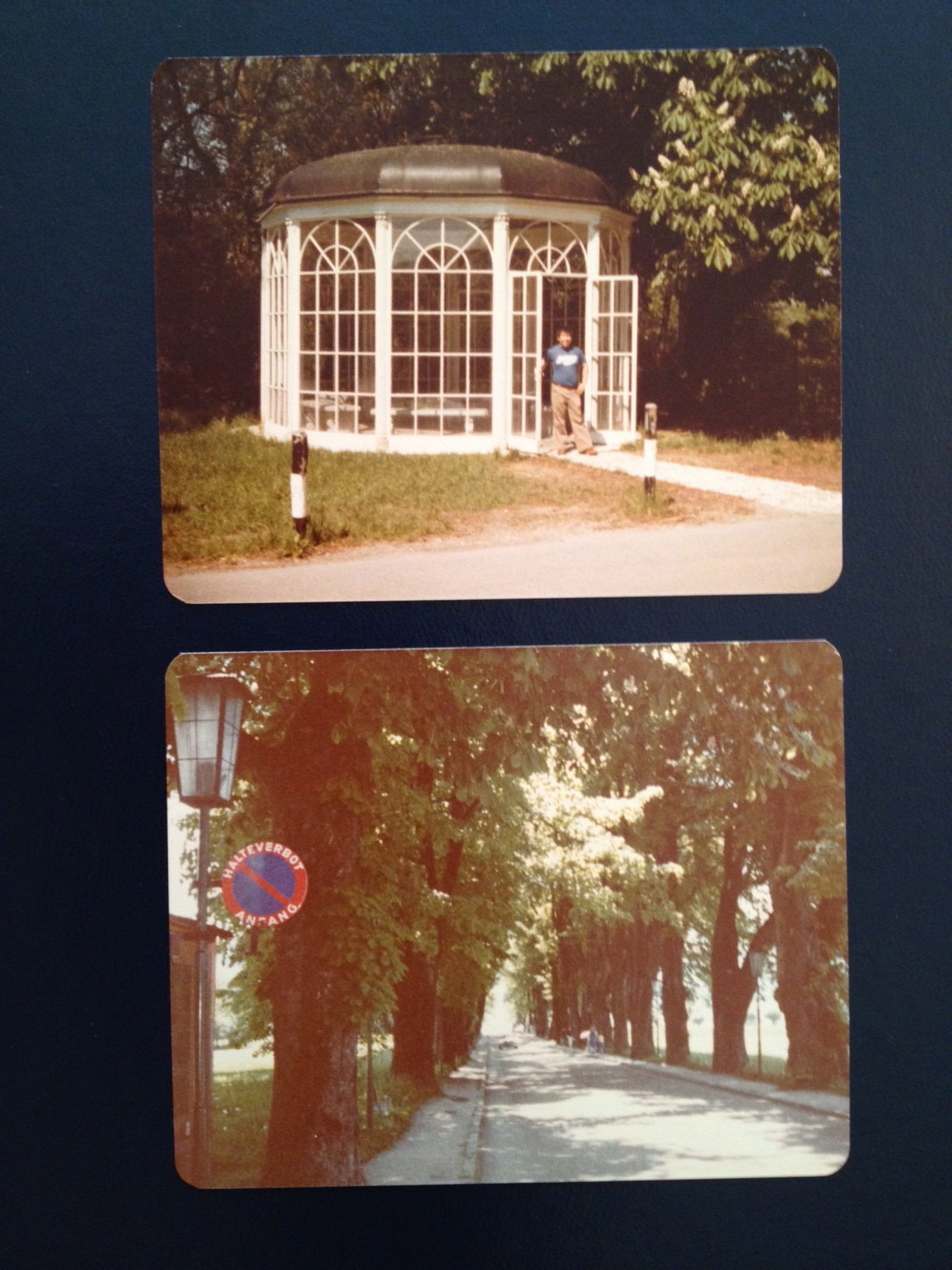
Top: The famous gazebo. Bottom: The road where the Von Trapp kids are up in the trees.

Top: The Von Trapp family home. Bottom: The cemetery in the abbey.
***
Photos: Third Man Museum (DY, 2015); Salzburg (DY, 1981).
My first camera: The Polaroid Swinger

The Polaroid Swinger camera (photo: Wikipedia)
As a young grade schooler, I really wanted a camera. Already being an independent type, I was drawn to the Polaroid cameras that produced more-or-less instantaneous photos, as opposed to the Kodak-brand models that required you to take or mail your film to a photo lab to be developed. Unfortunately, the Polaroids also cost a mint, and so I assumed it would never happen.
But in 1965, TV commercials for a new model, the Polaroid Swinger, started airing, with catchy lyrics that hyped its (barely) under $20 price point: [Trivia questions: (1) Who is the long-haired brunette featured in the commercial? (2) Who wrote and sang the jingle? Answers below!]
In case you want to sing along:
Hey, meet the swinger
Polaroid Swinger
meet the swinger
Polaroid Swinger
It’s more than a camera
it’s almost alive
it’s only nineteen dollars
and ninety-five
Swing it up (yeah yeah)
it says yes (yeah yeah)
take the shot (yeah yeah)
count it down (yeah yeah)
zip it off
Don’t get me wrong; $19.95 was a lot of money back in that day. But it made it under the line for a Big Gift, and so for Christmas 1965, the Swinger made its way under the tree.
I was ecstatic. I probably took a full roll on Christmas Day alone, all 12 shots. And while I didn’t exactly become a serious photographer, I used it often and at one point had quite a stack of prints. I remember being especially proud when my Uncle Kenny asked me to take his picture so he could use it for his next U.S. government employee I.D. photo!
I also was a perfect example of the emerging power of television advertising. That darn jingle got into my head and stayed there, both before and after I received the camera as a gift.
***
You can read more about the Polaroid Swinger in this piece recently published on Boston.com, marking the camera’s 50th anniversary.
***
Trivia question answers: (1) Ali McGraw; (2) Barry Manilow. Yup!
When crime novels, espionage thrillers, and mysteries connect us to favorite places
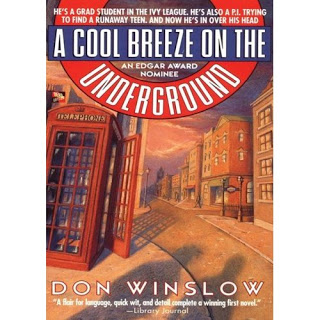
I just reread a book that I first encountered some 20 years ago, Don Winslow’s A Cool Breeze on the Underground (1991). Winslow has established himself as an entertaining, edgy writer of crime and mystery novels, and this was his very first.
The protagonist is a young private detective named Neal Carey. Early in the book, we learn how Neal’s hardscrabble upbringing during the 60s and early 70s New York City led him to become part of a secretive detective agency that achieves difficult results for high powered clients. Although not expressly stated in the novel, the primary story is set in the summer of 1976, and there’s a connection to that year’s Presidential campaign.
I found Neal to be an endearing character when I read the book 20 years ago, and I felt even more so this time around. In addition to becoming a savvy P.I. at a young age, he’s a scholar in the making, enrolled in an English literature graduate program at Columbia University. Some of the implausibilities of this scenario are overcome by the charming way it fits into the main plot, which eventually takes him to London.
I love the book’s uses of New York and London. The more familiar the reader is with these cities, the more vivid the story becomes, whether it’s grabbing a burger at the legendary Burger Joint in Manhattan, or navigating the labyrinths of London’s Underground subway system.
Winslow’s references to specific places send me off on my own journeys in those cities, today with more nostalgia than my during first reading. For example, one scene puts Neal at London’s Embankment along the River Thames:
Neal paid the cabbie and started across the pedestrian walkway on the bridge. The view up and down the Thames was one of his favorites. It might be the best spot to see London, he thought, and he stopped about halfway across to take it in.
This vista includes “a postcard view” of “Big Ben and the Houses of Parliament,” as well as the “stretched Victoria Embankment.”
I have to put the book down to drink in this passage. That’s my own favorite view of London, and I’ve made a point of crossing that footbridge during every one of my visits there!
For me, therein lies the appeal of so many crime novels, espionage thrillers, and mysteries: They take me back to places I know and enjoy, sometimes even prompting me see them in a different way, with scenes woven into plots full of suspense and intrigue.
In fact, the right location can lift a so-so plot for me. If a story is set in a place I don’t know, it better be a compelling tale to keep my attention!
In the U.S., New York is my favorite setting for mystery and suspense tales. Chicago, Boston, New Orleans, Hawaii, and Washington D.C. also appear on my list. When it comes to international intrigue, give me London, Cambridge and Oxford, Paris, and major cities in Austria and Germany, the latter especially if we’re talking about historical stories.
When it comes to fiction, I confess that I’m not a devotee of serious literature. Rather, this is my favorite genre, and when good stories are placed in cities I’ve come to know and love, it’s an added treat.
 Musings of a Gen Joneser
Recent Comments