Barcelona Dispatch
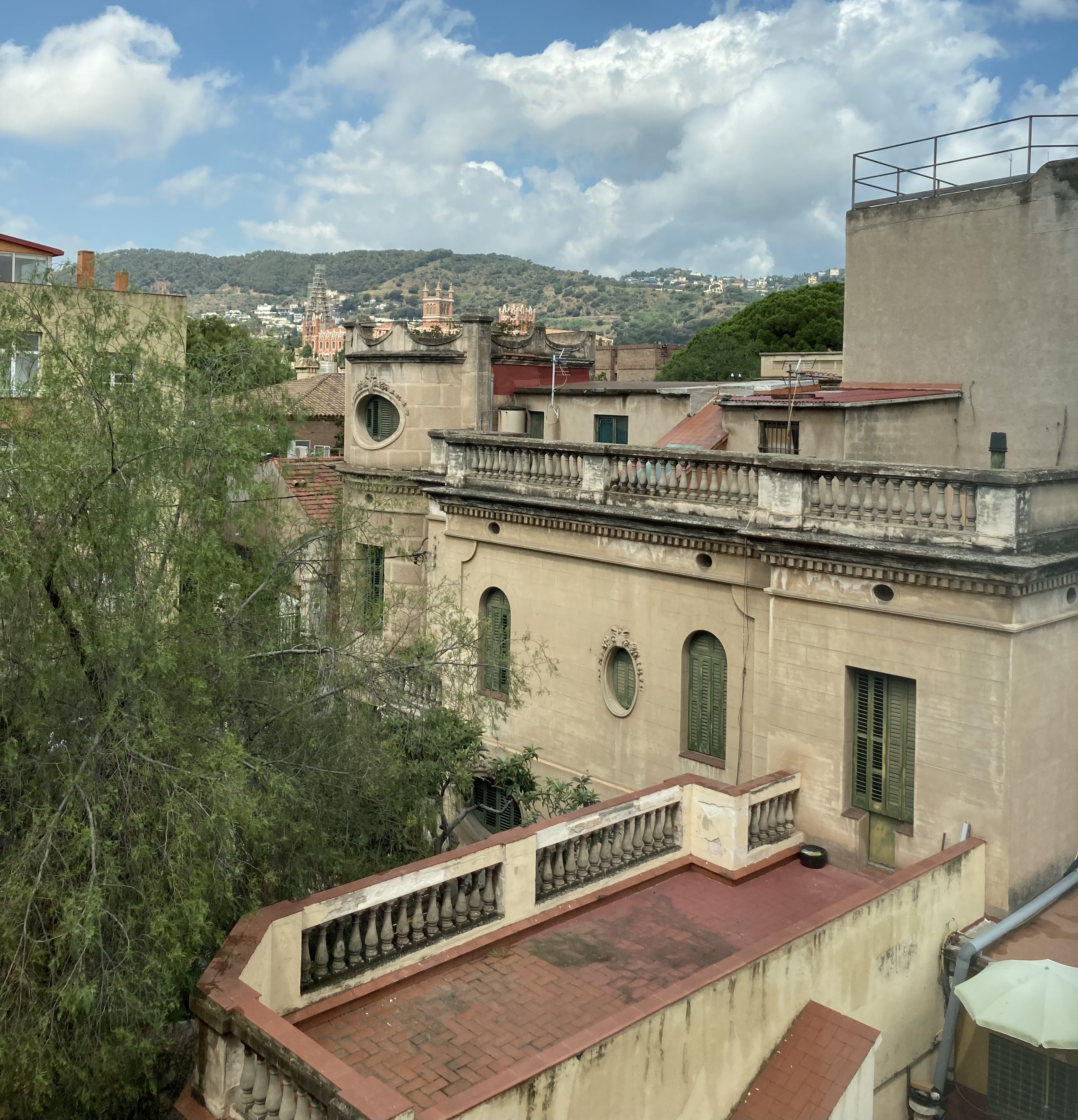
Hotel room view, Barcelona
I’m writing from a café in Barcelona, Spain, having spent the last week at the University of Barcelona Faculty of Law, attending and participating in the International Congress on Law and Mental Health. The Congress is a biennial conference organized by the International Academy of Law and Mental Health, held in different major cities. It attracts a global assemblage of scholars, practitioners, judges, and students, drawn heavily from fields such as law, psychology, psychiatry, and social work.
I’ll be flying back to Boston tomorrow morning. In the meantime, I’m sharing my three big takeaway reflections from this little sojourn.
First, among this historically literate group of conference goers, there was a strong sense that we are living in dangerous times. Although the Congress’s focus is not on large-scale politics and statecraft, its big-picture frame envelops the rule of law, human rights, individual and societal well-being, and psychological trauma. Attendees from around the world shared deep concerns about the rise of authoritarian leaders, which frequently infused conversations during session breaks and over meals.
The U.S. presidential campaign loomed large. Indeed, a Canadian friend and fellow conference participant was the first to text me that President Biden had withdrawn as the presumptive Democratic nominee. People are paying attention to what happens, deeply concerned about the critical damage that a Trump presidency would do to democracy, freedom, and the environment on a global scale.
Second, the conference itself served as an important reminder that for academics and others whose work is enriched by sharing our latest research and analyses, in-person gatherings still matter. The people drawn to this conference are doing compelling work in the broad intersections of law, public policy, mental health, and psychology. (For more on that, go here to read a short piece I posted to my professional blog.) While the pandemic, especially, has taught us that presentations can be delivered effectively via Zoom, in-person conferences and workshops create better space for informal conversations that stoke ideas, research, and practice and can lead to future collaborations.
And if the gathering is a good one, meaningful human connections emerge. Through this conference, I have met, and become friends with, so many remarkable individuals.
Finally, on a more personal level, I see changes in how I’m now regarding travel, especially the long-distance variety. This conference marks my first overseas journey since the 2019 International Congress held in Rome. Although the Congress is one of my favorite events, I opted not to attend the 2022 offering in Lyon, France, still feeling uncertain about the COVID situation. But I told myself that the Barcelona conference was the time to get back into global travel mode.
When I was doing my price comparisons, I found that I could save a bit of money by paying for another hotel night in Barcelona to avoid a more expensive return plane ticket. The extra time to enjoy Barcelona would be a bonus. But with the conference having concluded two days ago, and – more importantly — the special people with whom I spent so much time having departed, suddenly this worldly, historic, beautiful city has felt rather empty to me. Indeed, as an unintended experiment, my briefly extended stay has confirmed that (1) my sense of wanderlust diminished during the heart of the pandemic; (2) now when I travel, it’s much more about the who and the why, and less about the where.
And so, instead of spending my last sunny afternoon here doing more sightseeing, I’m hanging out in this café, with my thoughts veering back across the ocean. I’m catching up on emails, looking ahead at my schedule for the coming week, and — at least in my head — morphing back into regular life.
Forty summers ago, a first-ever trip to NYC

Forty summers ago around this time, I was packing a small suitcase in preparation for a first-ever trip to New York City. This was to be a reconnaissance mission of sorts, an initial exploration of what would be my new home for at least the next three years. (It turned out to be more like twelve.)
After having grown up in Northwest Indiana and attended college at Valparaiso University, located in the region’s outskirts, I yearned to spend time in another part of the country. This desire was fueled by a final collegiate semester at VU’s overseas study center in Cambridge, England, which greatly expanded my horizons.
Plans to attend law school provided an opportunity to satisfy that exploratory vibe, and initially I was looking very intently at the West Coast. Back then, I harbored great ambitions of having a career in politics, and I figured that California might be a good launching pad for that. But when New York University extended an offer to attend its well-regarded law school, located in the heart of a Manhattan neighborhood called Greenwich Village, I opted to go in the opposite direction.
My impressions of NYU and New York City in general were mostly on paper, supplemented by images drawn from television shows and movies set in the city. You see, I had never been to New York. The meager state of my finances was such that I had done all of my research about potential law schools by poring over admissions brochures and published commercial guidebooks. I had accepted NYU’s offer of admission sight unseen.
With my first year of law school beckoning in the fall, I figured I should check out what I had gotten myself into. So I planned a short summer trip to New York.
I booked a tiny room at the Vanderbilt YMCA on 47th Street in Manhattan. The bathroom was down the hall. The guest rent was $18 a night. At least it was an upgrade from my youth hostel travels during my semester abroad.
I’ve kept the guidebook I used to help plan my trip. In Frommer’s 1981-82 Guide to New York, author Faye Hammel writes:
You should be advised that there is one dangerous aspect of coming to New York for the first time: not of getting lost, mobbed, or caught in a blackout, but of falling so desperately in love with the city that you may not want to go home again. Or, if you do, it may be just to pack your bags.
Well, that’s pretty much what happened. My short visit didn’t allay all of my anxieties about moving to another part of the country to experience the rigors of law school, but the city immediately started to work its magic on me. I did some of the standard tourist stuff, including visits to the Empire State Building, the United Nations, and the wonderful Strand bookstore. And I spent time at NYU, checking out Vanderbilt Hall (the main law school building) and Hayden Hall (the residence hall where most first-year law students lived), both located on historic Washington Square.
I returned from my brief sojourn believing that I had made the right choice. This first impression would prove to be correct. New York and NYU were the right matches for me.
Later that summer, I used my little portable cassette player to tape this classic Sinatra number from the radio, and I would play it over and again. The lyrics spoke to me, as they have for countless others who have found their way to New York, for stays short and long.
I now live in Boston, and this city is home for me, quite possibly for the duration. Its smaller scale, slightly slower pace, and bookish, “thinky” vibe are more in line with who I am today. But New York will always be a part of me as well, starting with that summer 1982 visit.
Pandemic Chronicles #27: The holiday season having gone viral, I’m traveling abroad virtually for now

The experience of a second holiday season in pandemic mode, punctuated by the arrival of the latest coronavirus variant, serves as a stark reminder of how a state of abnormality has become our new normal. The other day, I was messaging with a long-time friend on Facebook (he started off by offering advice on protective masks — just another casual chat, these days), and we briefly speculated on how long these general circumstances might continue. I see us dealing with the pandemic at least through next year, and quite possibly beyond that.
For those whose 2022 aspirations involve travel — foreign or domestic — I’m not sure what this all means. Hopes for international travel, in particular, seem to be up in the air (pun intended) for next year. And for anyone whose travel abroad itinerary includes multiple countries, the varied and fluid public health regulations from nation to nation make planning especially difficult.
I’m still hoping to participate in a law and mental health conference that I’ve been helping to organize for next summer in France. I give it a 50/50 chance of happening. In the meantime, I’m going to do a bit of virtual traveling. Among other things, I was delighted to see that European travel guru Rick Steves has posted all episodes of his popular PBS series, Rick Steves’ Europe, to his company website (link here). While it may not be the same as seeing a show in London’s West End or checking out bookstalls along the Seine in Paris, virtual travel is a convenient — and, for now, safer — substitute for the real thing.
Most of all, I hope that safe and healthy travel will once again become a reality for those whose journeys have yet to be taken. I’ve been blessed to visit many fascinating places during my lifetime. And while I hope that more travel beckons for me, I especially wish for younger folks and others who haven’t had a chance to see much of this world opportunities to do so.
Pandemic Chronicles #26: Old postcards as time travel experiences

The pandemic has prompted me to revive a boyhood hobby of stamp collecting, as I’ve shared in my new blog on lifelong learning and adult education (here and here). It has been an enjoyable and relaxing pastime, and I’m sure I’ll be sticking with it for the longer run.
Among other things, I’m creating an album of postal covers and postcards that represent places and themes of my life. Toward that end, I’ve been searching eBay for old postcards of Valparaiso University (my undergraduate alma mater) and New York University (my law school alma mater), and I’ve scored several good deals averaging a few dollars a piece.
One postcard pictures VU’s Lembke Hall, opened in 1902 as a dormitory. By the time I arrived in 1977, it housed faculty offices, including those of the political science professors, my major. Perhaps my memory exaggerates, but I recall it as being quite the ramshackle building, a model of what real estate folks and contractors might call deferred maintenance. It felt like the whole thing might simply collapse. I don’t know when VU tore it down, but the equivalent of a strong wind may have been sufficient.
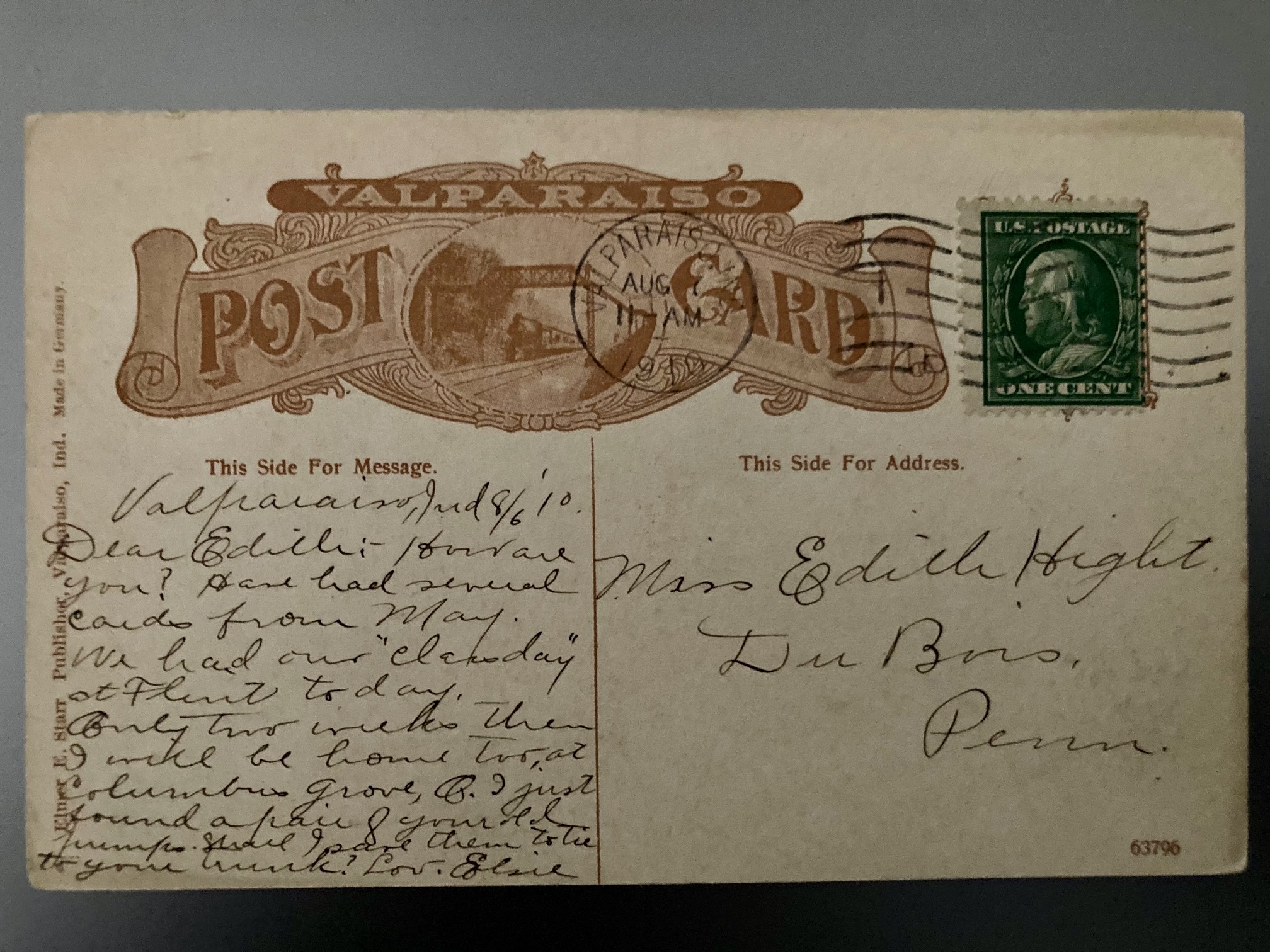
Anyway, this postcard is especially cool because it is postally used. The back reveals a quick little note penned by one Elsie to her friend Edith in Pennsylvania. It was postmarked from Valparaiso on August 7, 1910. What a neat snapshot of everyday life over a century ago!
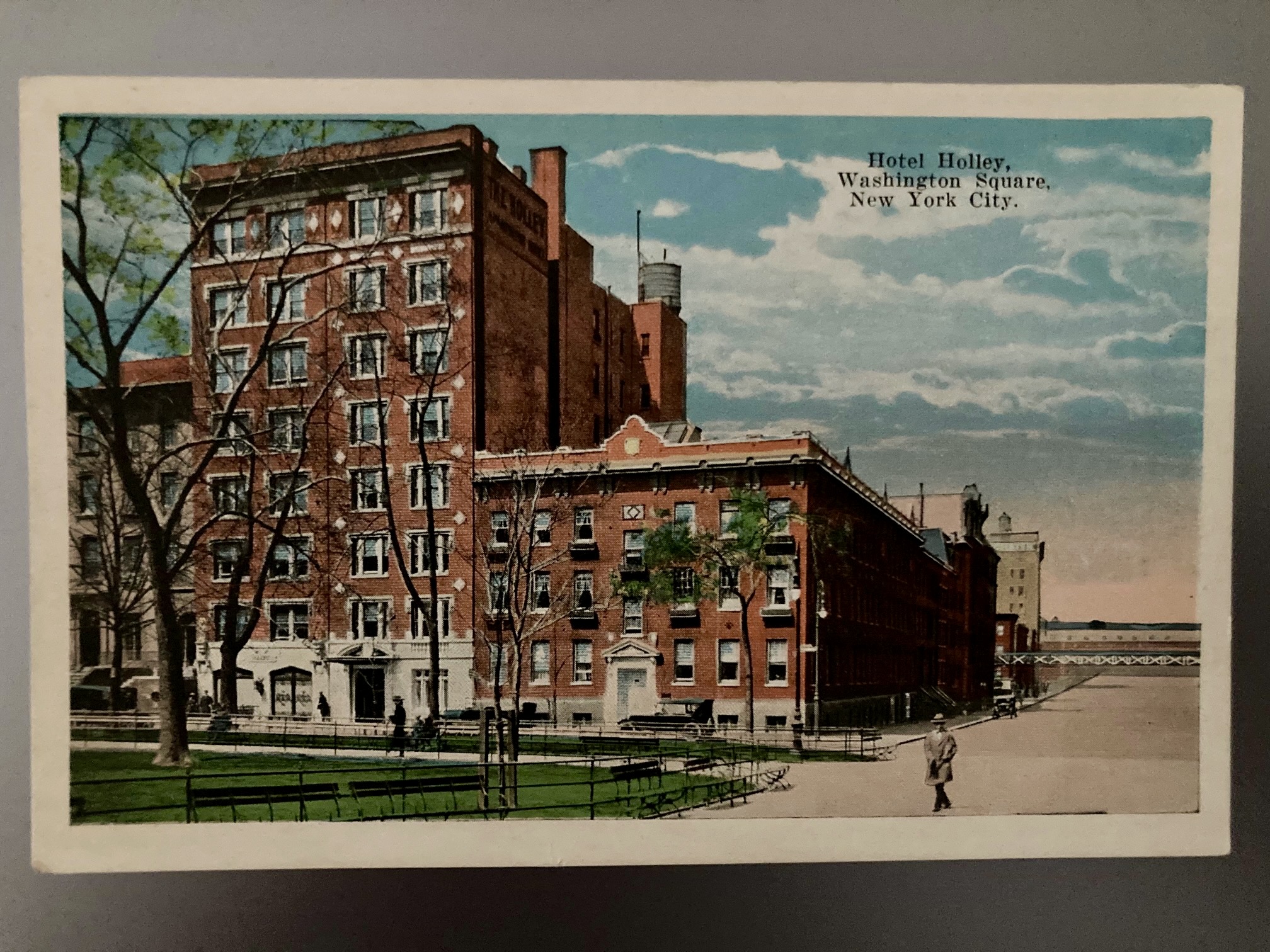
Below is a postcard depicting the Hotel Holley on Washington Square West, in the heart of Manhattan’s Greenwich Village neighborhood. There’s no date on it, but from the automobiles in the illustration and its overall design, it’s clearly from the early 1900s. Also pictured is the northwest corner of Washington Square Park. Alas, this postcard was never used, so I can only imagine who purchased it and why.
In the early fifties, NYU would buy the hotel and convert it to a residence hall for law students. It was designed to complement the opening of Vanderbilt Hall, the main law school building occupying the southwest corner of the Square. The new dorm was named Hayden Hall. Some 30 years later, I would live in it during my first year at NYU. The rooms were quite plain, shared with a roommate. But each room had a bathroom, and most had small study nooks to enable an early riser or a night owl to work without disturbing their roommate. Hayden Hall also had a cafeteria and group TV room on the ground floor, and it is via gatherings there with my classmates that I made many new friends.
Unless I win the lottery, Hayden Hall also happened to be the fanciest address that I will ever claim: 33 Washington Square West. (The ghost of Henry James must approve!) Here’s a shot of the building from one of my NYC visits several years ago.

Hayden Hall, contemporary view (photo: DY)
It struck me the other day that during the pandemic, I have returned to a hobby that allows me to travel over distance and time. My years at both VU and NYU yielded many good memories and planted seeds of future endeavors, cultural interests, and lifelong friendships. I’m glad that I can capture some of these memories in a stamp album.
Pandemic Chronicles #24: Not so fast
(image courtesy Clipart Panda)
In my last entry (link here), I wrote — somewhat breathlessly — that “Americans are traveling again, and I’m among them.” Although I wasn’t claiming victory over the pandemic here in the U.S., I did suggest that we were returning to some semblance of normalcy that included a fair bit of travel.
Well…not so fast.
A month later, the highly contagious and potent Delta variant is changing our tune, vaccines notwithstanding. A lot of folks are putting the brakes on ambitious travel plans, instead adopting a wait-and-see attitude. And they’re placing on hold a lot of aspirations for more extensive face-to-face socializing.
In the meantime, schools at all levels are re-opening. Many of them are returning to live classroom instruction after being online for roughly a year and a half.
This includes my university. On Monday I returned to the physical classroom for the first time since early March 2020, with vaccination and mask requirements imposed for students and faculty alike. My first meeting with students felt weird, a bit unsettling, despite that I’ve taught this subject for years.
The second time I met with the same group, we started getting back into a groove. I was more directed and centered, and the students were responding with comments and questions. I left the classroom feeling energetic and buoyed. That was a stark contrast to teaching on Zoom, when I gave maximum energy into teaching online, but often felt exhausted once the connection was turned off.
I dearly hope that we’ll be able to continue teaching in face-to-face mode through the 2021-22 academic year, though I understand that circumstances largely beyond my control will determine that matter.
In the midst of this uncertainty, I look forward to enjoying the beckoning fall. Here in Greater Boston, it’s the nicest season of the year. In fact, I think of a traditional New England fall as capturing the heart of Americana, with its seasonal bridge from hot-to-cold, plenty of autumn color, and historical sites waiting to be explored.
The ongoing presence of the pandemic may temper some of those qualities, but I don’t think it will be able to douse them.
Pandemic Chronicles #23: Americans are traveling again, and I’m among them

Logan Airport, Boston (photo: DY)
Although I’m not altogether confident that we’ve whipped this pandemic here in the U.S., it has become eminently clear that Americans are traveling again. Witness the photo above, the passenger security line at Terminal A of Boston’s Logan International Airport, just two Thursdays ago…at 8:00 a.m.! Alas, yours truly was at the tail end of this line. Without going into unnecessary details, let me say that I reached the gate with minutes to spare, the closest I’ve ever come to missing a plane flight outright.
Indeed, with my vaccinations in tow and a mask ready to go (hey, I made a rhyme!), I’ve been taking some shorter trips, such as hopping on a plane to Washington D.C. to help out a dear friend with an apartment move (hence, the Logan line) and to revive a periodic breakfast tradition with a group of friends, taking a commuter rail trip to Salem, Massachusetts for sightseeing with friends and researching the 1692 Salem witch hunts, and boarding an Amtrak train to Manhattan for a visit with family and friends.
I am grateful that I managed to get through this period of semi-quarantine in a state of solitude rather than loneliness. In some ways I benefited from the extended time alone. Socially distanced outdoor meals with two long-time friends in my neighborhood, trips to favorite stores, and various types of digital and social media helped to melt the isolation.
But I am enjoying connecting and reconnecting with people in person, and I look forward to more of the same during the coming months. That said, I am not overly sanguine about the public health situation. It appears that once again, numbers of new COVID-19 infections are creeping up, especially in locales with low vaccination rates. The Delta variant is the latest to present challenges, and we cannot assume that current vaccinations will be effective against future variants.
Of course, for Americans, this is a First World state of affairs. Many other nations are experiencing severe spikes in infections and have little access to the much-needed vaccines. Wrestling down this pandemic everywhere must be a shared global priority, and right now it isn’t. So, I accept as blessings my current ability to travel in relative safety, while hoping that we can safeguard everyone from this virus much sooner than later.
Pandemic Chronicles #21: Migrating
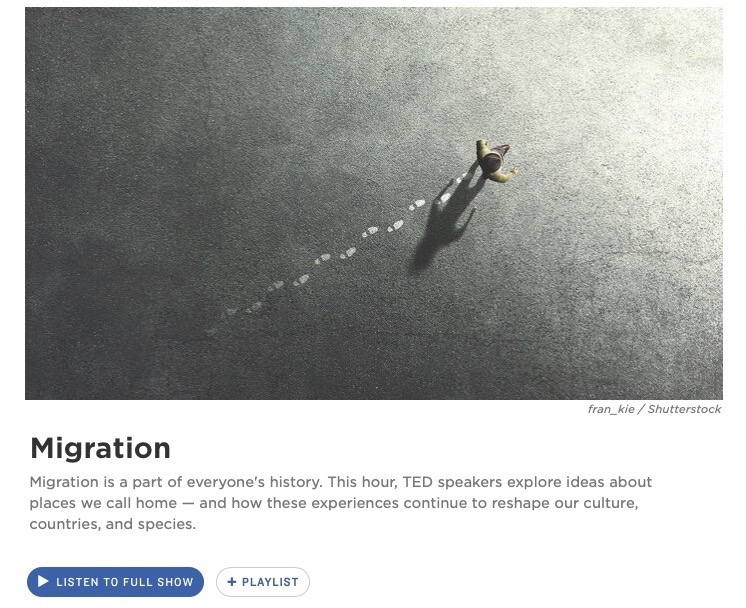
Have you ever moved to another part of your city, state/province, or country? Have you ever relocated to another nation? Why did you do it, and how did you get there?
NPR’s TED Radio Hour had me contemplating this topic during a feature on migration (link here), exploring why and how people have uprooted themselves from their original surroundings to less familiar ones. If you’ve made a big move or two during your life, or are contemplating doing so, this hour offers an interesting set of reflections and insights.
Location and the pandemic
Of course, the idea that location matters has become very significant during the coronavirus pandemic. One’s experience of this pandemic and public responses to it are based in part on where we live. Infection rates, medical and public health resources, population density, and beliefs in science and prevention vary widely by location.
Here in Boston, after a brutal year we are allowing ourselves to take literal and figurative breaths of relief. Our vaccination rates are trending upward, our infection rates and fatalities are in decline, and we’re gradually moving towards some resumption of living more normally.
Yesterday, however, I was on a webinar with law students and lawyers in India. I knew very well that they are reeling from a terrible surge in infections that, for now, shows no signs of abating. We may have been in the same virtual room together, but our experiences of that event were no doubt shaped by our respective perceptions of safety and health.
My moves
During my lifetime, I’ve made two bigger moves, a temporary move abroad, and a smaller move that felt like a huge one.
Going in reverse order, the small move that felt very big was leaving my hometown of Hammond, Indiana to attend Valparaiso University, all of one county and a 45-minute drive away. To an 18-year-old young man who wasn’t very worldly, it felt like I had moved halfway across the country, even though I remained squarely in northwest Indiana.
The temporary move abroad was in the form of a collegiate semester spent in England. As I’ve written before on this blog, those five months opened the world to me. Even before that study abroad experience, I had aspirations of moving to the West Coast or East Coast for law school. My semester abroad basically cemented that intention.
A year after returning from England, I would pack my bags for a much longer stay — twelve years in New York City — starting with law school at New York University. In 1994, an opportunity for a tenure-track teaching appointment at my current affiliation, Suffolk University Law School in downtown Boston, prompted a move to my current hometown.
With New York City and me, it was love at first sight. I will never again be as taken with a sense of place in the way that New York captivated me. With Boston, it has been more of an evolving affection, marked by the city’s insularity and parochialism slowly giving way (uh, sometimes kicking and screaming) to a growing cosmopolitan culture. It also helps that Greater Boston remains a place where ideas, invention, creativity, and books still matter. (Two years ago, I reflected on a quarter century of living in Boston. You may go here to read that.)
Many academics, even tenured ones, opt to be somewhat nomadic, moving from university to university as perceived greener pastures present themselves. While I’ve received periodic invitations to apply for teaching jobs elsewhere, I’ve opted to remain in Boston. Whether or not any more big moves remain for me, I cannot guess. But over the years, I’ve also taken countless plane and train trips to places far and near, and I expect that I’ll resume doing so as public health circumstances permit.
Pandemic Chronicles #20: Witnessing “The Troubles” 40 years ago

Belfast, Northern Ireland, 1981 (photo: DY)
With vaccinations on the increase and safer travel becoming a realistic possibility during the months to come, memories of past sojourns have become prominent in my nostalgic mind. Chief among them is my final undergraduate semester in 1981, spent at Valparaiso University’s study abroad centre in Cambridge, England. I have written with great affection about this formative time on this blog (e.g., “First-time sojourn across the pond,” here) and highlighted that experience in a reflective essay on my college years published in the university’s literary journal (“Homecoming at Middle Age,” The Cresset, here). Suffice it to say that seeds planted during that semester took hold in so many ways, shaping my sense of vocation and personal culture for a lifetime.
This writing finds myself contemplating a specific set of memories about that semester. Forty years ago this week, I was spending a part of our spring break in Northern Ireland and the Republic of Ireland, which at the time were marked by “The Troubles,” a span of great and violent political and nationalistic discord over the status of Northern Ireland as part of the United Kingdom. My brief visit occurred during a period of hunger strikes by Irish prisoners being held at Maze Prison in Northern Ireland, known as “H-Block” because of its physical configuration. Ten of these prisoners would die of starvation.

Photos of “H-Block” hunger strikers, Belfast (photo: DY)
Upon arriving in Belfast by bus, I felt very lost as I gazed around, with map in hand, wondering how to find the youth hostel where I planned to stay for a couple of days. Apparently I looked very lost as well, because a man approached me and asked if he could direct me somewhere. I explained that I was looking for the hostel, and he offered to give me a ride there. I readily accepted his offer. (Keep in mind that hitchhiking was a common practice for students studying abroad back then.)
In the car, I introduced myself and added that I had become interested in the political strife surrounding Northern Ireland. Well, that opened up a conversation. It turns out that this fellow was a BBC reporter, and he explained that he had just finished interviewing members of the Irish Republican Army, the paramilitary organization that was challenging British rule in Northern Ireland. He then asked if I had a few minutes to spare, offering to take me on a quick driving tour through parts of working class Belfast where he had talked to IRA members. Being a college newspaper scribe and fancying myself as a sort of foreign correspondent, of course I said yes.
I took the two snapshots above during that impromptu tour. To this day, I understand that this chance meeting gave me an opportunity to see parts of Belfast that I never would’ve ventured into on my own, during a violent and painful time in the city’s history.

On the way to the Belfast youth hostel. (photo: DY)
Belfast felt like a proverbial war zone during my visit. Security checkpoints screened entry into the city centre. Stores and movie theaters employed guards to search bags. One afternoon, as I walked back to the youth hostel, I saw a British troop car ahead of me. Soldiers were exiting it quickly, while their leader was focused on looking across the street. As I passed by, I asked what was going on, and they told me in a terse tone to just keep walking. I followed orders, briskly so. I have no idea what, if anything, happened later. However, I did manage to snap the photo above.

Easter weekend protest, Dublin, Ireland, 1981 (photo: DY)
From Belfast I traveled south to Dublin, via three hitchhiked rides. It was Easter weekend, and this marked the 65th anniversary of the historic Easter rising, an armed insurrection by Irish nationalists challenging British rule. Dublin was at the center of the insurrection, which led to nearly 500 fatalities and some 2,600 wounded.
Obviously, the current H-Block hunger strikes gave this anniversary considerable meaning. I took these photos of the Easter weekend protest march and rally. Above, the young man pictured struck a pose for me. (Note also the titles of movies playing at the city cinema!)

Old Post Office, Dublin, 1981 (photo: DY)
The Old Post Office and Bank of Ireland buildings, both of which were occupied by Irish nationalists during the Easter Rising, were prominent sites for this rally as well. I got snapshots of both.
Looking back, I now grasp how I had dropped myself into places that could’ve made for dangerous situations. At the time, I was sufficiently young and ignorant to assume that if any bullets flew in my direction, they would simply miss me.
That I visited Belfast and Dublin during this tumultuous time was a bit of a twist. You see, among our student cohort, I was not the most adventurous of travelers, often preferring to spend weekends remaining in Cambridge, while many of my fellow Valparaiso U students traveled around the UK.
Happily, though, the days spent traipsing around Cambridge did stick with me. I did not have plans to pursue a career in academe at the time, as I intended to go to law school as a prelude to entering the bloody world of politics. But the time I spent drinking in this historic, medieval university city worked its magic on me and contributed to my opting for the bloody world of academe instead.
In any event, my ongoing gratitude for that study abroad experience leads me to dearly hope that international study programs will recover and revive as we get through the worst of this pandemic. As I wrote last May (here), “(o)ne of the great sadnesses of the current coronavirus pandemic is how many thousands of college students may be denied similar opportunities.” We need to restore these chances to have life-shaping experiences.

Bank of Ireland building, Dublin, 1981 (photo: DY)
Pandemic Chronicles #7: Adventures lost

Our study abroad group at Coventry Cathedral, England, 1981
A couple of weeks ago, our study abroad group from college met for a Zoom-enabled happy hour/mini-reunion. It was the latest gathering of our spring 1981 semester abroad cohort from Valparaiso University’s program in Cambridge, England.
I can think of no other chapter in my life that so instantly flips on my personal nostalgia channel. I’ve written about that special semester many times on this blog (such as here, “First-time sojourn across the pond”). Here’s a snippet of what I wrote in 2016:
I was embarking on the most formative educational experience of my life. The semester would create enduring memories, new perspectives, and lifelong friendships. The seeds it planted permeate my life today, ranging from the way I live, to my choice of vocation, to how I spend my typical day.
One of the great sadnesses of the current coronavirus pandemic is how many thousands of college students may be denied similar opportunities. Right now, it’s highly questionable whether their main campuses will even be open for residential classes in the fall, much less offering study abroad options. Even when those possibilities begin manifesting themselves again, a lot of students (and their parents) may understandably be hesitant to take the plunge.
I dearly hope that a combination of smart public health practices and new developments in medicine will control the ravages of this virus sooner than later. Saving lives, preserving health, and re-opening our economic and civic society are, of course, our main priorities. The return of life-changing opportunities to spend meaningful time in other parts of the world would be welcomed, too, along with a renewed sense of adventure to take advantage of them.
Pandemic Chronicles #3: Carless in Boston
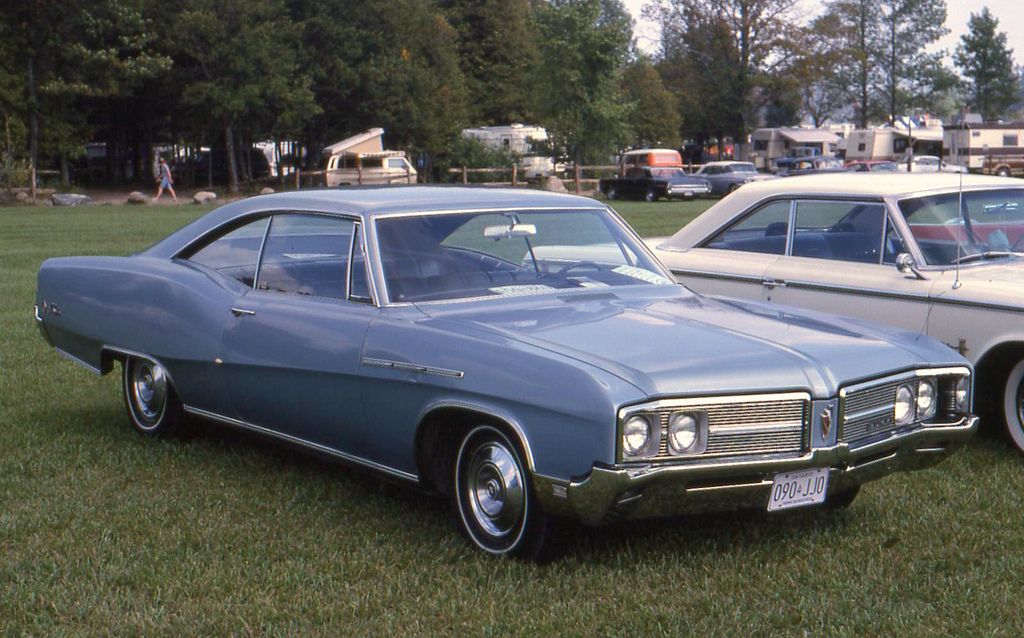
Model and make of the only car I’ve ever owned
It has taken a global pandemic to get me to a point where I feel limited by not owning a car.
Here in Boston, we’re experiencing a predicted surge in COVID-19 cases. Sheltering-in-place and social distancing remain the recommended best practices for those of us not working in essential businesses, and I’m taking these directives seriously. Thank goodness that my local grocery store and a number of area eateries continue to offer reliable delivery. But a car would make it easier to take occasional trips for other goods.
It has been over a month since I’ve taken the subway, which during 26 years in Boston and 12 years in New York City has been my primary way of getting around besides walking. I haven’t ordered a taxi or Uber since then, either.
As for having a car, well, I haven’t had a car of my own since 1982, when I left my home state of Indiana to attend law school at New York University, in the heart of Manhattan’s Greenwich Village neighborhood. During college, I owned a 1968 Buick LeSabre, a hand-me-down from my parents. A quick visit to New York during the summer before starting law school easily persuaded me that keeping a car there was neither practical nor affordable. I decided that the gas guzzling Buick would remain in Indiana.
The seeds of my new lifestyle had been deeply planted a year before, during a formative semester abroad in England through Valparaiso University, my undergraduate alma mater, which included a post-term sojourn to the European continent. Walking, buses, subways, trains, and the occasional boat trip became my modes of transportation, fueled by a sense of adventure. In addition, I didn’t have to worry about stuff like parking, upkeep, and insurance.
So, upon moving to New York, I became a happy city dweller and a creature of public transportation. I’ve never lamented a lack of wheels to take a quick trip to the country. In fact, since relocating to Boston, I’ve never traveled to Cape Cod or Nantucket, and I don’t have a burning curiosity to visit either.
In other words, for well over three decades, I’ve felt quite free bopping around cities without a car.
Until now, that is.
This afternoon, I left the immediate area of my home for the first time in a couple of weeks, to walk over to the drugstore for various provisions. Donning safety mask and gloves, I walked up the street, maintaining distance from the handful of others on the sidewalk. With a car, I could’ve completed a more ambitious shopping trip, and maybe hunted around a few other places for those elusive rolls of toilet paper and paper towels.
Honestly, though, I wasn’t unhappy about that. I did, however, feel genuine sadness at the eerie quiet in my neighborhood and the occasional sight of other masked pedestrians on what normally would’ve been a livelier Friday afternoon.
Okay, I’m not about to buy or lease a car because of this. I just hope that between various delivery options and occasional short walks to shop for necessities, I can continue to obtain the goods and supplies I need during this shutdown and any similar stretches, as we wrestle down this damnable virus.
 Musings of a Gen Joneser
Recent Comments