A quick trip to Brooklyn: A meet-up of past and present

Home to the First Unitarian Congregational Society, Brooklyn.
During a quick visit to Brooklyn for a workshop related to my work, I didn’t expect that a nostalgia trip would be part of the deal. But it came with no extra charge!
As I wrote in 2015, I lived in Brooklyn for nine years, which back in the day was a housing refuge for fellow Legal Aid lawyers and other non-profit and public sector types pushed out by the sky high rents of Manhattan. I spent chunks of that time traipsing around Brooklyn Heights, a beautiful, historic neighborhood located one subway stop away from Manhattan.
This workshop was hosted by the First Unitarian Congregational Society in the Heights, located in a beautiful Gothic Revival building erected in 1844. As I approached the church on my walk from the subway, I encountered a familiar building that I hadn’t seen in decades: The Appellate Division of the New York State Supreme Court, Second Department. Oh my! I was admitted to the New York Bar in a ceremony there, and as a Legal Aid lawyer I would argue cases before the appeals court in its majestic courtroom.

One of the courts in which I cut my legal teeth during the mid-80s!
I’m the kinda guy who doesn’t like to be late for things. Especially when I’m relying on public transportation to get me to and fro (which is, basically, almost all the time), I plan to get to my main destination a little early. The subway zipped me over from Manhattan to Brooklyn in minutes, so with time to kill and some rumbling in my stomach, I found Fascati Pizza, a classic New York slice joint, and ordered a slice of thin-crust cheese pizza. It hit the spot on a cold, wintry day — hot, flavorful, and crispy underneath.
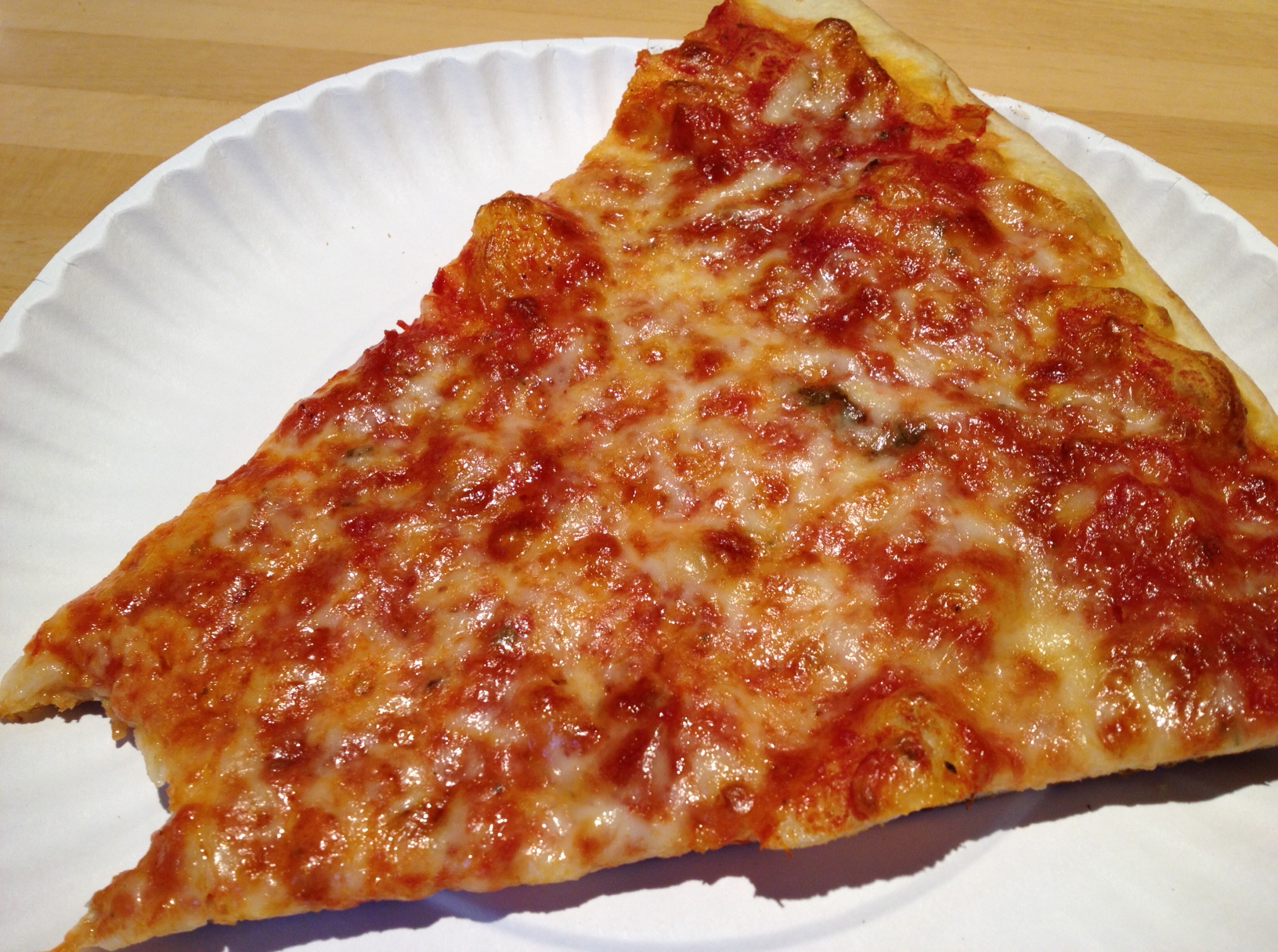
Umm, I took a couple of bites before thinking to take a picture.
Of course, my main purpose for this brief Brooklyn sojourn was not to wallow in memories, but rather to attend a workshop on bystander intervention training for harassment and related situations. The topic is pertinent to the work I’ve been doing on workplace bullying and abuse for many years. You can read a write-up on this excellent training session that I posted to my Minding the Workplace blog.
And so I found myself interspersing good memories with the work I’m doing today. The two are fairly distinct. My focus on issues of workers’ rights, workplace bullying and abuse, and human dignity was not on my radar screen when I was a young lawyer. I was drawn to law school generally by an interest in politics and a desire to engage in good works, but I was pretty clueless on so many things. Fast forward to today, I’m feeling the march of time, but I know what I’m supposed to be doing with my life.
Right now, however, I wish I could go back to that pizza place for another slice. My mouth is watering just looking at that photo.
Who you gonna call?

Dan Ackroyd, Ernie Hudson, Annie Potts, and Bill Murray visit with Jimmy Kimmel
It’s hard to believe that “Ghostbusters” is 32 years old as of this summer! And with the remake of the movie (and a new, female cast in the leads) scheduled for its theatrical release in July, several actors from the original are making the rounds of TV talk shows to indulge in some nostalgia and to promote the new arrival.
“Ghostbusters” is a great comedy, as one might expect of a flick featuring Bill Murray and Dan Ackroyd in their primes. I also count it among the wonderful New York movies. It made terrific use of the city, and there’s a line by Ernie Hudson at the end — no spoiler necessary — that captures it all: I love this town!!!
I remember the summer when “Ghostbusters” opened. I had finished my second year of law school at NYU, and I was working as a summer associate at one of the big law firms in Chicago. This was something of a test for me: To try out the corporate legal sector and to return to the Midwest. Well, as I’ve reminisced here previously, I felt like a fish out of water. The world of what is now called BigLaw wasn’t for me, and I badly missed New York. The city scenes in “Ghostbusters” made me pine ever more for the streets of Manhattan.
The theme music from “Ghostbusters” would become a hit single. I remember buying the movie soundtrack and playing it often on my cassette Walkman, which would serve as my “stereo system” until I finally cobbled together enough money to buy a nice boom box.
Oh gawd, once again my sense of time gets all distorted here. In the time machine that is my nostalgic brain, that summer remains a vivid memory. And yet there are stretches of my life from, say, 6 or 12 or 20 years past, that seem like epochs ago. Weird.
A view from the Garden

This 1940s wartime era photo prompts a nostalgic moment for me, even if I wasn’t around back then and my soggy sentiments have nothing to do with the picture itself. This is the old Madison Square Garden in New York City, and the marquee features coming sporting attractions, including basketball games featuring Valparaiso University (my undergraduate alma mater) and New York University (my law school alma mater).
Valparaiso posted the pic to its Facebook page in connection with the appearance of the current men’s basketball team in the semifinal round of the National Invitation Tournament, which will be played in the modern Madison Square Garden next week. This year’s squad has set a school record for wins, including three in the NIT. A victory against Brigham Young University on Tuesday will put them in the tourney championship game, to be played later in the week.
The vintage photo shows VU players arriving for their game at the Garden. VU’s war-era team was one of the nation’s best, thanks to its successful recruiting of talented players who were too tall to enter military service. The team traveled all the way from the Hoosier State to play Long Island University, no small journey in the days before jet airliners.
The second marquee game featured NYU hosting Colgate University. NYU was a major college sports presence during the first half of the last century, and its basketball team played in many of the prominent arenas along the east coast. Today NYU is a non-scholarship Division 3 school, with men’s and women’s basketball teams playing very competitively at that level.
***
We all have our personal narratives, and part of mine involves growing up and going to college in northwest Indiana, discovering something of the world during a final collegiate semester abroad, and then heading off to law school in New York City. To see both Valparaiso and NYU on that marquee, located on the wondrous island of Manhattan, symbolically brings together two educational institutions that have played important roles in my life.
As for Madison Square Garden, when I lived in New York I watched my share of basketball there, mostly Knicks NBA games. It was still possible back then to get cheap tickets (four dollars, then eight dollars) to sit up in the nosebleed seats. But when the Knicks were on top of their game and the Garden was rocking, well, it didn’t matter where you sat, it was quite an event.
After VU’s home court victory over St. Mary’s of California that punched the team’s ticket for the trip east, the public address system played Frank Sinatra’s “New York, New York.” That was my song, too. I hope their Manhattan sojourn turns out as well for them as it did for me.
***
Related post
Big Apple ghosts

Flatiron Building, 23rd Street, Manhattan (photo: DY)
Of all the places I have lived for long stretches of time — Northwest Indiana, New York City, and Boston — the Big Apple has made the deepest, lasting personal impression. I lived, went to law school, and worked in New York for 12 years, and the place simply imprinted itself on me.
Following a Thanksgiving visit to New York, I traveled to the city again for an annual workshop sponsored by Human Dignity and Humiliation Studies, a global network of scholars, practitioners, writers, activists, and students dedicated to advancing human dignity and reducing the experience of humiliation. It was an enjoyable and intense couple of days, spent in the company of a remarkable group of people.
The visit gave me a chance to spend a couple of extra days in New York. As usual, I got together with my awesome cousins (cousin Al, his wife Judy, and their youngest son Aaron), this time for a couple of super duper meals. But I also took some time to walk around the city.
For me, walks in Manhattan are a weird mix of the present and the past. I enjoy visiting New York for its own sake; it remains one of the most stupendous (and expensive) places on Earth. But I also see ghosts of the past everywhere: Ghosts from my years living there, ghosts from past visits, ghosts of a New York that I never experienced personally. So many Manhattan sites bring back an assortment of random, vivid memories.
One of my long-time friends, also a New York ex-pat, commented on Facebook that I’ll always be a 1980s New Yorker. She was spot-on with her observation. Although I was a pretty clueless young man back then, there’s something about that decade, lived in that city, that forever will be a big part of me.
But here’s a twist. I don’t yearn to move back there. I love my visits to New York, and if someone benevolently dropped a big pile of money into my lap, I’d consider returning. Nevertheless, I’d be ambivalent about moving back to a place that I so strongly associate, however positively, with my past. Does that sound odd?
For me, Boston has been more of an acquired taste, quite unlike New York, which I fell for immediately. But Boston also has been where I’ve done my most important work and met some wonderful people. Will I stay here forever? Who knows!? For now my present is much more grounded in Boston, and thus it is home.
Besides, despite my penchant for soggy nostalgia, I know that we often make the past look better by adjusting the rear-view mirror. It sometimes makes for a softer but less-than-accurate view….
Nostalgia for a New York experienced and occasionally imagined

Awaiting the okay to board, South Station, Boston (Photo: DY)
My annual Thanksgiving pilgrimage to New York included a traditional feast with family and friends and a lot of walking around to absorb the sights and sounds of the city. And while my trusty smartphone is not exactly state of the art, it continued to take decent pictures, a few of which I’m happy to share here.
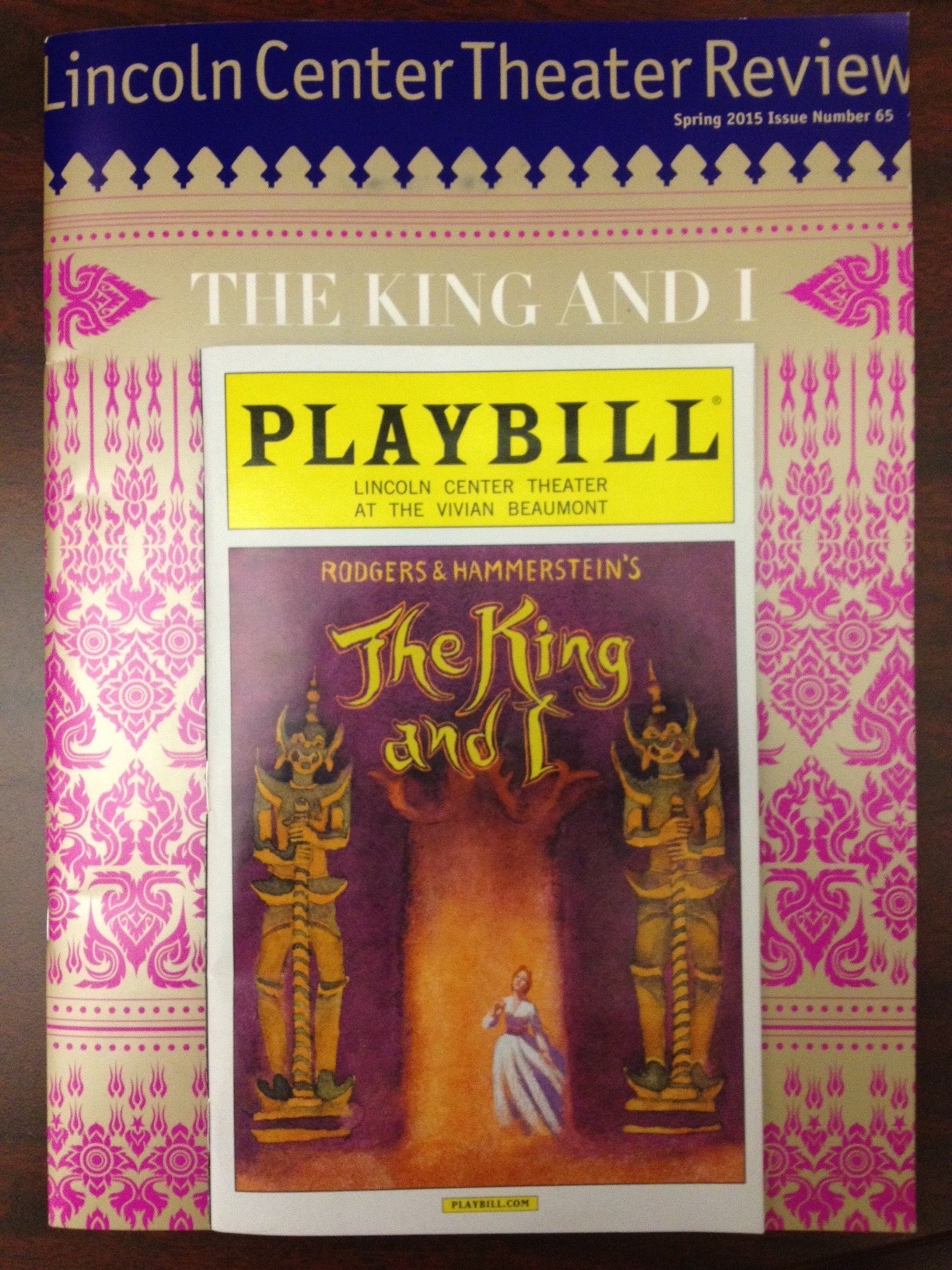
As good as it gets (Photo: DY)
Besides our Thanksgiving dinner, my favorite part of this visit was going with my cousin Judy, a true connoisseur of the New York theatre, to a performance of “The King and I” at Lincoln Center. Starring Kelli O’Hara (Anna) and Hoon Lee (King of Siam), this revival of a Rodgers and Hammerstein classic was simply breathtaking in every way. As the lead of this superb cast, O’Hara was other-worldly good, with flawlessly beautiful vocals and acting chops that brought a deep emotional intelligence to this show.
Returning to old haunts is usually part of any New York visit for me, and the Cozy Soup ‘n’ Burger at Broadway & Astor Place in Greenwich Village is a standard bearer. I’ve been going to this diner since my law school days at NYU, and almost every order includes a bowl of their awesome split pea soup.
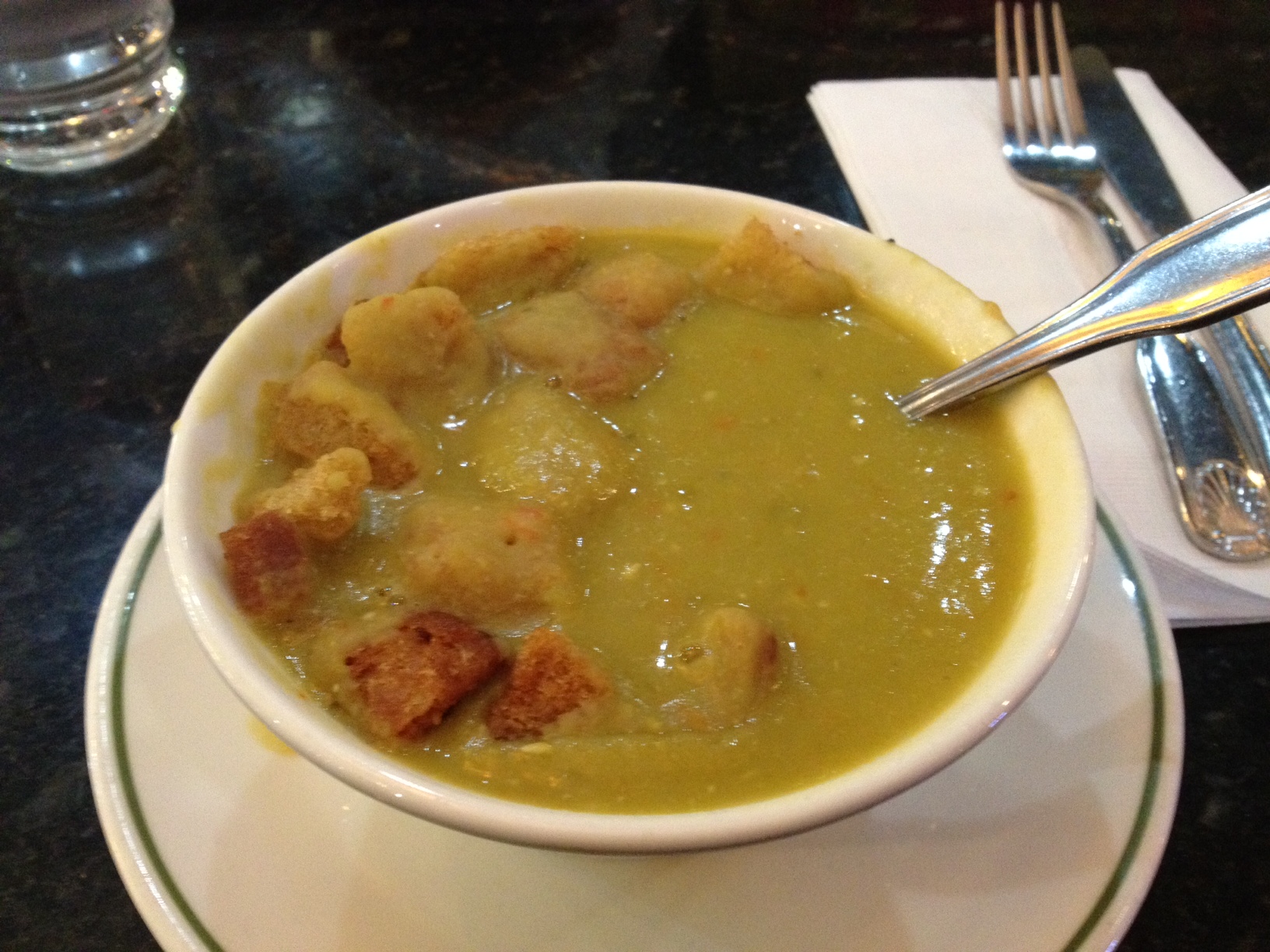
Delicious split pea soup from the Cozy Soup ‘n’ Burger, Manhattan (Photo: DY)
You may be wondering, where are the people in these photos? As I explained in a post last year, although this particular Thanksgiving gathering has been a part of our lives for well over a decade, for some reason no one has ever started taking pictures! Phone cameras abound within our group, and at least some of us are of Japanese heritage! The statistical odds against this shutter shutdown must be off the charts.

Back in the day, I worked for the NY Attorney General’s Office, in this downtown Manhattan building (Photo: DY)
My hotel was in lower Manhattan, so I did quite a bit of walking around there. Above is 120 Broadway, home to the New York Attorney General’s Office, where I spent three years as an Assistant Attorney General in the Labor Bureau before I started teaching. Robert Abrams was the AG then, and he set a high standard for the office. Many of my former colleagues have gone on to distinguished leadership positions in public service, the non-profit sector, and private practice.
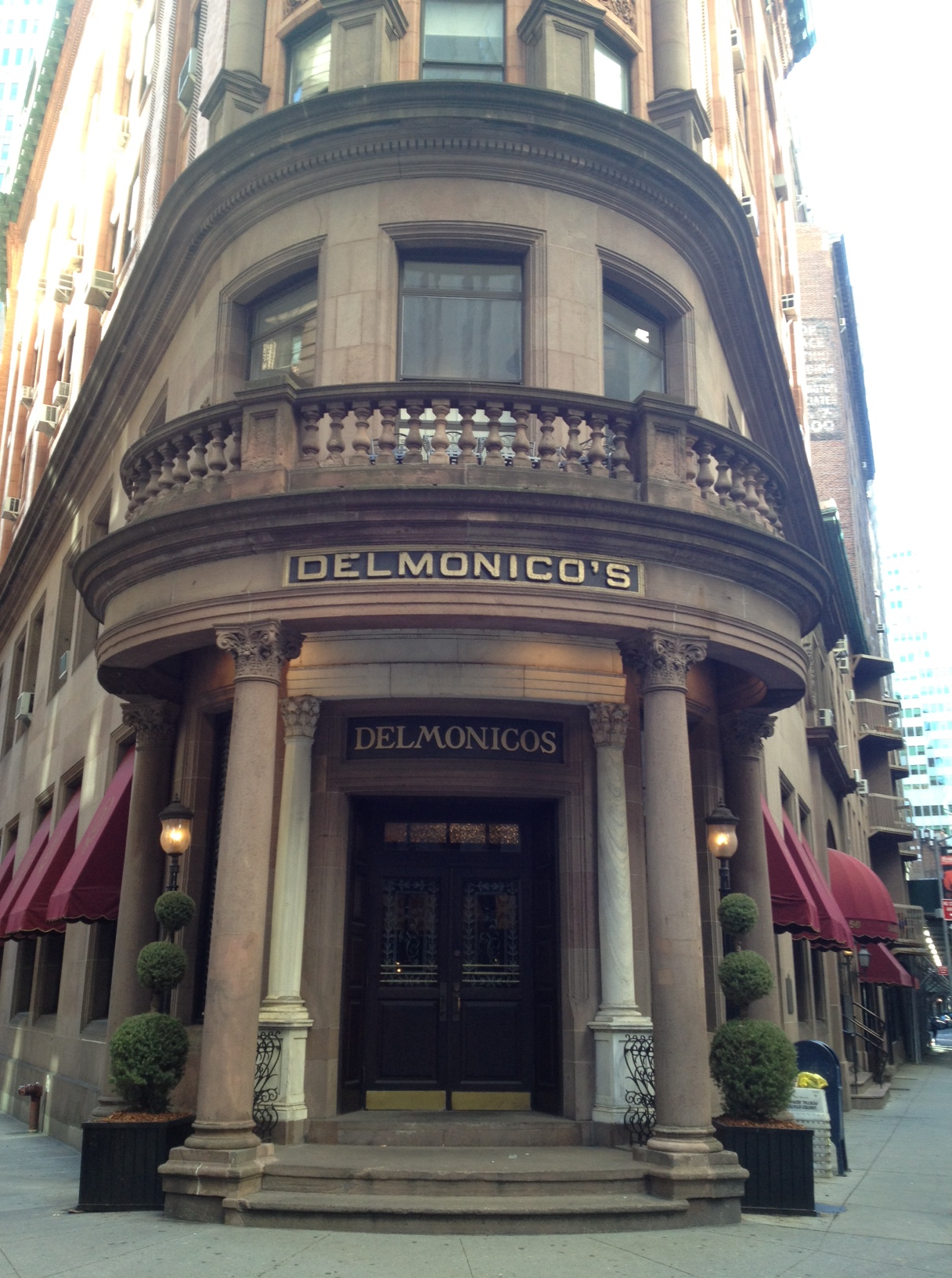
Someday I will enjoy a steak with all the trimmings at this place (Photo: DY)
Above is a place that exists for me in a kind of historical, imagined New York: Delmonico’s steak house in the Wall Street business district, a legendary dining establishment going back to the early 1800s. I’ve read about Delmonico’s in non-fiction books and novels about New York, and I’ve heard that they make an exceptional steak. But I’ve never eaten there! Someday it will happen. Medium-well for me, please, with a side order of hash browns.

A great find at the wondrous Strand Bookstore (Photo: DY)
When I lived in New York, a hefty share of my modest paychecks went to the Strand Bookstore. In recent years, the mighty Strand has undergone some interior remodeling to give the place a slightly more upscale feel, but it retains much of the dusty used bookstore feel that made it such a fun book hunting ground years ago. There I made my one Black Friday purchase for myself, a Folio Society edition of T.E. Lawrence’s (Lawrence of Arabia) Seven Pillars of Wisdom. With its slipcase and in excellent condition, I got it at a fraction of its original price.

A truly gourmet taco from La Palapa, East Village, Manhattan (Photo: DY)
My gustatory intake also included a couple of truly excellent tacos at La Palapa, a superb (and affordable!) Mexican restaurant on St. Mark’s Place in Manhattan’s East Village. Cousin Judy happens to be a manager at La Palapa, but I’d be raving about it even if I didn’t have family working there.

And speaking of the East Village, this new history of historic St. Mark’s Place (Photo: DY)
My cousin Al gave me this new history of St. Mark’s Place. St. Mark’s is a culturally famous street, with a history rich in noted writers, musicians, artists and other historically significant folks. Today it has not escaped the sky high cost of Manhattan living, but it’s still a great site of urban Americana. And paging through the book, I imagine incarnations of a New York that I’ve never personally experienced. Such is the pull of this little island.
Temporary escapism: NYC teens are discovering “Friends”

New York Times writer Ginia Bellafante reports that New York City teens have discovered the popular 1990s sitcom “Friends.” A big reason for its draw is its portrayal of the relatively carefree lives of its main characters, young Manhattanites Monica, Ross, Rachel, Phoebe, Chandler, and Joey. Bellafante writes:
What’s novel about “Friends,” or what must seem so to a certain subset of New York teenagers of whom so much is expected, is the absence among the six central characters of any quality of corrosive ambition. The show refuses to take professional life or creative aspirations too seriously.
. . . The dreamscape dimension of “Friends” lies in the way schedules are freed up for fun and shenanigans and talking and rehashing, always.
Among Bellafante’s interviewees was a 17-year-old high school girl in Brooklyn who sees “Friends” as a welcomed break from the stressors of school and prepping college applications:
It did not escape her attention that the characters are almost never stressed out about their jobs. “All they do is hang out in a coffee shop or a really nice apartment,” she said. “It’s the ideal situation.”
However, the young woman asked that her name not be used, lest she appear to be frivolous in the eyes of college admissions officers!
It’s wholly understandable why these young strivers might welcome “Friends” as a break from the pressure cooker of jockeying for grades and acceptances from top colleges. But it’s sadly telling that they’re seeking such escapism in a sitcom. One senses the anticipation of an early midlife crisis, grounded in the revelation that the game of obsessive hoop jumping often leads to more of the same, while already yearning for some healthy downtime.
Related post
Lost traditions: The Sunday newspaper

Not too long ago, a popular Sunday tradition was spending a good chunk of the day reading through the Sunday editions of the daily newspapers. Millions experienced the tactile delight of opening up a big Sunday paper, wondering what interesting stuff waited to be discovered. Even the advertising flyers were fun to page through, especially around holiday season.
The hefty Sunday newspaper has been a journalistic tradition for well over a century. One of my favorite coffee table books is Nicholson Baker & Margaret Brentano, The World on Sunday: Graphic Art in Joseph Pulitzer’s Newspaper (1898-1911) (2005), which celebrates Sunday newspapers published during the turn of the last century.
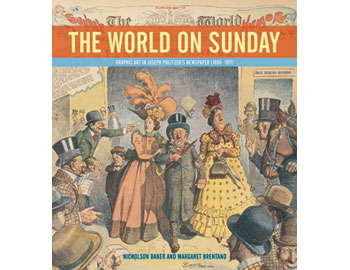
The World on Sunday and the tradition of Sunday newspaper reading represent an aspect of pre-digital culture that may be hard to understand for those weaned on an online world where wishes for news and commentary are instantly gratified. Fortunately, some of the major newspapers still land on doorsteps with a healthy thud on Sundays, containing some of their best in-depth reporting, feature articles, and opinion pieces.
Growing up in Chicagoland
My Sunday newspaper habit goes back to growing up in Northwest Indiana, where local papers and the Chicago dailies were readily available. Among the Sunday editions that regularly got my attention were the Chicago Tribune, Chicago Sun-Times, Hammond Times, and Gary Post-Tribune. The Tribune excelled at covering my beloved Chicago sports teams, and the Post-Tribune did a very good job with local news.
These papers deserve credit for turning me into a Sunday paper junkie. The Chicago influence was especially strong. The Windy City was a great, great newspaper town back in the day, fueled by the city’s colorful politicians, sports figures, and crime bosses. Beyond the headliners, however, the reporters and columnists who toiled for Chicago’s daily papers also had a knack for digging out the stories of everyday people. The human interest story had a regular place in the city’s newspapers.
Sundays in New York
When I lived in New York City (1982-1994), the Sunday papers were a special treat. The Sunday New York Times was an especially heavy load, a multi-pound door stopper packed with goodies and advertising circulars. The early edition of the Sunday Times would come out on late Saturday evening (and still does), and many a weekend night out included picking up a copy on the way home.
My personal favorite, however, was New York Newsday, the now gone NYC edition of the venerable Long Island daily. New York Newsday wasn’t as worldly as the Times, but it spoke more closely to the city’s middle class and did a superb job of covering local politics and sports. Its thick Sunday edition was chock full of extended features and commentaries. To this day, New York Newsday remains my favorite-ever newspaper.
And now in Boston
My Sunday paper of choice remains the New York Times. The Times has not abandoned the idea that the Sunday edition of a newspaper should be something special. I especially look forward to its Week in Review and Book Review sections.
The major daily here is the Boston Globe, and I have an online subscription. I have an on again, off again relationship with the Globe, and for now we are on digital terms only. In fact, despite a surfeit of subscriptions to printed periodicals, I increasingly get much of my news and commentary online.
And to be honest, I wouldn’t trade the remarkable world of information and news available online for the days of waiting for the paper to be delivered. I, too, have been spoiled by point and click access to news coverage from around the nation and the world. However, at a time when we can use more civilized, enjoyable, and affordable rituals in our lives, reading the Sunday newspaper remains a pretty good choice.
***
This is a revised version of a piece I wrote for another blog three years ago.
Latest binge view: “The Knick” (season one)

Last weekend I plowed through the ten episode first season of The Knick, a Cinemax drama set in a fictitious Manhattan hospital during the early 1900s. It stars Clive Owen as Dr. John Thackeray, a brilliant, driven, and cocaine-addicted surgeon. It has a great ensemble cast playing various doctors, nurses, hospital administrators, ambulance drivers, and board members.
The Knickerbocker hospital serves Manhattan’s poor and working class, and its medical staff attempts to be on the vanguard of treatments, diagnostics, and surgical techniques. It makes for sometimes gruesome scenes, and for this reason some readers might want to avoid it. (Think a turn of the century version of ER and you’ll have some sense of what I mean.)
Perhaps the most fascinating aspect of The Knick is how it portrays the evolution of health care as it moves out of the Victorian Age. Even those generally familiar with the history of medicine will appreciate the sense of drama in storylines about new and experimental approaches to health care.
The Knick also depicts treatments that by today’s standards are wrongheaded and even barbaric. Ambulance drivers are profiteers and body collectors. Issues of race are dealt with bluntly, including the presence of an African American surgeon whose knowledge and experience are completely dismissed when he joins the surgical staff.
And finally — no spoiler alert necessary — the last scene of the final season one episode is simply brilliant.
My cable subscription doesn’t include Cinemax, so I’ll have to wait for the season two DVDs to jump back into the world of the Knickerbocker Hospital. I can’t wait!
Brooklyn, 1985

In a New York Times real estate section piece last week, Alison Gregor spotlighted beautiful Brooklyn Heights. While I enjoyed the photos of this picturesque, historic neighborhood, what caused me to sit up straight were the real estate prices:
Depending on their size and the number of bathrooms they have, studio co-ops go for around $350,000 to $400,000; one-bedrooms for $450,000 to $750,000; two-bedrooms for $950,000 to $1.35 million; and three-bedrooms for $2.3 million to $3.2 million . . . .
. . . Rentals range from $2,000 to $4,000 a month for one-bedroom apartments; $2,500 to $6,500 for two-bedrooms; and $5,000 to $10,000 for three-bedrooms . . . .
Good grief. Brooklyn Heights has long been considered the borough’s jewel in the crown, thanks to its first-rate housing stock, wonderful urban vistas, and close proximity to Manhattan. But those housing numbers are staggering.
The price tags sent me into a nostalgic spin, recalling when I moved to Brooklyn in 1985, days after graduating from law school. . . .
Park Slope, here I come
With law school coming to a close in the spring of 1985, my days in the NYU residence hall were numbered. Late that semester, I was apprised of a possible apartment share in the Park Slope neighborhood of Brooklyn.
The Slope, as it was known (and probably still is), was a neighborhood “in transition” during an early period of gentrification in Brooklyn that seemed inevitable as Manhattan housing prices climbed steeply. I had accepted a position as a Legal Aid lawyer in lower Manhattan, starting at the princely salary of $20,000. Brooklyn was the most viable option in terms of convenience and price.
I agreed to join two others in renting a three-bedroom apartment in the top half of a brownstone owned by a young couple. Our monthly rent, to be split three ways, was $1,000. Yup, $1,000, split three ways.
Of course, the low monthly rent didn’t exactly make me Legal Aid’s version of Donald Trump (who, by the way, was coming into prominence right around then). The overall cost of living was high, and I was paying back student loans to boot.
Rough around the edges, but still good
Today Park Slope is home to well-to-do professionals and a fair share of celebrities, but back then it was a mix of long-time locals, farsighted buyers and speculators, and younger non-profit types priced out of Manhattan.
Overall, the streets closer to Prospect Park (another New York showpiece by Frederick Law Olmstead) were fancier and safer. Away from the park, the dicier things could get. I was mugged twice in Park Slope during my nine years there, and lots of other Slope denizens shared similar tales of criminal victimhood.
But no matter, this was during the heart of my love affair with New York. I enjoyed it on a shoestring, while dealing with its occasional hazards. And after three years of being a Manhattanite during law school, I explored parts of the wondrous Borough of Brooklyn, a place with as rich a history and variety of humanity as any in America.
My neighborhood’s in-transition status also meant that affordable eateries could still be found, albeit varying greatly in quality. I recall one diner on now-fancy Seventh Avenue, doors from the subway station, that served a thoroughly mediocre meatloaf platter, replete with imitation mashed potatoes and canned green beans. Taste aside, it was a filling match for my public interest lawyer’s budget, and so I ate there often after work.
Although the draw of Manhattan remained strong, I spent a fair share of my time in the Slope and its environs. Among other things, the area featured a neat little bookshop, a popular video store, and a dumpy but serviceable movie theatre. Soon after I moved there, I became active in a local reform Democratic club and volunteered for several campaigns.
Of course, the aforementioned Prospect Park was a wonderful draw. From the late spring through the early fall, lawyers and staff from our Legal Aid office would play weekly softball games there. It also was a great place for a walk with a friend or a slow afternoon with a book in hand.
Pictured above
The photo above shows the hardcover edition of Thomas Boyle’s Only the Dead Know Brooklyn (1985). It is the first entry in an entertaining crime trilogy featuring police detective Francis DeSales.
The real star of the book and the series, however, is the changing nature of Brooklyn, circa 1980s. I devoured Only the Dead when it first came out, and it helped me to understand the culture(s) of the borough, wrapped around a well-told story. It was also a fun read that nailed some of the details of living there, such as the view from the F train as it passed over the mega-polluted Gowanus Canal.
It has now been over 20 years since I’ve lived in Brooklyn. That chapter of my life seems like that of another epoch, no small milestone for someone whose nostalgic instincts can make events of decades ago feel like yesterday. Maybe it’s time to pull Only the Dead off the shelf and see how it reads many years later.
When crime novels, espionage thrillers, and mysteries connect us to favorite places
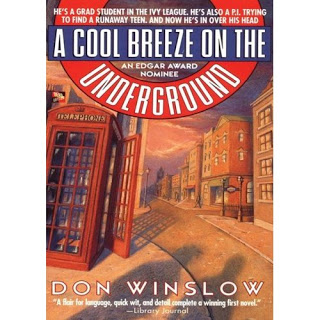
I just reread a book that I first encountered some 20 years ago, Don Winslow’s A Cool Breeze on the Underground (1991). Winslow has established himself as an entertaining, edgy writer of crime and mystery novels, and this was his very first.
The protagonist is a young private detective named Neal Carey. Early in the book, we learn how Neal’s hardscrabble upbringing during the 60s and early 70s New York City led him to become part of a secretive detective agency that achieves difficult results for high powered clients. Although not expressly stated in the novel, the primary story is set in the summer of 1976, and there’s a connection to that year’s Presidential campaign.
I found Neal to be an endearing character when I read the book 20 years ago, and I felt even more so this time around. In addition to becoming a savvy P.I. at a young age, he’s a scholar in the making, enrolled in an English literature graduate program at Columbia University. Some of the implausibilities of this scenario are overcome by the charming way it fits into the main plot, which eventually takes him to London.
I love the book’s uses of New York and London. The more familiar the reader is with these cities, the more vivid the story becomes, whether it’s grabbing a burger at the legendary Burger Joint in Manhattan, or navigating the labyrinths of London’s Underground subway system.
Winslow’s references to specific places send me off on my own journeys in those cities, today with more nostalgia than my during first reading. For example, one scene puts Neal at London’s Embankment along the River Thames:
Neal paid the cabbie and started across the pedestrian walkway on the bridge. The view up and down the Thames was one of his favorites. It might be the best spot to see London, he thought, and he stopped about halfway across to take it in.
This vista includes “a postcard view” of “Big Ben and the Houses of Parliament,” as well as the “stretched Victoria Embankment.”
I have to put the book down to drink in this passage. That’s my own favorite view of London, and I’ve made a point of crossing that footbridge during every one of my visits there!
For me, therein lies the appeal of so many crime novels, espionage thrillers, and mysteries: They take me back to places I know and enjoy, sometimes even prompting me see them in a different way, with scenes woven into plots full of suspense and intrigue.
In fact, the right location can lift a so-so plot for me. If a story is set in a place I don’t know, it better be a compelling tale to keep my attention!
In the U.S., New York is my favorite setting for mystery and suspense tales. Chicago, Boston, New Orleans, Hawaii, and Washington D.C. also appear on my list. When it comes to international intrigue, give me London, Cambridge and Oxford, Paris, and major cities in Austria and Germany, the latter especially if we’re talking about historical stories.
When it comes to fiction, I confess that I’m not a devotee of serious literature. Rather, this is my favorite genre, and when good stories are placed in cities I’ve come to know and love, it’s an added treat.
 Musings of a Gen Joneser
Recent Comments