Will I ever again be a Mad Scientist?
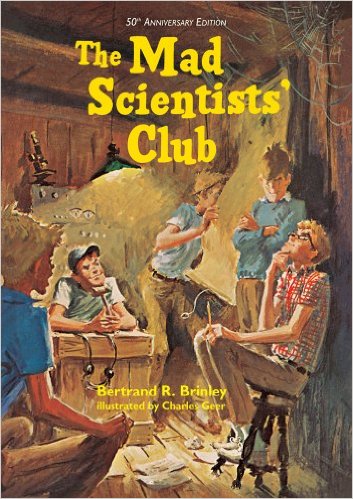
One of my favorite boyhood books was Bertrand R. Brinley’s The Mad Scientists’ Club (1965), a collection of short stories about a group of young science geeks in the fictional town of Mammoth Falls. The boys of the club used their scientific know-how to get in and out of various adventures. They had a clubhouse, scientific equipment scrounged up from here and there, and enough outdoor gear to support their explorations.
With stories like “The Strange Sea Monster of Strawberry Lake,” “Night Rescue,” and “The Big Egg,” The Mad Scientists’ Club takes us back to a time when kids created their own fun, without having every hour scheduled and coordinated by adults. The unstructured time enabled children to improvise and imagine. More often than not, they, nay, we managed to do so without getting into too much trouble!
Grade school years are a wonderful time to stoke curiosities about science, and The Mad Scientists’ Club captures that fascination. But I know that things have changed. Today, I’m afraid, keyboards, screens, and smartphones might overcome the exploratory instincts of yore.
I caught the science bug early. My first view was to the skies. I became interested in astronomy early in grade school. This was, after all, the early heyday of America’s space program, and our young imaginations were filled with wonder over what might exist above. What would it be like to travel in a space capsule? Is there life on Mars? Do UFOs exist?
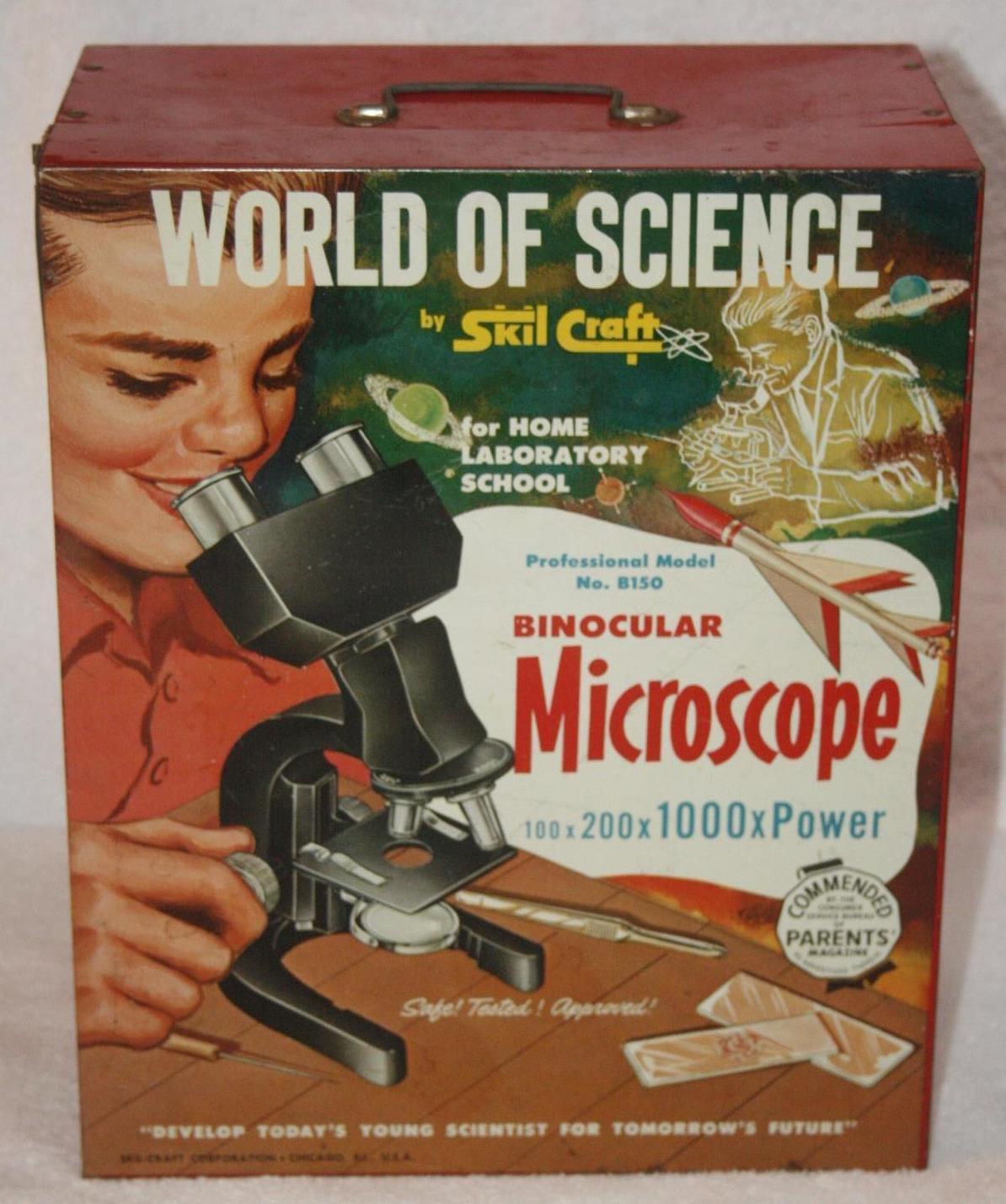
Soon my fascination turned toward the invisible, and those curiosities required a microscope. A birthday present in the form of a student microscope (much like the one pictured above) brought enough magnifying power to observe the activities of one-celled animals — protozoa — such as amoeba and paramecia. I read up on early pioneers such as Anton van Leeuwenhoek, the 17th century Dutch scientist who used his own hand-crafted microscopes to explore the world of microorganisms.
The microscope gave me many hours of fun exploration, especially when I made slides filled with stagnant water, blood, tiny brine shrimp, plant cuttings, and other objects. The cheap metal case that came with the microscope opened to form my own little lab in the bedroom I shared with my brother Jeff.

I think it’s more than nostalgia for my childhood — which wasn’t nearly as dramatic or exciting as that portrayed in The Mad Scientists’ Club — that has caused me to go online at times to price out student microscopes and biology kits. I live within walking distance of a pond where I could collect all sorts of specimens to view through a microscope, and I sometimes wonder if I could lose myself in a hobby that appeals to the little kid in me.
For now, I’ve got plenty of good stuff to keep me busy, and I’m not sure where I’d find the time to add another hobby. But I’ll definitely keep this on my radar screen.
On typing and typewriters

No power needed, except that of your fingers and your mind. (Vintage typewriter courtesy of Adeline Moya)
For many years I’ve quipped that Introduction to Typing and Driver’s Education were the two most valuable courses I took in high school. Actually it’s more than a quip. If you toss my junior year American History course into the mix, I think you’d have the academic holy trinity of my high school career. (Yes, I was something of a rebellious underachiever in high school.)
Anyway, back to typing class: I really wanted to learn how to type. Even as an adolescent, I felt that typing out my thoughts and ideas would somehow render them more, well, significant. Once I learned how to type, I would use my mom’s old Royal manual typewriter to bang out term papers for school. And when I got involved in the student council, I would learn how to cut mimeograph stencils for printing out the council newsletter.
Of course, just because I enjoyed typing doesn’t mean I was good at it. I made lots of mistakes…and still do. In the ancient era before word processing programs and home computers, that usually meant using either liquid paper or Ko-rec-type to cover up one’s mistakes and then type over them. I did this a lot, and it slowed down my typing speed.
Off to college
When I went off to college at Valparaiso University, my main off-to-school present was a Smith-Corona electric typewriter. Whoa…..I was now moving up in the world! This model used ribbon cartridges instead of old-fashioned spooled ribbons. If you made a typing error, you could swap out the ribbon cartridge for a correcting cartridge that would white out the mistake. It is a miracle that I did not develop a repetitive stress injury swapping out those cartridges.
My typing life changed when I joined the staff of my college newspaper, The Torch. You see, the newspaper office had two IBM correcting Selectric typewriters. Typing on those machines was a sublime experience. During down times when folks weren’t working on stories, we were free to commandeer the typewriters for our papers and projects. The presence of those typewriters is one of the reasons why that office became our unofficial hangout, even when we weren’t working on the newspaper.
Now, those of later generations might not fully appreciate these challenges, but writing term papers and other assignments in the B.C. era (Before Computers) was a very, very different experience, especially when minimum or maximum page limits were in play. Most of us would first write out our papers in long hand, and then estimate if the cumulative sheafs of paper would, when typed up, potentially run afoul of the page limits. If you didn’t have a good sense of how your cursive writing translated into typed pages, you might be in for some unpleasant surprises, leading to late nights before papers were due.
Lugging it to NYC
I took my Smith Corona with me to law school at NYU. I cannot recall how I got that heavy, bulky machine to its destination, but I may have even checked it as part of my baggage for the flight from Chicago to New York. In some ways, these challenges have not changed; even in the digital era, there are only so many ways to move one’s belongings from here to there.
This was right before the home computer revolution, and very few of my classmates had PCs. Most of us continued to type our papers, with added challenges in terms of margins and page length when writing out practice versions of legal documents. By this time, we were overlapping with the emerging age of computers. At NYU I worked on one of our scholarly law journals and on the law school student newspaper, and we had computer word processing capabilities for both publications.
A computer of my own
I would not own a personal computer until several years after graduating from law school, a Commodore 64 that supported a superb game library and rudimentary word processing programs. I would later move up to an IBM PC compatible machine, and at that point I transitioned from typewriter to word processing. I became enamored of the wonderful, awesome WordPerfect 5.1 for DOS program, which remains to me the best ever software package for writing productivity. In fact, ever since being more or less forced into using the tyrannical, control-freakish, and cumbersome Microsoft Word, my writing efficiency has declined.
Today, I’ve morphed over to Apple products, but I’m still stuck with Microsoft Word. Someday I’d like to give a serious tryout to Scrivener, a word processing program that has a fiercely devoted following. As for my blogs, I use the WordPress platform, which I find easy to navigate.
Changing technologies aside, it’s clear to me that my original motivation for learning how type — to share my thoughts and ideas — remains the main reason why I’m sitting before a keyboard today. And thank goodness that you, kind reader, get to read what’s on my mind with (most of) the typos cleaned up.
Memo to self: Experiences, not possessions, bring greater happiness
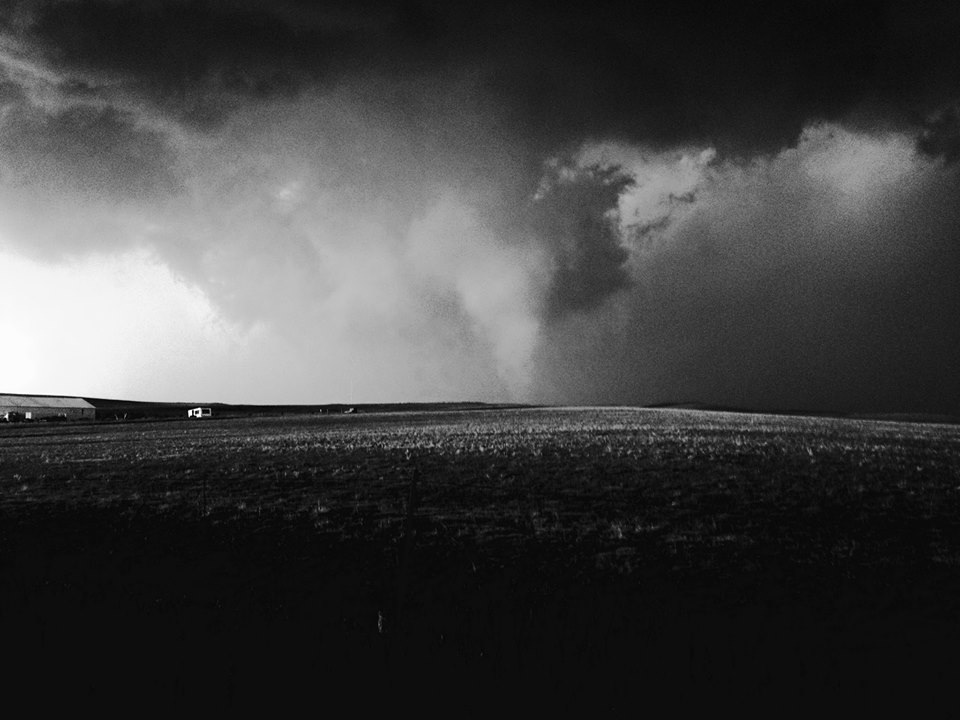
Northern Colorado, storm chase tour (Photo: DY, 2012)
Over the weekend I was fiddling around with some photos using the editing tools on my computer, when I reminded myself of an important lesson, buttressed by scientific research: When it comes to using my discretionary cash, I am more likely to derive longer-term happiness by spending it on experiences than on material possessions.
Jonesing for bad weather
The photos were taken during a 2012 storm chase tour with Tempest Tours, a company that offers storm chasing expeditions into America’s tornado alley for enthusiasts of bad weather, led by highly experienced storm chasers.
I have been drawn to tornadoes ever since I was a very young child, when one passed through our NW Indiana neighborhood. (I’ve told the story in more detail here.) This fascination has continued well into my adult years, to the point where I’ve devoted to several vacations to storm chase tours with Tempest. In fact, one of the most exciting days of my life was the first day of my first chase tour in 2008, when our group intercepted a single supercell in northern Oklahoma that spawned multiple tornadoes throughout the afternoon and early evening.
My summer 2012 tour happened to deliver a great week of storm chasing, even without the benefit of post-facto tornado verification. We had a wonderful group of people that simply jelled, and thanks to our expert lead guides, we witnessed memorable storms, including several tornadoes.
But just how many tornadoes remains uncertain. One of the notable characteristics of that tour was encountering a number of “Is it or isn’t it?” views of possible tornadoes. You see, not every tornado is a sharply defined funnel from cloud to ground, with a visible debris field at the bottom. Light, distance, and angles may make it difficult to discern whether a funnel has actually reached the ground, thus becoming an “official” tornado.
So here I am this past weekend, playing around with photos from the 2012 tour, especially the “Is it or isn’t it?” shots. By using the photo enhancement tools on my Mac, I was able to make out various funnel clouds and apparent tornadoes on the ground. Four years after the fact, I now understand that we witnessed more tornadoes than originally met the naked eye!
Studies tell us…
I have great memories of these chase tours, and I’m still in touch with many of the professional storm chasers and fellow tour guests. Now, I don’t blame anyone for questioning the wisdom of someone who wants to spend precious money on a week of traveling thousands of miles in vans, eating grab & go meals from fast food restaurants and convenience stores, and staying in motels that will never be highlighted in travel guidebooks.
But for me, it’s an awesome experience that gets into my bones.
As I noted above, this isn’t just me talking. A growing body of psychological research suggests that, when we are making discretionary spending decisions, using our money to create good experiences rather than to accumulate more “stuff” will likely create greater happiness over the long run. Experiences, studies tell us, have staying power. They become a part of us, sometimes even more positively as time goes on. (Remember that vacation when everything seemingly went wrong? Now it’s the stuff of great stories.)
New possessions, by comparison, may give us a momentary new morale boost, but after that, the happiness they bring tends to level off. (Think about the fleeting pick-me-up of “retail therapy.”)
Overlaps
This is not to say that we do not derive satisfaction from buying nice things. After all, how we use, consume, or view them can provide ongoing pleasures, i.e., they may help us to create experiences.
Think about a favorite book, movie, game, item of clothing, or piece of art. Or new cooking utensils that lead to delicious meals. And, yup, the computer that enables us to sort out and play around with our collections of photographed memories.
Sometimes good experiences overlap directly with buying stuff we like. For example, I love checking out used bookstores and used book sales, and I confess that I get a little soggy over some of my book buying expeditions.
I get it
But I understand the larger point. As I scroll through this personal blog, I sense my energy levels rising when I write about favorite experiences, which include singing with friends, extended visits with friends and family, quick weekend trips, holiday rituals, and even academic conferences in the company of great people. They contribute to the fabric and richness of my life, often in ways that my latest purchases cannot.
That’s something to think about whenever I walk into a store or browse the retail world online. Better to seek out stormy weather, yes?
Three years ago in Boston
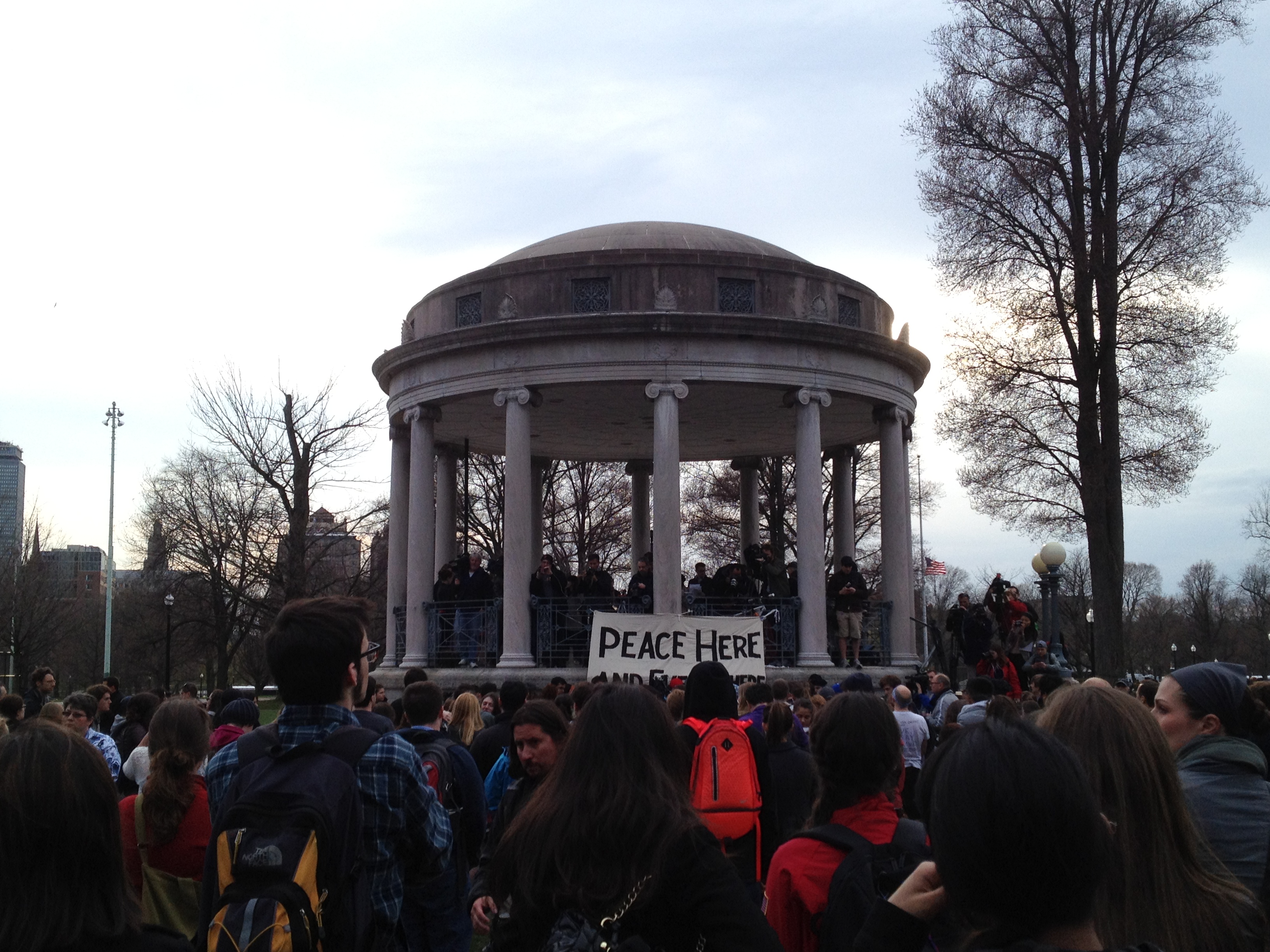
Peace vigil, Boston Common, the day after the Marathon bombings (April 2013; photo: DY)
Here in Boston, we are observing the third anniversary of the Boston Marathon Bombings. As recounted by the History Channel:
On April 15, 2013, two bombs went off near the finish line of the Boston Marathon, killing three spectators and wounding more than 260 other people. Four days later, after an intense manhunt that shut down the Boston area, police captured one of the bombing suspects, 19-year-old Dzhokhar Tsarnaev, whose older brother and fellow suspect, 26-year-old Tamerlan Tsarnaev, died following a shootout with law enforcement earlier that same day.
This was one of the saddest and most dramatic weeks in the city’s history.
Here’s what I wrote about the scene captured in the photo above for my Minding the Workplace professional blog, the day after the bombings:
Had you been transported to Boston’s busy Downtown Crossing area at lunchtime today, it may not have been evident that just the day before, at least three people died and over a hundred were injured (many severely) by two bombs that were detonated near the finish line of the Boston Marathon, a few short subway stops away.
You would’ve seen the usual scurrying about, with some folks carrying bags from quick shopping trips, and others lining up at one of the food carts for a bite to eat.
. . . Just another working day, yes?
Hardly. You can’t see what’s going through everyone’s minds, but mark my words, very few people were not in some way distracted, anxious, preoccupied, upset, angry, or grieving. I don’t think a lot of work got done today.
. . . Boston has been changed forever. . . Yesterday, this often insular, tribal city was forced to mature and identify with cities around the world in a terribly painful way.
But very early this evening, I found myself embracing a piece of the parochialism that at times I have struggled with so mightily. Walking through the Boston Common, I could see what appeared to be a peace vigil ahead of me and made out the sounds of a choir.
. . . (T)he choir was singing “Danny Boy,” and it sounded beautiful.
Adult student enrolling in Hogwarts

Many years ago, my long-time friends the Driscolls gave me the first two books in the Harry Potter series. Give them a try, they said. All five family members were big Harry Potter fans, and they thought that I might enjoy the books.
I did give the first book, Harry Potter and the Sorcerer’s Stone (known as Harry Potter and the Philosopher’s Stone in the U.K.), at least a half-hearted try. But after a couple of chapters, I put it aside. I’ve never been into the fantasy genre, and despite the legion of grown-up Harry Potter aficionados, I just couldn’t see what the big deal was all about.
Fast-forward to this week. It dawned on me that I’ve read rave comments about the Harry Potter series from favorite writers, ranging from Stephen King to Brené Brown, praising the stories and their insights on the human condition. I’ve also admired author J.K. Rowling for her down-to-earth demeanor and sense of social responsibility. So I posted on Facebook that I was thinking of giving Sorcerer’s Stone another try, and several friends share effusive praise for the books.
(Slight spoilers ahead…)
I’m now about 100 pages into Sorcerer’s Stone. Folks have cautioned me that it’s a little slow going at first, that the set-up takes a while to build, and that the story won’t start to sparkle until later in the book.
And yet, I already find it charming, engaging, and very, very clever. Of course, as someone steeped in workplace anti-bullying work, I couldn’t help but to pick up on the bullying themes in Harry’s life with the Dursley family. Now Harry is preparing to enter Hogwarts, and I’m excited for him. With Hagrid’s help, he is picking out his school supplies. Rowling captures beautifully the anticipation and nerves that go with starting a new school.
I haven’t read many fantasy or children’s books, but I can tell a great storyteller from an okay one, and this early foray into Harry Potter’s world is enough to show me that Rowling is a brilliant writer. Her ability to create vivid detail and her sense of empathy and humor come through from the start.
Being something of an Anglophile, I love the little references to London, including the Underground and Platform Nine and Three-Quarters at the King’s Cross rail station. As someone who has been around schools and public transportation all my adult life, maybe I’m already identifying with parts of the story!
On Facebook, one of my friends suggested that I suspend my grown up reader’s worldview and let the inner child in me enjoy the stories. The only problem is that I didn’t like to read fiction as a child. I emphatically preferred non-fiction, and my 11-year-old self would’ve rebelled at having to read the Harry Potter stories. Even today, I estimate that some 80 percent of my personal library is non-fiction.
No, mine is more a tale of arrested reading development. Call me a late bloomer, but it’s a twist that I’ve had to go deep into adulthood to be “ready” for the Harry Potter series.
It may take me another week to finish Sorcerer’s Stone, as lately, I haven’t been one to rush through novels and stories. But I’ve already got Harry Potter and the Chamber of Secrets ready to go, so it appears that I am matriculating into Hogwarts as an adult student. Better late than never.
Good food and sights in Boise

Tasted even better than it looks (photo: DY)
One of the benefits of being in academe is the opportunity to travel to interesting and new places for various academic events. I had the pleasure of making a quick trip to Boise, Idaho, to participate in a conference on equality in employment at the University of Idaho College of Law. The conference itself was excellent, and it gave me a chance to see something of this beautiful, compact city.
The unexpected bonus was the delicious food. The University of Idaho treated us to a couple of wonderful dinners at local restaurants, including a first-rate steak at a place called The BrickYard.
In addition, I met up with long-time friends and colleagues Gary and Ruth Namie, founders of the Workplace Bullying Institute, for breakfast on Saturday before catching my afternoon return flight to Boston. They took me to their favorite breakfast place, the Original Pancake House, famous for its apple pancakes that take 45 minutes to cook. I managed to polish off my plate pretty quickly.
In case you want photographic proof that I saw more of Boise than its eateries and a university conference room, here’s a shot of the beautiful State Capitol building, located in the city’s downtown.

Idaho State Capitol, Boise (photo: DY)
And although you can’t see much of it, here is Boise State University’s football stadium, featuring its famous blue field.

The blue gridiron (photo: DY)
Learning about the 1916 Easter Rising
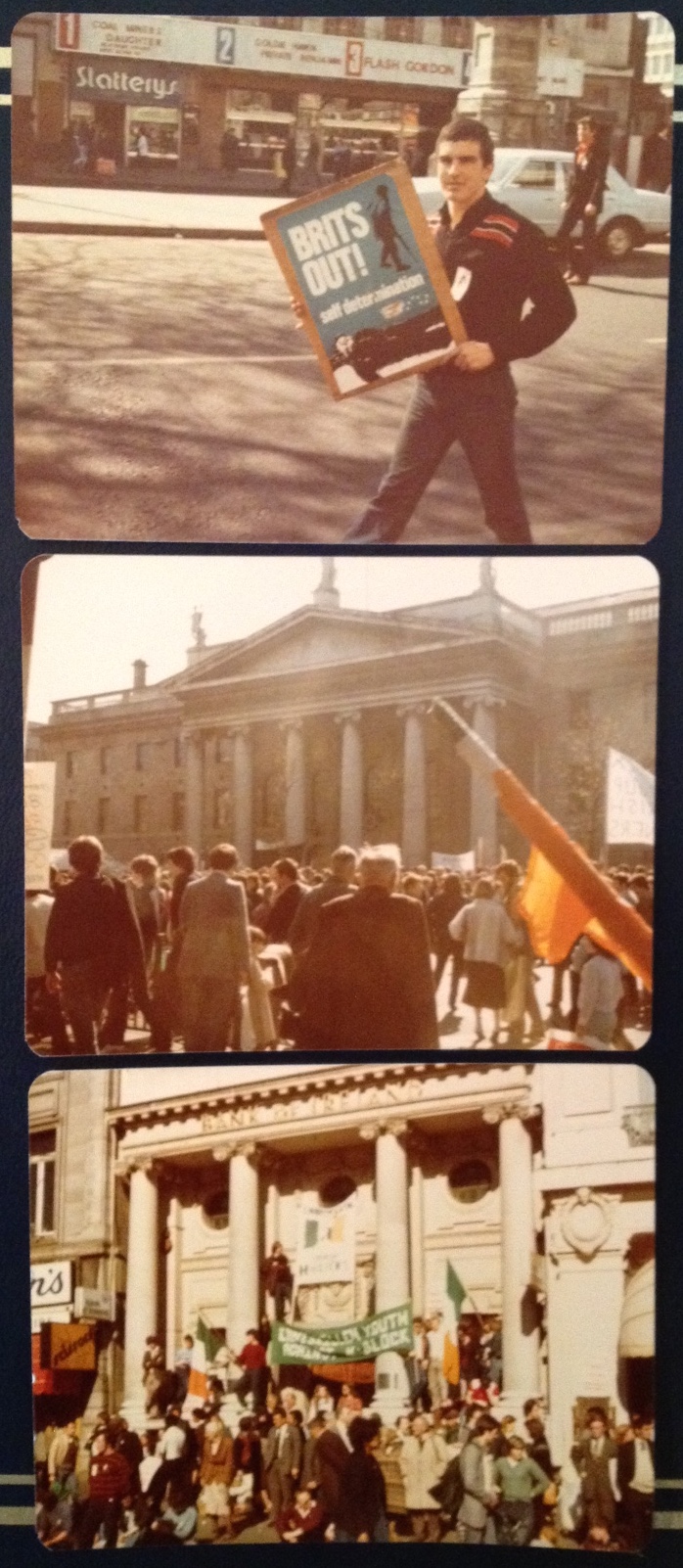
Easter weekend in Dublin, 1981 (photo: DY)
The 1916 Easter Rising was an armed insurrection centered in Dublin, and led by Irish Republicans who opposed British rule and sought to establish an independent Irish Republic. Although the Rebellion was quashed, it planted the seeds for British-Irish relations during the 20th century and remains one of the most significant events in Irish history.
As I wrote here last year, I became interested in this subject during a 1981 collegiate semester abroad in England. “The Troubles,” as they were dubbed, had reached tumultuous and violent stages. Irish political prisoners were staging well-publicized hunger strikes, and a prominent Irish Republican Army leader, Bobby Sands, was among them. (He would die in prison that May.)
I devoted part of my spring break to visiting Belfast and Dublin, and the tensions were evident. I was in Dublin over Easter weekend, which marked the 65th anniversary of the Easter Rising. A large, boisterous protest and rally ensued in the downtown.
I’ve put together three snapshots from that event. During the protest march, a young man stopped to allow me to take the photo at top.The rebel headquarters for the Easter Rising was the General Post Office, shown in the second photo above. The third photo was taken in front of the Bank of Ireland.
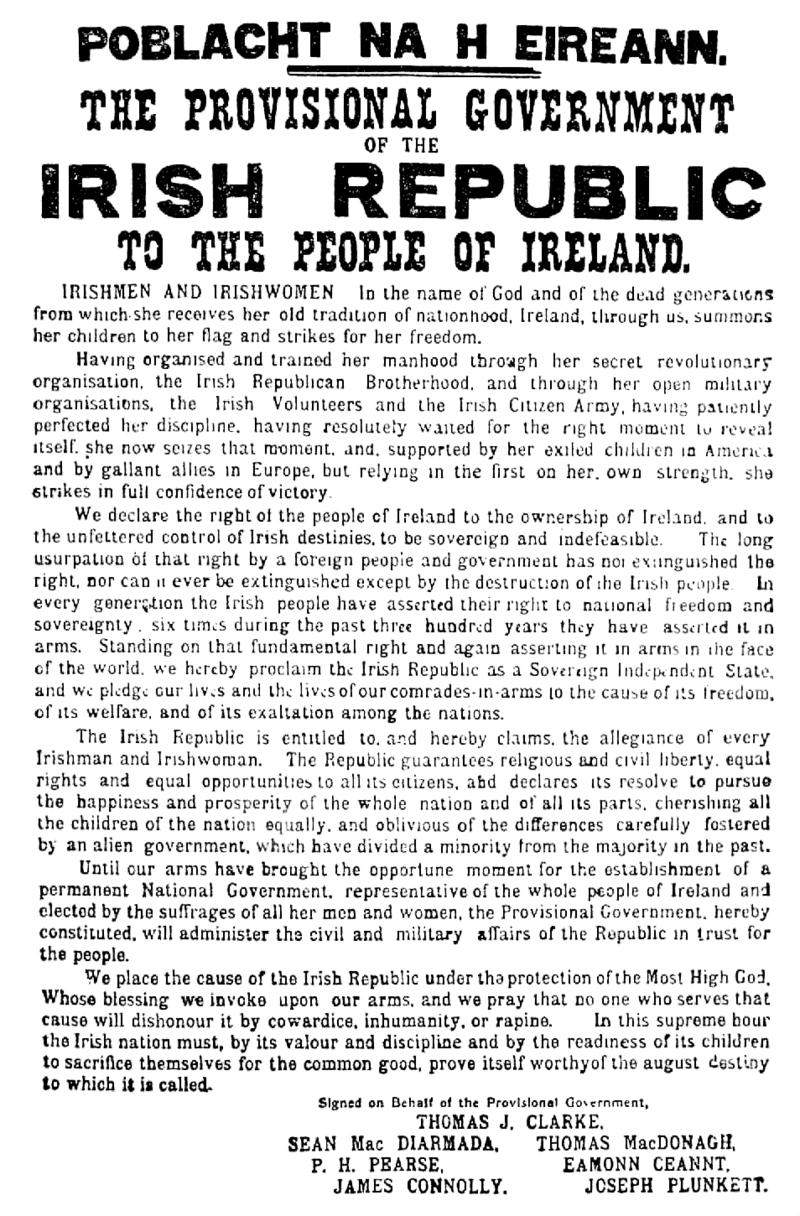
And here’s the 1916 Easter Proclamation:
A view from the Garden

This 1940s wartime era photo prompts a nostalgic moment for me, even if I wasn’t around back then and my soggy sentiments have nothing to do with the picture itself. This is the old Madison Square Garden in New York City, and the marquee features coming sporting attractions, including basketball games featuring Valparaiso University (my undergraduate alma mater) and New York University (my law school alma mater).
Valparaiso posted the pic to its Facebook page in connection with the appearance of the current men’s basketball team in the semifinal round of the National Invitation Tournament, which will be played in the modern Madison Square Garden next week. This year’s squad has set a school record for wins, including three in the NIT. A victory against Brigham Young University on Tuesday will put them in the tourney championship game, to be played later in the week.
The vintage photo shows VU players arriving for their game at the Garden. VU’s war-era team was one of the nation’s best, thanks to its successful recruiting of talented players who were too tall to enter military service. The team traveled all the way from the Hoosier State to play Long Island University, no small journey in the days before jet airliners.
The second marquee game featured NYU hosting Colgate University. NYU was a major college sports presence during the first half of the last century, and its basketball team played in many of the prominent arenas along the east coast. Today NYU is a non-scholarship Division 3 school, with men’s and women’s basketball teams playing very competitively at that level.
***
We all have our personal narratives, and part of mine involves growing up and going to college in northwest Indiana, discovering something of the world during a final collegiate semester abroad, and then heading off to law school in New York City. To see both Valparaiso and NYU on that marquee, located on the wondrous island of Manhattan, symbolically brings together two educational institutions that have played important roles in my life.
As for Madison Square Garden, when I lived in New York I watched my share of basketball there, mostly Knicks NBA games. It was still possible back then to get cheap tickets (four dollars, then eight dollars) to sit up in the nosebleed seats. But when the Knicks were on top of their game and the Garden was rocking, well, it didn’t matter where you sat, it was quite an event.
After VU’s home court victory over St. Mary’s of California that punched the team’s ticket for the trip east, the public address system played Frank Sinatra’s “New York, New York.” That was my song, too. I hope their Manhattan sojourn turns out as well for them as it did for me.
***
Related post
Clothes shopping: My imitation of a Japanese bullet train

It takes forever to remove all the detritus
As faithful readers of this little blog might guess, I can spend an hour in a used bookstore, and ultimately leave with a $5 bargain and a smile on my face.
But when it comes to clothes shopping, I can drop $200 with the speed of a Japanese bullet train, out of pure desperation to minimize the misery of the experience.
There are few tasks that I enjoy less than shopping for clothes. When I can, I do it online. But sometimes it’s easier to bite the bullet (there’s that word again — this topic gets me violent) and head over to Macy’s in downtown Boston, where I will do a super quick grab & pay for whatever I need.
And so it was a few days ago, when the sorry-a** state of my wardrobe demanded a replenishing of dress shirts, pants, socks & underwear, and a few other things I seem to have already forgotten. As I made my instantaneous choices, with an eye out for sales signs, the stuff was falling out of my arms. Within a few minutes, I plunked down my credit card and assessed the damage. Mission accomplished, I rushed out to reconnect with civilization.
I hauled all it home on the subway, and the next day I started the arduous process of removing the packaging. It took me almost as long to remove all the stickers, tags, tape, needles, and those make-me-homicidal little plastic fasteners as it did to buy the clothes in the first place. I will never be able to recover those minutes of my life. They’re gone — poof.
By contrast, this is why Hawaiian shirts are my top garment of choice: You open the package, you remove a sticker or tag or two, it’s ready to wear, and it’s comfortable. No drama, no multiple-safety-hazard needles, no stiff cuffs or necks to cramp my style — to the extent I have a style.
Anyway, I have survived my annual/semi-annual/whatever clothes shopping ordeal, and now I can breathe easily. I don’t think I’ll have to enter that retail zone again for at least another half year. Phew.
Server down + St. Pat’s Day = Playing hooky
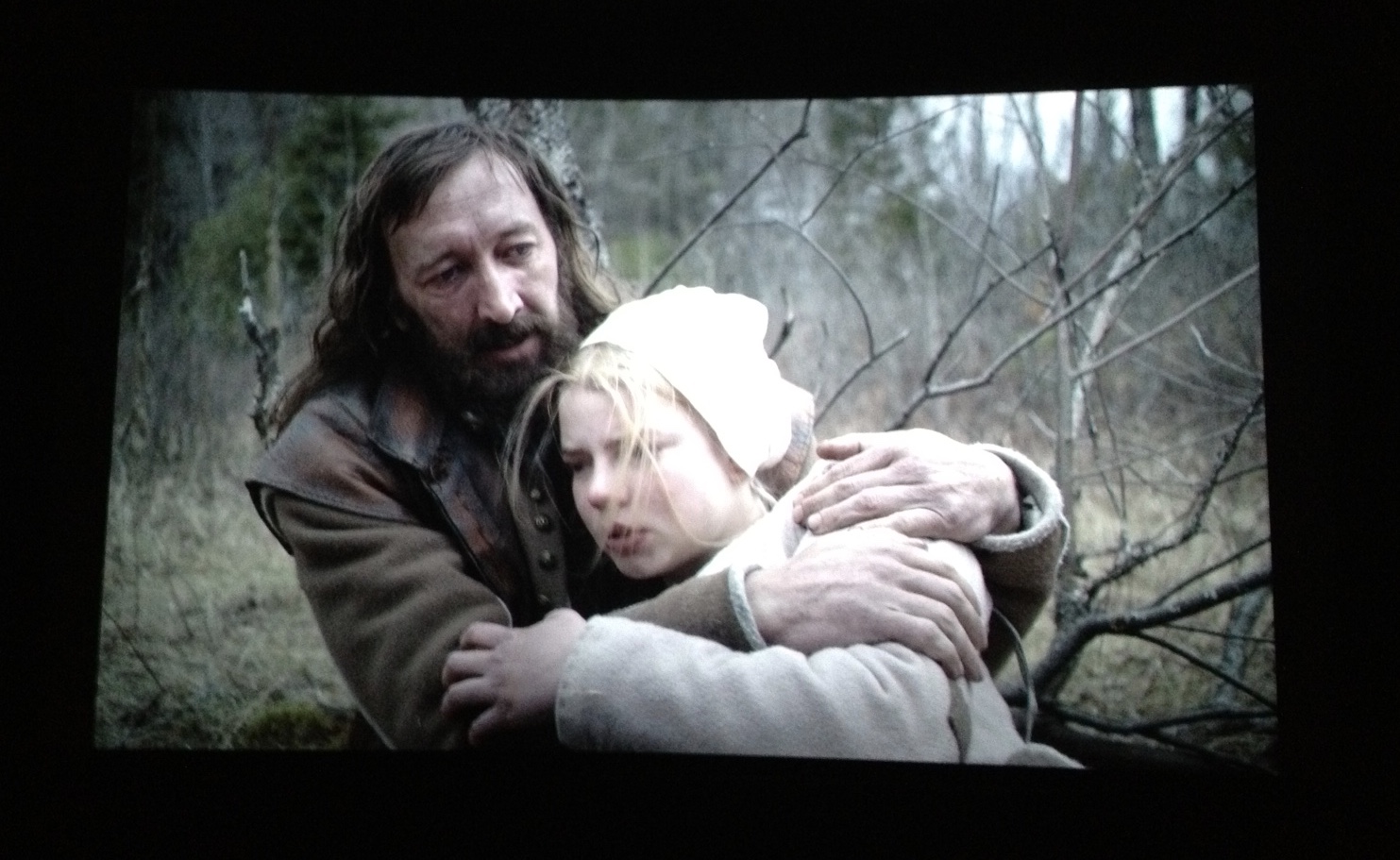
Not to be seen alone, in my case, completely so!
It’s spring break week at my university, and I’ve been using the time to get caught up on a variety of writing projects and other commitments. Yesterday I intended to dive into edits of a couple of articles I’m working on, but the university server was down and I couldn’t access the files I needed. It was St. Patrick’s Day anyway, so I figured, why not take the afternoon off? And that I did.
It started with a matinee viewing of “The Witch,” a chilling film set in 1630s New England, some 60 years before the infamous Salem Witch Trials. Here’s how IMDB describes it:
William and Katherine lead a devout Christian life, homesteading on the edge of an impassible wilderness, with five children. When their newborn son mysteriously vanishes and their crops fail, the family begins to turn on one another. ‘The Witch’ is a chilling portrait of a family unraveling within their own fears and anxieties, leaving them prey for an inescapable evil.
Pictured above are the father, William (Ralph Ineson), holding his oldest daughter, Thomasin (Anya Taylor-Joy). The cast is excellent, with Taylor-Joy delivering an especially exceptional performance.
Please don’t be concerned that I was disturbing fellow movie goers by snapping that photo with my iPhone camera. You see, there was no one else in that theatre. (That’s a first for me.) Although “The Witch” has received strong reviews, it has been out for a while, and I guess St. Pat’s revelers were in no mood to watch a movie that might cause them to feel guilty about their earthly behaviors.
After the movie, I walked over to the nearby Brattle Book Shop, my favorite used bookstore in the Greater Boston area, and found a few affordable goodies, including a couple of gifts for friends. I visit the Brattle at least once a month, sometimes more often. When the weather is decent, their big draw is an array of outdoor book carts in their adjoining lot, containing thousands of wonderful bargains priced at $5, $3, and $1.
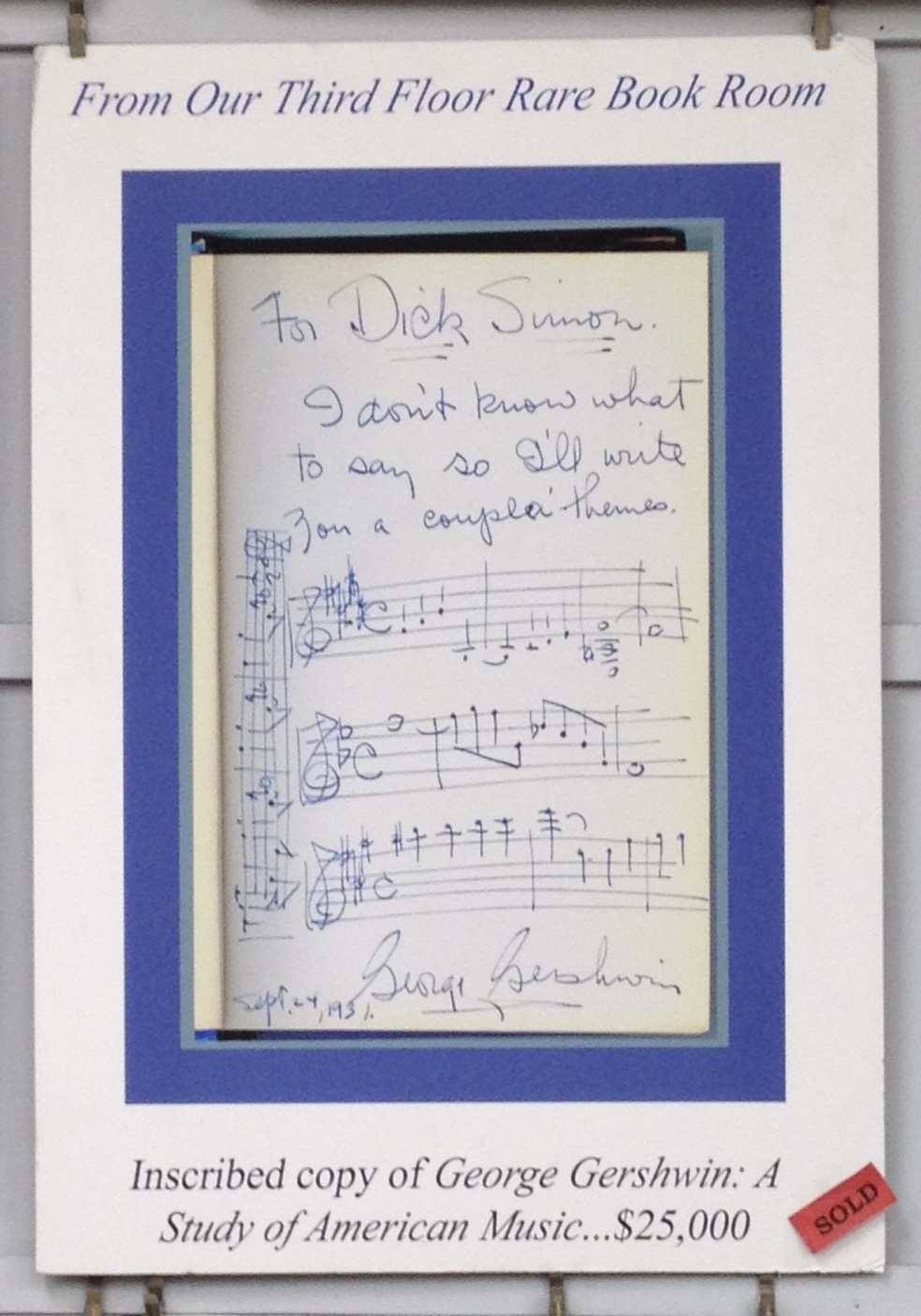
However, higher end collectors will also find plenty of treasures in their rare book room. Here’s a photo of an item they sold for a tidy sum. Nope, despite my love of anything Gershwin, I was not the buyer. (I’m opting to pay my mortgage this year instead.) But I did pick up a couple of songbooks with selections from that era for only five bucks a pop. Not a bad deal if I say so myself.
 Musings of a Gen Joneser
Recent Comments