Campus nostalgia
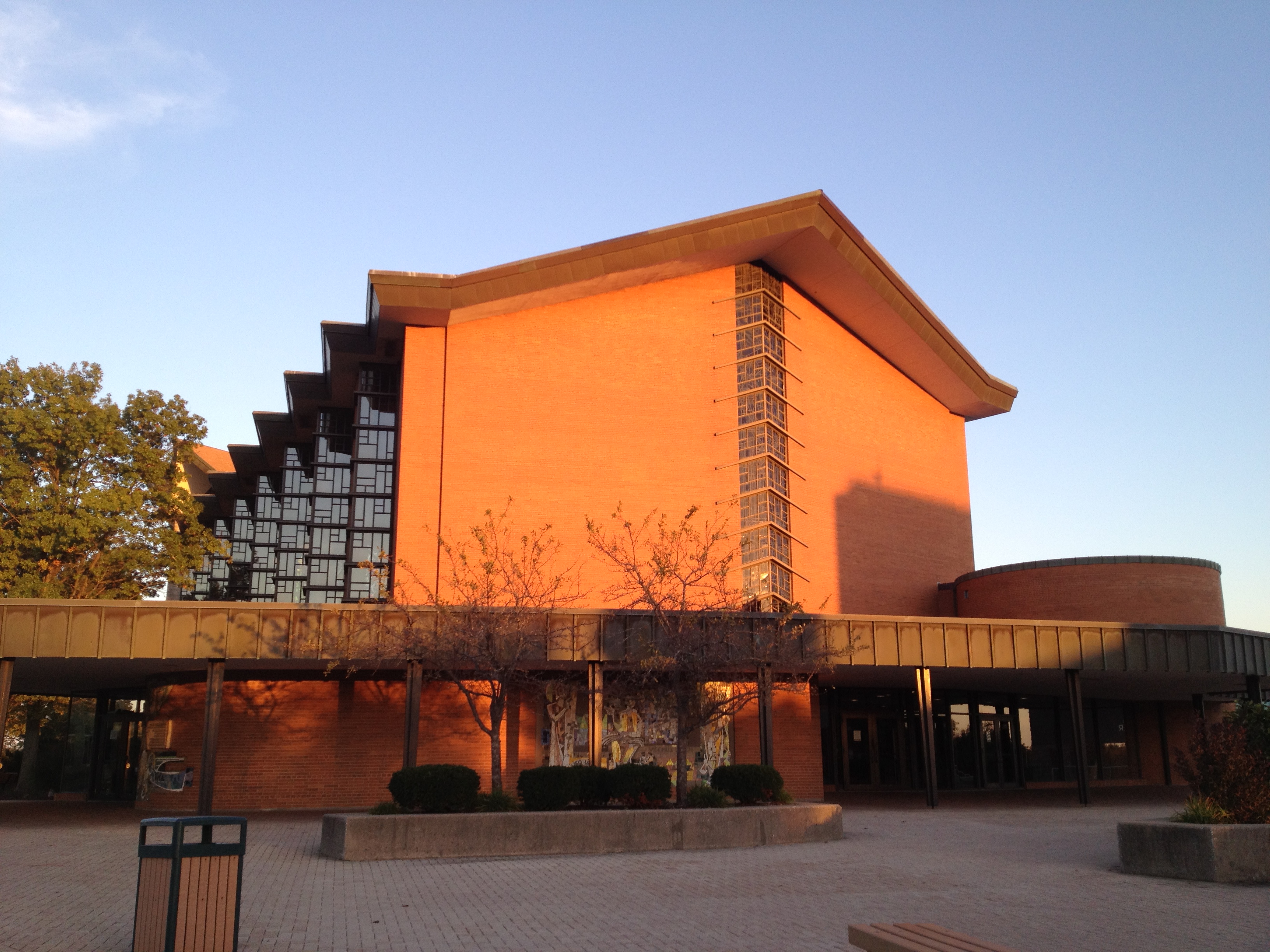
Valparaiso University’s Chapel of the Resurrection at sunset, Fall 2016 (photo: DY).
I spent much of last week attending a conference on psychological health and safety in the workplace, held at the University of Washington in Seattle. Mostly because of my terrible sense of direction (even with Siri and Google maps at my disposal), I saw a lot of this large, beautiful campus. I imagined how lovely it must be to walk these grounds every day as a student.
Furthermore, traipsing around this college campus activated my strong sense of nostalgia for my own undergraduate years at Valparaiso University in northwest Indiana. So if you have a few minutes, please indulge this trip down memory lane….
The modern VU presents an appealing campus and aligns the downtown of a small city that has come a long way since my student days. But when I matriculated in the fall of 1977, the city of Valparaiso was considered to be on the far outskirts of the Chicagoland region. It felt like something of an outpost.
The campus itself was in great need of repairs and upgrades, with a lot of old, ramshackle structures actively used to hold classes, host cultural and sporting events, and house faculty offices. I can now romanticize about the overall shabbiness of the place, but in truth, much of the physical plant was a showpiece of deferred maintenance.
Its rundown appearance aside, Valparaiso University of that time delivered a quality classroom education, thanks to many dedicated, able professors who cared about helping undergraduates of widely varying levels of maturity find their ways forward. Although few were prolific scholars (punishing teaching loads made sure of that), many were true intellectuals.
Two aspects of my VU years were especially meaningful and life changing: Serving as a department editor of The Torch (VU’s student newspaper), and spending my final semester at VU’s study abroad center in Cambridge, England. In addition, Valparaiso planted seeds of many friendships that are now lifelong.
These elements would infuse the heart of a 2017 essay, “Homecoming at Middle Age,” which contains deeper remembrances of, and reflections on, my VU years. The process of writing the piece — inspired by several weeks spent on campus during a research sabbatical the year before — clarified the long-term meaning of my college years in gratifying ways. Rather than trying summarize all of that, I’ll simply invite you to click here for the published version in The Cresset, VU’s long-time review of literature, the arts, and current events.

Literary origins
More recently, I have found the college experiences of some close VU schoolmates to be much more interesting than my own. Among other things, I see in their VU days a clear path to creative and literary passions that animate them to this day.
Sorting through a box of mementoes recently, I unearthed an issue of The Darkling Thrush, an indie literary magazine published by VU pals as an alternative to the university-funded undergraduate journal. In the era before desktop publishing programs would offer their multiple fonts, templates, and fancy graphics, publications like The Darkling Thrush had a definitely home brewed look. I don’t know if the term zine was in use during the early 1980s, but this lovingly photocopied and stapled publication certainly qualified for the label.
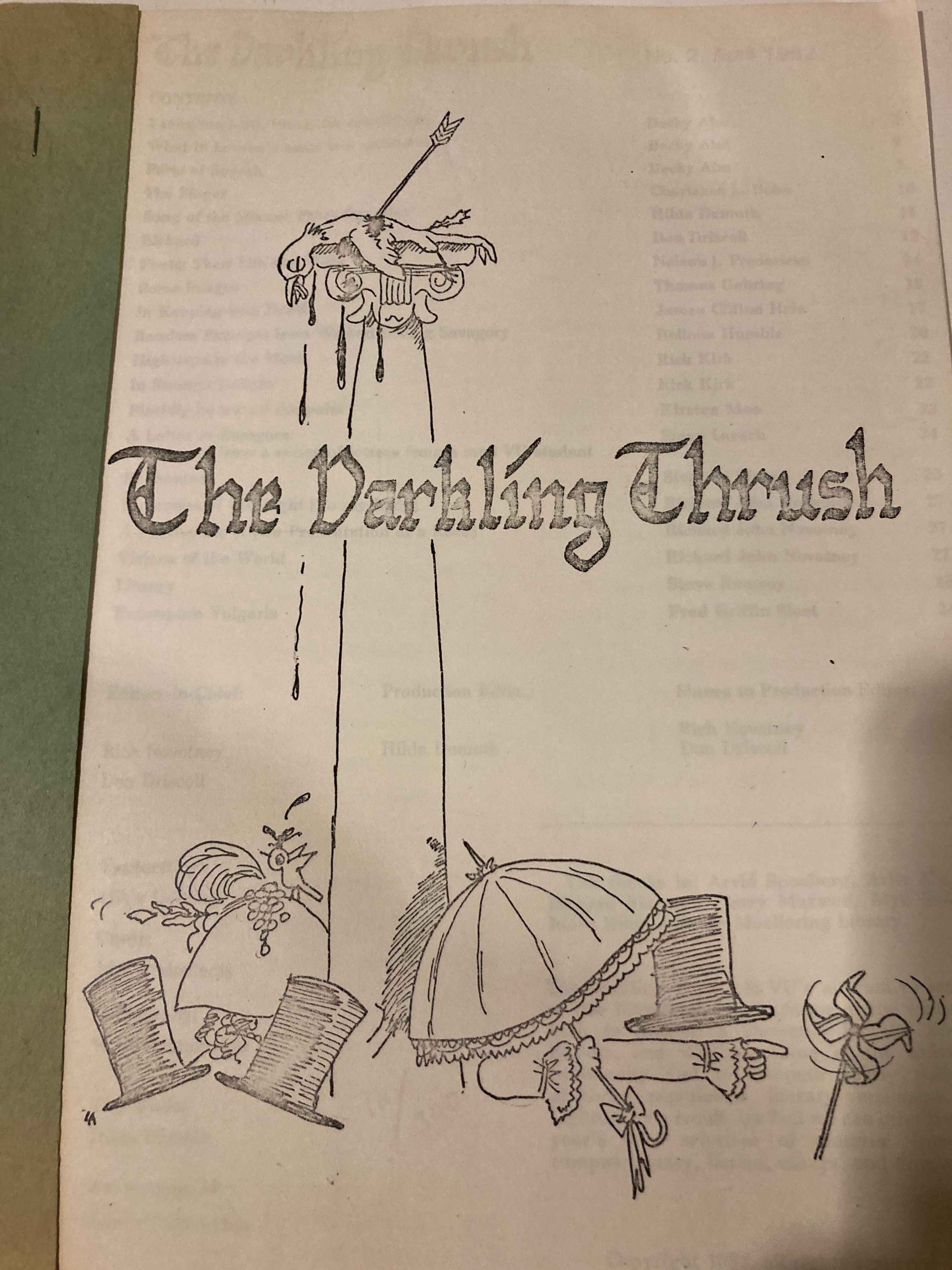
Photo: DY

Photo: DY
And talk about origin stories! The table of contents and editorial masthead — click the photo on the right — listed names of several dear friends whose literary interests still burn brightly. To wit:
Hilda Demuth-Lutze has authored several published volumes of historical fiction, with her next work coming out soon. Rich Novotney is a published author with several promising works of fiction in progress. Jim Hale became a reporter at a couple of daily newspapers. (I suspect that a creative writing project or two may come from Jim as well.) Don Driscoll has long been a discerning and prolific reader of fiction and history, and he is often asked to comment on drafts written by our friends.
***
By comparison, you won’t see my byline in any campus literary journal from our VU days. Unlike my more cultured schoolmates, I was not a very intellectual collegian, nor did I want to be one. I greeted literature and the fine arts with a Philistine phalanx of resistance so strong that even my awakening semester abroad in England could barely make a dent. Why, I protested, should we bother with a Shakespeare play or an art museum, when we can hang out and talk about our favorite TV show theme songs instead? (I’m happy to report that my cultural tastes have expanded and matured since then.)
Overall, I was a striver, not a scholar. I worked hard to get good grades because I wanted to go to law school, with plans to pursue a career in public interest law and politics. Happily, the law school part worked out very well. A year after graduating from VU, I would pack my bags for New York City to pursue my law degree at New York University. But omigosh, I was a pretty callow young man when I made my way to the East Coast.
***
Among my VU friends mentioned above, Hilda and Rich are working on book projects with the university as a featured location. I’ve seen from their posted Facebook comments and photos describing recent visits to the VU campus that those days of yore carry a lot of meaning for them.
Perhaps like me, but with literary panache, they are writing in part to more deeply understand the meaning of our collegiate years and those early chapters of our lives generally. I know that writing the 2017 reflection on my VU days was so clarifying that I closed the piece this way:
We cannot change the past, but subsequent events, new understandings, and mature reflection can change how we regard it. It took me many years, and some negotiation, to recognize VU as my alma mater in the truest sense of the term. Today I am grateful for this renewed and positive relationship, which includes a quality education of lasting impact and a cohort of treasured, lifelong friends. After all, in a world more uncertain and fractured than it was some thirty-five years ago, we need these healthy human and institutional connections to help us navigate it.
Thus, I will be very curious to read my friends’ respective takes on their student lives at our shared alma mater. And because their VU days were a lot livelier than mine, I won’t blame them if their tales are safely fictionalized to protect the guilty, and perhaps even relocated in time. It will make for some fun speculation.
Transitions, sad and happy
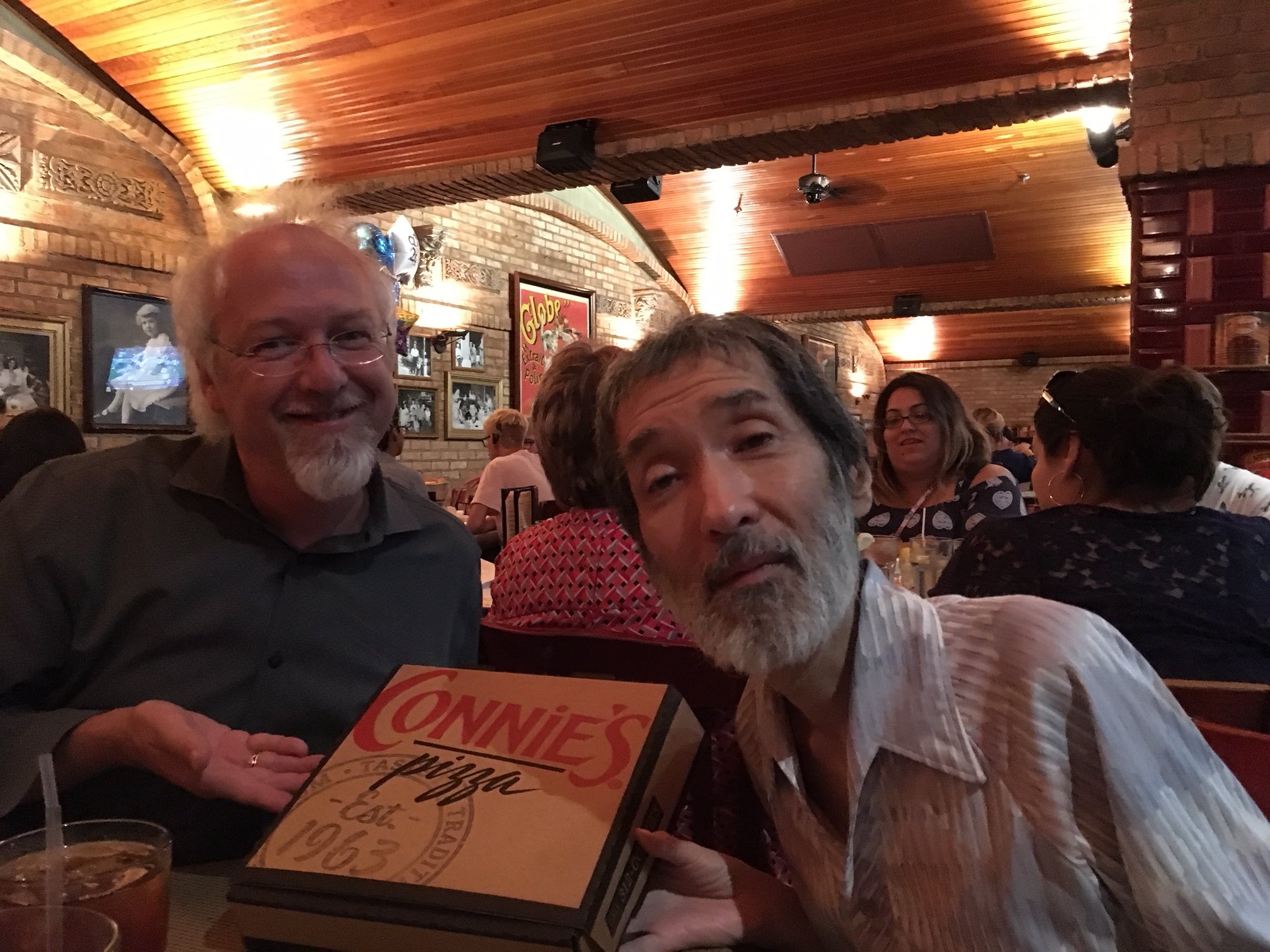
Get togethers with Jeff often included pizza at a Chicagoland eatery. Here’s Jeff (r) with our long-time Mark (l), a bond going back to elementary school.
It has been some time since I’ve posted to this blog. For reasons that will quickly become clear, it is appropriate for transitions to be the centering theme of this entry.
Jeffery P. Yamada (1961-2024)
The very sad transition that I must report is the passing of my brother, Jeff Yamada, last October, after a short illness.
Jeff was a kindhearted soul and an intelligent and stubbornly independent individual. He was always true to his own rules and values and never got caught up in popular trends. He lived minimally, took strong umbrage at the rightward political direction of the nation, and often positioned himself at the edge of the grid.
My brother grew up in northwest Indiana and spent most of his adult life living in Glen Ellyn, Illinois. After studying graphic arts at Hammond Gavit High School and at Indiana State University, he became a self-taught techie who set up and fixed computer systems, both for fees and (very often) for free. Many family members and friends owe him thanks whenever they turn on their computers.
Jeff is dearly missed by his family and a coterie of long-time friends. Although he had some health issues that contributed to his early passing, and our family had lost older cousins of this generation, he was the first of my more immediate age cohort of siblings and cousins to die. This was a jolt to some of us.
Jeff also died without a will, just weeks before he turned 63. I will gently use this opportunity to urge all of us to get our affairs in order earlier than later. Without such directives, the legal and personal challenges of settling one’s estate multiply considerably.
I know that after our mom passed in 2002, Jeff missed her dearly. (So do I….) I hope that somehow, some way, he is reunited with her.
(The photo above captures what became an informal ritual when I would return to the Chicagoland area for a visit. Jeff, our long-time friend Mark, and I would meet up at a local pizza place for a bite to eat and to catch up on things.)
Phasing into semi-retirement
The happier transition to report is that this fall, I am starting a voluntary phased retirement program at my university. For the next three academic years, I’ll be assigned a half-time teaching load with a proportionately lower salary. It’s a smart, gradual off-ramping approach from a full-time teaching career that just concluded its 34th year.
That said, I’m not going anywhere. I will stay professionally active even after this phased retirement period concludes. I will remain visible as a scholar, advocate, and subject-matter expert on workplace bullying, therapeutic jurisprudence, and similar topics that have been deep focal points over the years. I also plan to continue teaching on a very part-time basis. In addition, I will maintain a set of active volunteer commitments to various non-profit boards and advisory groups.
But as much as I have enjoyed teaching and working with a lot of wonderful students, I will not miss the piles of final exams and term papers to grade at semester’s end. Furthermore, after teaching on Monday and Wednesday evenings during both semesters for many years, I’ll be happy to be free from the built-in structure of an academic schedule.
I’ll be even more delighted to jettison the various faculty and committee meetings that can eat up so much of academic life. If there’s one aspect of my academic job that has failed to return equivalent satisfaction in terms of time and energy invested, it’s this one. So much time goes into supporting good ideas that never come to fruition and opposing bad ideas that somehow manage to gain momentum.
Overall, I’m happy to be stepping away from my full-time professorial job on my own terms. It has been a good run and a tremendously rewarding career in many ways, and now it’s time to strive for the kind of work-life balance that has largely eluded me on this journey so far. This will include more socializing, karaoke singing, quality binge viewing, reading for pleasure and mental stimulation, and some travel, among other things. I’m looking forward to it.
Barcelona Dispatch
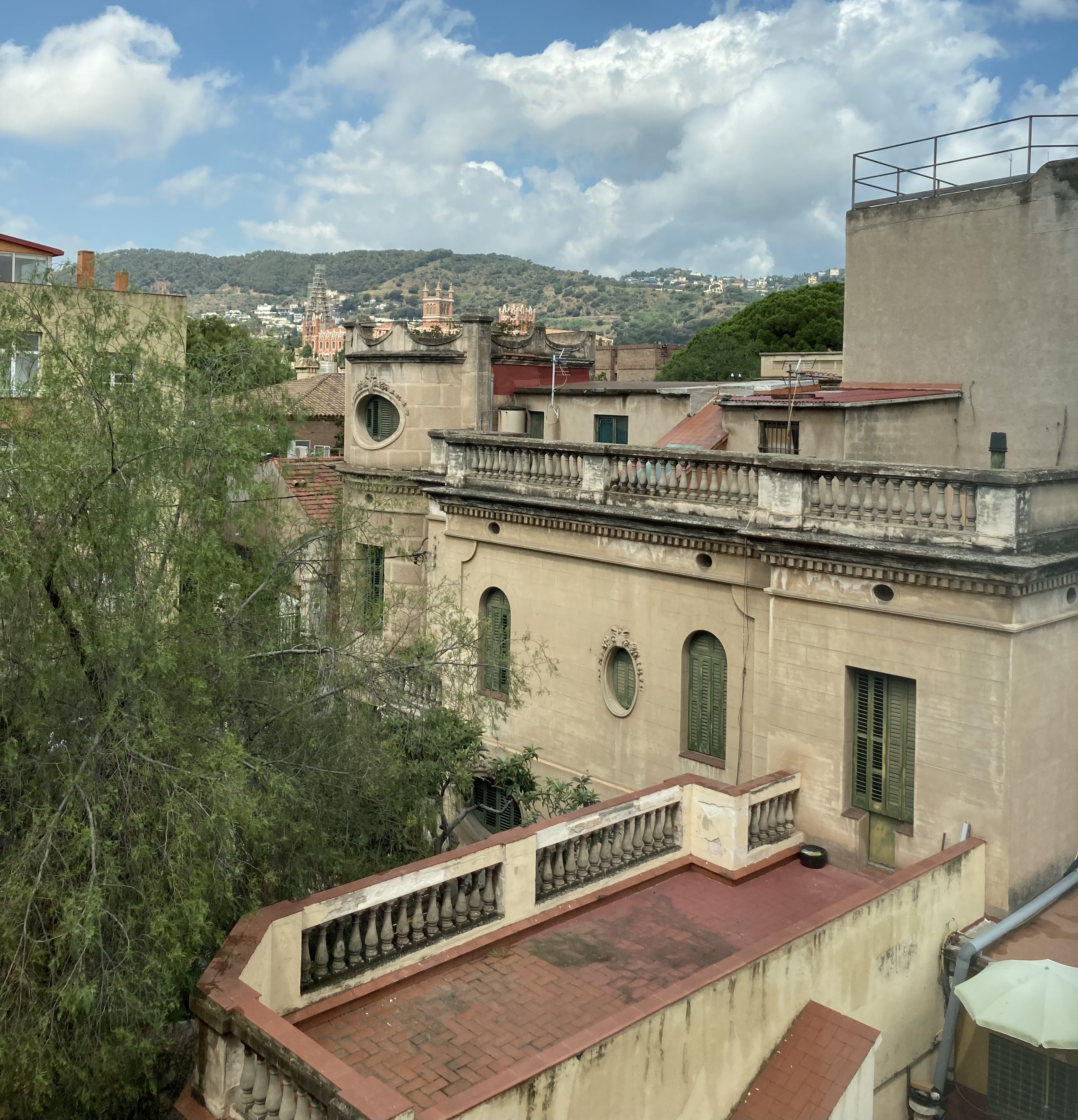
Hotel room view, Barcelona
I’m writing from a café in Barcelona, Spain, having spent the last week at the University of Barcelona Faculty of Law, attending and participating in the International Congress on Law and Mental Health. The Congress is a biennial conference organized by the International Academy of Law and Mental Health, held in different major cities. It attracts a global assemblage of scholars, practitioners, judges, and students, drawn heavily from fields such as law, psychology, psychiatry, and social work.
I’ll be flying back to Boston tomorrow morning. In the meantime, I’m sharing my three big takeaway reflections from this little sojourn.
First, among this historically literate group of conference goers, there was a strong sense that we are living in dangerous times. Although the Congress’s focus is not on large-scale politics and statecraft, its big-picture frame envelops the rule of law, human rights, individual and societal well-being, and psychological trauma. Attendees from around the world shared deep concerns about the rise of authoritarian leaders, which frequently infused conversations during session breaks and over meals.
The U.S. presidential campaign loomed large. Indeed, a Canadian friend and fellow conference participant was the first to text me that President Biden had withdrawn as the presumptive Democratic nominee. People are paying attention to what happens, deeply concerned about the critical damage that a Trump presidency would do to democracy, freedom, and the environment on a global scale.
Second, the conference itself served as an important reminder that for academics and others whose work is enriched by sharing our latest research and analyses, in-person gatherings still matter. The people drawn to this conference are doing compelling work in the broad intersections of law, public policy, mental health, and psychology. (For more on that, go here to read a short piece I posted to my professional blog.) While the pandemic, especially, has taught us that presentations can be delivered effectively via Zoom, in-person conferences and workshops create better space for informal conversations that stoke ideas, research, and practice and can lead to future collaborations.
And if the gathering is a good one, meaningful human connections emerge. Through this conference, I have met, and become friends with, so many remarkable individuals.
Finally, on a more personal level, I see changes in how I’m now regarding travel, especially the long-distance variety. This conference marks my first overseas journey since the 2019 International Congress held in Rome. Although the Congress is one of my favorite events, I opted not to attend the 2022 offering in Lyon, France, still feeling uncertain about the COVID situation. But I told myself that the Barcelona conference was the time to get back into global travel mode.
When I was doing my price comparisons, I found that I could save a bit of money by paying for another hotel night in Barcelona to avoid a more expensive return plane ticket. The extra time to enjoy Barcelona would be a bonus. But with the conference having concluded two days ago, and – more importantly — the special people with whom I spent so much time having departed, suddenly this worldly, historic, beautiful city has felt rather empty to me. Indeed, as an unintended experiment, my briefly extended stay has confirmed that (1) my sense of wanderlust diminished during the heart of the pandemic; (2) now when I travel, it’s much more about the who and the why, and less about the where.
And so, instead of spending my last sunny afternoon here doing more sightseeing, I’m hanging out in this café, with my thoughts veering back across the ocean. I’m catching up on emails, looking ahead at my schedule for the coming week, and — at least in my head — morphing back into regular life.
Thirty years in Boston: A contemplation
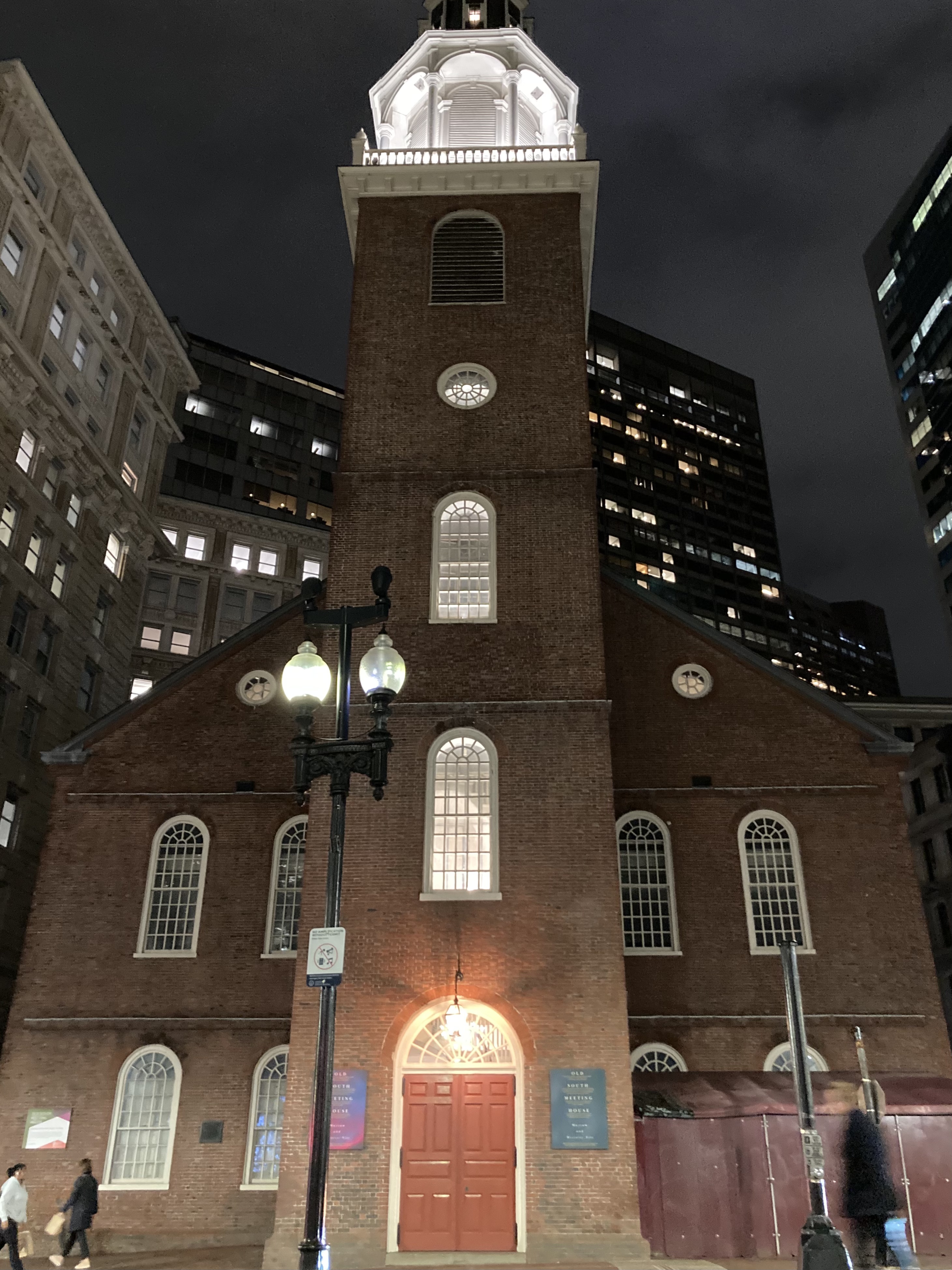
Old South Meeting House, Boston
Thirty summers ago, I packed my bags (and many dozen boxes — mostly books!) for a big move from New York City to Boston. The reason for my move was job-related. I had secured a tenure-track teaching appointment at Suffolk University Law School in downtown Boston.
This was the next step in what was turning out to be an unlikely academic career. In 1991, I returned to my legal alma mater, New York University, as an entry-level instructor in its first-year Lawyering program. That appointment came on the heels of six years of legal practice in the public interest sector. But I didn’t take the job because I thought of myself as an academic in the making. I just figured that it would be an engaging and fun opportunity.
However, I took to teaching immediately. It just clicked for me. Instructors in the Lawyering program were capped at three years, so during that time, I worked hard to make myself competitive for tenure-track appointments. I built a strong record of teaching and started publishing in the field of employment law. During the 1993-94 academic hiring cycle, I entered the tenure-track teaching market and eventually opted to take an offer from Suffolk. Located in the heart of Boston, and regarded as a law school with a historical legacy of opening doors to the area’s working class and emerging middle class populations, it looked like a good match for me.
I didn’t know much about Boston before I arrived here. Beyond a family trip to Boston during my early childhood, a few quick NYC-to-Boston trips to see baseball games at Fenway Park, and interviews at Suffolk Law, I had no on-site familiarity with the city. So, I assumed it was a sort of mash-up between a smaller version of New York City and a big university town, with a diverse, cosmopolitan look and feel.
Oh boy, was I in for a surprise.
Suffolk Law
You see, upon arriving in Boston, I quickly felt like I had moved to a city that seemed stuck in a time warp, characterized by a deep parochialism and struggles with issues of race. It was as if I had somehow traveled back in time some 20 years.
Unfortunately, the culture of Suffolk Law c.1994 was an insular one, very much embracing that regressive look and feel. It surely didn’t roll out the Welcome Wagon to newcomers — especially to those of us who weren’t part of its dominant demographic group.
Even as a pre-tenured professor, I openly confronted aspects of that culture, which led to some very stressful and lonely times. I won’t go into bloody detail here, other than to say that although my concerns were valid (or so agreed the American Bar Association, the Law School’s accrediting agency, in a scathing review of the school’s record of inclusion, prompted by a complaint I filed), they were not well-received by the institution. Accordingly, I knew that had to build a largely bulletproof tenure portfolio, and I did my best to make it so.
In 2000, I would earn tenure — only the second professor of color to do so at a law school that was then almost a century old. I certainly had some hard bruises to show for it. That’s why getting tenure felt more like a fist-pumping triumph over Suffolk than an achievement celebrated in partnership with it. The summer of my tenure year, I visited Maui, Hawaii, for a reunion of cousins. I came back with a large haul of Hawaiian shirts. I called them my “tenure wear” collection, a new wardrobe for teaching class. Out went the dress shirts and ties. I was making a statement: Hello, I’m baaaack!
To my surprise (and perhaps yours, dear reader), I have remained at Suffolk ever since. I still often wear my Hawaiian shirts to class, and my relationship with the institution has sloshed between pretty good and a Facebook-style “it’s complicated.” That said, Suffolk has served as my home base for a successful and satisfying academic career. I get to teach, write, and serve on terms over which I have a fair and appropriate say, protected and empowered by the tenets of academic freedom. That makes me very fortunate.
I hasten to add that there is plenty of good in the institution. Against the backdrop of its virtues and faults, Suffolk has an authentic quality. It is not a stuffy, ivory tower kind of place. It bridges and sometimes negotiates the human dimensions of older and newer Boston. The prototypical Suffolk law student is smart, hardworking, and grounded. Both the Law School and the rest of the university are closely in and of the legal, civic, business, and cultural landscapes of Massachusetts (and New England generally). For someone like me, a city dweller who enjoys operating at the line between research and ideas on one side, and action and application on the other, that makes for a good fit.
My teaching is centered on Employment Law, Employment Discrimination, and Law & Psychology. In three subject-matter areas — workplace bullying and abuse, unpaid internships, and therapeutic jurisprudence (a deep take on law and psychology) — I’ve made significant scholarly, advocacy, and service contributions. None of this was foreseeable when I started at Suffolk 30 years ago. I’ve been able to mature into my true calling during this time.
(For a closer look at some of my work, check out my faculty bio [click here] and my Minding the Workplace blog [click here].)
Boston
As for Boston generally, it has grown on me to a point where I now consider it more than simply an acquired taste. Although the city still exasperates me at times, today I better understand its many complexities. And there are aspects of it that I downright enjoy.
On a personal level, I find it notable that among my circles of friends, most of us grew up outside of Greater Boston — often well beyond Massachusetts. It remains the case that a lot of people born and bred here apparently do not recognize any naturalized paths to genuine Boston citizenship, if you get my drift. (As a Suffolk alumna who fled to the West Coast some 15 years ago quipped, the locals “aren’t taking applications.”)
The city’s challenges with inclusion, race, and tribalism have softened but persist. Boston’s neighborhoods remain fairly divided by their ethnic, racial, social class, and sexual identities. With women, people of color, and LGBTQ folks now asserting their political power, these tensions frequently play out in local elections. Although Boston has long been a solidly Democratic town, the left, liberal, and conservative factions often do battle in the party primaries. Politics remains a bloodsport here.
In keeping with its somewhat bifurcated nature, Boston’s insularity is matched by its intellectual and cultural worldliness. This remains a place where books, history, artistic expression, and innovative ideas still matter. Greater Boston abounds with colleges and universities, medical and scientific research centers, libraries and bookstores, theatre companies, concert halls, cultural and learned societies, and art, history, and science museums. It’s a nerdy place in the best of ways.
History, books, sports, music…and easy accessibility
Several of these intellectual and cultural qualities have a special, ongoing appeal to me.
First, history is ever-present here. In some parts of the city, one can walk on the same streets that Bostonians of the Colonial and Revolutionary eras traversed during their daily lives. Boston’s famous Freedom Trail features historic sites going back to the 1600s.
For a history geek like me, this is all very cool stuff. In fact, I recently joined the board of directors of Revolutionary Spaces, a non-profit organization that oversees two nationally significant historic buildings — the Old South Meeting House (pictured above) and the Old State House — and offers public education programs about freedom of expression, democracy, and the city’s history.
Second, there are books, tons of them. Greater Boston is home to leading public, private, and university libraries. Even in the retail era of online bookselling, the area offers great bookstores, new and used, general and specialized. Two of my favorite places are the central branch of the Boston Public Library, widely recognized as one of the world’s great public libraries, and the Brattle Book Shop, one of the nation’s oldest antiquarian book sellers.
Third, the current century has been a Golden Age for Boston’s professional sports teams. While I still celebrate my Chicago Bears pounding the New England Patriots in the 1985 season Super Bowl, I started following the Pats even before their remarkable run of NFL championships. And I enjoy rooting for the iconic Boston Celtics as well. (Sorry, but when it comes to baseball, I remain a Chicago Cubs fan. I’ve never warmed up to the Red Sox.)
And finally, Greater Boston makes a lot of music, of all varieties. You can go to prestigious conservatories to hone your vocal or instrumental skills. You can start or join a band. You can sing professionally or perform in local shows. If, like me, your music-making aspirations are more modest, then you can take voice lessons at an adult education center and croon tunes to friendly applause at a karaoke club or a piano bar.
These features are enhanced by a city that is both walkable and accessible — the latter via aging, but still decent subway, bus, and commuter rail systems. On this note, Boston has enabled a lifestyle that I discovered and embraced during a collegiate semester abroad in England: City living with a college town vibe, and no car to worry about because I could walk and take public transportation.
Looking ahead
And so, this city that I’ve cursed and struggled with, while coming to enjoy and appreciate, has become my home. Will I ever grow to love Boston? Maybe not, for we have too much of a history for that to happen. But I have come to be strongly “in like” with it, for sure. During my time here, I’ve grown into what I consider to be my best and most impactful self. These surroundings and experiences have contributed mightily to that.
Will the city remain my home for the duration? Well, you won’t see me retiring to a beachside community in Florida, or heading out to some Thoreauvian shack in the woods. But beyond those obvious “not in a million years” possibilities, who knows? For now, in any event, I’m settled in, with plenty more good works left to do, more books to read, and more songs to sing.
***
Editor’s note: This post was slightly revised in August 2025.
Pandemic Chronicles #32: Is it over yet?
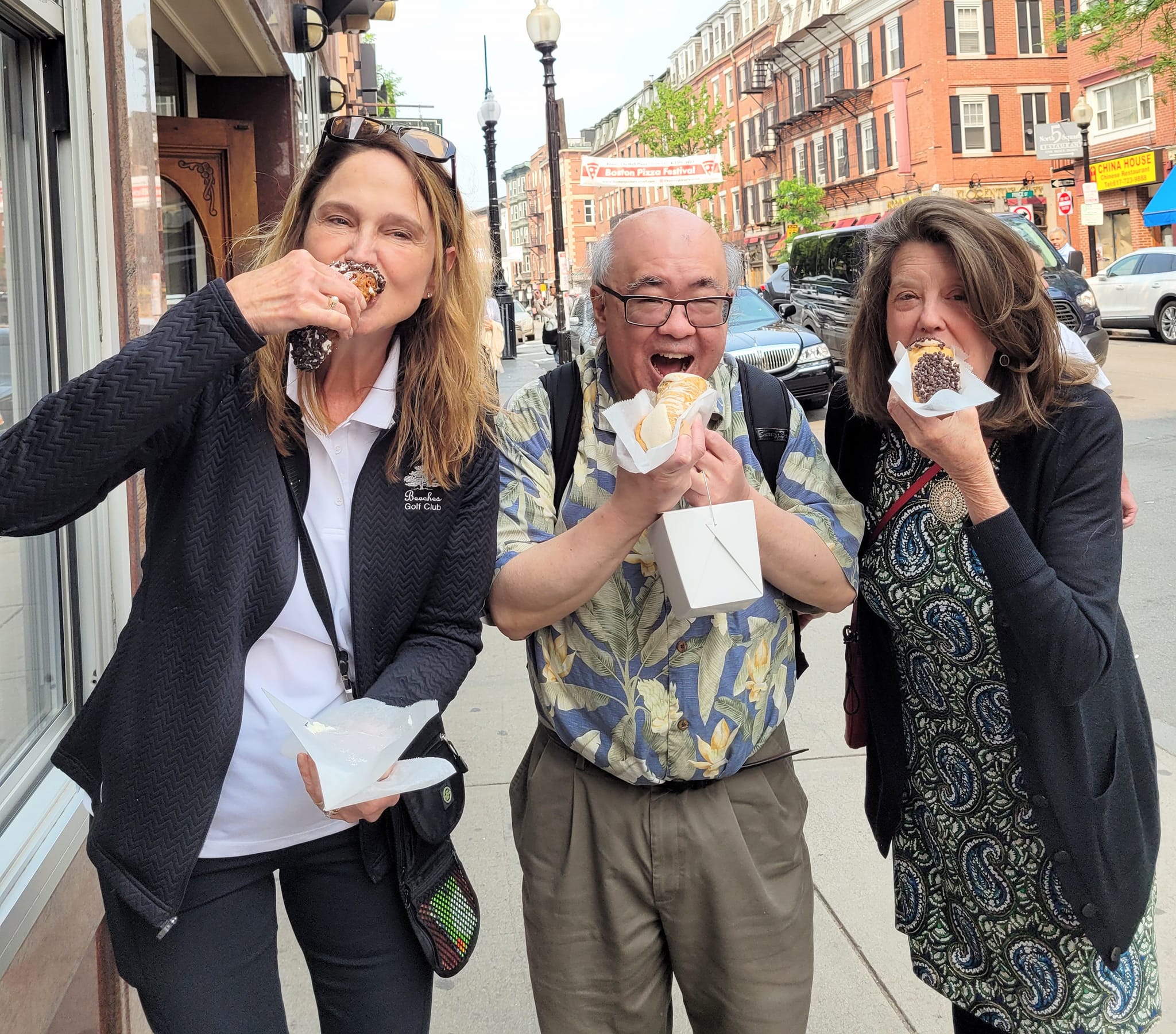
Enjoying cannolis in Boston’s North End with dear friends Liana and Joanne during their recent Boston visit.
Here in the U.S., various pronouncements have told us that the pandemic is, in essence, over. Of course, COVID hasn’t exactly disappeared. People continue to catch it, and some get very sick and even die from it. But the infection numbers are way down, and for many, the sense that we are living under an awful cloud appears to have lifted.
Personally, it has become my nature not to assume that matters beyond my control will either stop or start. Change is the only constant, right? I will continue to take some precautions, including wearing a mask during extended subway rides, or applying hand sanitizer after touching surfaces in public. (Both measures, I hope, will also help me to avoid other bugs that might be going around.)
Memories and reflections, still being processed
In the meantime, for anyone alive and aware of the state of the world since early 2020, references to “the pandemic” will likely generate a bounty of memories for the rest of our lives. Just think of how many of our conversations include variations of “during the pandemic” or “before the pandemic.” Our personal timelines will be defined in part by this momentous event.
During this spring, I found myself thinking a lot about the first half of 2020, when COVID landed hard in the U.S. A signature moment for me during that time was a personal reckoning that I could be living in virtual shutdown mode for at least the next year. I pretty much knew that this was not a short-term thing. In addition to wanting to avoid getting horribly sick, I wondered how this might affect my emotional well-being. I drew inspiration from the fact that two generations ago, members of my family had experienced the Second World War. I also recognized that I had resources to weather this storm, including a relatively secure job that I could do remotely.
For me, the pandemic brought a variety of major and minor changes, ups and downs, and a few genuine opportunities for growth and human connection.
For many others, life sort of froze during the pandemic. Some refer to these as “lost” years that cannot be recovered. Countless millions had to deal with job losses and financial insecurity, and folks valiantly struggled to keep their businesses afloat. A lot of people got very sick, many died, and a good number of survivors are still dealing with health complications. Many have had to grieve over the loss of loved ones.
Overall, our lives were significantly, sometimes brutally, disrupted.
In sum, these past three years have left their mark on virtually every aspect of everyday life. We are still assessing the costs (human and otherwise) of this time, and we are still defining what the new normal really means.
In any event, for now…
…and hopefully for good, I will conclude this series of pandemic-themed posts.
A few weeks ago, two dear, long-time friends visited Boston. Our friendship was forged during a 1981 semester abroad in England, which included some wonderful travel adventures together. Several decades later, we greatly enjoyed each other’s company once more, as sightseeing, food, and conversation made our short visit feel like a mini-vacation.
During our guided walking tour of Boston’s Freedom Trail, we encountered countless other tour groups exploring the city’s historic sites. The streets were busy. Restaurants seemed more crowded. I found myself much less cognizant of the pandemic. Was this letting my guard down, or perhaps a transition into a new phase? I’m not quite certain, but I sure had fun.
Yes, once again, life could change at a moment’s notice. After all, the pandemic has taught us a lot about our vulnerabilities to big situations that suddenly present themselves. But I’m not living in fear of that possibility. Rather, I’m grateful for the new semblance of normalcy that is breathing energy back into our lives. Onward, with fingers crossed.
Pandemic Chronicles #31: And so, what about 2023?

On this last day of 2022, I visited Boston’s Museum of Fine Arts, to see a special exhibit devoted to the rich history of Life magazine and how photojournalism shapes our perceptions of world events around us. The exhibit was engaging and thought-provoking and well worth the visit. I made a bit of an event out of it by treating myself to lunch in MFA’s open air café and by visiting its excellent bookshop, where I made a couple of purchases.
Perhaps I was also drawn to MFA today because of an odd sense of nostalgia. It was roughly three years ago that I decided to join the museum, inspired by a visit there with my long-time friends Sharon and Don Driscoll. Don and I are college chums going way back, including a semester abroad in England. During that semester, I received by far my lowest grade in college, a D+ in Art Appreciation. I’ll spare you the bloody details about how I earned that grade, but suffice it to say that I was not interested in an early morning class that featured slides of a lot of old paintings. I had more important things to do. Like sleeping.
Anyway, during one of the Driscolls’ welcomed trips to Boston, the MFA was on our list. The highlight of that visit was a wonderful introductory tour by one of the super-knowledgeable MFA docents. One of my digital mementoes of that visit is this photo that Sharon took, with a painting of the Boston Common behind me:

photo by Sharon Franklin Driscoll
I decided after that visit to join the MFA, which happens to be three short subway stops away from my home. With unlimited museum admissions as a benefit of membership, I figured that I could make periodic short visits as interest and opportunity dictated.
During my first sojourn there as a member, I texted Don and Sharon to announce my new quest for cultural literacy. Don, recalling my D+ in Art Appreciation, replied that I was proof of the theory of evolution. As I looked ahead to 2020, I figured that regular visits to MFA would be part of the upcoming year.
Well, we know what happened a few months later. Talk about a global tsunami of an event. And we’re still living with it.
This is my long-winded way of saying that with 2023 just hours away, I am making few assumptions about how the year will go. I have hopes and aspirations for it, of course, but if nothing else, the past three years have taught us how quickly our lives can change in dramatic ways outside of our control. The new normal puts a premium on changing and adapting to new circumstances.
So, I’m buckled up again for the journey. I hope it’s a happy and healthy one for you and yours. And maybe it will include visits to great museums and other fine places.
You’re invited: “The Dignity of an Intellectual Life for All,” Oct. 21, 1-3 pm eastern, free online
The Dignity of an Intellectual Life for All
Friday, October 21, 2022, 1:00-3:00 p.m., Eastern Time, Online Format
Hosted by Suffolk University Law School (https://www.suffolk.edu/law/) and co-sponsored by:
Basic Program of Liberal Education for Adults, University of Chicago, Graham School https://graham.uchicago.edu/programs-courses/basic-program)
Harrison Middleton University (https://www.hmu.edu)
World Dignity University Initiative of Human Dignity and Humiliation Studies (https://www.worlddignityuniversity.org)
With a focus on Dr. Zena Hitz’s thought-provoking book, Lost in Thought: The Hidden Pleasures of an Intellectual Life (2020), this program will examine the value of embracing the liberal arts and humanities for their own sake and consider how a rich intellectual life for everyone enhances human dignity. The program opens with a conversation featuring Dr. Hitz, followed by a responsive panel comprised of four distinguished educators, with opportunities for Q&A.
Featured Speaker
Zena Hitz, Tutor, St. John’s College, Annapolis, MD, and author, Lost in Thought: The Hidden Pleasures of an Intellectual Life (Princeton, NJ: Princeton U. Press, 2020). https://zenahitz.net
Guest Panelists
Joseph Coulson, President, Harrison Middleton University https://en.wikipedia.org/wiki/Joseph_Coulson
Hilda Demuth-Lutze, English teacher (ret.), Chesterton High School, IN, and author of historical fiction https://kingdomofthebirds.wordpress.com/about-the-author/
Amy Thomas Elder, Instructor, Basic Program of Liberal Education for Adults, University of Chicago, Graham School https://graham.uchicago.edu/person/amy-thomas-elder
Linda Hartling, Director, Human Dignity and Humiliation Studies https://www.humiliationstudies.org/whoweare/linda.php
Moderator
David Yamada, Professor of Law, Suffolk University Law School, Boston, MA https://www.suffolk.edu/academics/faculty/d/y/dyamada
UPDATE: A freely accessible recording of this very engaging program has now been posted to YouTube. Go here to watch it!
Forty summers ago, a first-ever trip to NYC

Forty summers ago around this time, I was packing a small suitcase in preparation for a first-ever trip to New York City. This was to be a reconnaissance mission of sorts, an initial exploration of what would be my new home for at least the next three years. (It turned out to be more like twelve.)
After having grown up in Northwest Indiana and attended college at Valparaiso University, located in the region’s outskirts, I yearned to spend time in another part of the country. This desire was fueled by a final collegiate semester at VU’s overseas study center in Cambridge, England, which greatly expanded my horizons.
Plans to attend law school provided an opportunity to satisfy that exploratory vibe, and initially I was looking very intently at the West Coast. Back then, I harbored great ambitions of having a career in politics, and I figured that California might be a good launching pad for that. But when New York University extended an offer to attend its well-regarded law school, located in the heart of a Manhattan neighborhood called Greenwich Village, I opted to go in the opposite direction.
My impressions of NYU and New York City in general were mostly on paper, supplemented by images drawn from television shows and movies set in the city. You see, I had never been to New York. The meager state of my finances was such that I had done all of my research about potential law schools by poring over admissions brochures and published commercial guidebooks. I had accepted NYU’s offer of admission sight unseen.
With my first year of law school beckoning in the fall, I figured I should check out what I had gotten myself into. So I planned a short summer trip to New York.
I booked a tiny room at the Vanderbilt YMCA on 47th Street in Manhattan. The bathroom was down the hall. The guest rent was $18 a night. At least it was an upgrade from my youth hostel travels during my semester abroad.
I’ve kept the guidebook I used to help plan my trip. In Frommer’s 1981-82 Guide to New York, author Faye Hammel writes:
You should be advised that there is one dangerous aspect of coming to New York for the first time: not of getting lost, mobbed, or caught in a blackout, but of falling so desperately in love with the city that you may not want to go home again. Or, if you do, it may be just to pack your bags.
Well, that’s pretty much what happened. My short visit didn’t allay all of my anxieties about moving to another part of the country to experience the rigors of law school, but the city immediately started to work its magic on me. I did some of the standard tourist stuff, including visits to the Empire State Building, the United Nations, and the wonderful Strand bookstore. And I spent time at NYU, checking out Vanderbilt Hall (the main law school building) and Hayden Hall (the residence hall where most first-year law students lived), both located on historic Washington Square.
I returned from my brief sojourn believing that I had made the right choice. This first impression would prove to be correct. New York and NYU were the right matches for me.
Later that summer, I used my little portable cassette player to tape this classic Sinatra number from the radio, and I would play it over and again. The lyrics spoke to me, as they have for countless others who have found their way to New York, for stays short and long.
I now live in Boston, and this city is home for me, quite possibly for the duration. Its smaller scale, slightly slower pace, and bookish, “thinky” vibe are more in line with who I am today. But New York will always be a part of me as well, starting with that summer 1982 visit.
Pandemic Chronicles #30: Summer reading

Summer reading.
The phrase continues to enchant me, even if summers at late middle age fly by faster than ever before. And in this third summer of the pandemic, when life has morphed into a weird normal/not normal state and the world feels disturbingly unsettled, the idea of summer reading is the equivalent of literary comfort food.
Writing in the Boston Globe (link here), journalist David Schribman opens his reflection on summer reading this way:
I pack light for my summertime ramblings in New England.
For years I loaded in a pile of books for my trips — presidential biographies, World War II chronicles, Cold War spy novels, mysteries. Then I realized that I got to hardly any of them. I was distracted — by the cool waters of Echo Lake at the base of New Hampshire’s Cannon Mountain, for example, and by the view from Mount Willard in Crawford Notch, and by the tang of fried clams from Harraseeket Lunch in South Freeport, Me., the cool relief of a mid-afternoon ice cream from Round Top in Damariscotta, the smell of the pies baking across the region, and the rich crunch of picked-today sweet corn from an unattended wooden roadside stand in backroads New Hampshire.
I was also distracted by the books I borrowed along the way.
In houses we visited or rented, in inns we frequented or visited just once, and sometimes even in chain hotels, there were tucked-away jewels and gems, sometimes out in the open (on yawning bookshelves), sometimes on stone mantelpieces (leaning one way or another), occasionally employed under a wobbly table (to keep the crockery from sliding).
Reading this and the rest of Schribman’s contemplative piece, I’m imagining a lazy summer spent in assorted New England venues…relaxing, brewing up some coffee or tea, and reading books. Ahhhhh.
Well, even for me, an academic who actually lives in New England, my summers typically aren’t so tranquil. I’m usually working on a research and writing project (or fretting about not making progress on same), as well as keeping busy with a variety of non-profit and advocacy commitments. While I am grateful for the flexibility of my schedule and the freedom to take breaks and occasional trips, I have yet to experience that truly idyllic “summer off” during some 30 years of teaching. (Perhaps I should make this a priority!)
Nevertheless, I am looking forward to a summer that includes some enjoyable leisure reading. I’ve started off with a twisty murder mystery novel, Sulari Gentill’s The Woman in the Library (2022). It’s set in one of my favorite venues, the Central Library of the Boston Public Library! The novel has been getting rave notices, including a starred review from Publishers Weekly.
As for summer reading selections after this one, I haven’t decided. When not reading more systematically for a specific purpose, I tend to go with the flow when it comes to picking out what to read next. There are many worthy possibilities, so at least it will be difficult to make a bad choice.
Pandemic Chronicles #29: Recalling the calm before the COVID storm, March 2020

Part of my initial food stash, which fortunately improved mightily during the months to come
I recall vividly what it felt like two years ago, as we awaited the arrival of the coronavirus here in Boston, with a deepening sense of fear and uncertainty. At Suffolk University Law School, where I’ve taught since 1994, we were heading into spring break. During our last faculty meeting before the break, I raised my hand and suggested that many of us had probably taught our last in-person classes for some time. I sensed that others thought that I was being an alarmist. If only….
Indeed, the virus was already here in Boston; most of us just didn’t know it at the time. In February, for example, a major tech company, Biogen, would host a national conference in the city that eventually would be linked to some 20,000 COVID cases, one of the first “super spreader” events of the pandemic.
During that spring break, I had intended to park myself in one of the booths of the law school cafeteria and toil away at a big writing project that I had hoped to finish by the end of the month. I managed to get in a few productive days, but public health responses were moving quickly in anticipation of the storm ahead. During the break, my university joined others in deciding to teach remotely for the rest of the academic year. In a manner that now makes me wince a bit, faculty returned to campus to pile into a classroom to learn about teaching by Zoom. I don’t recall anyone being masked yet.
During this time, I engaged in some modest stockpiling of food and household goods, including the canned foods pictured above. Fortunately, the pandemic would prompt me to learn how to cook a bit, which resulted in an upgrade in my food consumption — though I still occasionally enjoy all three products in that photo!
This two-year mark is resonating strongly with me. Maybe it’s because we’re now relaxing many of the masking policies, while experiencing a steep decline in infections. Of course, I don’t take anything for granted. Another coronavirus variant could change things very quickly. But presently, at least, we appear to be enjoying a higher degree of normalcy, at least with the pandemic. (The awful war news from Ukraine, however, is another story, as I last wrote.)
In any event, the impressions of February and March of 2020 are quite sharp in my mind. Those days represent to me the start of a new major life chapter, one that is still in progress, with the conclusion not settled.
 Musings of a Gen Joneser
Recent Comments