Singing the Great American Songbook

Some of the sheet music and song books I’ve used over the years!
As my first year of teaching in Boston was coming to a close during the late spring of 1995, I wanted to do something that was less cerebral and distinctly non-legal. It had been a grueling academic year that started with a move to Boston, followed by a heavy load of new courses. After immersing myself in law school casebooks, I wanted to have some fun.
I picked up a catalog from a local adult education center and spied a listing for a class titled “Beginning Voice.” I had always enjoyed singing, and based on the course listing, I assumed it would be a sort of group chorus experience. So I signed up.
On a Tuesday night in May, I showed up for the first class, and I was in for a surprise. Jane, our conservatory-trained instructor, explained the course format: Each week, every student will perform a song of their choice to piano accompaniment — solo — and then be coached in front of the group. Uh, lady, you must be high, I thought to myself. I thought this was like group chorus. For those of us new to the class (a good number were repeat takers), Jane pointed to a pile of music books and said we could pick out a song for that evening.
I nervously rifled through one of the books and found an old Cole Porter classic, “I Get a Kick Out of You” (featured in the show Anything Goes), and figured it was worth a try. Eventually it was my turn to sing, so I got up and went to front of the room. Bruce, our accompanist, started to play, and I managed to channel Frank Sinatra finish the song. I got some polite applause, Jane gave me a few coaching tips, and I sat down, extremely relieved.
Despite my initial surprise over the class format, I returned for the remaining seven sessions. In fact, I’ve never stopped going! I have registered for just about every session of this class since then. That’s 19 years. My repertoire has revolved around the Great American Songbook, singing old standards made famous by the Gershwins, Cole Porter, Rodgers & Hammerstein, and other prominent composers and lyricists during the first half of the last century.
Although I’ve reached a point where I’m a pretty decent singer, I don’t have huge ambitions beyond this class. Over the summer I took a workshop in musical theatre, and I’ve done some open mic nights and would like to do more. And there’s always the occasional karaoke gathering.
However, for me it’s about the satisfaction of singing great old songs. I’ve joked that this singing class has saved me thousands of dollars in therapy costs, but there’s actually a large dose of truth in it. Singing is about being in the moment, of having a safe and enjoyable haven from the ups and downs of the day or the week. I’ve made some dear friends in the process. It’s good for my soul, and a lot of fun to boot.
Jonesing for the Eighties

I’m now into a slightly extended binge viewing of Season 1 of “The Americans,” an FX drama series featuring Keri Russell and Matthew Rhys as a Soviet couple operating as deep cover spies in Washington D.C. during the early 1980s, the decade leading to the end of the Cold War.
It’s a great series, and a vivid reminder of U.S.-Soviet tensions of the era. But irrespective of its dramatic quality, I was won over by the opening scene, a bar in which Quarterflash’s “Harden My Heart” is playing in the background.
Yeah, it pushed my Eighties nostalgia buttons, and I was hooked.
If you’ve followed my posts here, you know that I get nostalgic even for historical eras I am too young to have experienced. But the Eighties are very much my time, and I regard the decade fondly.
Okay, so it may not have been the best years for America. This was the decade of trickle-down economics, “greed is good” (a philosophy popularized by financier Ivan Boesky, who landed in prison for overdoing what he preached), the emergence of the Middle East as a dominant hot spot, and a lot of political corruption. Many of the challenges we face today have their roots in those years.
Personally, however, I think of the Eighties as a comparatively innocent, wide-eyed time of my life. It covered the heart of my 20s, starting with my last year of college at Valparaiso University, then through law school at NYU, and finally post-law school life and work in New York City. Though I was barely masquerading as an adult during that time, I experienced a lot of growth and memorable times during the decade.
Moving to New York was a big deal, for I was a pretty sheltered Midwesterner. (To clarify, not all Midwesterners are sheltered, but I sure was.) I fell for New York completely, and during those years it was possible to explore the city on a tight budget. To be young and broke in New York wasn’t a terrible thing back then; there was a sort of gritty romance about making it on a shoestring.
Anyway, back to the “The Americans”: Season 1 opens in 1981, right after the inauguration of Ronald Reagan. A few episodes into the series, we see American and Soviet intelligence operatives scrambling madly to respond to the March assassination attempt on the President. Although the would-be assassin, John Hinckley, turned out to be a mentally ill man whose actions had nothing to do with Cold War politics, neither side knew that in the immediate aftermath of the shootings.
I recall that time well. We all lived under the nuclear threat. It was part of our existence.
Yesterday it was about the Cold War, the nukes, and the Soviets. Today it’s about terrorism, airport security, and Al-Qaeda. And the economy and jobs, always. The beat goes on.
Beautiful music in the city streets and subways
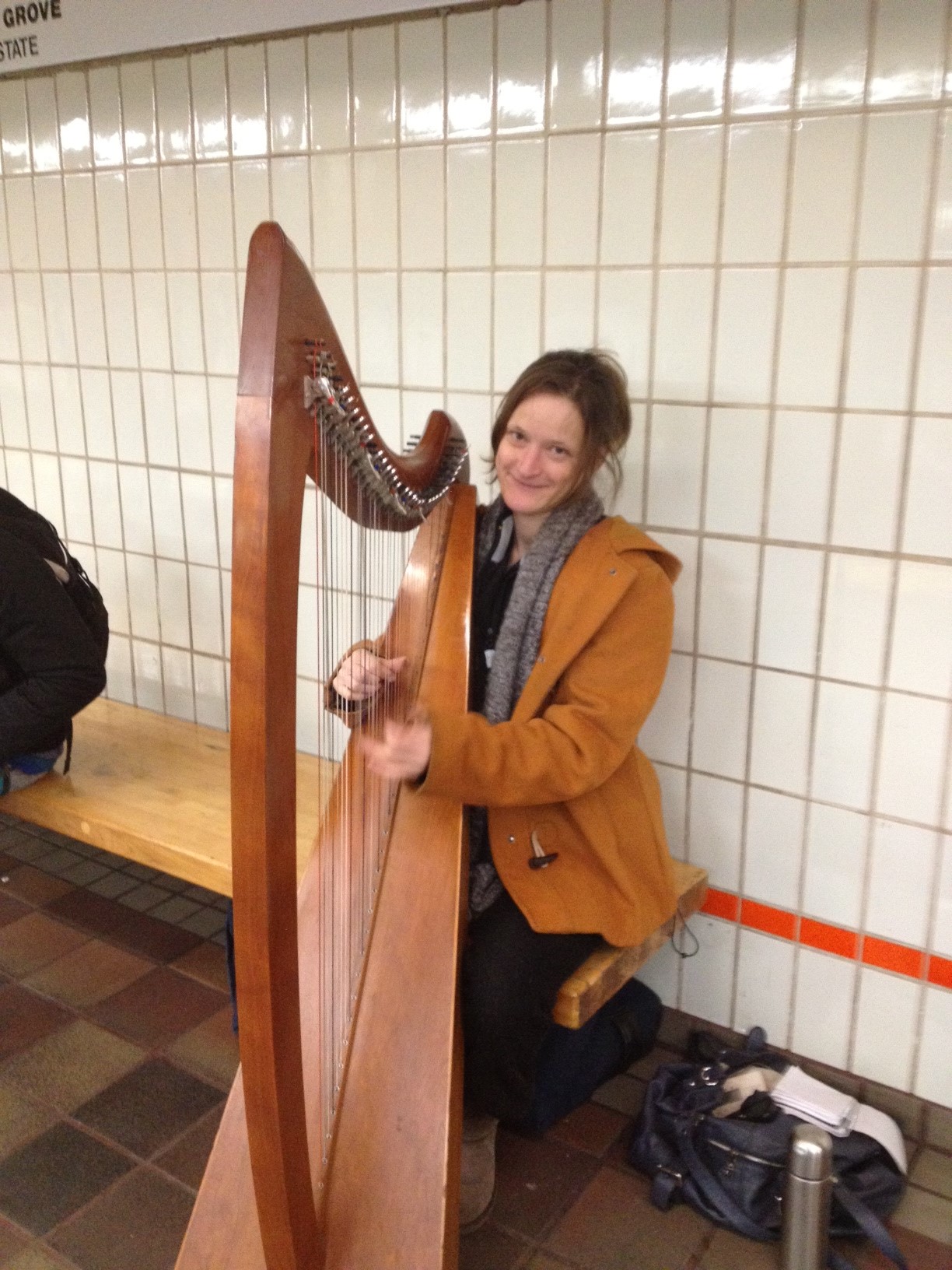
Harpist Alàis Lucette, playing on a Boston T platform (Photo: DY, 2014)
Nearly every day, I travel from my Boston neighborhood of Jamaica Plain to the downtown via the “T,” the local shorthand for the subway. During rush hours especially, the Downtown Crossing stop is crowded and loud, and all too often the human vibes throw off major amounts of impatience and stress.
If I’m lucky, however, I’ll step off the train and hear the lovely sounds of classically trained harpist Alàis Lucette, who sometimes sets up there and helps to calm the nerves of frazzled subway travelers going to and fro. (You may listen to samples of her music and order her CD here.) There is something eminently civilizing about soothing music that cuts through the noise of mass transit.
When I lived in New York City and made my daily subway commute from Brooklyn into Manhattan, on occasion there was a violinist who would make his way through the subway. While some interruptions in the subway can be irritating, this fellow was a welcomed distraction and instantly put me in a better mood for the morning.
I’ve been living in cities all my adult life. I should be over the “novelty” of talented musicians playing in the streets and subways. But I can’t help it, it’s often still a treat to me, especially when the music takes me to a better place in my mind.
In fact, I remember well the first time I heard and saw street musicians in full playing mode. After a collegiate semester abroad in England, I met up with some classmates in Paris, and we took the obligatory stroll through the Latin Quarter. It was filled with lively street music on a beautiful May evening. Perhaps this betrays how sheltered I had been in my NW Indiana upbringing, but I was absolutely taken by the idea that folks would just set up on the street and start playing!
So here’s to those gifted makers of music who add joy and civility to metropolitan life. We city dwellers are indebted to them!
Music and memories
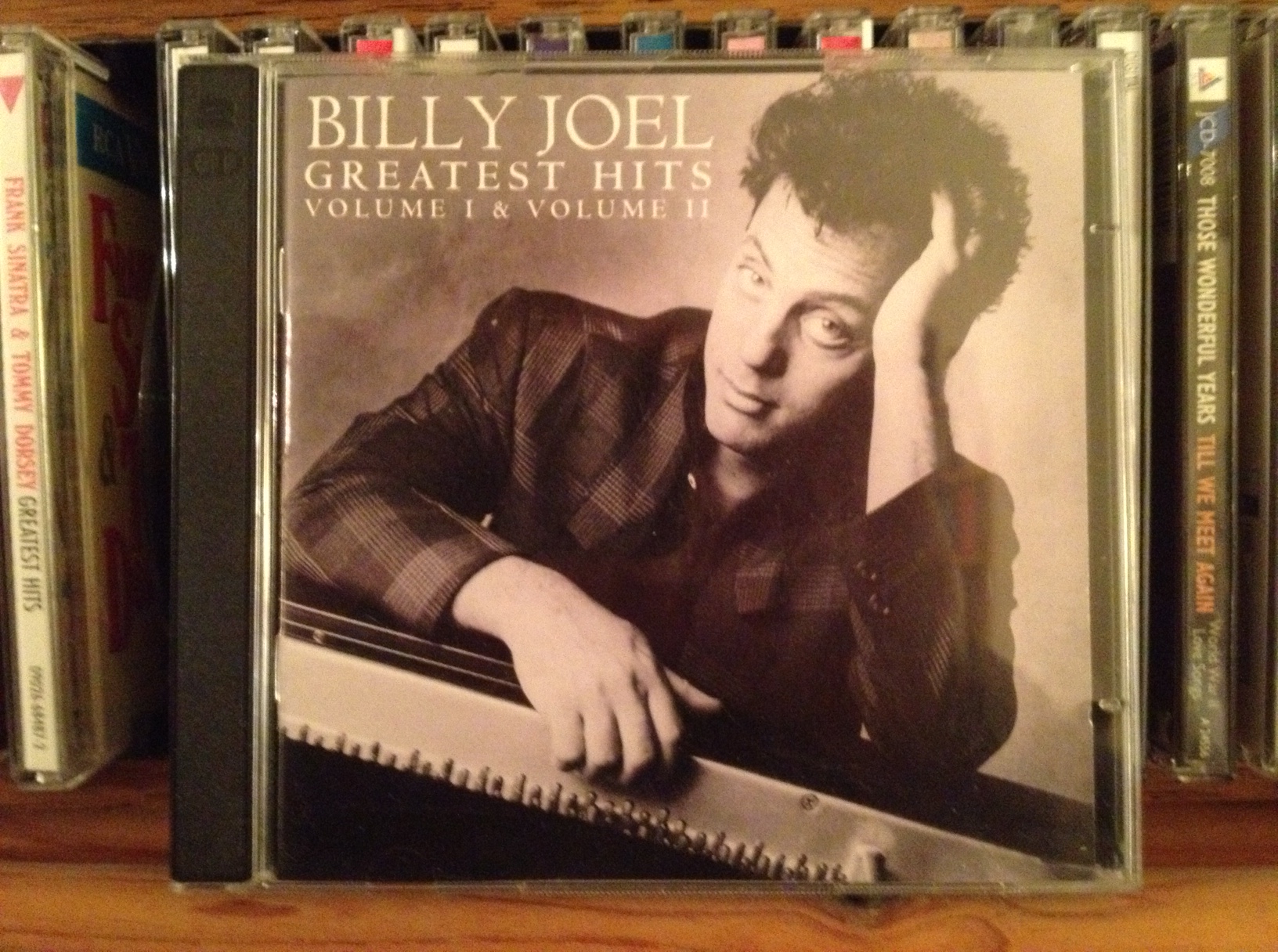 Music and memories. We hear an old pop tune on the radio or MP3 player and it quickly summons memories — good, bad, in-between — about a chapter of our life we associate with that music. Are there any stronger connections between popular culture and our life experiences?
The Andrews Sisters or Glenn Miller and The Greatest Generation. The Beatles or Motown and classic Baby Boomers. Music can be an instant on switch to a personal nostalgia channel.
Gen Jonesers and pop music
For many Generation Jonesers, Billy Joel provides a body of memory-making music. The songs contained in volumes I and II of his Greatest Hits album were especially popular during my college and law school years (late 70s through mid 80s). When I listen to them in the rough order of their release as singles, I’m treated to a year-by-year “mind’s eye” trip down memory lane.
Among the 25 songs in the album, my favorites are “Piano Man,” “New York State of Mind,” “You May Be Right,” “Allentown,” “Tell Her About It,” “Uptown Girl,” and “The Longest Time.”
But they’re not on the list because they’re necessarily the best songs, objectively speaking. No, I include them mainly because I associate memories with each. Overall, they capture a meaningful time in my life when I was finishing college in Indiana and moving to New York for law school. In fact, it’s hard for me to listen to the album for its own sake, because the memories connected with those songs are so sharp.
Given my druthers, I prefer the popular music of the first half of the last century to the stuff that followed. Yup, I’m more likely to listen to Frank Sinatra than to The Clash, though I enjoy both. In any event, I know I’m not alone among my peers when I turn on that 80s “oldies” station and fill with memories.
A song and a smile
Associations between music and memories can run deep, into the recesses of minds otherwise harder to reach. About ten years ago, I was part of a group that gave short vocal concerts at senior homes. At one of our little gigs, I sang a classic from the World War II era, “A Nightingale Sang in Berkeley Square.” Here’s a lovely Vera Lynn rendition:
While I sang, a resident of the home grew the sweetest smile on her face. The way her eyes lit up, I could tell that the song resonated with her, that it touched some part of her experience. After our show was over, I thought I’d say hello and went over to her. But my effort to strike up a friendly chat quickly revealed that she was non-responsive to verbal messages, that she had withdrawn back to the place that likely led to her to be living in a senior home.
It was a quick lesson: Music could reach her in a way that ordinary conversation could not. And it could still cause her to smile.
Synchronicity and A Foggy Day
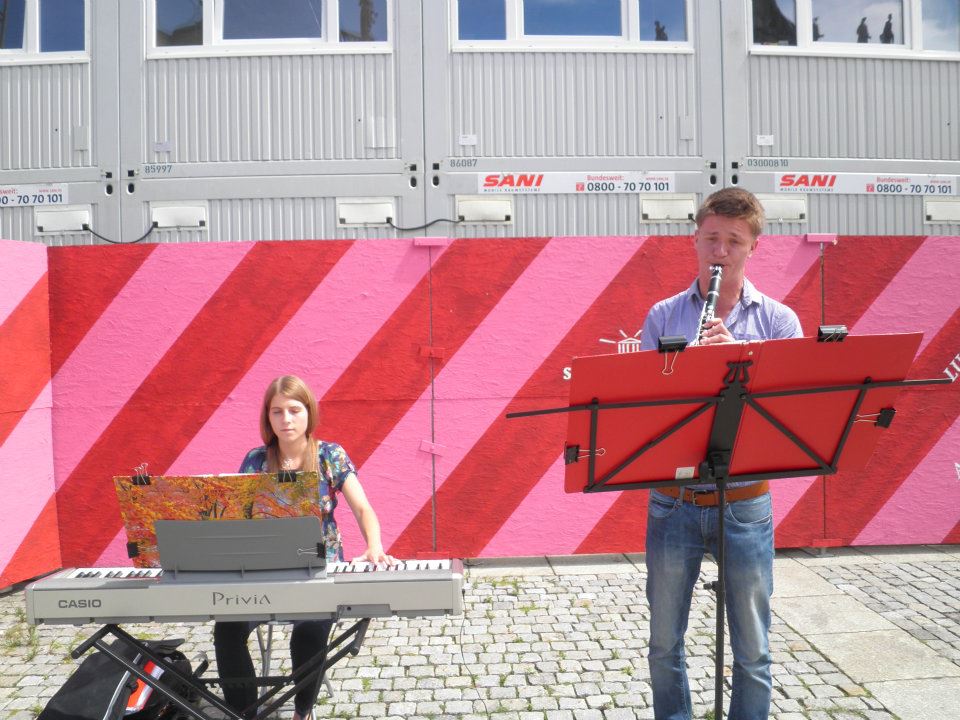
Here’s the story behind this photograph: In July 2011, I participated in a law & mental health conference at Humboldt University in Berlin. On one of the conference days, all morning and into a lunch hour walk, I found myself humming one of my favorite Gershwin songs, “A Foggy Day (In London Town).” I simply couldn’t get it out of my head!
Well, with lunch hour coming to an end, I made my way back to the conference site, and as I turned the corner into the main university plaza, these two students were playing…yup…you guessed it. It sent a (good) chill up and down my spine…and earned the kids a few euros.
The phenomenon is called synchronicity, a pair of related events that do not appear to be causally connected. Some would call it a coincidence, but those who know of the theories of psychologist Carl Jung might well suggest that a more psychic element is at play. I would tend to agree. I’m not the most psychic or intuitive person around, but I’ve had these moments too often to write them off as products of chance.
What about you? Do you buy into the idea of synchronicity?
Tapestry: Iconic Gen Jones album and a timeless classic

Carole King’s “Tapestry”
“Timeless” may be one of the more overused tags to tout popular songs, books, and movies, but in the case of Carole King’s 1971 album Tapestry, the label fits. Don’t just take my word for it: It’s 36th on Rolling Stone’s list of the 500 all-time greatest albums:
On Tapestry, King remade herself as an artist and created the reigning model for the 1970s female singer-songwriter – not to mention a blockbuster pop record of enduring artistic quality.
King was no stranger to the music world when Tapestry was released. She had been a successful song writer for artists like Aretha Franklin and The Shirelles during the 60s. Fortunately she was encouraged to enter the recording studio, and Tapestry was the result.
Here’s the album’s original song list, courtesy of Wikipedia:
- Side 1
- “I Feel the Earth Move” – 2:58
- “So Far Away” – 3:55
- “It’s Too Late” (lyrics by Toni Stern) – 3:53
- “Home Again” – 2:29
- “Beautiful” – 3:08
- “Way Over Yonder” – 4:44
- Side 2
- “You’ve Got a Friend” – 5:09
- “Where You Lead” (lyrics by Toni Stern) – 3:20
- “Will You Love Me Tomorrow?” (Gerry Goffin, King) – 4:12
- “Smackwater Jack” (Goffin, King) – 3:41
- “Tapestry” – 3:13
- “(You Make Me Feel Like) A Natural Woman” (Goffin, King, Jerry Wexler) – 3:49
And here’s one of the livelier numbers, “I Feel the Earth Move,” from YouTube:
The singles from Tapestry were all over the pop charts. And if we stick with the defining Gen Jones age range (born 1954 through 1965), we see that it arrived during the heart of our childhoods and teen years, when we spent a lot of time listening to the radio and playing favorite music. The memories associated with these songs would fill volumes.
 Musings of a Gen Joneser
Recent Comments