Classic movie report: May 2015

I declared as one of my New Year’s resolutions that I would watch more classic old movies, so each month I’m devoting an entry to how I’m doing with it. It has been a very busy month, so I have only one selection to review, but in honor of the college commencement season, it’s a classic:
Animal House (1978) (4 stars out of 4)
This wonderfully tasteless comedy about the debauched Delta fraternity at (thankfully fictional) Faber College during the early 60s ranks as one of my favorite movies ever. I watch it roughly every year — including this past weekend — and every time it cracks me up. It is so full of hilarious lines and scenes, I cannot even begin to list them out. (The IMDb site has collected many of the best quotes here.)
Animal House launched John Belushi as a major star, playing deranged Delta frat member John Blutarsky. Other favorite cast members of mine include Tom Hulce (as Larry Kroger), Stephen Furst (Kent Dorfman), James Widdoes (Eric Hoover), Tim Matheson (Eric Stratton), Karen Allen (Katy), Bruce McGill (“D Day”), John Vernon (Dean Wormer), Verna Bloom (Marion Wormer), Kevin Bacon (Chip Diller), and Mark Metcalf (Doug Neidermeyer).
Director John Landis and writers Harold Ramis, Doug Kenney, and Chris Miller did brilliant work here.
The extras included in the “Double Secret Probation” DVD edition are worth checking out as well. They include a reunion video that contains some great stories about the making of the movie. They obviously had a lot of fun on this production. Many of the cast members apparently lived their roles off screen as well, including a lot of partying.
I was in college when the movie was released, and let’s just say that it had a massive influence on campus life at schools across the country, for better or worse (usually the latter). Fraternity life, inspired by the movie, often went haywire, and toga parties became all the rage.
I was a hardcore independent, more likely to be lobbing criticisms at frat behavior from my perch as a campus newspaper reporter and editor than joining in on the hijinks, so perhaps it is odd that I find this movie to be so uncontrollably funny. Animal House manages to skirt around some of the darker excesses of fraternity life during the era, and it puts a hilarious spin on the rest of it.
Final exam season: Recalling late night munchies for student chow hounds
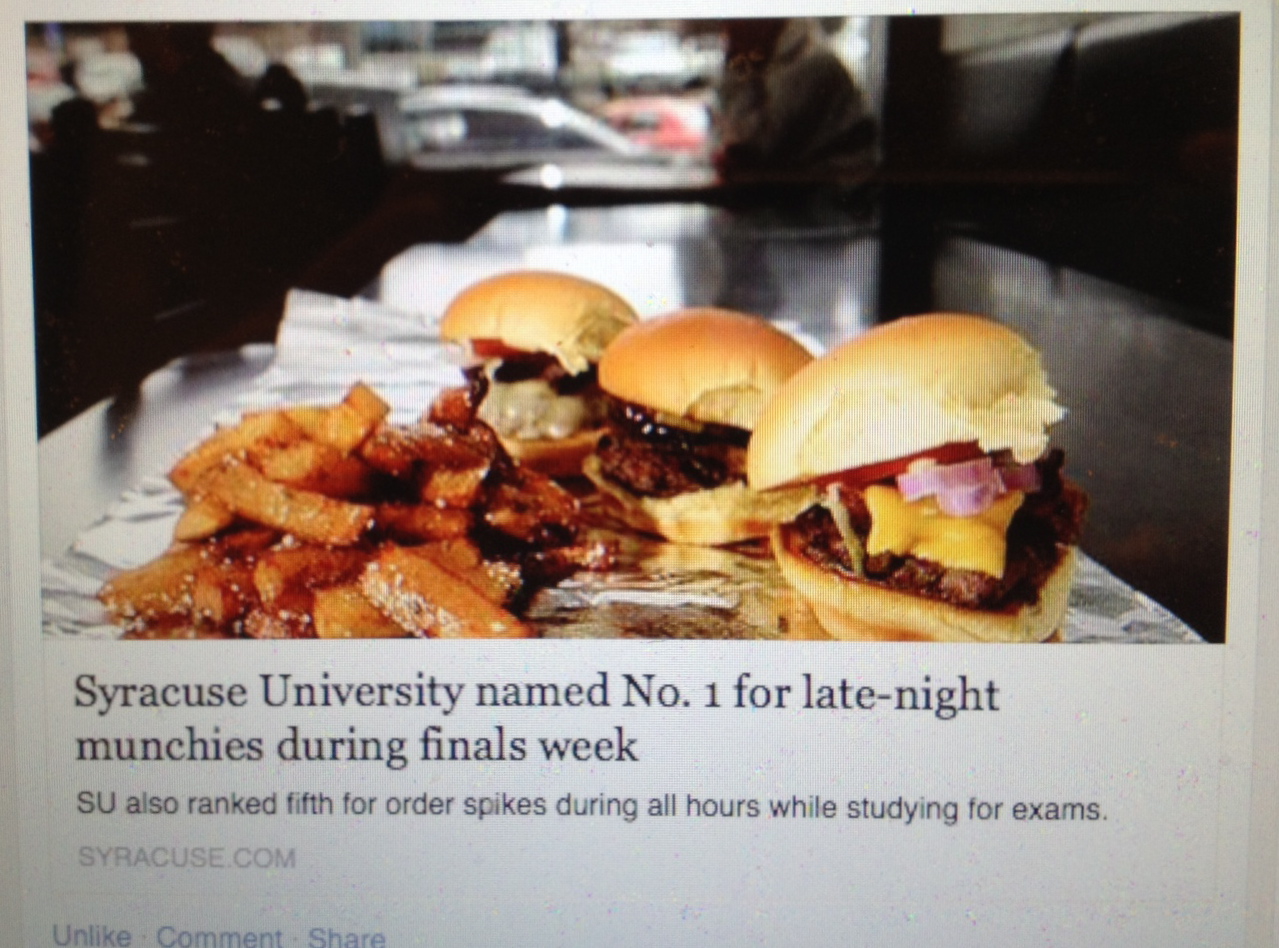
You’ve come a long way, baby: Late night college chow has upgraded its game
If this headline and photo are to be believed, collegiate munchies have definitely stepped up a notch or two since my student days. Those burgers look pretty darn good, don’t they?
During this month of May, I’ll be reminiscing even more about collegiate and law school experiences, and this particular entry is appropriately about food. After all, especially around finals time, late night eateries near campuses do a landmark business. Back in the day, I contributed mightily to this sales uptick.
At Valparaiso University in northwest Indiana during the late 70s and early 80s, late night chow options were somewhat limited, at least within reasonable walking distance. In fact, this post was triggered by a Facebook conversation the other day posted by a fellow dorm dweller (hat tip to Dr. Mark Kegel here), during which we reminisced about local eateries. A place called Greek’s Pizza deservedly enjoyed semi-legendary status, and the VU student union did a decent job on pizza as well, but beyond that the pickings were uneven.
I recall an independent donut shop that apparently had escaped regular health code inspections; I considered it a destination of desperation. There was a food truck selling pretty good stromboli sandwiches that would drive around campus. I also ate more microwaved sandwiches from the local 7-Eleven than my large intestine cares to remember. Toss in a Dairy Queen and a few other fast food places, and that was basically it.
When I got to law school at NYU a few years later, the midnight munchies situation got much better. This was, of course, Greenwich Village of the early 80s, and affordable eateries abounded. Thanks to my more gastronomically adventurous law school pals, my appetite would diversify considerably, especially when it came to ethnic foods.
Late night food options, however, reverted back to basics, with the 24-hour diners at the top of the heap. The Washington Square Diner on West 4th Street was the site of numerous 2 a.m. bacon cheeseburger runs and breakfast platters, and the Cozy Soup ‘n’ Burger on Broadway at Astor Place served up many a burger and cups of their awesome split pea soup. Empire Szechuan delivered tasty Chinese food into the wee hours. And after a late night of studying in the library, a pitstop at Ben’s Pizzeria for a serviceable quick slice was sometimes in order. (All of these places are still in business, by the way!)
In both college and law school, these intakes didn’t exactly make for the healthiest of diets. I have a feeling that many of today’s students are doing a little better on that count. Chipotle’s might not count as fast food, but it’s healthier and fresher than a visit to the Golden Arches. Then again, for a pure late night food experience, a good bacon cheeseburger in the wee hours of the morning beats a burrito bowl any day.
On being a college sports fan: A waif’s journey
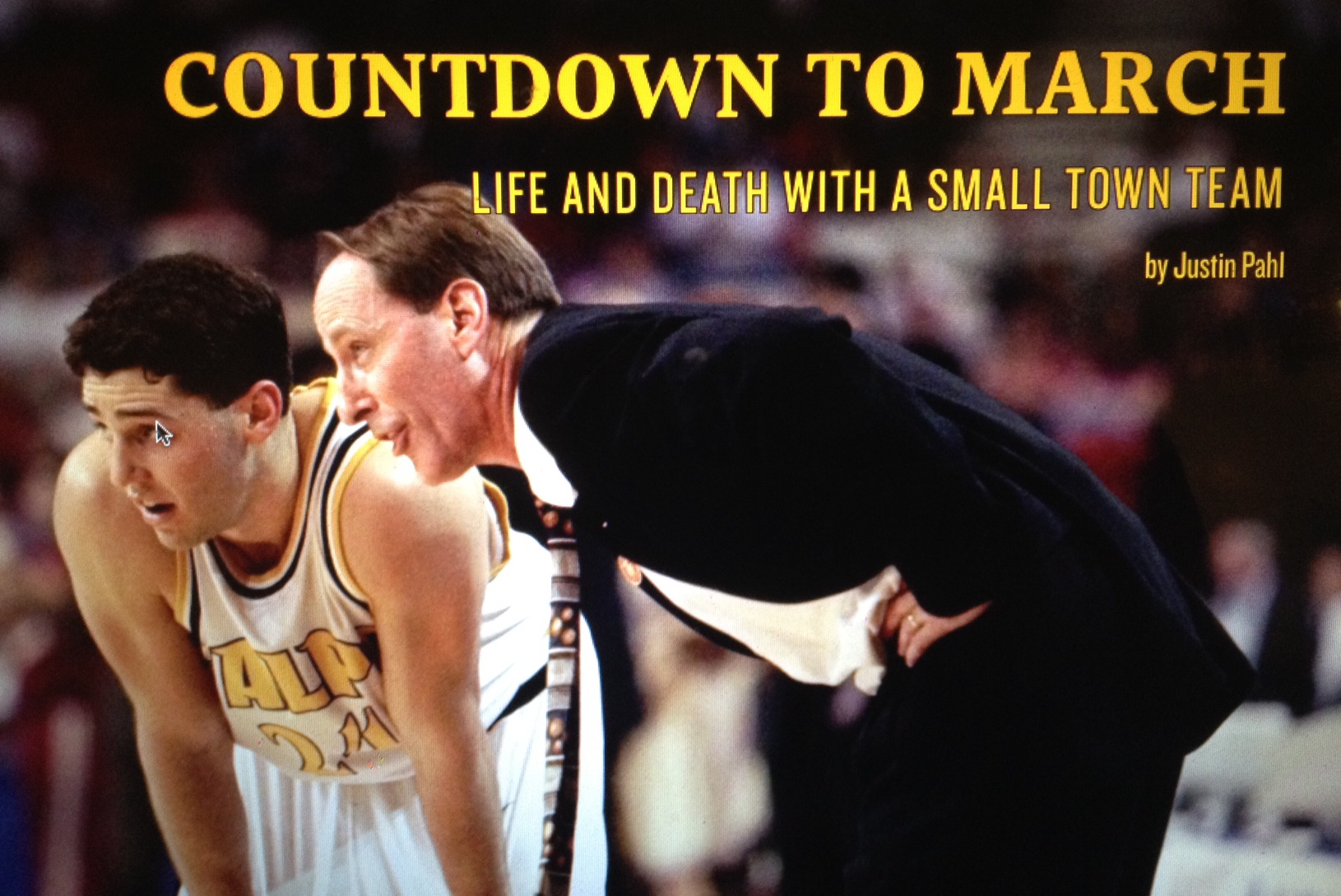
From SBNation.com
Although I’m a moderately serious sports fan, and I’ve been associated with a good number of colleges and universities over the years, I’ve never attended a school with a big-time sports program. On the pro side, I’ve maintained my strong affinity for Chicago teams (Cubs, Bears, and Bulls, oh my!), and been a fair-weather fan of the New York Mets (mid-80s), New York Knicks (80s-early 90s), and New England Patriots (Brady-Belichick era). However, when it comes to college basketball and football, I’ve been something of a waif.
I’ve been writing a lot about my college and law school experiences lately, so let’s take them from a sporting angle.
Starstruck and Bobcats
I received a very good classroom education at Valparaiso University, but its intercollegiate sports teams during the late 70s and early 80s were lackluster and not a big focus of campus life. VU had just made the jump to Division 1 basketball, and those early teams struggled for respectability. I went to only one game, against then-No. 1 ranked DePaul University, led by All American forward (and future NBA All Star) Mark Aguirre. When DePaul walked onto the court for warm-ups, the VU fans stood up — not to applaud or to jeer, but rather because we were starstruck that a top-ranked team was in our midst. The game itself played out as one might expect.
My next educational port of call was New York University for law school. During the early to mid 20th century, NYU enjoyed national success in both basketball and football circles, but by the time I arrived in 1982, intercollegiate sports had been de-emphasized to the point of irrelevance. It would relaunch its men’s basketball program at the Division 3 level during the mid-80s. They quickly assembled some good teams, even reaching the national championship game in the early 90s, and have remained competitive since then.
Each year I lived in New York, I would go to a few NYU hoops games, usually alone. D3 hoops games aren’t a big draw with the rest of Manhattan at your fingertips. Or maybe it was hard to get excited about a college team whose mascot is named after the library’s card catalog (Bobst Library Card Catalog, or Bobcat for short).
As for NYU’s football team, it remained undefeated throughout my years in the city, holding steady at 0-0. (Ba dum.)
Irrational fandom
Over the years, I’ve kept my affinity for Notre Dame football — a product of having grown up in Northwest Indiana. Fandom can be irrational; I’m neither Catholic nor a Notre Dame alum!
Because a dear friend is an Annapolis graduate (Class of 1953), I root for the Navy Midshipmen as well. Had some weird twist of fate ever led me to the Academy, I would’ve lasted about a week before getting booted out for continually questioning orders, so go figure.
During the 2000s, the University of Hawaii had a string of successful, fun-to-watch, pass happy teams, and I enjoyed pulling for them. The highlight of that run was an undefeated regular season in 2007, culminating in a Sugar Bowl appearance.
For reasons I can’t explain, I also follow from afar (usually by checking the box scores) the powerhouse Division 3 football team at the University of Mount Union in Ohio. Although they’ve been stymied in the national championship game in recent years by nemesis Wisconsin-Whitewater, they have compiled some of the most remarkably dominant seasons in the history of collegiate football.
Back to Valpo
As for college basketball, well, I’m now rooting for Valparaiso(!), which has become a very competitive mid-major D1 team since my days there. The foundation was set seventeen years ago, when the Crusaders enjoyed a storybook season, topped off by a trip to the 1998 NCAA tournament and a Cinderella run to the Sweet Sixteen. Its star player was guard Bryce Drew, the coach’s son, who hit a legendary, buzzer beating 3-point shot to upset powerhouse Ole Miss in the first round:
Drew followed his collegiate glory with a solid stint in the NBA. He is now the Valparaiso head coach, and when VU makes an appearance on one of the ESPN stations, I’ll often watch or record the game. They made the NCAA tournament this year, losing in the opening round to Maryland in a close game.
This month, SB Nation ran an excellent long form piece by Justin Pahl, son of a former VU faculty member, who wrote about growing up with the emerging, underdog VU basketball program during the 1990s. It’s a very good story about life and sports in a small, Midwestern university town. I took a screen shot and pasted it in above.
Before the college application process went haywire

New York Times columnist Frank Bruni is getting a lot of attention for his new book, Where You Go Is Not Who You’ll Be: An Antidote to the College Admissions Mania (2015), which urges young people and their families not to buy into the huge anxieties and nuttiness that surround the college application process. In essence, he’s saying that the people and communities that we bring into our lives have much greater bearing on life satisfaction than getting into a prestigious school.
I think the overall message is a sound one, but the topic is more complicated than first meets the eye.
A good number of friends around my age have gone through this process with their children. Especially for high school students aspiring to attend a highly-ranked school, the college admissions game has become a significant, part-time job for them and their parents, one wrought with adolescent emotions, adult anxieties, and difficult cost-benefit assessments.
Sadly, I don’t think this will change, especially in an America where families in the middle and upper-middle classes are fearful of their ability to maintain their stations in life, college costs have gone through the roof, and the promise that the kids will do better than their parents is looking more and more precarious.
As a non-parent, it’s easy for me to claim from my detached perch that I wouldn’t buy wholeheartedly into that mania, but in truth it’s very, very hard to ignore this dynamic. And the peer pressure and social expectations for young students and parents alike are significant in high school settings that are turbo-charged about college placement.
Nevertheless, as a nostalgic creature by nature, does this make me a little wistful for the days when the college application process wasn’t so riddled with anxiety?
As a high school senior, I assumed I’d go to college, but I took the process rather casually. I visited a few schools in my home state of Indiana, and I ended up applying to only one, Valparaiso University in northwest Indiana. It was a smaller school, emphasizing the liberal arts, and it seemed comfortable and close enough to home. I figured it would be good enough, and it appeared that my chances of admission were strong.
I was accepted, and that was the extent of my college “search.” Easy peasy, right?! Isn’t this a perfect example of how low key the college application process was back in the day?
But herein lies the truth behind much nostalgia: It becomes a little, well, rose-colored fictitious. Even before the U.S. News rankings of colleges became ubiquitous and top 10/50/100 lists of schools started popping up everywhere, there was a rough sense of which schools were considered among the elite. And my story of applying to only one school and basically assuming I’d get admitted is exactly that, only mine. In the meantime, thousands of others who had more focused aspirations and their sights set on certain schools were sweating out the process.
In fact, five years later, I would ramp up my own anxieties when I applied to law schools. I was considerably more invested in the process, and I took active responsibility for researching law schools and identifying which ones might be good for me. Now, that’s the generic description. In truth, I became obsessed with the whole deal, and full of the kind of self-absorption that can inflict an ambitious young person during such life chapters. The moment I received New York University’s letter of acceptance, I pretty much knew I would go there, as I had many reasons to believe it would be a very good match for me.
So how do these schools look in the rear-view mirror some 30 years later? I’ve written on this blog many times about my experiences at Valparaiso (here, for example). My relationship with it has changed much for the better over the years, in large part because I have a greater appreciation for the quality education it gave me, and I have treasured friendships from those years that I know will be lifelong. As for NYU Law School, I am deeply grateful for the experiences, friendships, and opportunities it provided. In many ways, it was the right place at the right time for me. (You can read a bit more about that, here.)
As I reflect on all this, maybe Frank Bruni’s title — Where You Go Is Not Who You’ll Be — is overstating it, even if we welcome its underlying message. Many of us have been shaped profoundly by the schools we attended, though not necessarily because they were/weren’t considered “prestigious” in the eyes of others. The deeper questions associated with the college application process are more vital and complicated ones, fostering considerations about how much we should allow markers of prestige to shape our beliefs, decisions, and experiences.
In sum, for anyone who believes that upward mobility and “success” are, generally speaking, worthwhile aspirations, but that a good life embodies much more than collecting trophy lines on resumes, this conversation may be rife with honest and very human contradictions and inconsistencies. Easy peasy it ain’t.
“Airplane!” is 35 years old
Airplane!, the gut busting, hilarious send-up of airplane disaster movies, turns 35 this year. For a long list of reasons, I’m not sure that a similar kind of movie could be made now, but especially for Gen Jonesers who grew up with the movies and television shows poked at and parodied in the film, it doesn’t get any funnier.
The IMDb.com profile gives you a list of the awesome cast, reader reviews, a list of classic quotes from the movie, and more.
In a great interview with co-producer David Zucker conducted by Yahoo’s Jordan Zakarin, we learn some of the backstories that led to the casting of the movie, including that of Peter Graves as Captain Oveur :
Peter Graves famously didn’t want to play the aspiring-pedophile pilot at first. Was he reluctant to deliver lines like “Have you ever seen a grown man naked”?
Peter Graves’s reaction [to the script] was, “This is the most disgusting piece of garbage I’ve ever read.” His wife and his daughter read it and they laughed all the way through and they said, “Dad, you have to do it.” So he was ready to do it when we shot.
Across the pond
My first experience of watching Airplane! was odd and memorable. It was the spring of 1981, and I was spending my final undergraduate semester at Valparaiso University’s Cambridge, England, study abroad center. I went with a group of fellow VU students to a local movie theatre. Amidst a somewhat sparsely attended screening, we were the only ones laughing uncontrollably throughout, while the rest of the (presumably British) audience chuckled politely on occasion.
How could our British moviegoers have understood how LOL funny this was! If you’re not familiar with Barbara Billingsley’s role as suburban housewife June Cleaver in the TV sitcom Leave It to Beaver, then you have no idea how hilarious it is to listen to her speaking jive to a couple of black passengers.
Of course, perhaps the Brits that night didn’t fully appreciate Airplane!‘s over-the-top, un-PC American-style humor, done in such rapid-fire, equal-opportunity target style that you don’t have time to become mortally offended.
I only know that my stomach was sore from laughing so hard.
If you’ve got some time to kill…
As some of you know, I’ve been writing a professional blog, Minding the Workplace, for over six years. A lot of the material is heavier stuff, looking at employee relations, workplace bullying, employment law, psychological health at work, and so on. But on occasion I’ve written pieces with a lighter touch that may be of interest to readers here. I thought I’d dig into the archives of that blog and share a few of them:

Taking stock at midlife: Time for reading assignments? (2014) — “So, in the absence of these colleges for 40-year-olds (and beyond), how can we think and reflect upon our lives to date, our lives right now, and our lives to come? For those who, like me, sometimes turn to good books for guidance, let me introduce a thick anthology, Leading Lives That Matter: What We Should Do and Who We Should Be (2006), co-edited by Mark R. Schwehn & Dorothy C. Bass, both of Valparaiso University, my undergraduate alma mater.”
What now, not what if (2013) — “Currently stored on my DVR are a PBS program and a National Geographic docudrama about President Kennedy, both produced to coincide with the 50th anniversary of his assassination. Although I’m a devotee of history, I have a feeling that I won’t be watching them….That lesson was reinforced to me in Stephen King’s 2011 time travel epic, 11/22/63, which takes us back to the years leading up to the assassination of President Kennedy.”
The perils and pleasures of nostalgia, even about work?! (2013) — I get especially nostalgic about two work experiences. The first was my initial year as a Legal Aid lawyer in Manhattan, following my graduation from NYU’s law school….My second nostalgic focus: Returning to NYU after six years of legal practice as an instructor in its innovative first-year Lawyering Program….Both clusters of memories, however, gloss over the fact that I was years away from discovering my true passions as a teacher, scholar, and advocate. I was clueless about a lot of things, and not exactly on the leading edge of emotional maturity.”

August 1982: Next Stop, Greenwich Village (2012) — “This month, I find myself particularly nostalgic over events of 30 years ago, when I moved from Hammond, Indiana to New York City to begin law school at New York University, located in the heart of Greenwich Village. This was a pretty big deal for me. Although I had benefited greatly from a semester abroad in England during college at Valparaiso University, I was far from worldly and had never been to New York City before applying to NYU….Within a few days of my arrival, I would start classes in Vanderbilt Hall, the main law school building, on the southwest corner of Washington Square….”
Collegiate reflections: Studying the liberal arts (2012); Collegiate reflections: Working on the campus newspaper (2012) — “With Commencement season coming to a close at colleges and universities across the nation, I beg my readers’ indulgence as I use a short series of posts to reflect upon my own collegiate experience….”
Ch-ch-ch-changes: Some books to guide toward good transitions (2012) — As we turn the calendar to a New Year, I wanted to gather together some recommended titles for those who are engaged in or contemplating a major work or personal transition….If you’re in the midst of big changes, these books may prove a worthy investment in terms of your livelihood and well-being. I hope you find them helpful.
Does life begin at 46? (2010) — “Conventional wisdom, according to research, is wrong. True, we start off our adulthoods pretty happy and become increasingly disenchanted as middle age approaches. However, our outlook then gets better as we age. The Economist cites research studies to back up its proposition, overcoming the presumption that this is more Boomer-inspired babble about how 60 is the new 40.”
Embracing creative dreams at midlife (2010) — “Dreams die hard is something of an old chestnut, but having entered the heart of midlife, I am thankful that this often is true. I think especially of creative energies waiting to be tapped and unleashed, perhaps after some of life’s other priorities and responsibilities have been addressed, and pursued with the benefit of experience and maturity. Two long-time friends come to mind when I ponder this. Hilda Demuth-Lutze is a friend from college days at Valparaiso University (Indiana) who is the author of historical novels for young adults. Mark Mybeck is a friend going back to grade school in Hammond, Indiana, whose band, Nomad Planets, is creating a niche for itself in the Greater Chicagoland indie rock scene.”
Not-so-random acts of kindness for the non-saintly among us

Maybe some of the course rubbed off on me.
Last November, I was crossing the street near Boston’s Faneuil Hall when I saw a man huddled in a blanket, shuffling past me in the opposite direction. I caught a glimpse of his eyes for only a second, but I could see a lot of sadness in them. When I got to the other side, I turned around and watched him make his way to a public bench, where he sat and seemed to just stare down.
I decided to go back across the street, and then I walked over to the man. I pulled some money from my wallet and offered it to him, saying that it looked like he could use something to eat. He appeared to be in very bad health, but when he saw that I was giving him twenty dollars and we began talking, his face lit up. He was very grateful for the money, and I believe he was appreciative that someone took a few minutes to converse with him.
What some might call a random act of kindness actually wasn’t all that random. Last fall I completed a non-credit, online adult education course, “The Science of Happiness,” led by psychology professors associated with UC-Berkeley’s Greater Good Science Center. It was a substantial course on emerging scientific discoveries about what makes people happy, with weekly readings, video lectures, and quizzes, as well as mid-term and final exams. Among our optional assignments was to engage in random acts of kindness, drawing on psychological literature indicating that giving promotes happiness in both the giver and the receiver.
Indeed, a little voice from that course was speaking to me when I walked up to that man and gave him money, and I found myself feeling very emotional afterward. Since then, I’ve repeated this act maybe a half dozen times, approaching people who appear to be very down on their luck, saying hello and giving them a twenty dollar bill. Over the weekend it was a man sitting on a subway bench with all of his worldly belongings stuffed into a grocery cart. Earlier this month it was a woman digging through a trash receptacle in search of food, a few feet away from where I was enjoying my lunch.
A couple of times the recipients didn’t say much to me, but on other occasions they expressed surprise and deep gratitude. One man even hugged me. When you see someone’s facial expression go from weariness and despair to a big smile in a matter of seconds, then you know you’ve made someone’s day a little better.
I have hesitated to put this in a blog post because I don’t wish to portray myself as being someone I’m not. I walk by most people I see panhandling on the street, and I’ve never volunteered at a homeless shelter. And let’s be honest: Twenty bucks isn’t exactly a huge sacrifice for a single guy earning a professional salary. But I thought I’d offer this story as just one example of how the non-saintly among us can make a modest difference in the world. No, it’s not “social change” in the grander way that I’d like to see, but if enough of us engage in these acts, then maybe the good stuff starts to add up to something substantial.
Your not-so-random acts of kindness need not be the same as mine. But I can pretty much guarantee that whatever you decide to do, both you and the recipient(s) will feel better because of it.
***
Happiness course
Go here if you’d like to learn more about the free “Science of Happiness” course.
This piece is cross-posted on my professional blog, Minding the Workplace.
Throwback Thursday: Math 14 and my pursuit of mathematical genius

Brilliantly anticipating the Digital Age: My final project for Math 14 (Photo: DY)
As a political science major, my bachelor’s degree program at Valparaiso University included a set of distribution requirements covering basic liberal arts subjects. Among other things, I had to choose three mathematics and science courses, with at least one math offering among them. Heading into my senior year in the Fall of 1980, I had already managed to take a pair of science courses to cover two of the three, but the dreaded math course still loomed in front of me.
You see, I hadn’t taken any math courses since my junior year of high school, and I was happy to be done with them back then. Although I’ve tended to be a pretty good logical thinker, that aptitude or affinity has never quite extended to the field of mathematics. Indeed, I was a living exception to the stereotype about Asians and math.
And so I reviewed the math course listings in search of something palatable, or at least passable. At VU, they were numbered in the 100s, 200s, 300s, and so forth, to signify their relative level of complexity. But mixed in with the three-digit numbered courses was one offering, Math 14, a/k/a “Mathematical Ideas,” with a description free of scary terms like “proofs” or “calculus.”
With a sigh of relief, I enrolled in Math 14. In the class, I saw a few students I knew previously, including a fellow political science major or two. However, by far the most notable cohort was comprised of members of the VU football team. VU was refreshingly short on “rocks for jocks”-type courses, but this was an apparent exception.
Math 14 was taught by a friendly senior professor who actually cared about stoking some enthusiasm for the subject matter among we math-phobes. He also adopted a textbook equal to our skill sets; I can’t recall the exact title, but it was something like Mathematics for Everyday Life or close to it. And yup, inside the book were a lot of story problems.
Hey, I’m not meaning to brag here, but I kicked butt in that course. Our final project was to assemble a set of 3×5 index cards using hole punchers to simulate a simple digital computing function. (Keep in mind that the personal computer era was a few years away.) Boom, I pulled off that baby without a hitch! And thanks to my penchant for not throwing anything away, I can now proudly share a photo of that project above. (Go on, tell me this isn’t like gazing at the collegiate notebooks of a young Stephen Hawking.)
Despite this rousing success, I did not attempt to switch my major to math at that late juncture, tempted as I was to continue on this newfound path of excellence. Instead, I stuck with the political science major and would go on to law school, as I had planned. But at least my index card computer remains operational; some exhibitions of raw brilliance must endure.
Returning to the scene of the crime
On Monday I was in Washington, D.C., to participate in a panel discussion on employment law at the Annual Meeting of the Association of American Law Schools (AALS), the primary organization for legal academicians. The panel went very well; it was a genuinely engaging and interactive discussion with fellow presenters and colleagues who attended. My paper was on workplace bullying and the law, a topic I have studied and written about intensively for some 15 years. (For more on that, see this entry posted to my professional blog, Minding the Workplace.)
The conference was held at the Marriott Wardman Park hotel, adjoining the city’s Adams Morgan neighborhood. It’s a huge hotel, with multiple towers of rooms. Even with the guidance of the hotel’s helpful employees, you can easily feel lost and bewildered attempting to navigate it, especially if you’re at a professional event and have to get from one location to another in a matter of minutes.
And herein lies the nostalgic connection: Way back in the fall of 1993, I spent two nerve-wracking days at the same hotel, taking part in initial screening interviews for law teaching positions at the annual “meat market” hiring fair hosted by the AALS. I was in my third year of teaching as a junior instructor at NYU Law School (my legal alma mater), and now I was going on the market for a tenure-track appointment.
Here’s how it works: A successful screening interview may lead to an invitation for an extended, follow-up “callback” at a school’s campus, consisting of more interviews and a formal presentation. The process is a grueling one that can span several months, with no guarantee of success. I was fortunate that it worked out for me, including the offer I accepted from my current employer.
Thus, going to the Marriott Wardman Park was a bit of a trip down memory lane, a return to the scene of the crime. For so many who have experienced the AALS hiring fair at this hotel, the sprawling layout of the place contributed to the already Code Red anxiety levels we felt in our guts. This was especially the case if you happened to have interviews scheduled closely together on opposite ends of the hotel!
In that weird way that may be inherent with middle aged memories, in some ways it seems like yesterday, in other ways it feels like an epoch ago.
Some two decades later, I can breathe a small sigh of relief and be enormously thankful that I jumped through that big hoop in 1993. Participating in a panel discussion at that same hotel, this time purely for the purposes of sharing my work and learning from others, was a blessed thing indeed.
My mortifying slip-and-fall near Stonehenge and the stoking of curiosity

College chums helping to accelerate the eventual roping off of Stonehenge from tourists (Photo: DY, 1981)
I can thank a British sheep or two from 1981 for stoking my interest in this story:
In a piece for the Huffington Post, science writer Macrina Cooper-White reports on a potentially significant discovery near Stonehenge in Britain:
Archaeologists studying Stonehenge and its environs say they’ve unearthed the remnants of an untouched, ancient encampment that dates back 6,000 years–a find that could rewrite British prehistory.
“This is the most important discovery at Stonehenge in over 60 years,” Professor Tim Darvill, a Bournemouth University archaeologist and a Stonehenge expert who was not involved in the new discovery, told the Telegraph. And as he told The Huffington Post in an email, the discovery overturns previous theories that “Stonehenge was built in a landscape that was not heavily used before about 3000 B.C.”
It’s pretty cool stuff, yes? But I might’ve passed on the story had Stonehenge not made its own indelible mark on my life decades ago.
During my 1981 semester abroad in England via Valparaiso University, one of our weekend group trips included a visit to Stonehenge. (As the photograph above indicates, we were ultra-serious about these mini-sojourns, giving new meaning to the term “visiting scholars.”)
You see the comely lass waving to me in the photo below? That’s my long-time friend Hilda, now an English teacher and novelist in Northwest Indiana. You can visit her book sites here (Kingdom of the Birds) and here (Plank Road Stories).

Near Stonehenge (Photo: DY, 1981)
Anyway, if memory serves me well, just a few minutes after snapping that picture of Hilda, I would take a short slide down a hill. Although it was damp and cold that day, it wasn’t precipitation that precipitated my fall. No, I had slipped and scooted down on a big pile of sheep droppings.
Yup, really, really gross. And kind of mortifying.
I won’t dwell too much on the odoriferous aftermath, but suffice it to say (1) thank God our bags were packed in the bus nearby, so I could change; and (2) although my wardrobe was sparse — most of us did our best to pack light for our semester abroad — I removed those trousers and quickly threw them away.
Now, you rightly may be asking yourself what the heck this has to do with a potentially significant archeological discovery near Stonehenge, and I agree the connection seems weak.
But here’s one thing I’ve learned about travel and education: Simply being there plants a lot of seeds. (No jokes about fertilizer, please.) I was not anything close to being an Anglophile when I opted to spend my final undergraduate semester abroad. But I got sooo much out of that experience, despite my remarkable immaturity at the time. In fact, I’ve returned to England at least a half dozen times since that collegiate semester, and each visit has been rewarding.
So when I read about this exciting discovery near Stonehenge, I thought to myself, cool, I’ve been there!, and then checked out the article with great interest.
Of course, it’s not necessary to have visited a country in order to appreciate it. I’m fascinated by ancient Greece, for example, but have never visited there. In my case, however, it does help to have walked around a place.
And who knows, maybe that location is close to where I did my slide down the hill!? Talk about deep-seated connections….
 Musings of a Gen Joneser
Recent Comments