The snow is as high as an elephant’s eye

The view from my street corner, Tuesday a.m.
Well folks, we’ve set a local record for the most snowfall in a week, with over 35 inches here in Boston. Last week’s blizzard was topped off by another very heavy snowstorm that tapered off on Monday night. The mega-mound pictured above is a typical sight right now all over the city. Everyone has run out of places to put the stuff, so building up is the only viable alternative.
I don’t own a car, but I’m told that the roads are a mess, despite valiant efforts to keep them plowed. My travel lifeline, the subway, is in a constant state of delay, with the area transit system’s dysfunction and aging rolling stock conspiring against us. This means long waits on the subway platforms, some of which are open air, only to find trains packed with passengers when they do arrive.
Though like most any teacher or student, I enjoy the occasional snow day, this is getting out of hand. At my university, our “spring” term started on January 20, but one of my classes has met only once because of numerous class cancellations. I’ll have to schedule a couple of marathon make-up sessions, which is not ideal but the only realistic alternative when you’ve got a mix of full-time and part-time students with myriad work schedules and other obligations.
In any event, it appears that people are dealing with the weather as well as can be expected, and sometimes with good cheer. The New England Patriots’ remarkable Super Bowl victory on Sunday has helped to lift spirits above the snowdrifts. (Full disclosure: I’m a diehard Chicago Bears fan, but I enjoy rooting for the Pats as well.) And as someone who grew up in Northwest Indiana, this has been an occasion to wax nostalgic with friends from the Midwest over blizzards and snowstorms of the past.
We’re looking at a bit more snow later this week, so it appears that these mounds are going to be with us for a while.
“Sons of Liberty”: Historical fiction vs. fictional history

Colonial rebels about to fight the Battle of Bunker Hill (photo: DY)
From the standpoint of pure entertainment, I thoroughly enjoyed “Sons of Liberty,” a three-part mini-series depicting events leading up to the American Revolution, which premiered earlier this week on The History Channel.
The series is centered in Boston between 1765 and 1776. Major events such as the Boston Massacre, Boston Tea Party, Battles of Lexington and Concord, and Battle of Bunker Hill are all there. Much of the everyday action takes place in the streets, taverns, and homes of old Boston, and that look-and-feel renders a gritty authenticity to the series, despite — as I’ll explain below — its many historical inaccuracies.
Among the various film depictions covering Boston’s Revolutionary history, this one vividly imagines what it must’ve been like to live there and then. So many of these historical sites have been preserved, and now I want to go visit them again.

Hancock (l) and Sam Adams (r) often butt heads (Photo: DY)
Most of the iconic historical characters are present, too: The tension between rebellious, rough-edged Samuel Adams and financier/smuggler John Hancock receives a lot of play. Among the colonials, Dr. Joseph Warren, John Adams, Paul Revere, Benjamin Franklin, and George Washington also get their share of air time. On the British side, governor Thomas Hutchinson and General Thomas Gage are most prominent, with Gage’s young wife Margaret playing a key role in the story. (You can check out the main cast members here.)
“Sons of Liberty” attempts to give these figures distinct, relatable personalities, with varying success. Sometimes they utter lines that made me think to myself, surely they didn’t talk like that back then, did they?

Depicted here is the old State House, also the site of the Boston Massacre (Photo: DY)
The series opens with Sam Adams escaping from British troops in a roof-hopping scene befitting an action show — fans of Jack Bauer in “24” will enjoy it — immediately telling us that “Sons of Liberty” will not be a stiff docudrama. This mini-series is meant to hold our interest, and its narrative flow moves along briskly.
Along the way, it takes a ton of historical, umm, liberties, many of which are explained in an excellent post by historian Thomas Verenna, “Discover the Truth Behind the History Channel’s Sons of Liberty Series” for the Journal of the American Revolution blog. In brief, a lot of the facts are wrong, the personalities of major characters are sometimes at odds with those of their real-life counterparts, and the British officers and soldiers behave much more brutally than the historical record indicates. Especially after reading critiques of “Sons of Liberty” by historians deeply familiar with the era, I’d suggest that it straddles the line between historical fiction and fictional history.
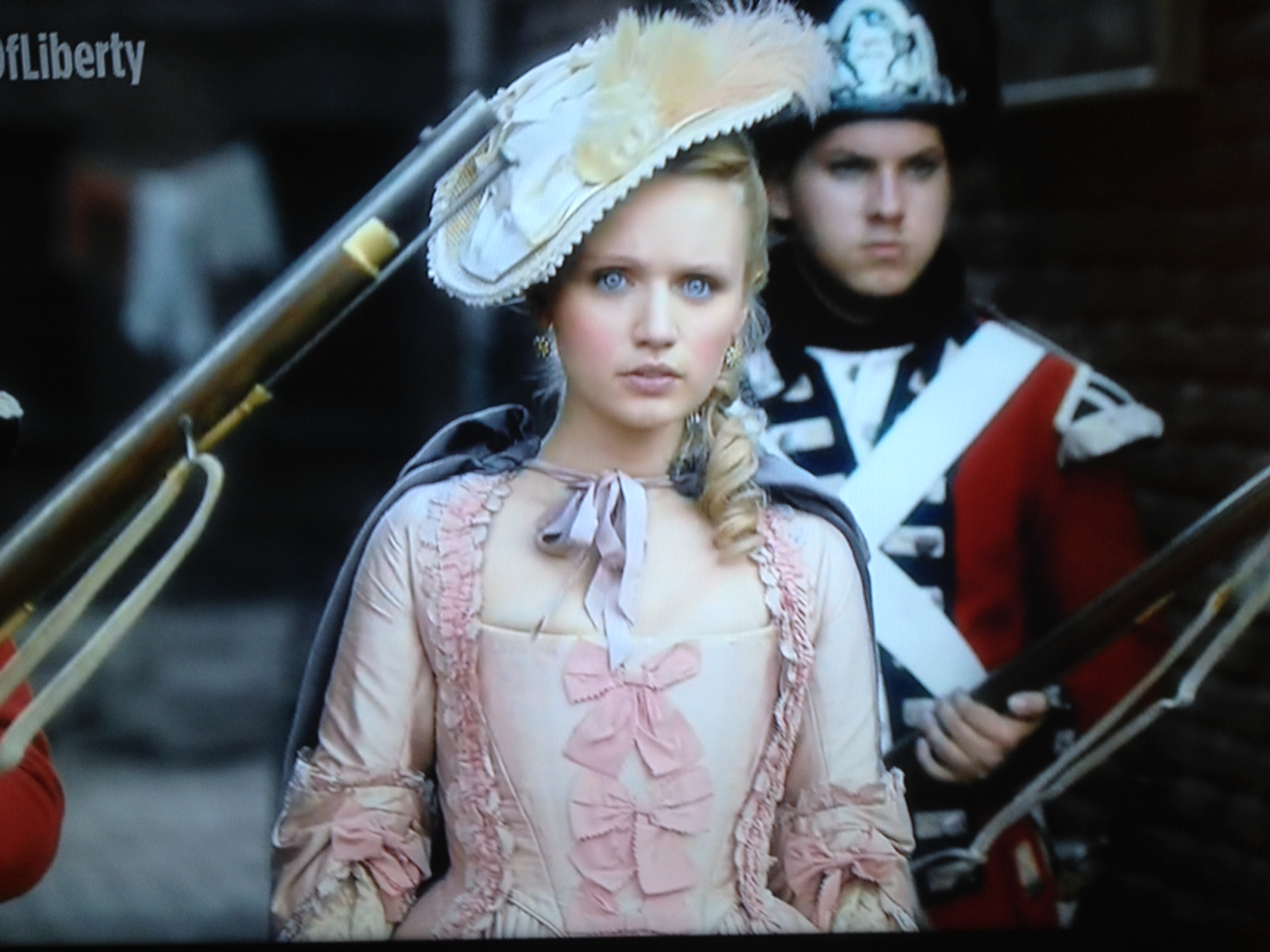
General Gage’s supposed trophy wife turns out to be much more than just another lovely face (Photo: DY)
That said, I really enjoyed this mini-series, and I’m sure I’ll watch it again. My suggestion is to view “Sons of Liberty” first, and then to read Verenna’s article. Its faults notwithstanding, the series breathes life into the major events and figures of the Revolutionary era. Verenna understands this when he diplomatically avoids slamming “Sons of Liberty” for its inaccuracies, even after documenting them:
The takeaway from this is that the Sons of Liberty program is highly entertaining historical fiction. We hope it energizes more people to study the Revolution and discover the truth behind these events. In many cases, the real story is better than fiction.
Winter Storm Juno: The view from Jamaica Plain, Boston
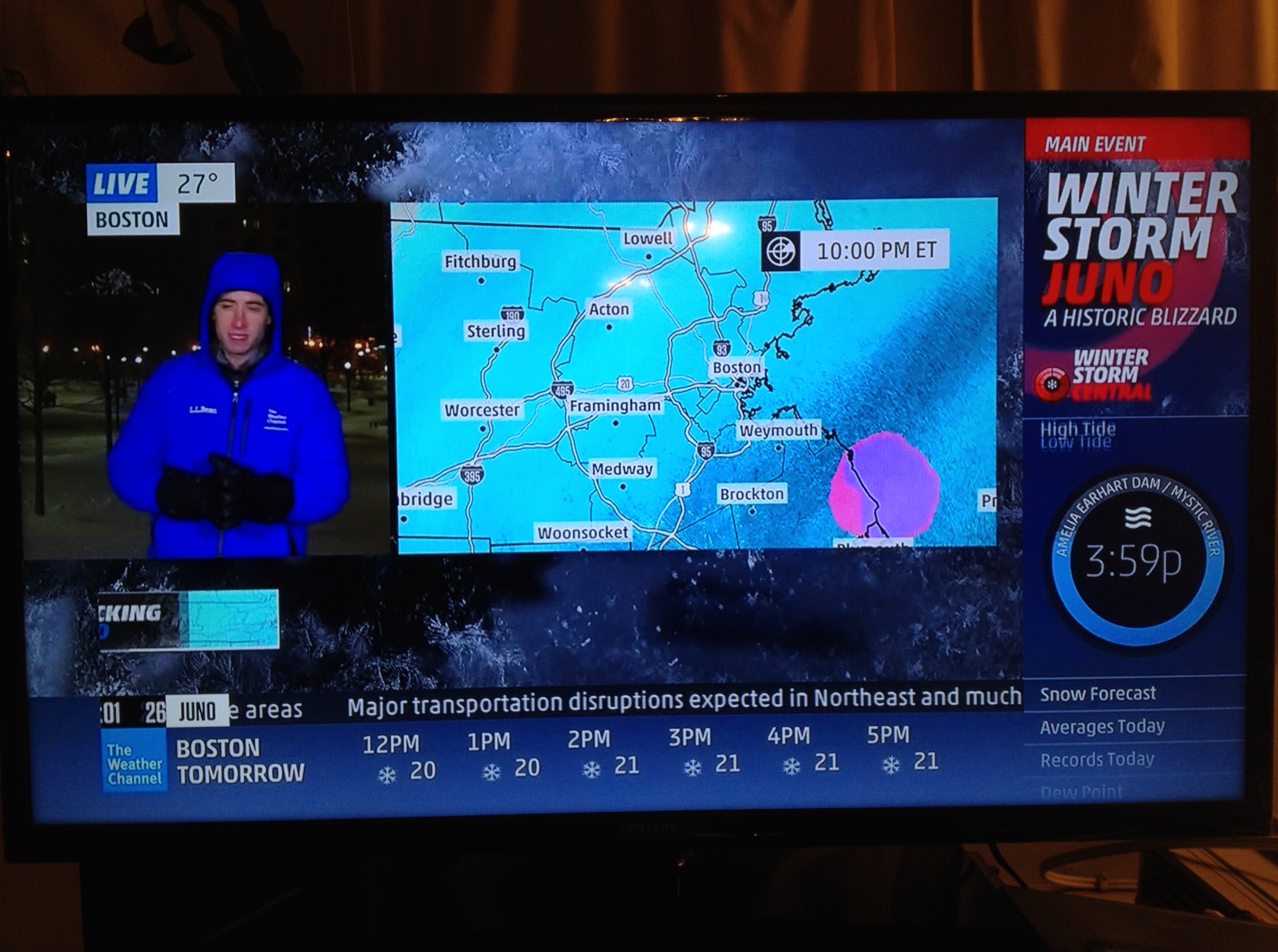
10 p.m., Monday night. Awaiting the brunt of Juno.
We’re in the midst of a major blizzard here in New England, and the Greater Boston area is getting plenty of its share right now. I thought I’d share a few views from the area surrounding my home in the neighborhood of Jamaica Plain.

Now we’ve got a blizzard! 1 a.m. Tuesday, corner of Boylston & Chestnut Ave, Jamaica Plain, Boston
The snow and wind started to pick up substantially after midnight. As you can see below, I got into the spirit of things, venturing out to survey the scene and take a picture or two. I also exchanged a hello with a guy driving one of the snowplows. If my neighborhood is any indication, the City of Boston has done a very good job plowing the streets.

Tuesday 1 a.m. blizzard selfie, with my street and condo building in the background.
I woke up this morning to news that the snow and wind will continue through much of the day, as expected. The snow certainly piled up during the time I was asleep.

Tuesday morning view from my condo.
Most of the city will be shut down today. The subway is closed. Most of us will be waiting out the rest of this storm, wondering if things will be cleared up enough to have a semblance of a normal day tomorrow. My university closed as of 4 p.m. yesterday, and while “snow days” are fun, we’ll probably have to make up missed classes later in the semester.
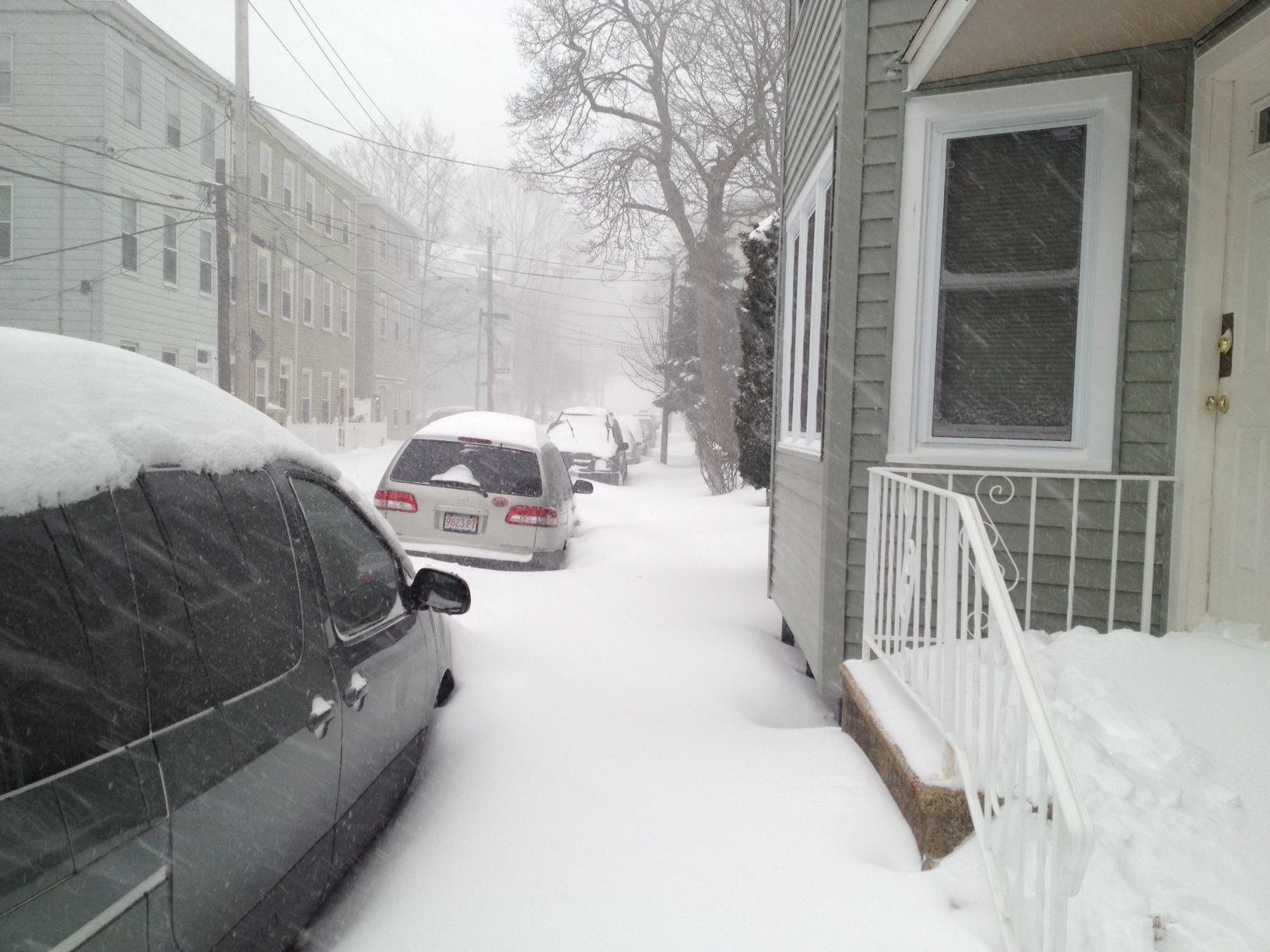
Looking down my street. It’s coming down heavy.
Among the things I don’t understand: Why is there a run on bread, eggs, and milk when a blizzard beckons? OK, bread I can understand — you can eat it even if the power goes out. But eggs are pretty useless if you can’t cook them, and milk is, well, what makes it so much more important during a blizzard? Anyway, my favorite neighborhood store, the City Feed & Supply, will be open for business soon, and I’ll be there.

I think he deserves bonus pay.
Papercuts JP: A new indie bookstore in my ‘hood!
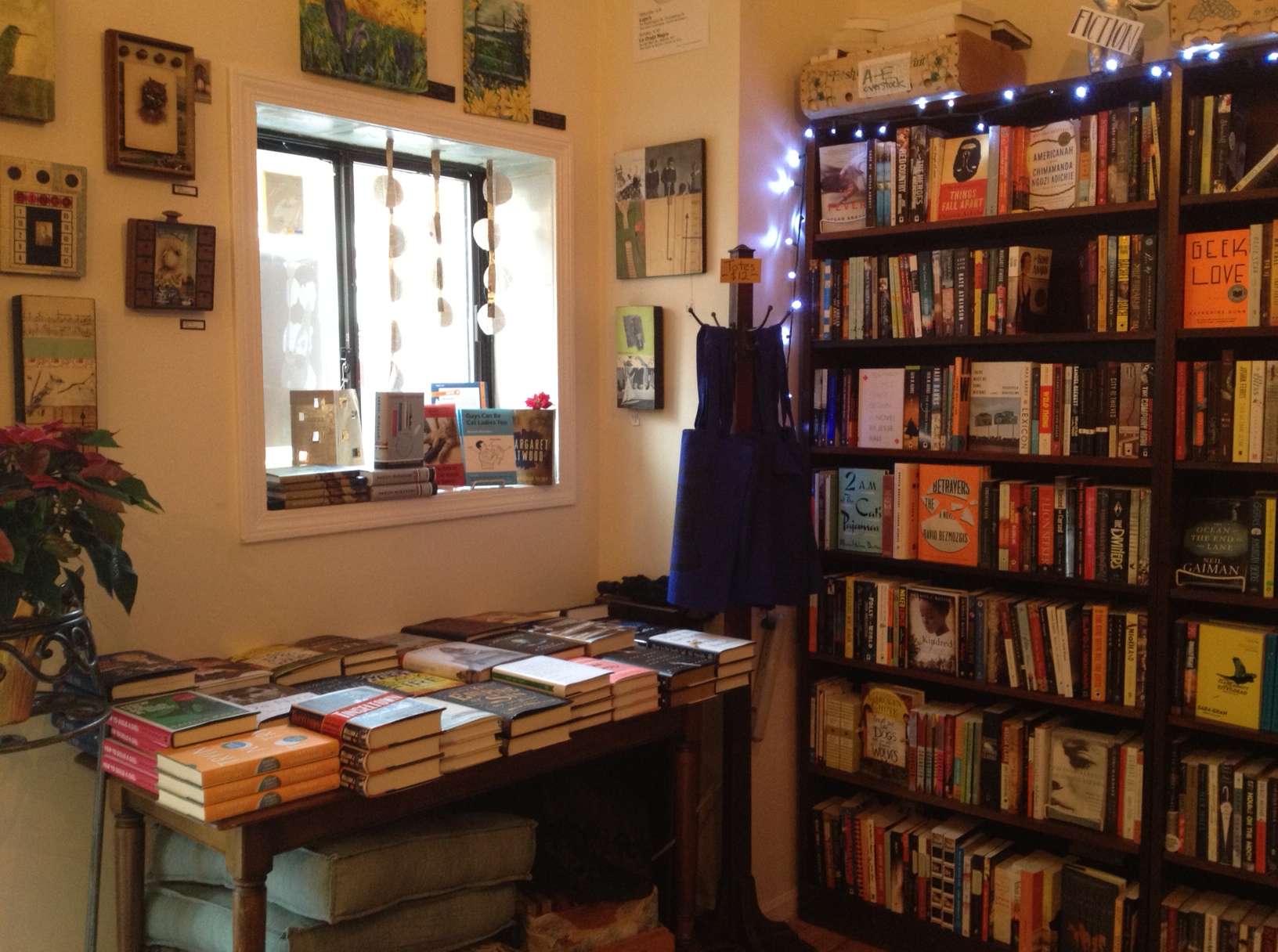
Papercuts JP in Jamaica Plain, Boston (photo: DY)
It’s always a boost for popular culture when a new brick & mortar bookstore appears on the scene, especially when it’s an interesting independent one. Here in my Boston neighborhood of Jamaica Plain, I’m delighted that a new indie bookshop called Papercuts JP is now open for business. It’s a cozy little store that manages to stuff several thousand carefully selected titles into its 500 square feet.
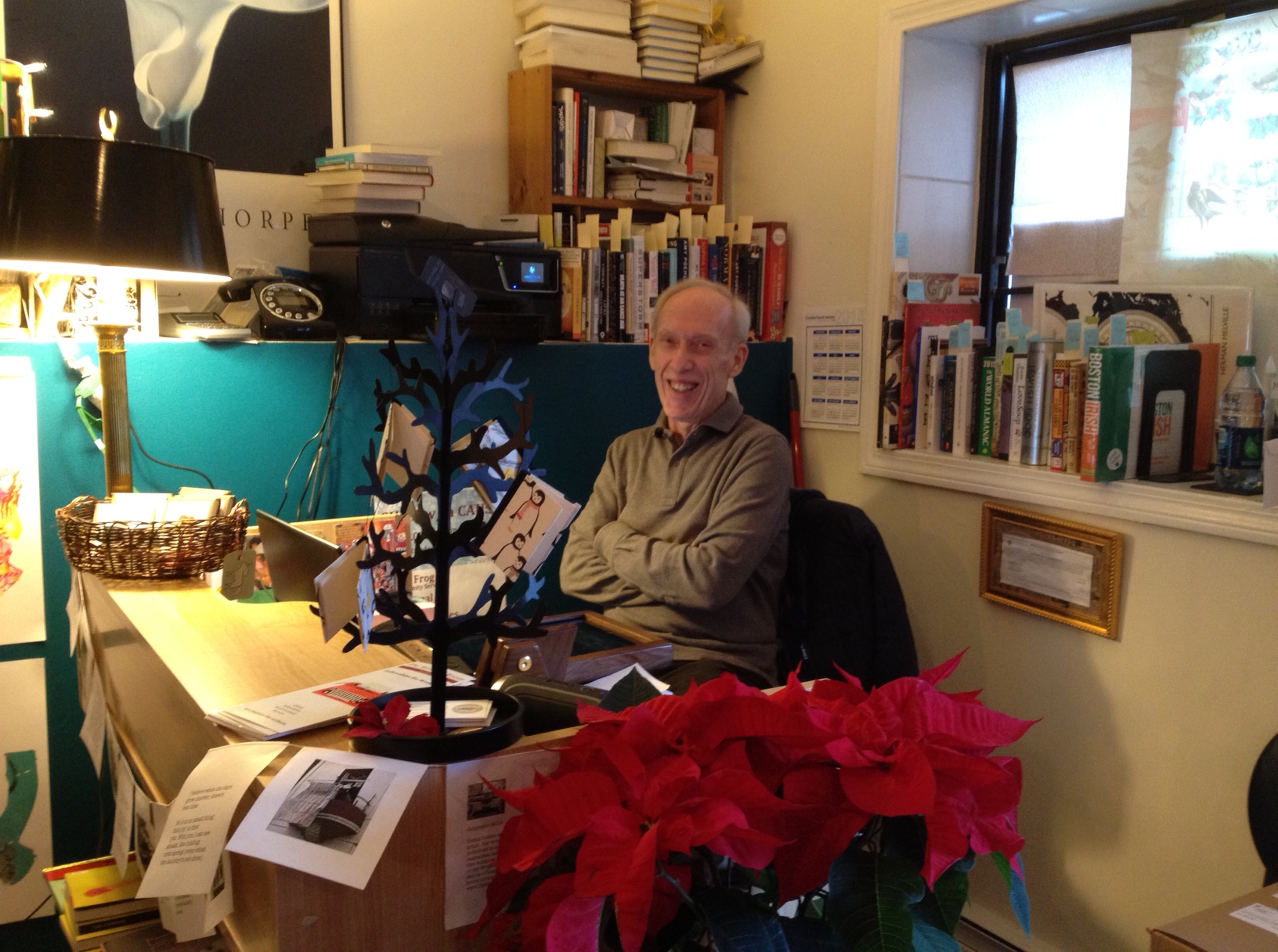
A bookseller with a smile! (photo: DY)
Boston Magazine blogged about Papercuts and its owner, Kate Layte, upon the store’s opening last month:
“I figured, if I didn’t take the leap now, I’d just get more scared as time goes on.”
That was the risk Kate Layte took when she decided to open her very own indie bookstore in Jamaica Plain. Now, after two years of planning, learning, fundraising, and prep, the Central Mass. native will finally open up her new shop, Papercuts JP, to the public November 29, a.k.a. Small Business Saturday.
…Layte, who says she is anti-genre, has already stocked the shelves with all sorts of gems. Starting out with about 3,500 titles, Papercuts has fiction, nonfiction, science and nature, art and design, humor, cookbooks, graphic novels, kids’ books, local books, poetry, biography and autobiography, and more.
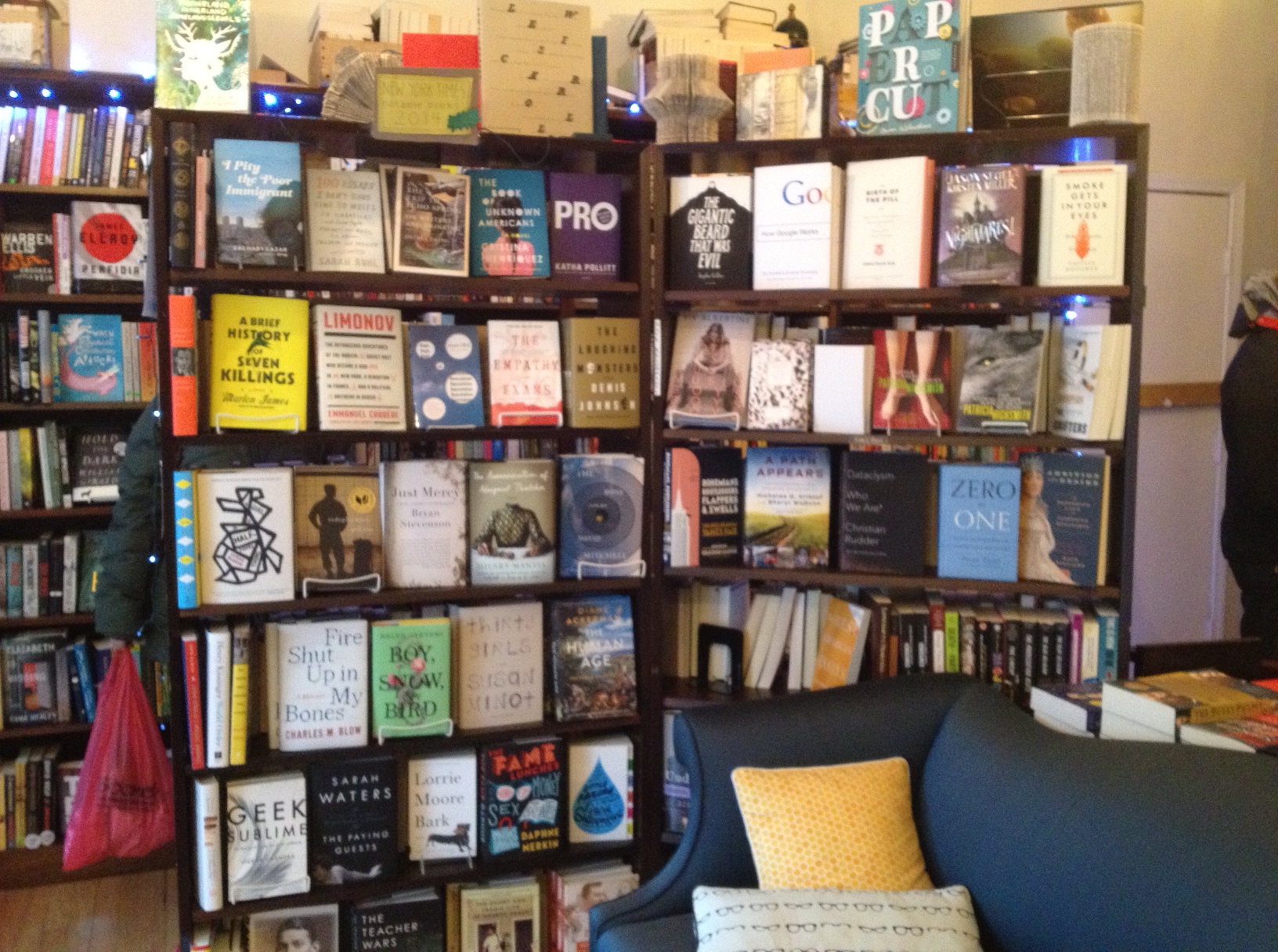
The store features an eclectic selection of mainstream and less-so titles (photo: DY, 2014)
Although JP is home to a lot of writers, artists, and avid readers, it has been without a dedicated bookshop for several years. That’s among the reasons why Papercuts is such a welcomed arrival. It’s a grassroots effort all the way: Earlier this year, Layte did a crowdfunding campaign to raise seed money for the store. I was pleased to be among the sponsors, but I must admit, it was an act of faith. However, now that I’ve paid my first visit, I’m in awe of what they’ve packed into this little storefront.

Yup, open the door to a cozy, wondrous bookstore! (photo: DY)
Although Papercuts may be swimming upstream against the bigger brick & mortar stores and the online sellers, it is the latest candidate to become part of an indie bookstore revival. Earlier this year, Zachary Karabell wrote a piece for Slate suggesting that the independents are staging a modest comeback:
In the words of Oren Teicher, CEO of the American Booksellers Association, “The indie bookselling amalgam of knowledge, innovation, passion, and business sophistication has created a unique shopping experience.” Teicher is hardly a neutral observer, but the revival of independents can’t be statistically denied. Not only have numbers of stores increased, but sales at indies have grown about 8 percent a year over the past three years, which exceeds the growth of book sales in general.
In sum, Papercuts has bonafide potential to become a lasting, enriching addition to the local business and cultural scene. I know that I’m looking forward to future visits!
***
Papercuts is located at 5 Green Street, right off Centre Street in the heart of JP. You can check out their Facebook page here.
Throwback Thursday (a day late): Moving to Boston 20 years ago

Bookshelves everywhere: A snapshot of my humble abode, Jamaica Plain, Boston
Twenty years ago, I packed my bags and boxes in Brooklyn and moved to Boston to begin a new job as a law professor. It was a big move for me. Not only was I embarking on the next major step of an academic career, but also I was leaving a beloved city that was my first chosen home.
I don’t love Boston the way I love New York City. Yes, Boston is “thinky,” manageable (as larger cities go), and contemplative, all qualities I appreciate and now truly embrace. However, it also can be thuggish, uptight, and lacking a sort of joie de vivre in its civic culture and social DNA. (On the latter point, my starting evidence is musical: The Gershwins and Cole Porter never wrote songs about it, and Sinatra never sang about it!)
But amidst this mixed bag, I have grown a lot here, become much wiser (umm, it takes some of us a while…), found great meaning in the work I do, and made lifelong friendships. And on the musical side, I’ve even discovered singing, a topic I’ll write about at greater length sometime soon!
Through ups and downs, Boston has taught me the differences between “happy” in a sort of superficial way vs. meaning in a deeper sense. These are no small blessings, and I accept them with gratitude.
The view from my burrito bowl: On Chipotle and Millennials

Chipotle, downtown Boston (Photo: DY)
I worked into the evening at my faculty office today, and after a quick assessment of what I might find in my fridge at home, I decided to grab a bite to eat before hopping on the subway. I settled on Chipotle because it’s quick, inexpensive, and close to the subway entrance.
As far as fast food goes, it also happens to be relatively healthy and tasty. I opted for a burrito bowl consisting of brown rice (I’m trying…), shredded pork, black beans, salsa, corn, a bare sprinkling of cheese, and shredded lettuce. Not bad, seriously.
I’ve gone to this Chipotle around a half dozen times this summer (actually, it’s the only one I’ve been to), and during each visit I’ve noticed that I am just about the oldest person in the place. Most of the customers (not to mention the workers) are in their 20s or younger. I’ve also noticed in random blogs and commentaries by Millennials that Chipotle pops up in their conversations, like it’s part of their generational culture.
So when I got home, I searched “Millennials” and “Chipotle,” and up came a fistful of articles saying that Millennials are opting for places like Chipotle over usual fast food suspects like McDonald’s and Burger King. Furthermore, the company’s marketing efforts are targeting Millennials, especially with appeals based on sustainable food practices.
I guess my observational instincts were pretty good!
In terms of quality and healthier casual eating, the Millennials have it over the Boomers and others on this one. Chipotle isn’t exactly health food, but it’s much higher up on the gustatory chain than a Whopper and onion rings.
To close on a brief historical note: The Chipotle I patronize is housed in a historic, old Boston building that once was a well-known bookstore. It does break my heart a little to think that a chain restaurant now inhabits this historic site. I’d be very surprised if many of the other weekday evening customers are aware of its provenance.
Was the summer of 2004 Boston’s high-water mark?
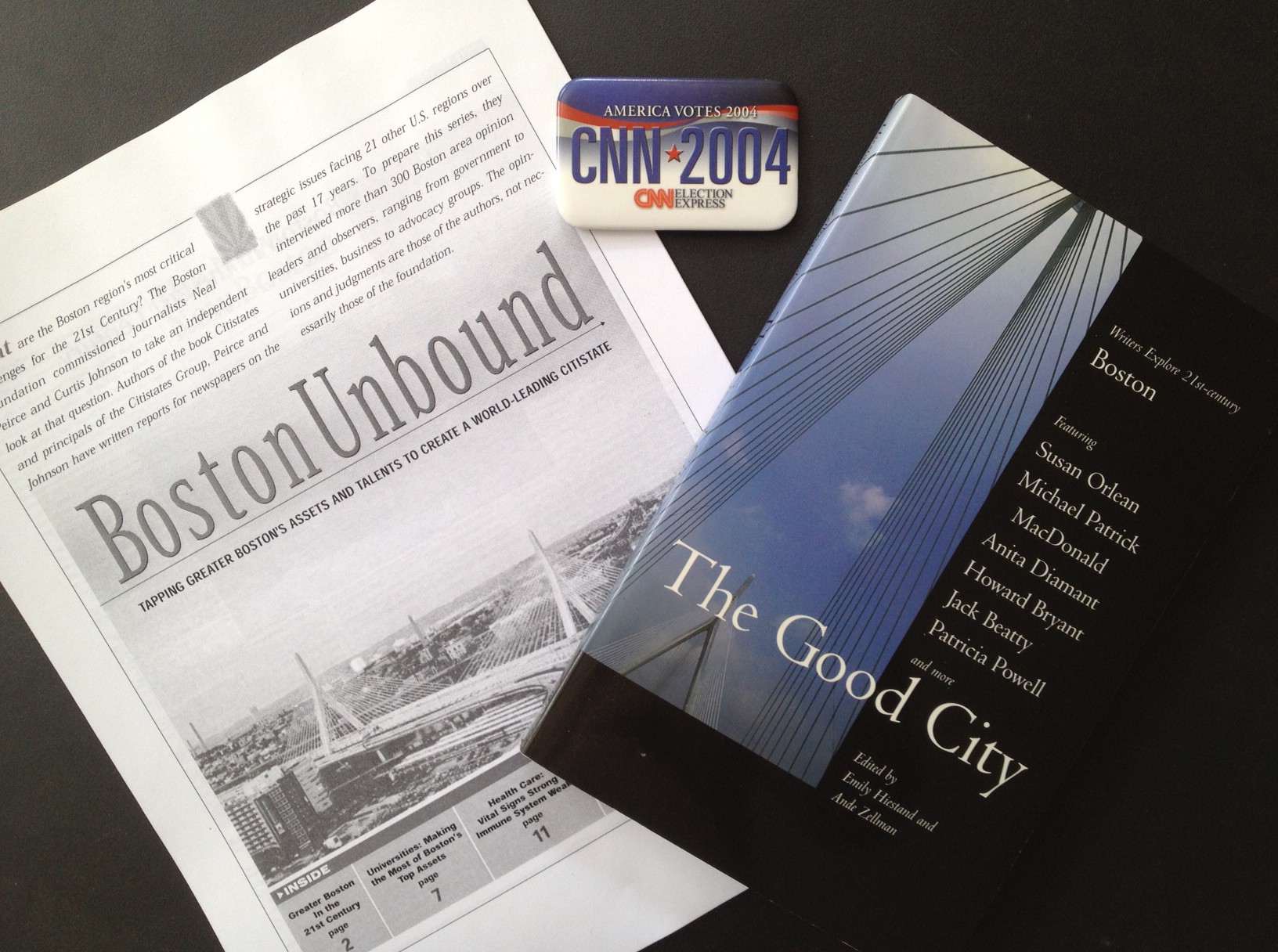
Ten summers ago, Boston was abuzz with energy. The Democratic National Convention (DNC) was held here, and during that week, nationally prominent politicians and media personages could be seen everywhere, walking about the city streets. After years of nursing a big sporting chip on its shoulder, Boston was home to the two-time Super Bowl winning Patriots (with one more to top off the ’04 season!) and to the soon-to-be World Series champion Red Sox. Overall, there was a sense that Boston was shedding some of its parochial past and becoming a more cosmopolitan, inclusive city.
The presence of the DNC was a big boost. John Kerry was the party nominee, and even if he could never approach the popularity of Ted Kennedy, it was still pretty neat to have a native son accepting the party nomination in his own backyard. In the heart of this very walkable city, you could trek from place to place observing the various convention-related events. (I picked up the refrigerator magnet in the photo above while stopping by a CNN outdoor studio at Faneuil Hall.)
That year, the Boston Foundation, a prominent and influential civic organization, released a major report, Boston Unbound, which assessed the city’s strengths and weaknesses. Although the report didn’t dodge the challenges facing Boston, its generally positive outlook captured the potential of a city ready to take its next big step.
Less wonky and more introspective, The Good City, an edited volume of personal essays about Boston’s past, present, and future, appeared on the scene as well. As a sort of literary non-fiction way of taking stock, this book, too, served as a statement that Boston was at a promising crossroads.
Personally speaking
This month marks the beginning of my 21st year in Boston, and I have watched this city change and evolve. I believe that the summer of 2004 was Boston’s modern era high-water mark, at least to date. A vibe of punchy optimism was in the air. Some of the knee-jerk defensiveness grounded in the city’s traditional culture was beginning to recede. Painful, complicated tensions over racial and ethnic diversity, long woven into Boston’s civic fabric, were softening.
As a relative newcomer to Boston (yes, 10 years in Boston still renders one a “newcomer”), I felt that change, and in modest ways I was involved in initiatives that were a part of it. That summer I graduated from a one-year professional fellowship program called Lead Boston, which organized monthly day-long seminars on topics related to city life and community service. I also served on the boards of two new initiatives, the City-Wide Dialogues on Boston’s Racial & Ethnic Diversity, and the Union of Minority Neighborhoods. Through my work as a law professor, I was the founding director of a grant-funded summer fellowship program for law students in the Greater Boston region who were interested in public service and state and local government.
The years since then
Looking back over the past decade, I can’t say that the buoyant civic optimism of 2004 translated into genuine transformation. Boston hasn’t exactly been stuck in place since then, but the advancements have been more incremental than dramatic. In some places, like the Downtown Crossing area in the heart of the city, we have seen a lot of deterioration. While ripple effects of the global economic meltdown have contributed toward this state of consolidation or plateau, so have shortcomings in the city’s civic and business leadership.
My own involvement in Boston community activities has declined, largely because of my immersive involvement in employee relations issues (see my professional blog, Minding the Workplace), and the frequent travel this work has required. If the day comes when I have more time for local activities, I would like to concentrate those efforts within my Boston neighborhood of Jamaica Plain, where I have lived since 2003. “JP,” as we denizens call it, is a great little part of the city, and someday I would enjoy becoming more involved in its goings on.
Heaven is a used bookstore

Brattle Book Shop, downtown Boston, exterior (Photo: DY, 2014)
Over the weekend I made an extended pitstop at the Brattle Book Shop in downtown Boston. I was reminded once again how used bookstores have been a place of happy sanctuary to me, going back to my early adult years.
The Brattle, pictured above, is one of America’s oldest bookstores, and it’s one of my favorites. Inside, you’ll find two floors of used books and review copies, plus a top floor of rare books. Outside, at least when the weather is okay, you’ll find shelves and carts of discounted used books, marked at $5, $3, and $1. Lots of the $5 books are quality volumes that would be a boon to many a personal library, and there are plenty of great bargains among the $3 and $1 offerings as well.
The discounted books outside draw me in. The weekend stop, for example, started with a discovery from one of the $3 carts, The World of Charles Dickens (1997), a colorful, illustrated guide to Dickens’ works and times, by London popular historian and Victorian crime expert Martin Fido.
But then I went inside. Uh oh. Let’s just say that the books I found on adult education and on psychology ran up the bill to considerably beyond three dollars. They may have been real “bargains” as measured by their original prices, but they lightened my wallet nevertheless.
Favorite haunts
Especially with the decline of brick & mortar bookshops, I’m delighted and appreciative that Greater Boston still supports used bookstores. In addition to Brattle, Commonwealth Books, Raven Used Books, and the basement level of Harvard Book Store are among the stores that offer plenty of used book treasures.
Elsewhere in the U.S., the Strand in Manhattan, Powell’s in Chicago, and Moe’s in Berkeley are favorite haunts. (Not surprisingly, all are within close proximity of one or more major universities.) During a recent trip to New Orleans, I was delighted to find several used bookstores in the French Quarter. And on those fortunate occasions when I’ve traveled to England, I’ve always been on the lookout for used bookstores.
New York
New York City’s used bookstores hold a special place in my heart. By the time I moved there, its famous “Book Row” on 4th Avenue was no more. But during my years in New York (1982-94), the Strand was a classic, creaky, and vast used bookshop. I visited regularly as a law student, and during my stretch as a perpetually broke Legal Aid lawyer, I would make pilgrimages there on paydays when I felt (very temporarily) flush. The Strand has done some upscale remodeling in recent years and now sells a lot of new titles along with its storehouse of used books. Nonetheless, it remains a standard stop during my New York visits.
Another favorite was the Barnes & Noble Annex on 5th Ave. and 18th Street, across the street from the original B&N flagship store (which recently closed). The Annex was a multi-floored wonder, full of remaindered and heavily discounted new titles and used books. B&N would shutter the Annex sometime after I moved to Boston. I recall that when I discovered it had closed, I felt like a small piece of my New York life was gone too.
Book sale in a tent
The origins of my enjoyment of rummaging through piles of used books trace back to the summer after my first year of college. I was spending the summer at home in northwest Indiana, and my mom had clipped from the Chicago Tribune a small notice about a big used book sale in Wilmette, Illinois.
Later I would learn that the book sale was an annual, week-long fundraising event organized by the Chicagoland chapter of the Brandeis University women’s committee. It was legendary among many bibliophiles across the country, some of whom would rent camping vehicles to drive there and load up on good books for the year.
Anyway, I did the 90-minute drive to check it out. When I arrived, I could scarcely believe my eyes. The sale — offering some 250,000 used books(!) — was held in a huge tent that covered a big stretch of a mall parking lot. I spent just about every bit of spare change I had to my name. I filled several bags of books, and a few days later I would return to buy even more. Though I felt too silly to call it as such, this marked for me the beginning of a personal library.
Apparently some form of this book sale survives to this day. Hopefully others are deriving the same pleasure of visiting it and loading up on great discoveries. Maybe, like me, it will fuel a lifelong devotion.
With the Sunday paper in a Boston café
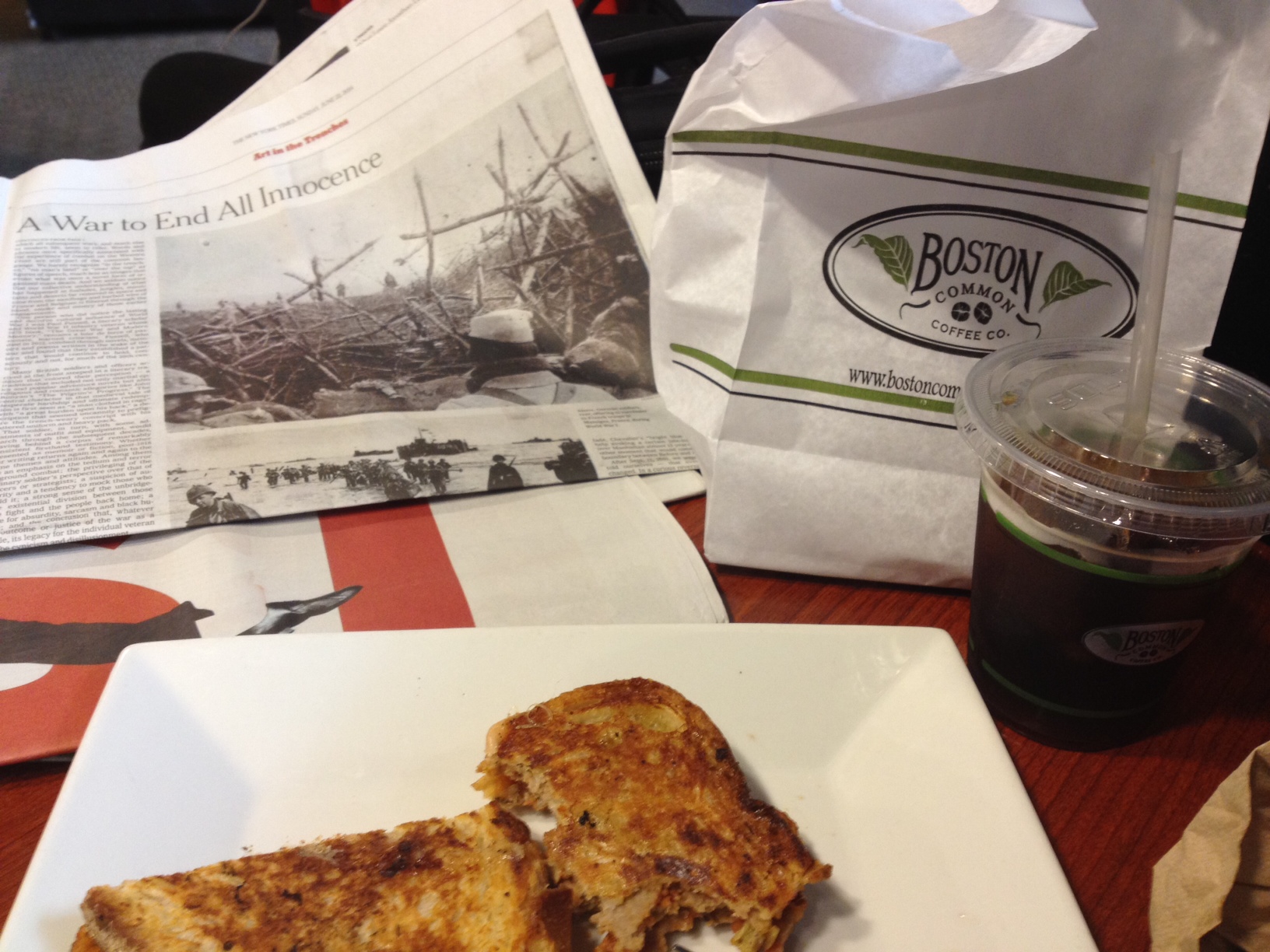
(Photo: DY, 2014)
Before heading into the office today to pick up some work (I’m one of those academicians who embraces quirky work hours), I stopped by the Boston Common Coffee Company, a downtown café, for a late lunch. It is there, while enjoying a sandwich & greens, iced coffee, and part of a cookie, that I realized how weird I have become. No, it’s not that I’ve changed all that dramatically over the years. Rather, it’s how the world has changed around me.
You see, while sitting at a small table with my food, drink, and a few sections of the Sunday newspaper, I looked around and realized that among the 20 or so people in the café, I am the only one reading a newspaper. In fact, I’m the only one reading any kind of hard copy material at all. Just about everyone else, whether alone or in a small group, has a gadget or laptop out.
Of course, it was a younger group of customers, as befits a coffee place located among buildings of two urban colleges with dorms full of summer visitors. So the generational thing certainly was at play. By contrast, when I was in law school at NYU some 30 years ago, on any given Sunday you could go to a neighborhood coffee shop and see students trading sections of the Times, Daily News, and Post over a (usually late!) breakfast or brunch.
Though I get a lot of my news online, spending time with a hefty Sunday newspaper remains a treat for me. There’s a small sense of adventure in flipping through the sections to see what awaits me. And when coffee and a bit of good food are added to the mix, it makes for an extraordinarily pleasant way to spend part of a day.
In praise of the mundane and slow blogging

My triple decker condo building, on the right, Jamaica Plain, Boston (Photo: DY, 2014)
Commenting on my previous dramatic, pathbreaking post about coffee (NOT), one of my friends remarked on Facebook that I had a knack for making even mundane subjects sound engaging and interesting. That’s a real compliment for a personal blog — thank you, Holly!
That said, “mundane” isn’t exactly what inspired blogging, which first became popular roughly a decade ago as a way to publish breaking news and commentary on major events. In addition to serving that journalistic purpose, blogging also has grown into a medium for synthesizing information and for sharing analysis and opinion.
In any given week, I read a fair share of blogs for all of these purposes. And through my professional blog, Minding the Workplace, I attempt to contribute to that dialogue by writing about issues of employee relations, workplace bullying, and psychological health at work. On occasion, I even help to break a story within my realm of work.
However, I also find myself increasingly drawn to blogs about everyday life, hobbies, travel, memoirs, TV shows, books, sports, avocations, and anything else that isn’t about hard news, analytical thinking, and conflict. They offer interesting, entertaining, and sometimes fascinating windows into our daily lives. And since launching this personal blog last fall, I’ve come to enjoy writing about some of the more common or ordinary aspects of life, two words often used to define mundane.
Understanding “slow blogging”
To characterize these less momentous uses of blogging, I reference the term slow blogging, the philosophy and practice of which has been beautifully articulated in the Slow Blogging Manifesto by software designer and writer Todd Sieling. (He hasn’t updated his blog in years, but this post alone is worth keeping it online.) Here are a few snippets:
Slow Blogging is a rejection of immediacy. It is an affirmation that not all things worth reading are written quickly, and that many thoughts are best served after being fully baked and worded in an even temperament.
***
Slow Blogging is a reversal of the disintegration into the one-liners and cutting turns of phrase that are often the early lives of our best ideas.
***
Slow Blogging is a willingness to remain silent amid the daily outrages and ecstasies that fill nothing more than single moments in time, switching between banality, crushing heartbreak and end-of-the-world psychotic glee in the mere space between headlines.
The happily mundane
Maybe we need to make a more prominent place for slow blogging about the common and ordinary. We all want to live good, rewarding, purposeful lives. Many of us have a tendency to frame this in terms of milestones, such as major work accomplishments or family events. But perhaps we should spend more time appreciating and reflecting upon the everyday stuff as part of our search for that meaning.
So I leave you with this photo of my three-unit condo building in Jamaica Plain, Boston (“JP” to locals), taken on a dreary, wet, overcast day earlier this year. Having moved there in 2003, this is the longest I’ve lived anywhere since my childhood. Although my condo is nothing elaborate in terms of space, views, furnishings, or architecture, it’s a good home.
Equally important, as someone who doesn’t own a car, my place is a quick walk to subway (aka the “T” in Boston) and bus lines. The T’s Orange Line takes me into the city’s downtown area. Logan Airport and South Station (Amtrak) are short T rides away, a boon to frequent travelers such as myself.
My home is close to JP’s shops, stores, and restaurants. And when I’m hungry and don’t want to cook heat up something, I can bop across the street to the City Feed and Supply Store for a sandwich, order a pizza from Il Panino, or call in for Chinese delivery from Food Wall.
The photo above doesn’t capture the beauty of JP, a diverse, picturesque neighborhood in the southwest region of Boston. I was reminded of this a couple of weeks ago when I slept past my subway stop and got off at the next station, still in JP. To get home I walked along the Southwest Corridor Park, a linear park that runs roughly parallel to the T tracks through a long stretch of the city. It was a beautiful walk, the kind that makes you think “urban oasis.”
These are simple things that can make for an enjoyable day, and pleasant reminders — even for those of us too caught up in destinations at times — that the journey counts for a whole lot.
 Musings of a Gen Joneser
Recent Comments