I read an entire, hard copy book — and enjoyed it!
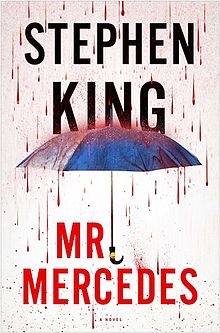
This is a rather pathetic title for a blog post, especially by someone who calls himself an avid reader. But lately my reading has been very task-oriented, both books and articles alike, and almost entirely of the non-fiction variety.
So I credit Stephen King for serving up a novel that I eagerly read from start-to-finish over a week’s time. Mr. Mercedes (2014) is King’s foray into hard-boiled detective fiction, and it’s a good one. The main protagonist is a retired police detective, Bill Hodges, who gets caught up in an unsolved multiple homicide. The perpetrator — identified very early in the story (no spoiler alert necessary) — is a pretty messed up dude with serious mommy issues.
I enjoyed this book, and easily place it in the “didn’t want it to end” category. Thus I’m delighted that King launched it as the first of a planned trilogy featuring Hodges and his sleuthing pals, with the next title expected sometime next year.
Back in January, I sang the praises of the latest incarnation of Amazon’s Kindle e-reader, especially for folks who travel often. However, last weekend I decided to take this hardcover edition of Mr. Mercedes with me for a quick out-of-town visit with friends, even though it took up precious backpack space. (Although this is not among King’s longer works, it still clocks in at a hefty 440+ pages.) I’m glad that I did. Reading Mr. Mercedes as a printed book rather than as an e-book was such a pleasure. Hey, it’s not often when you’re wishing the plane ride was just a little bit longer so you can squeeze in another chapter!
I know it has become something of a cliché for those who love the printed page to say they prefer the tactile experience of reading a physical book to the convenience of using an e-reader. Nevertheless, count me among them. Even with my fifty-something eyesight (oy…) and frequent travel schedule, there remains something very cool about reading an old fashioned printed book.
Picking the worst pop songs of the 70s: Where do I begin!?
When I was younger and went to loud parties more often, one of my frequent contributions to the festivities would be to croon bad songs from the Seventies. Although I’m not a drinker, I managed to fit in well with those who were en route to inebriation (or already there), and we would regale torture fellow partiers with our own versions of some of the worst pop tunes imaginable.
Of course, this may explain why I don’t get many party invitations anymore. Whatever.
Anyway, here’s the dilemma: How does one choose from the Bad Seventies Songbook??? It’s sort of the opposite of trying to pick the best of Sinatra or the Beatles. The choices are endless, in the worst ways.
Now, before anyone gets too cross with me, let me acknowledge that a ton of great groups and performers were part of that decade: Bands like Aerosmith and Queen. Singer-songwriters like Carole King and Billy Joel. It’s a long list.
But for some reason, the 70s also bore witness to some of the most horrible pop music in the history of humanity. For what it’s worth, here are some of my obvious choices, in no particular order, though concededly heavy on treacle:
- Anything by the Captain & Tennille
- Paper Lace, “The Night Chicago Died”
- Starlight Vocal Band, “Afternoon Delight”
- Paul Anka, “You’re Having My Baby” (perhaps the sequel to above)
- Anything by the Bay City Rollers
- Bo Donaldson, “Billy Don’t Be A Hero”
- Terry Jacks, “Seasons in the Sun”
- Michael Jackson, “Ben” (I mean c’mon, he’s singing to a rat)
- Morris Albert, “Feelings” (featured above, if you’re in a masochistic mood)
- A lot of stuff by Barry Manilow
- The Carpenters, “Merry Christmas, Darling” (though Karen Carpenter’s voice was a gift)
- Debby Boone, “You Light Up My Life”
For maximum pain infliction, you’ll find renditions of most of this stuff on YouTube.
And if you want more, Google around to find assorted lists attempting to select the worst of the worst, such as this one by Rolling Stone magazine or this one by RateYourMusic.com. I realize there’s room for disagreement here. For example, the RateYourMusic.com list includes some tunes I actually like, such as “Don’t Pull Your Love” by Hamilton, Joe Frank & Reynolds. (Also, I just can’t bring myself to put anything by Her Lusciousness Olivia Newton-John on my list.)
You may also disagree with the choices. Hey, maybe you’ve got Billy Joel on your “worst of” list! Indeed, if you’re a music company repackaging 70s songs into albums, you can use the same numbers for the “best of” and “worst of” collections! In fact, a couple of my NYU law school classmates had something of that idea in mind when they formed the “Seventies Preservation Society,” which they grew into a major label, Razor & Tie. Apparently there’s still money to be made off of these terrible tunes.
Visiting Berlin during the Cold War

Berlin Wall (Photo: DY, 1981)
Twenty-five years ago, the Berlin Wall fell, marking a symbolic end to the Cold War. This week’s observances of that event have prompted memories of visiting Berlin in May 1981. A few weeks earlier, I had finished my final undergraduate semester at Valparaiso University’s study abroad program in England, and Berlin was among my stops on a whirlwind trip through parts of the European continent.
In 1981 the Cold War very much remained a defining element of international relations, and divided Berlin captured the heart of the era. Although I was but one of millions of tourists to the city during that time, it felt adventurous to be splitting off from my friends for a brief solo trip there.
I’ve included some of my grainy snapshots, temporarily plucked from my study abroad photo album.

Allied Checkpoint Charlie, Berlin (Photo: DY, 1981)
It was possible to get a one-day pass to travel from democratic West Berlin into Communist East Berlin. Via the Allied Checkpoint Charlie, you were processed through to the other side, under the watchful eyes of East German guards. You also had to exchange a minimum amount of money, and what you didn’t spend had to be “donated” to the East German government before crossing back to the west side.

East Berlin (Photo: DY, 1981)
Whereas life in the heart of West Berlin seemed loud and decadent, the streets of East Berlin felt lifeless under Communist rule — as drab and dreary as the photo above suggests.
There also wasn’t a lot to spend one’s money on; the (excellent) museums were free and food options were sparse. As my day in East Berlin drew to a close, I still had a fair amount of money left, and I didn’t want to simply hand it over to the East Germans. I thought I had lucked out when I spotted a bookstore, figuring I’d buy a book as a souvenir. However, the only title in English, displayed prominently for folks like me, was a hardcover edition of the complete works of Lenin. So I bought it! I would spend the rest of my European jaunt lugging around that big volume. Though I did bring it home with me, I cannot recall ever reading it before giving it away many years ago!

Reichstag building, Berlin (Photo: DY, 1981)
The specter of the Second World War was also very much present. I did a quick tour of the Reichstag building that housed the German parliament until 1933, when a fire of unknown origin prompted the Nazi government to suspend most of the individual rights contained in the nation’s constitution. I also visited the Olympic Stadium in which African American track and field star Jesse Owens won his gold medals, achievements said to have undermined the myth of Aryan superiority.

1936 Olympic Stadium, Berlin (Photo: DY, 1981)
I’m very glad that I made Berlin a stop on my European itinerary, but there was something about the city that made me uneasy. I think I felt the energy of so much terrible stuff happening there during the city’s 20th century life. I would return to Berlin in 2011 when I attended a conference at Humboldt University, and I couldn’t shake that disturbing sense even though it had changed dramatically. Some places just have a certain discomforting feel, you know?
New Fall TV: I’m liking “Gotham”
I’ve been pretty busy this fall, so I’ve had to ration my TV time carefully. But among the handful of shows I’m following, FOX’s Gotham has become a regular in the rotation.
Gotham is, in a nutshell, a prequel to the Batman stories. (MILD SPOILERS AHEAD.) It starts with the street murder of young Bruce Wayne’s parents before his very eyes, and then quickly shifts to the police work of green detective Jim Gordon and his senior partner Harvey Bullock.
Gotham‘s Gotham City is a dark, corrupt urban society with a 1940s New York City look and skyline. It’s also a time bender with mobile phones and cable-quality TV reception. In the early Gotham episodes, we’re introduced to more of the characters who later will be part of Batman’s world. (I’ll leave it to you to discover them for yourself.)
If you grew up with the Batman television series of the mid-60s, be prepared for a contrast! This is not a zam-wham-pow kids’ show. Gotham is the stuff of comic book noir, a sinister place where nearly everyone has secrets and many are the make. I’m not an avid comics reader or a devotee of the superhero genre, but I think it’s a lot of fun.
Tornado dreams

That’s a funnel cloud lowering behind me in Colorado, summer 2012.
I had one of my periodic tornado dreams last night. It was, as these dreams tend to be, vivid, dramatic, but not at all scary.
In this dream, I was at some type of a program, hosted in a multi-level, homey-type building, when I looked out the window and saw funnels lowering toward the ground. Even though one of the tornadoes passed directly over us, there was no real damage and no one was hurt.
I have been fascinated by tornadoes since I was a child growing up in northwest Indiana, and I’ve been having variations of these dreams for as long as I can remember. As I wrote here last spring, in recent years I’ve even gone on storm chase tours to see the real thing. One of the most exciting days of my life was the first day of my first chase tour in 2008, when our group encountered a single supercell in northern Oklahoma that spawned multiple tornadoes throughout the afternoon and early evening.
Anyway, back to the tornado dreams. I know what some people might say: These dreams have a deeper meaning. I did a quick search — “dreams about tornadoes” — and found what I largely expected, such as an entry from DreamDictionaryNow.com asking if I am experiencing “emotional upheaval,” “destructive behavior,” or “sudden change.”
In my case, these dreams haven’t correlated with acute emotional episodes of my life. However, if there is a consistent theme in them, it’s that I’m girded for, but not frightened by, a tornado coming toward me. In fact, I’m utterly captivated. So maybe these dreams are telling me that I’ve got more capacity for change than the comparatively stable life of a professor might suggest.
Of course, my tornado dreams may be more transparent than that. The look and power of these storms have had a hold on me for decades. Maybe that fascination simply follows me into dreamland.
Throwback Thursday: Most favorite and least favorite Halloween treats

Given that trick-or-treating is a hallowed Halloween activity for kids, I thought I’d take a stroll back to my childhood and list out what made me cheer and boo when I checked out the goodies in my stash. How does my list compare to yours?
Favorites
1. Baked goods (donuts, cupcakes, cookies, or Rice Krispy treats) or caramel apples — These items were the gold standard. However, by the late 60s and early 70s, urban legend paranoia about poisoned homemade treats and apples containing razor blades had invaded suburban Indiana, and some parents warned their kids not to consume anything that wasn’t pre-packaged. Properly warned, we made sure to eat those items before we got home. For some reason, I retain a memory of an exquisite, fresh hot donut given out by an older couple in the neighborhood.
2. Kit Kat bars — Kit Kats didn’t make their appearance until the early 70s, if my memory is correct, but I remember being pleased to see them in my Halloween sack!
3. Nestlé’s Crunch bars — I’m developing a theme here of chocolate with crunchy stuff.
4. Money — Yes, cold hard cash. Every once in a while, someone would give out money, usually a quarter, which back in the day was real money to a little kid.
5. Nestlé’s $100,000 bars — Add gooey stuff to the chocolate and crunch.
Honorable mentions — Peanut M&Ms, Milk Duds, Whoppers, Almond Joys, and Milky Ways were solid staples. I would develop an affinity for Reese’s peanut butter cups later in life.
I was indifferent toward Snickers bars, Mars bars, Hershey bars, and various peanut candies.
Overall, chocolate ruled the roost.
Least favorite
1. Anything with licorice, especially Good n’ Plenty — I just couldn’t deal with licorice as a flavor. I still feel that way!
2. Necco wafers — Bleeecccchhh!
3. Candy corn — I never understood the appeal of what tasted like pure chewy sugar.
4. Chewing gum — Serviceable, but it didn’t rock my trick-or-treat world.
5. Lollipops — Eh….though Dum Dums and Tootsie Roll pops were okay.
As you can see, I was less crazy about the super sweet stuff.
Throwback Thursday: Dorm living

End of semester: Packing boxes in Brandt Hall, Valparaiso University, 1980
This morning I clicked on a Facebook posting from New York University, my legal alma mater, to a short piece about dorm living for law students. A photo of one of the NYU Law dorm rooms (see below) reminded me once again that many universities have upgraded their residence hall accommodations considerably since back in the day, especially in terms of private rooms and bathrooms. (Of course, this has contributed significantly to rising tuition costs, but that’s for a more serious post….) In any event, the article sent me into a brief trip down nostalgia lane.
Valparaiso University
In many ways, dorm living tends to look better mainly with the passage of time, at least when it comes to furniture, décor, and creature comforts. During college at Valparaiso University in Indiana, I lived in dorm rooms throughout my stay, first in Wehrenberg Hall, and then in Brandt Hall, two rather plain vanilla buildings built sometime during the 50s or 60s. The VU dorms were typical of undergraduate dwellings of their era, offering small shared rooms with pullout beds and bathrooms down the hall. During my last year of college, I qualified for a shared Brandt Hall first-floor room with a private bathroom, a nod to the fact that I was a good student who managed to stay out of trouble.
In the photo above, I’m standing in front of my desk. The boxes and papers to the right obscure the mattress of the pullout bed. I was packing my boxes at the end of the fall semester of my senior year, in anticipation of departing after the holidays for a final semester in England. My roommate Chris’s furniture configuration was exactly the same, the main difference being that he was a very disciplined and neat pre-med student who periodically and politely would push my growing piles of books and papers to my side of the invisible Mason-Dixon Line, as we jokingly called it. Every evening, when Chris would dutifully turn in after watching the Johnny Carson monologue, I would gather my books, papers, and — if necessary — typewriter to join other more nocturnal students in the cafeteria, which served as a nighttime study hall.
NYU
When I got to NYU in 1982, I had a much fancier address, Hayden Hall at 33 Washington Square West (yes, that Washington Square). The toney Greenwich Village exterior masked the spare accommodations similar to those of my collegiate days, with a few New York cockroaches tossed in as free bonuses. At the time, Hayden Hall was the primary dorm for first-year law students. A converted old hotel, it had a few interesting nooks and crannies in addition to the drab rooms. Its first floor cafeteria and TV room provided opportunities for breaks and socializing.
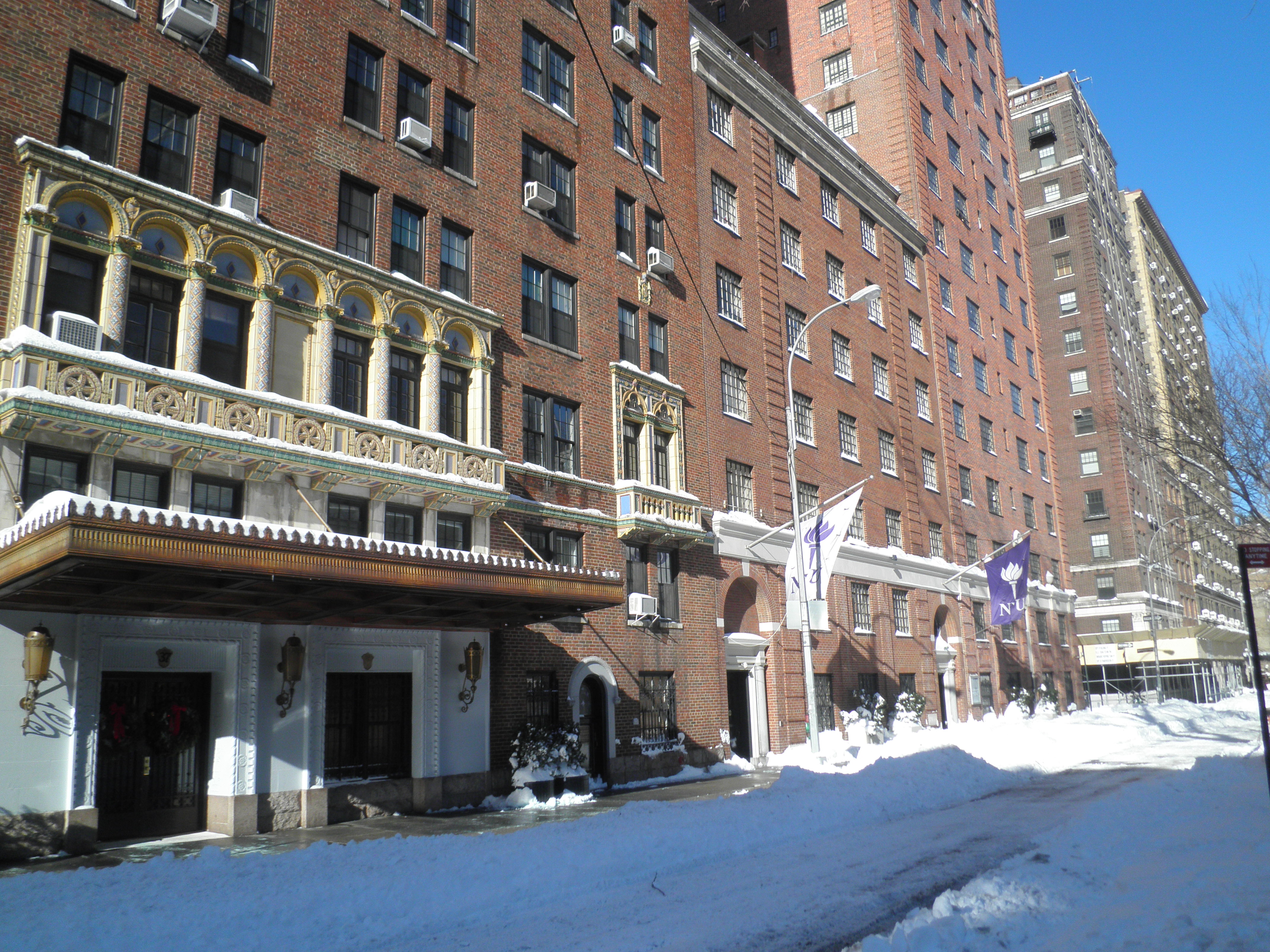
Modern view of NYU’s Hayden Hall (photo: DY)
I would spend my second and third years of law school living in NYU’s Mercer Street residence hall, a (then) brand-new building featuring small apartments with individual bedrooms and kitchenettes. While I didn’t do much cooking, the fridge and stove made it possible to store and heat up Chinese take-out and delivery morsels. With some physics-defying moving around of beds and furniture, apartment units could host pretty decent parties, replete with room for dancing to Michael Jackson, The Clash, and other 80s music artists. We also had waifs’ Thanksgiving and Christmas dinners for those of us too far or too broke to return home for the holidays. The Mercer dorm provided my nicest accommodations during 12 years in New York.
In fact, they remained among my nicest digs ever until I moved into my Jamaica Plain, Boston condo in 2003. For the longest time, I was satisfied with a sort of enhanced “grad student” standard of living. It took me until well into adulthood to do an upgrade!

A current NYU Law dorm room. (From http://blogs.law.nyu.edu/lifeatnyulaw/life-in-the-law-school-dorms/)
Of ghosts, goblins, and the Great Pumpkin
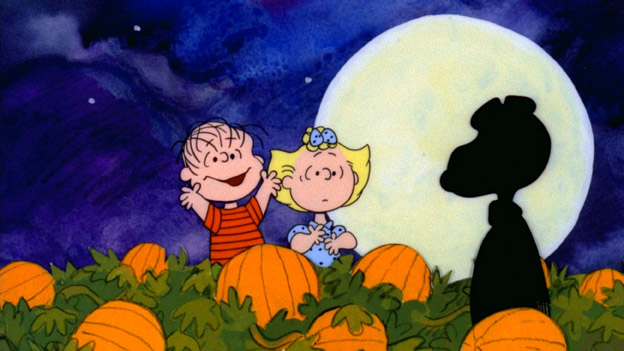
(Picture: abc.com)
Tonight I took a short break to watch an old favorite, It’s the Great Pumpkin, Charlie Brown, one of the classic Peanuts TV specials. It’s funny, sweet, innocent, and clever. As a kid, I so wanted the Great Pumpkin to make an appearance! Nowadays, I especially enjoy Snoopy’s adventure as a First World War flying ace.
This particular appearance of the Peanuts gang means that we’re into the heart of October, and Halloween beckons. Ghosts and goblins are also part of the story. To get the supernatural atmosphere right, it helps to be in a part of the country that experiences genuine changes of seasons, and New England certainly fits the bill. Although today happened to be a tad on the warm side, we’ve already had several days of fall chill.
To help capture the season, I’ve included this photo of Joseph A. Citro’s Weird New England (2005). You see, in New England, that Halloween feeling is about more than simply the weather. This is an old part of the country, and old stuff tends to bring a lot of haunted spirits, or so they say. (By contrast, while I’m sure they have ghosts in Los Angeles, it’s just not the same.)
Halloween still has the power to bring out the little kid in all of us, so here’s to ghosts, Peanuts specials, and maybe a candy bar or two to top them off.

Have our gadgets sapped some of the adventure out of travel?
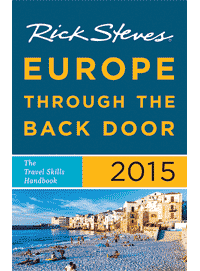
You’ll find a lot of advice about gadget management in today’s leading travel guidebooks
During my recent trip to Chicago, I was talking with one of my friends about how our digital gizmos — cellphones, tablets, laptops, and so forth — have changed the experience of travel. In some ways, they have greatly enhanced travel in terms of access to information, safety & security, and keeping in touch with folks back home. But at the same time, I suggest that they have sapped some of the adventure out of travel by shrinking the world so much that it’s harder to get that sense of exploring the Great Elsewhere.
You could be visiting a wondrous National Park, while talking to a friend back home on your cell. You could be gazing at a beautiful European cathedral, while texting a family member with a reminder to water the plants at home. You could be sitting on a beach with the Pacific Ocean before you, while reading an e-mail about a pending project.
The fact that our electronic gadgets now tend to follow us everywhere is hardly a cutting-edge insight. But I submit that we haven’t fully appreciated the trade-off between the advantages of instantaneous communications and the sense of being away that even the most modest of sojourns once could deliver more easily.
Perhaps you have to be of a certain age to get this. If you are old enough to have experienced travel during the B.C.E. (Before Cellphone Era), then it’s much more likely that you understand where I’m coming from.
My most formative travel experience was a semester abroad in England back in 1981 B.C.E. Now, I would’ve killed to have access to something like the Internet back then, when even long-distance international phone calls were student budget busters. But I also know that the sense of distance I felt, while sometimes a source of homesickness and anxiety, was part of the grandness and personal growth of the experience. It also was a time when the art of letter writing was not lost on us, and daily mail deliveries were filled with anticipation. Quite a different experience than checking your inbox.
Sometimes our gadgets create interesting twists. A few summers ago, I was part of a storm chase tour in the heart of America’s Tornado Alley. While the storm we were on showed promise of developing into something big, the real action was back in Massachusetts, where a freak severe tornado captured the weather headlines for the day. Two of us on the tour were from Boston, and we followed the breaking news with cellphones and iPads. Cool that we could do this, but it distracted our attention from what was right in front of us.
We can’t go back on this one. Oh, I suppose it’s possible that on my next longer trip, I could leave behind anything that has a microchip and requires recharging, but I know darn well that I won’t. And try as I may to ration my time online, I’ll be taking regular looks at my e-mail and favorite Internet sites. Even progress has its compromises.
Throwback Thursday: Steve Anderson’s “Retro Football Games”

Those who want to play a game of simulated football today are likely to fire up Madden Football on their video game systems or check the status of their fantasy football teams. But before these brands of fake football became all the rage, gridiron fans who wanted to coach their very own teams could opt from a rich variety of board and electronic football games.
For a grand stroll through these offerings, check out Steve Anderson’s Retro Football Games (2014), an illustrated look at vintage tabletop football games from the last century. It’s a beautifully done book, featuring hundreds of games, ranging from very simple recreations of the sport, to complex statistical simulations that incorporate actual player performances and play calling options. Interspersed with the photographs and brief descriptions are short sections on football trivia and collectibles.
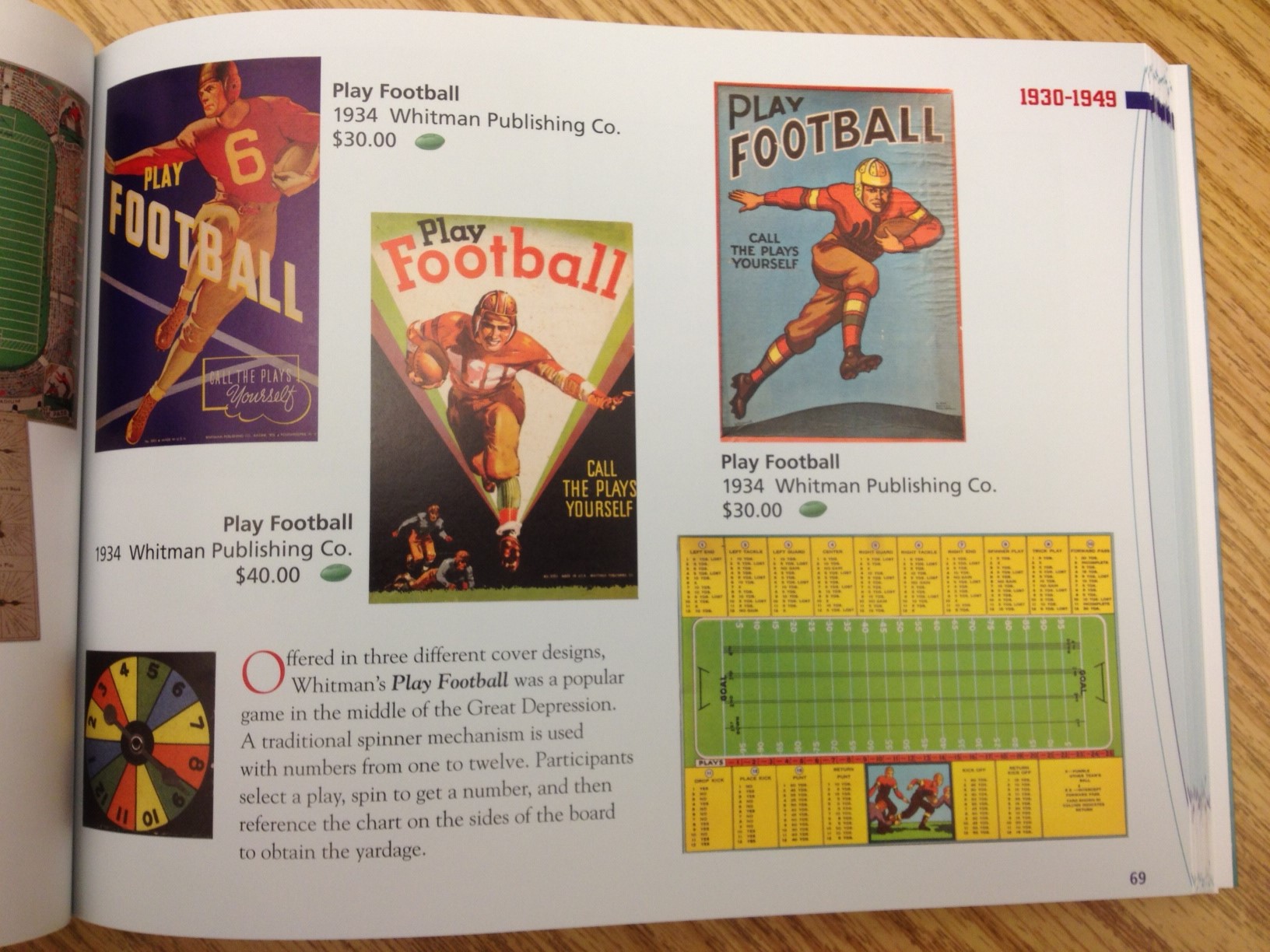
The Whitman Play Football game from the 1930s is an example of a simpler version of tabletop football. It’s activated by a spinner, with the play results obtained from the game board.
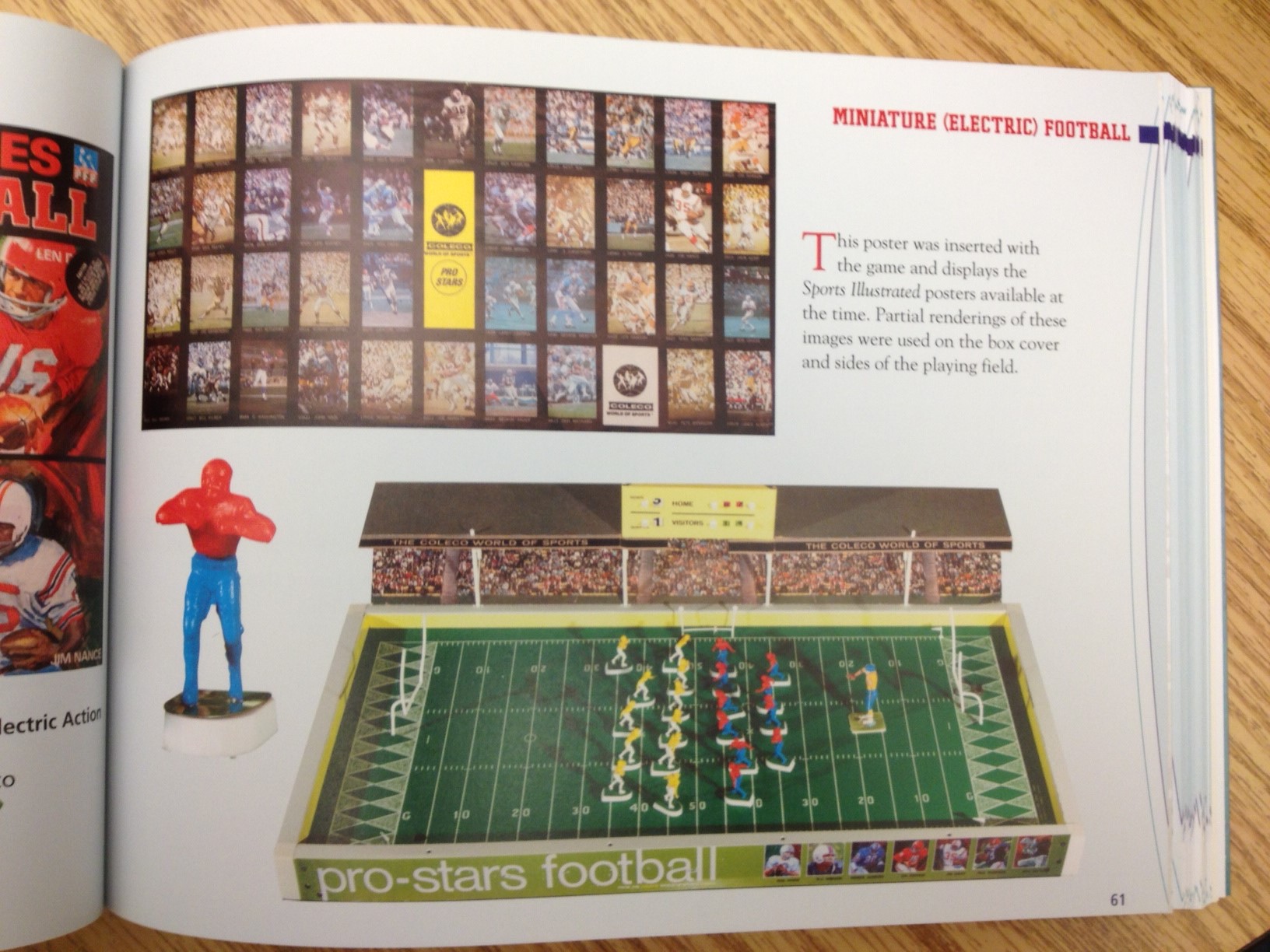
If you were a young fan in the 60s or 70s, it’s very possible that you played some brand of electric football. A vibrating field and quarterback figures who could “throw” a tiny felt football were the supposed keys to the plastic players executing their plays, but for many of us the results included mainly wrong-way runs and errant passes.

Eventually tabletop football became more complex and sophisticated, with game systems that used real player performances translated into player cards and roster sheets with statistical ratings that would be taken into account when determining play results. No longer did you have to imagine your star player overwhelming the opposition based on generic result charts like the Whitman game. Instead, games like APBA Football would allow you to pick your lineups and plot game strategies.
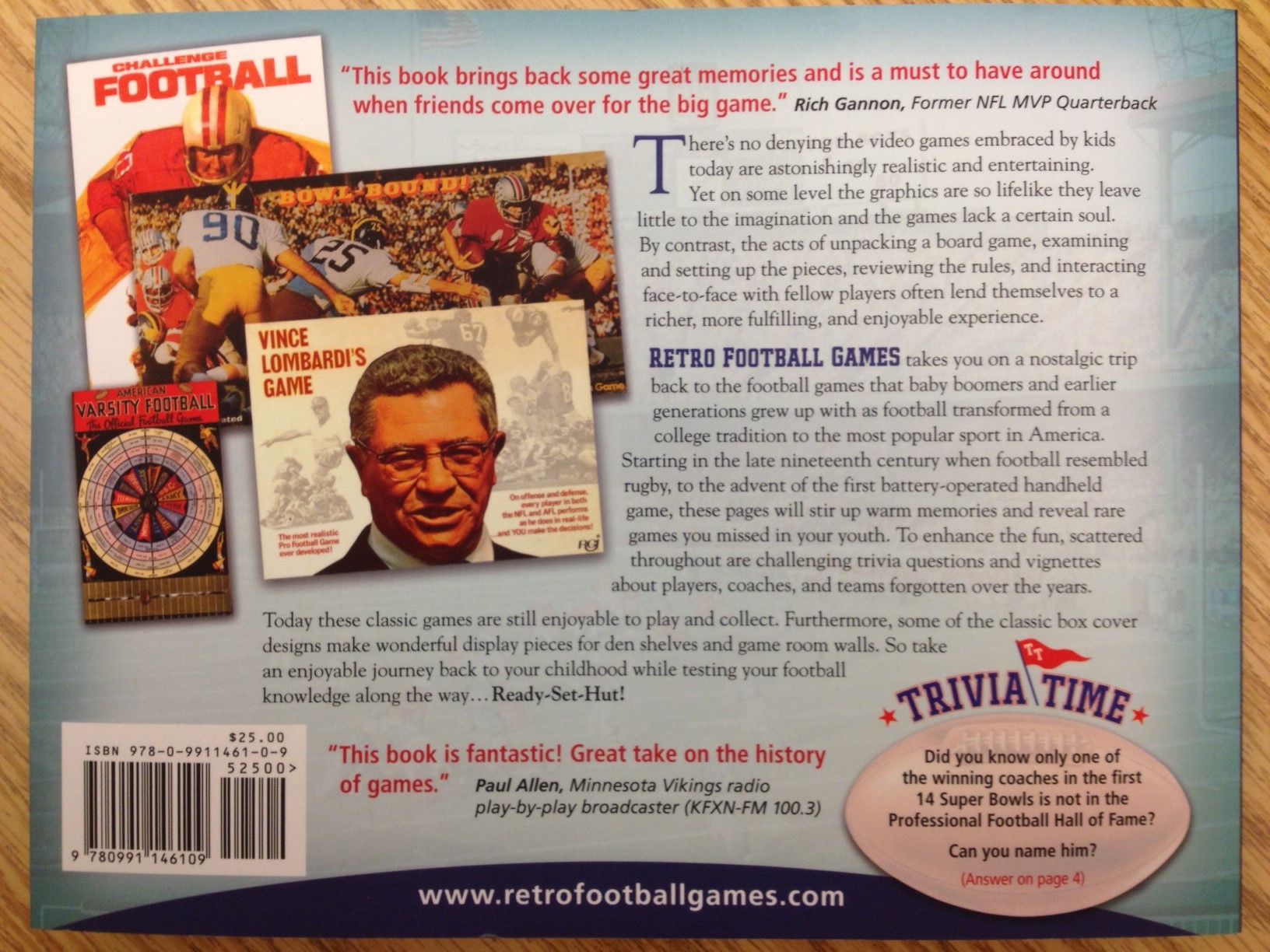
Steve’s book arrives just as the current football season is in full swing. Especially for those who grew up during this era, it’s nostalgic eye candy and a fun read. For more information and ordering details, go to his website, here.
***
For more fun
Tabletop football is not dead — far from it! In fact, buoyed by consistent demand from a lot of guys around my age, many of these games continue to be offered, with new offerings popping up all the time. There’s also an active after-market on e-Bay and sites dedicated to tabletop sports games, such as this popular site on Delphi. In addition, the second issue of a new tabletop sports zine, One for Five, features a cover package including descriptions of currently available football games.
All photos (including the blurry ones): DY, 2014
 Musings of a Gen Joneser
Recent Comments