Memorial Day weekend edition: Victory at Sea
Many students of history will recognize this iconic opening theme of Victory at Sea, the celebrated 1952 television documentary series about naval warfare during the Second World War. The 26-part series first aired on NBC, and it garnered Emmy and Peabody Awards. With extensive archival film footage of WWII naval operations, the steady, serious narration by Leonard Graves, and the beautiful score by Richard Rodgers, Victory at Sea was a television milestone that has held up to this day.
VAS has been part of three distinct chapters of my life. The first was as a grade schooler in the late 60s, when a local television station would rerun episodes every week. These years marked the beginning of my lifelong enjoyment of history, and I couldn’t get enough of the series.
The second was when I bought a cassette tape of the VAS soundtrack at the Barnes & Noble on 5th Avenue and 18th Street in Manhattan during law school. While others may have walked the city streets grooving to the latest creations from East Village bands on their Walkman portable cassette players, I bopped around town listening to the soundtrack from a 1952 documentary. Geekdom, indeed.
More recently, I’ve enjoyed watching VAS episodes when visiting one of my dear friends, retired naval officer and fellow history buff Brian McCrane. Brian grew up during the WWII era and later entered the U.S. Naval Academy at Annapolis, followed by a distinguished career as an officer and captain on destroyers during the Cold War. It’s fun to watch these episodes with someone whose own career contributed to the making of history.
When first available on VHS and then DVD formats, the complete set of Victory at Sea was somewhat pricey. But now, a full DVD edition, re-released in 2012, lists at $9.98, well within the budgets of most viewers. It remains a stirring, impressive work of documentary filmmaking on a vitally important chapter of history.
24: Virtually reuniting with college chums to follow the power of Bauer

If you recognize the name Jack Bauer, then you’re undoubtedly familiar with 24, the Fox espionage and terrorism drama that ran from 2001 to 2010. If Bauer’s name doesn’t ring a bell, then here’s a piece of the Wikipedia entry on the series:
24 is an American television series produced for the Fox network and syndicated worldwide, starring Kiefer Sutherland as Counter Terrorist Unit (CTU) agent Jack Bauer. Each 24-episode season covers 24 hours in the life of Bauer, using the real time method of narration. Premiering on November 6, 2001, the show spanned 192 episodes over eight seasons, with the series finale broadcast on May 24, 2010.
24 gained something of a cult following, with its fans taking apart the many twists provided in each episode. Every hour served up a civil libertarian’s nightmare, as the, uh, goal-oriented Bauer stopped at nothing (er, almost nothing) to get the job done. With its fixed time frame and claustrophobic sense of contained reality, 24 created a compressed world of terrorist threats and violence.
For many fans of suspense TV, including this left-of-center one, 24 was a guilty pleasure.
Jack’s back…
Well folks, after a four-year hiatus, Jack Bauer has returned to the small screen in 24: Live Another Day, a 12-episode mini-series on Fox that premiered this past Monday.
The two-hour opening episode is vintage 24, with plenty of Bauer-inflicted mayhem, some of it so over the top that I couldn’t decide whether to laugh, cheer, or grimace. Putting on my law professor hat, I saw countless violations of the law, not to mention grounds for a personal injury suit or three.
In other words, I’ll definitely be following the rest of the season!
…and so is the gang
Plus, I have an added incentive to watch. With the return of 24 comes the revival of a small, super-exclusive 24 e-mail discussion group made up of three of my college schoolmates and me. We’re all graduates of Valparaiso University, today dotted across the country: Sheralynn in California, Don and Myk in Illinois, and yours truly here in Massachusetts.
For the better part of the show’s long run, we debriefed each episode and engaged in deep speculation on how the story lines might develop before the end of the “day.” Now we’re virtually reuniting again to pick up on this abbreviated season.
With apologies to Don and Myk, Sheralynn is our best reviewer. She digs into the details and typically writes a sharp summary that competes favorably with the entertainment blogs. But we three guys aren’t slackers either.
And so, through e-mails, we’ve created a sort of Web 1.0 equivalent of watching a favorite show in our dorm rooms and then kicking around the details later. All that’s missing is the pizza delivery.
Jonesing for the Eighties

I’m now into a slightly extended binge viewing of Season 1 of “The Americans,” an FX drama series featuring Keri Russell and Matthew Rhys as a Soviet couple operating as deep cover spies in Washington D.C. during the early 1980s, the decade leading to the end of the Cold War.
It’s a great series, and a vivid reminder of U.S.-Soviet tensions of the era. But irrespective of its dramatic quality, I was won over by the opening scene, a bar in which Quarterflash’s “Harden My Heart” is playing in the background.
Yeah, it pushed my Eighties nostalgia buttons, and I was hooked.
If you’ve followed my posts here, you know that I get nostalgic even for historical eras I am too young to have experienced. But the Eighties are very much my time, and I regard the decade fondly.
Okay, so it may not have been the best years for America. This was the decade of trickle-down economics, “greed is good” (a philosophy popularized by financier Ivan Boesky, who landed in prison for overdoing what he preached), the emergence of the Middle East as a dominant hot spot, and a lot of political corruption. Many of the challenges we face today have their roots in those years.
Personally, however, I think of the Eighties as a comparatively innocent, wide-eyed time of my life. It covered the heart of my 20s, starting with my last year of college at Valparaiso University, then through law school at NYU, and finally post-law school life and work in New York City. Though I was barely masquerading as an adult during that time, I experienced a lot of growth and memorable times during the decade.
Moving to New York was a big deal, for I was a pretty sheltered Midwesterner. (To clarify, not all Midwesterners are sheltered, but I sure was.) I fell for New York completely, and during those years it was possible to explore the city on a tight budget. To be young and broke in New York wasn’t a terrible thing back then; there was a sort of gritty romance about making it on a shoestring.
Anyway, back to the “The Americans”: Season 1 opens in 1981, right after the inauguration of Ronald Reagan. A few episodes into the series, we see American and Soviet intelligence operatives scrambling madly to respond to the March assassination attempt on the President. Although the would-be assassin, John Hinckley, turned out to be a mentally ill man whose actions had nothing to do with Cold War politics, neither side knew that in the immediate aftermath of the shootings.
I recall that time well. We all lived under the nuclear threat. It was part of our existence.
Yesterday it was about the Cold War, the nukes, and the Soviets. Today it’s about terrorism, airport security, and Al-Qaeda. And the economy and jobs, always. The beat goes on.
The (American) Revolution will be televised
AMC probably should send me a little thank-you e-mail for this, as I’m touting an upcoming new series as an act of faith, but a new Revolutionary War spy drama premiering on April 6, TURN, looks very promising. From the show’s website, here’s a brief description:
Based on Alexander Rose’s book Washington’s Spies, AMC’s TURN tells the untold story of America’s first spy ring. A historical thriller set during the Revolutionary War, TURN centers on Abe Woodhull (Jamie Bell), a farmer living in British-occupied Long Island who bands together with his childhood friends to form the Culper Ring — an unlikely team of secret agents who not only went on to help George Washington turn the tide of the war but also gave birth to modern spycraft.
TURN is getting positive advance reviews. The Week newsmagazine featured it as its “Show of the week,” calling it a “suspenseful new series” about “America’s first spy unit.”
Quality dramas about the American Revolution are few and far between, on either the big or small screen, contributing to a sense of distance from this historical era. HBO’s excellent John Adams series, based on David McCullough’s biography, is about the best thing out there, but the overall offerings are thin. The Patriot, starring Mel Gibson, is an entertaining movie, but it’s not great history. So maybe TURN will breathe some needed dramatic life into this historical period.
“The Civil War” on PBS

Some 24 years have passed since the premiere of the groundbreaking PBS documentary series, “The Civil War,” by Ken Burns. It stands as probably the best historical documentary series ever made. Burns mixed photos, graphics, interviews, readings, music, and pitch-perfect narration by historian David McCullough to create an evocative and gripping story of America’s Civil War, fought from 1861 to 1865.
At the time it aired, I was a broke-as-hell public interest lawyer in New York, with no cable and a rabbit-eared black & white television set given to me by friends. The lack of decent TV reception made no difference; I knew I was watching an instant classic. Burns and his team pulled off the seemingly impossible. In nine episodes totaling roughly eleven hours, they made an era come alive in documentary form. No CGI. No Civil War re-enactors. Just brilliant content.
Of course, the series was criticized by some partisans for North and South alike for what it did or didn’t do, but the overall response to “The Civil War” was abundant, enthusiastic praise. It helped to rekindle a national interest in Civil War history that endures to this day. It certainly had that effect on me.
The producers of “The Civil War” brilliantly selected a modern piece of music with a 19th century feel, “The Ashokan Farewell” by Jay Ungar, as the series theme. Here’s Ungar playing a rendition with a folk band just a few years ago. It’s a beautiful, haunting tune, perfect for the series, and well worth five minutes of your time:
Even better, rent or pick up the series and watch it. You’ll get the whole deal, a documentary that breathes heart and soul into a story of one of the signature events in American history. And you’ll never tire of hearing “The Ashokan Farewell” over and again.
***
I have to toss in a side note about series narrator David McCullough, one of America’s leading popular historians. Several years ago, McCullough spoke at Boston’s Old South Meeting House — a key stop on the city’s “Freedom Trail” of historic Revolutionary-era sites — to preview one of his upcoming books. He started his talk by looking up at the packed house, opening up his arms wide, and warmly proclaiming “Aren’t we lucky to be here!?” It was his own way of celebrating how we all could share our love of history in this significant building. For a history buff like me, it was such a great, fun moment.
Photo of DVDs: DY, 2014
Saturday night television (back in the day)
As a grade schooler during the late 1960s, I always looked forward to Saturday night’s television lineup. The real world might’ve been in a state of crisis and unrest — this was, after all, the heart of The Sixties — but the realm of network television was still very much a sheltered place. Starting in the fall of 1968, for example, the following TV shows made up our standard Saturday night fare (Central times listed):
6:30 — “Adam-12” — A cop show, co-produced by Jack Webb, featuring patrol officers Reed and Malloy on the streets of pre-Rodney King Los Angeles.
7:00 — “Get Smart!” — I didn’t appreciate the brilliant humor until I was older, but this spy vs. spy sitcom featuring Don Adams as dimwitted Agent 86, Maxwell Smart, and Barbara Feldon as his brainy, beautiful partner, Agent 99, made for excellent comedy!
7:30 — “My Three Sons” — Featuring Fred MacMurray as a widower raising his three sons. A sentimental, feel-good family sitcom. Extra points for those who can hum the all instrumental theme song.
8:00 — “Hogan’s Heroes” — Who woulda thunk that a sitcom set in a German prison camp could be so stupidly funny? The character of Sergeant Schultz (John Banner) is iconic to a certain generation of viewers. (If someone tells you, “you’re just like Sergeant Schultz,” do not take it as a compliment!)
8:30 — “Petticoat Junction” — A light sitcom set at the Shady Rest Hotel in the rural town of Hooterville, featuring a neat old steam train and three comely lasses, Billie Jo, Bobbie Jo, and Betty Jo. Those who tired of the Ginger vs. Mary Ann debate could refocus their attentions here.
9:00 — “Mannix” — The only one-hour show on the list. A private detective series featuring Mike Connors as tough guy Joe Mannix. He was sort of the clean-up hitter of the Saturday night lineup.
Of these programs, only “Get Smart” and, yup, “Hogan’s Heroes” manage to hold up over time, due to some hilarious characters and clever dialogue. But back then, Saturday night TV meant an uninterrupted run of fun shows and after-dinner goodies, staying up late with no school the next day — a more innocent time of life, before the tumult of adolescence, and with little more to worry about than whether Mannix would catch the bad guy.
***
You can check out the full 1968-69 television lineup here on Wikipedia.
What makes those British TV dramas so good?

If you need more evidence of the triumph of television as a premiere form of entertainment, just check out the continually growing list of quality dramas from across the pond, usually via PBS or BBC America.
Downton Abbey is the obvious pick right now, but it’s one on a long list. I’m especially drawn to British crime dramas. Helen Mirren’s brilliant Prime Suspect is one of my favorites, but what about more recent additions such as Broadchurch and Whitechapel? And let’s not forget old standbys such as Foyle’s War, or the Oxford pair of Inspector Morse and Inspector Lewis.
The good stuff from Britain can pop up unexpectedly. For example, I was searching around Amazon’s streaming video a few months ago and discovered London Hospital (a/k/a Casualty 1900s in the U.K.), a short-lived drama about the Royal London Hospital set during the turn of the last century. It’s got a touch of ER and a load of Victorian atmospherics and understated Brit acting (wholly unlike ER). It also serves as a bit of a history lesson about health care 100 years ago.
British TV dramas typically mix great use of locations with astonishingly good acting. And whereas even the best American TV dramas usually feature young, very attractive lead actors and actresses, the Brits aren’t as obsessed with youth and looks. As a result, the characters tend to grow on you in more nuanced ways, like real people do.
Furthermore, the storylines are more compelling than so many American counterparts. The crime dramas tend toward the gritty and authentic. You’ll never confuse an episode of Prime Suspect with, say, one of TNT’s The Closer or its successor, Major Crimes.
However, it’s also fair to say that America is catching up, thanks largely to a cluster of superb dramas on cable, such as The Wire, Mad Men, and Breaking Bad (so I’m told — binge view to come soon).
Here in Boston, we’re looking at a pretty cold winter. What better time than to access the treats awaiting us on the small screen?
The communal experience of watching a great movie or TV show
One Sunday night during my first semester of law school at New York University, I had reached my fill of studying, so I decided to catch a movie. I checked the Village Voice and saw that “Singin’ in the Rain,” the classic 1952 musical starring Gene Kelly, was playing at the Theatre 80 St. Marks movie house in the East Village. I had never seen the movie before, but I thought I’d enjoy it.
So I trekked over to the theatre and plunked down my five bucks at the ticket window. I expected that the theatre would be pretty empty — I mean, c’mon, who goes to see a 30-year-old movie on a Sunday night? — but lo and behold, hardly any free seats remained!
Within a half hour into the screening, I knew I was watching what would become my favorite movie. I was thoroughly entertained, enchanted, and uplifted. And what added so much to the experience was that people were clapping, enthusiastically, after each of the iconic musical numbers, such as Gene Kelly’s signature performance of the title song (click above!) and Donald O’Connor’s dazzling, funny song-and-dance number, “Make ‘Em Laugh.”
I had never before been at a theatre where strangers cheered scenes of a movie in each other’s company. We reveled in that film, and obviously it made for a lifetime memory.
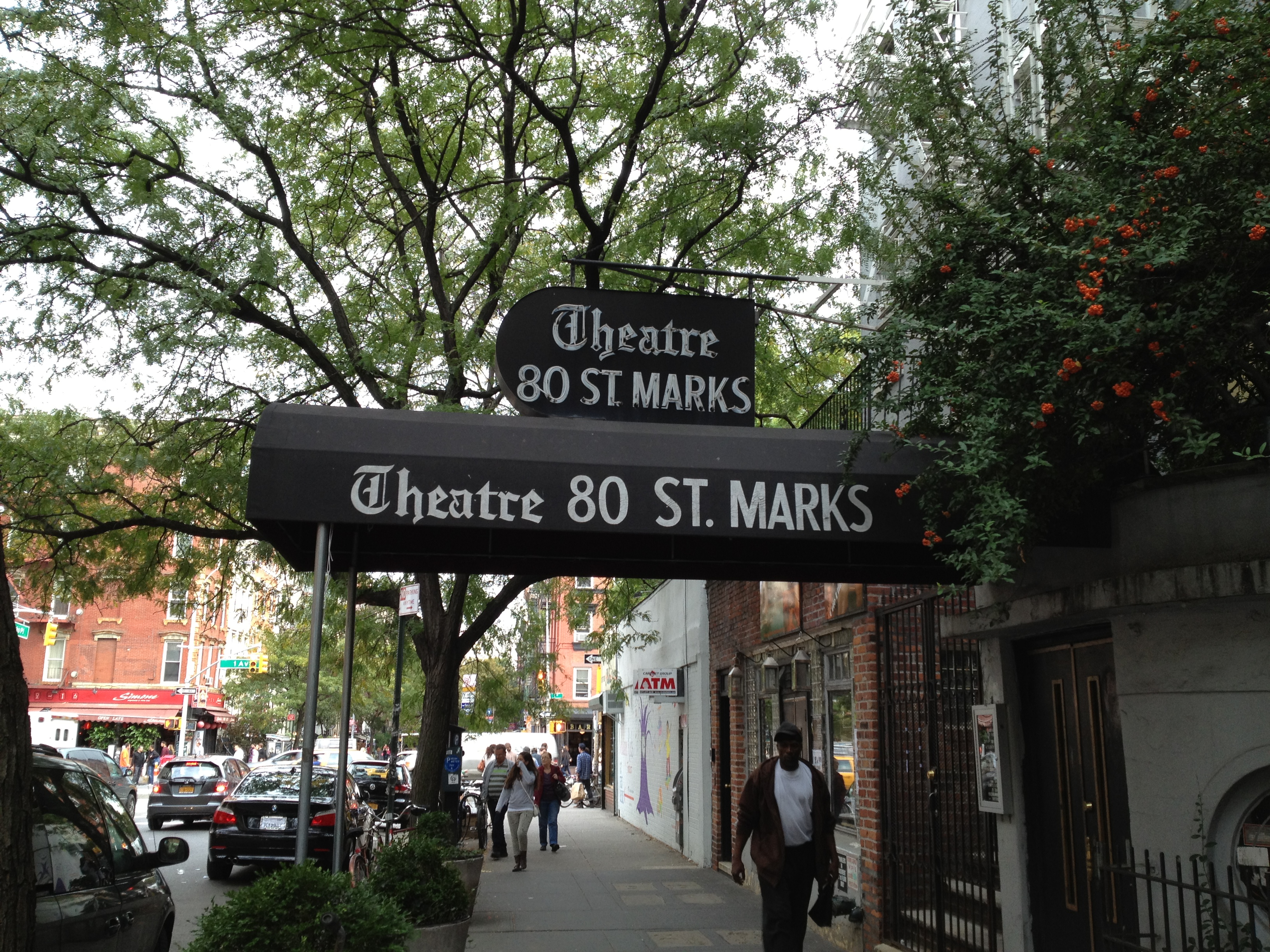
Theatre 80, East Village, Manhattan (photo: DY)
Going to see movies at Theatre 80 and other revival movie houses would become a staple of my New York experience. At times I would drag someone along, and on other occasions I’d just go by myself. How cool it was to watch classic old movies on a big screen!

Seasons 1 & 2 are on DVD
At the risk of sounding like the first year of law school was a cakewalk (rest assured, it wasn’t), another good memory of communing before a screen occurred every week in the Hayden Hall dormitory where most first-year law students lived. The dorm had a TV room, and dozens of us would gather to watch “Hill Street Blues” and “Cheers” as a group study break.
“Cheers” was at the start of its long run, and we enjoyed it. But it was “Hill Street Blues” — a cop show that anticipated just how good TV dramas could become — that most captured our attention. Largely unknown actors such as Daniel Travanti (Capt. Frank Furillo), Bruce Weitz (Sgt. Mick Belker), and Betty Thomas (Sgt. Lucy Bates) made for one of the best ensemble casts in television history, and the developing storylines maintained our interest from week to week.

Hayden Hall, NYU, Washington Square: Back in the day, lots of cockroaches, but a nice TV room (Photo: DY)
Such communal viewing experiences are few and far between these days. The old Theatre 80 still stands and is used for performing arts events, but it’s no longer a movie theatre. The widespread availability of VCRs pretty much killed off the revival houses, and with them went the experience of watching a classic movie in the company of others.
I have no idea if the TV room in Hayden Hall is still around, but even if it is, I’d be surprised if it plays the same community-enhancing role for the undergraduates who now live there. Most of them probably have their own TVs or use their laptops to watch the latest small screen programs.
As the rows of DVDs running along my bookshelves and my Netflix subscription attest, I appreciate being able to pop in a disc of a favorite movie or TV show. But I know it’s not the same as applauding with others for “Singin’ in the Rain” at Theatre 80, or rooting with friends for Captain Furillo and his squad to catch the bad guys and survive City Hall politics on “Hill Street Blues.”
The Winds of War: Over and again

Do you have a book, movie, or mini-series that you’ve read or watched over and again, and will continue to as long as you’re here on terra firma? I have several, and one of them is Herman Wouk’s The Winds of War, both the 1971 novel and the 1983 television mini-series adaptation.
The Winds of War starts in 1939, as war clouds are swirling about Europe. It follows the fortunes of the Henry family, headed by U.S. Navy officer Victor “Pug” Henry, along with his wife Rhoda, sons Warren and Byron, and daughter Madeline.
Joining them as major figures are famous Jewish author and retired professor Aaron Jastrow and his niece, Natalie, who are living in an Italian villa. Their journeys also become focal points. Also prominent is Pamela Tudsbury, a young British woman who travels the globe helping her father, foreign correspondent “Talky” Tudsbury, as well as foreign service officer Leslie Slote.
With the novel weighing in at some 880 pages, and the mini-series clocking in at seven hefty episodes, The Winds of War qualifies as a sweeping epic. It opens with Europe on the brink of another war, and it continues on through the Japanese attack on Pearl Harbor. Throughout the story, the major characters and others cross paths, move apart, face life-threatening danger, and fall in and out of love, in places as disparate as London, Berlin, Italy, Portugal, Washington D.C., Hawaii, and the Philippines, among many others.
Major historical figures such as Roosevelt, Churchill, Hitler, Mussolini, and Stalin all make their appearances. (In story turns that are somehow believable, our trustworthy, no-nonsense Captain Henry meets all of them.)

My introduction to The Winds of War came via the mini-series. I missed it when it first aired, but during a holiday trip home to see my family many years ago, I discovered it at a local video rental store and dove in.
Robert Mitchum stoically plays Pug Henry, with Polly Bergen as wife Rhoda. Among the Henry siblings, young Byron (Jan Michael-Vincent) is featured most prominently in the mini-series, along with Natalie Jastrow (Ali McGraw) and uncle Aaron (John Houseman), Pamela Tudsbury (scrumptious Victoria Tennant), Leslie Slote (David Dukes), scientist Palmer Kirby (Peter Graves), and German general Armin von Roon (Jeremy Kemp).
Contemporary reviews of the casting decisions were mixed, with Ali McGraw bearing the brunt of the criticism. However, the story lines were compelling and the cinematography won a well-deserved Emmy, among three garnered by the mini-series.
Now Winds is on DVD, and I’ve watched it at least a dozen times over the past ten years. You know how a character in a story just resonates with you? Well, for some reason I feel that way about multiple figures in Winds. I keep imagining myself in their world, living their adventures and challenges.
If you want more evidence of my obsession, here it is: I even tracked down a used copy of a “making of” published diary put together by publicist James Butler. It’s a cheaply produced, spiral-bound paperback featuring profiles of leading cast members and Butler’s reminiscences of filming Winds around the world in 1981. It’s an affectionate remembrance. For example, notwithstanding Ali McGraw’s uneven performance as Natalie Jastrow, we learn that she was a down-to-earth class act in working with the production crew and interacting with the public on location. And a lot of the guys had major crushes on her.
The photo above is a page from Butler’s on-location diary. At bottom left are Robert Mitchum and Victoria Tennant. At top right are director Dan Curtis and actor Howard Lang, who made for a pretty good Churchill.
And yes, I even have the mini-series soundtrack:

Wouk would complete his panorama of the Second World War in War and Remembrance, notable especially for its brutally authentic depictions of Nazi death camps. It, too, appeared first as a novel (1978), followed by a mini-series (1988-89) that included scenes filmed at Auschwitz. I’ve devoted repeat viewings and readings to Remembrance as well, but The Winds of War has captured my primary affection among Wouk’s two mega-works.
So, at some point during the next year, I’ll pull out the Winds DVDs, and lose myself in a tumultuous world of some 75 years ago.
Twenty Generation Jones sitcoms

Image: Wikipedia
Many a Gen Joneser watched a good share of television as a kid, especially a variety of sitcoms that spanned the spectrum of quality. Here are twenty that come to mind, not in rank order, though I do lead with a classic:
1. Dick Van Dyke Show — One of the very best sitcoms of all time, groundbreaking in its own modest way, starring Dick Van Dyke and Mary Tyler Moore as Rob and Laura Petrie. Episodes were set in the Petrie’s New Rochelle NY home and at Rob’s job as head writer for the Alan Brady Show in Manhattan.
2. Gilligan’s Island — The theme song says it all. It’s iconic TV for Gen Jonesers. (Plus, the ultimate question: Ginger or Mary Ann?)
3. Andy Griffith Show — Sheriff Andy Taylor (Andy Griffith) keeps the peace in the small town of Mayberry, North Carolina, aided by his bumbling but well-meaning (and hilarious) deputy, Barney Fife (Don Knotts).
4. Get Smart! — A Mel Brooks classic, starring Don Adams as hapless Agent Maxwell Smart, with his smart and beautiful sidekick, Agent 99 (Barbara Feldon).
5. Bewitched — Elizabeth Montgomery’s Samantha Stevens was the world’s most comely suburban witch.
6. I Dream of Jeannie — Larry Hagman is an astronaut who discovers a genie in a lamp, a/k/a Jeannie (Barbara Eden), and the rest is all kind of silly. Yes, but we watched.
7. Hogan’s Heroes — With a little bit of work, this could’ve been Mel Brooks-level brilliant. It needed Mel Brooks to get there. Still, Colonel Klink and Sergeant Schultz gave us reason to laugh at the Nazis.
8. F Troop — Politically incorrect but sometimes hilarious sitcom of U.S. cavalry stationed at Fort Courage, forging business deals with an Indian tribe led by a chief with a New York accent.
9. McHale’s Navy — I remember the reruns on afternoon television. I remember wincing at references to “the Nips.” Oy.
10. Beverly Hillbillies — Gotta tell you a story ’bout a man named Jed. Sick-at-home, morning rerun television.
11. Green Acres — Another legendary theme song. Fred Ziffel and Arnold the Pig were my favorite characters.
12. Petticoat Junction — Billie Jo, Bobbie Jo, and Betty Jo made it easy to forget about Uncle Joe. Plus, if you loved trains as a kid, the Hooterville steam engine was a fave.
13. The Odd Couple — My office has been inspired by Oscar Madison’s interior decorating scheme.
14. The Brady Bunch — “Here’s the story, of a lovely lady.” You know the rest. Plus the whole Marcia vs. Jan thing. A defining Gen Jones sitcom.
15. The Partridge Family — David Cassidy and Shirley Jones sing some very corny pop songs. I confess that I liked this show.
16. Mary Tyler Moore Show — This time MTM is a single career woman, working for a TV news station, with a grouchy boss and a hilariously inept lead anchor. A great 70s sitcom amidst a sea of clunkers.
17. Bob Newhart Show — Deadpan hilarious Bob Newhart plays therapist Bob Hartley, with lovely Suzanne Pleshette as wife Emily, and a motley crew of colleagues and clients.
18. MASH — We’re bridging to the modern era with this important classic that mixed comedy and drama. Alan Alda as Dr. Hawkeye Pierce led one of the great series of all time.
19. Happy Days — The Fonz and all that. One, two, three o’clock, four o’clock rock.
20. Welcome Back Kotter — Gabe Kaplan starred as a New York schoolteacher presiding over a rowdy bunch of high schoolers called the sweathogs, one of whom was a young John Travolta.
Please feel free to add your favorites to the list, or take aim at mine!
 Musings of a Gen Joneser
Recent Comments