The communal experience of watching a great movie or TV show
One Sunday night during my first semester of law school at New York University, I had reached my fill of studying, so I decided to catch a movie. I checked the Village Voice and saw that “Singin’ in the Rain,” the classic 1952 musical starring Gene Kelly, was playing at the Theatre 80 St. Marks movie house in the East Village. I had never seen the movie before, but I thought I’d enjoy it.
So I trekked over to the theatre and plunked down my five bucks at the ticket window. I expected that the theatre would be pretty empty — I mean, c’mon, who goes to see a 30-year-old movie on a Sunday night? — but lo and behold, hardly any free seats remained!
Within a half hour into the screening, I knew I was watching what would become my favorite movie. I was thoroughly entertained, enchanted, and uplifted. And what added so much to the experience was that people were clapping, enthusiastically, after each of the iconic musical numbers, such as Gene Kelly’s signature performance of the title song (click above!) and Donald O’Connor’s dazzling, funny song-and-dance number, “Make ‘Em Laugh.”
I had never before been at a theatre where strangers cheered scenes of a movie in each other’s company. We reveled in that film, and obviously it made for a lifetime memory.
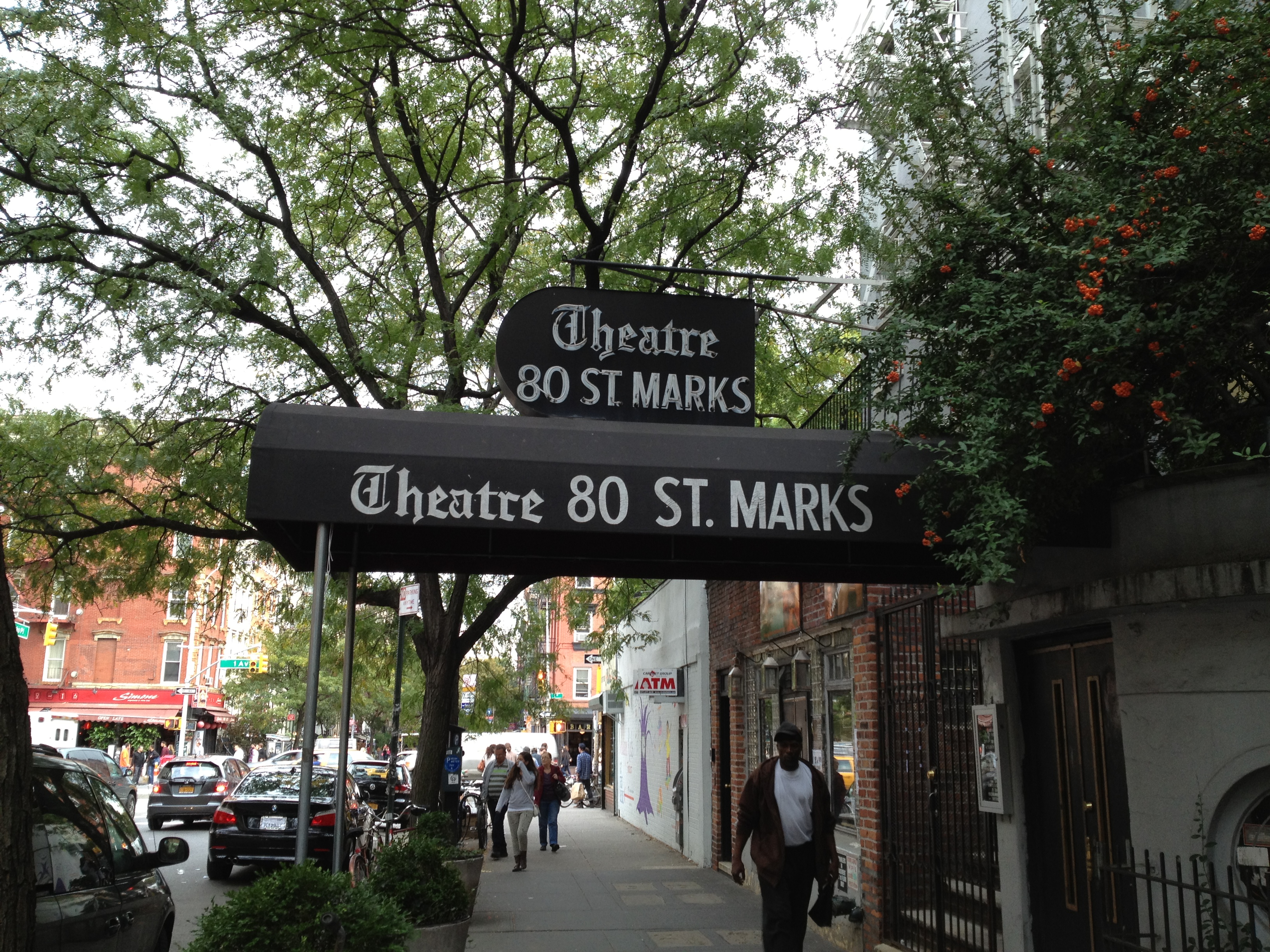
Theatre 80, East Village, Manhattan (photo: DY)
Going to see movies at Theatre 80 and other revival movie houses would become a staple of my New York experience. At times I would drag someone along, and on other occasions I’d just go by myself. How cool it was to watch classic old movies on a big screen!

Seasons 1 & 2 are on DVD
At the risk of sounding like the first year of law school was a cakewalk (rest assured, it wasn’t), another good memory of communing before a screen occurred every week in the Hayden Hall dormitory where most first-year law students lived. The dorm had a TV room, and dozens of us would gather to watch “Hill Street Blues” and “Cheers” as a group study break.
“Cheers” was at the start of its long run, and we enjoyed it. But it was “Hill Street Blues” — a cop show that anticipated just how good TV dramas could become — that most captured our attention. Largely unknown actors such as Daniel Travanti (Capt. Frank Furillo), Bruce Weitz (Sgt. Mick Belker), and Betty Thomas (Sgt. Lucy Bates) made for one of the best ensemble casts in television history, and the developing storylines maintained our interest from week to week.

Hayden Hall, NYU, Washington Square: Back in the day, lots of cockroaches, but a nice TV room (Photo: DY)
Such communal viewing experiences are few and far between these days. The old Theatre 80 still stands and is used for performing arts events, but it’s no longer a movie theatre. The widespread availability of VCRs pretty much killed off the revival houses, and with them went the experience of watching a classic movie in the company of others.
I have no idea if the TV room in Hayden Hall is still around, but even if it is, I’d be surprised if it plays the same community-enhancing role for the undergraduates who now live there. Most of them probably have their own TVs or use their laptops to watch the latest small screen programs.
As the rows of DVDs running along my bookshelves and my Netflix subscription attest, I appreciate being able to pop in a disc of a favorite movie or TV show. But I know it’s not the same as applauding with others for “Singin’ in the Rain” at Theatre 80, or rooting with friends for Captain Furillo and his squad to catch the bad guys and survive City Hall politics on “Hill Street Blues.”
Has the Kindle Paperwhite pushed e-reading devices over a tipping point?

Kindle Paperwhite, e-book cover
Over the years, I’ve owned several incarnations of the Amazon Kindle e-reader, and though I’ve found it especially useful while traveling, ultimately I’ve been happy to return to the real things. However, the latest Kindle offering, dubbed the “Paperwhite,” has crossed a major technological line in terms of clarity and lighting. It won’t replace the books in my library, but it’s a darn good Plan B.
Basically, it boils down to the reading experience. The Paperwhite stands out with the sharp clarity of its text and its excellent lighting feature, the latter so good that you can read in bed with all the lights off. This photo of the text screen doesn’t do it justice, but maybe it’ll give you an idea:

Kindle Paperwhite e-text
Currently the most inexpensive version of the Paperwhite is selling for $119. That’s not exactly a cheap initial investment, even for an avid reader. But this is the first Kindle upgrade that, at least for me, provides a reading experience good enough not to make me long to have a book in hand. And with all the traveling I sometimes find myself doing, it’s a treat to be able to bring a few dozen books with me via an e-reader that makes reading a pleasure.
I know that many regard the printed book as sacred and the e-book as a sacrilege. I’m not out to change anyone’s mind on this question, other than to say that all things being equal, I’d still rather have an actual book at my side. Nevertheless, I’m currently on an extended out-of-town visit with some friends, and the new Kindle has proven to be very handy.
Plus, it is pretty cool to turn the lights off and still be able to read. It’s sort of the grown up edition of reading a book under the covers with a flashlight.
Remember writing and receiving real letters?
Graphic from Phillip Martin (http://languagearts.phillipmartin.info/la_writing_letters.htm)
Somewhere in my basement storage area, I have several file folders stuffed with personal letters from back in the day, the product of an inveterate saver and collector. If memory serves me well, very few of these letters contain news or sentiments of extraordinary significance, especially when weighed against events of a lifetime. Nevertheless, they harken back to when writing and receiving letters via the mail was a welcomed part of our everyday lives.
My most intense phase of letter writing ran from college through law school, covering my late teens through early twenties. It makes sense. We often take our daily lives rather seriously during those years, and the diaspora of friends and family via assorted personal milestones creates the need to keep in touch as we move around.
In the days before e-mail, Facebook, and cheap long-distance calls, letter writing was the way we did it. I recall exchanging veritable tomes at times. And while today I might be a tad embarrassed over some of the missives I wrote and mailed, sending and receiving letters was very meaningful to me.
Today, of course, technology has largely supplanted old fashioned letter writing. I sometimes wonder what records of our everyday exchanges will be available to anthropologists of the future as they search for clues of how we shared ideas, information, thoughts, and feelings from a distance. Will our digital footprints disappear with us? And even if they are available, how will someone sort through the mounds of empty chatter to get to the real stuff?
Though sentiment creeps in when I write about writing letters, I have no illusions that we will see a revival of this form of communication anytime soon. It’s too bad, though. Anticipating a personal letter from a dear friend or family member sure beats turning on the computer, awaiting the pile up in my inbox.
Bye bye, Blockbuster

This week’s announcement that Blockbuster is shuttering its remaining video stores was greeted with a ho hum by most of the public. Some may have assumed that the company already had disappeared, recalling its 2010 bankruptcy filing. Others may have skipped past the news as they clicked into their Netflix queue.
In my case, of course, news of Blockbuster’s demise triggered a bout of remembrance….
As much as I love movies, I was a latecomer to home video. I didn’t buy my first VCR until the summer of 1992, when I was in my early 30s. But once the VCR was set up in my apartment, I went into video rental overdrive, and the Blockbuster on 6th Avenue near 8th Street in Manhattan got a lot of my business that summer (and thereafter).
It wasn’t the cool, artsy video store in the East Village, nor the cozy neighborhood shop where I lived in Brooklyn. Nevertheless, Blockbuster had movies, and lots of them. Its blend of the latest hits, popular older movies, and some of the classics was just right for me.
I visited Blockbuster 3-4 times a week that summer, always filled with anticipation over what I might discover. I’d start with the new arrivals in the front of the store, then went toward the back to check out the oldies. Rare was the time I walked out empty handed.
Businesses may come and go, and Blockbuster has had its run. But I’m not alone in remembering the fun of picking out a movie there and loading it into my VCR later that night, minutes after the pizza was delivered! Having that kind of easy access to thousands of movies — no more scouring the TV listings in hopes that a favorite would pop up — changed dramatically how we engaged the medium, and made for many enjoyable evenings at home.
***
Logo:Wikipedia
School supplies nostalgia
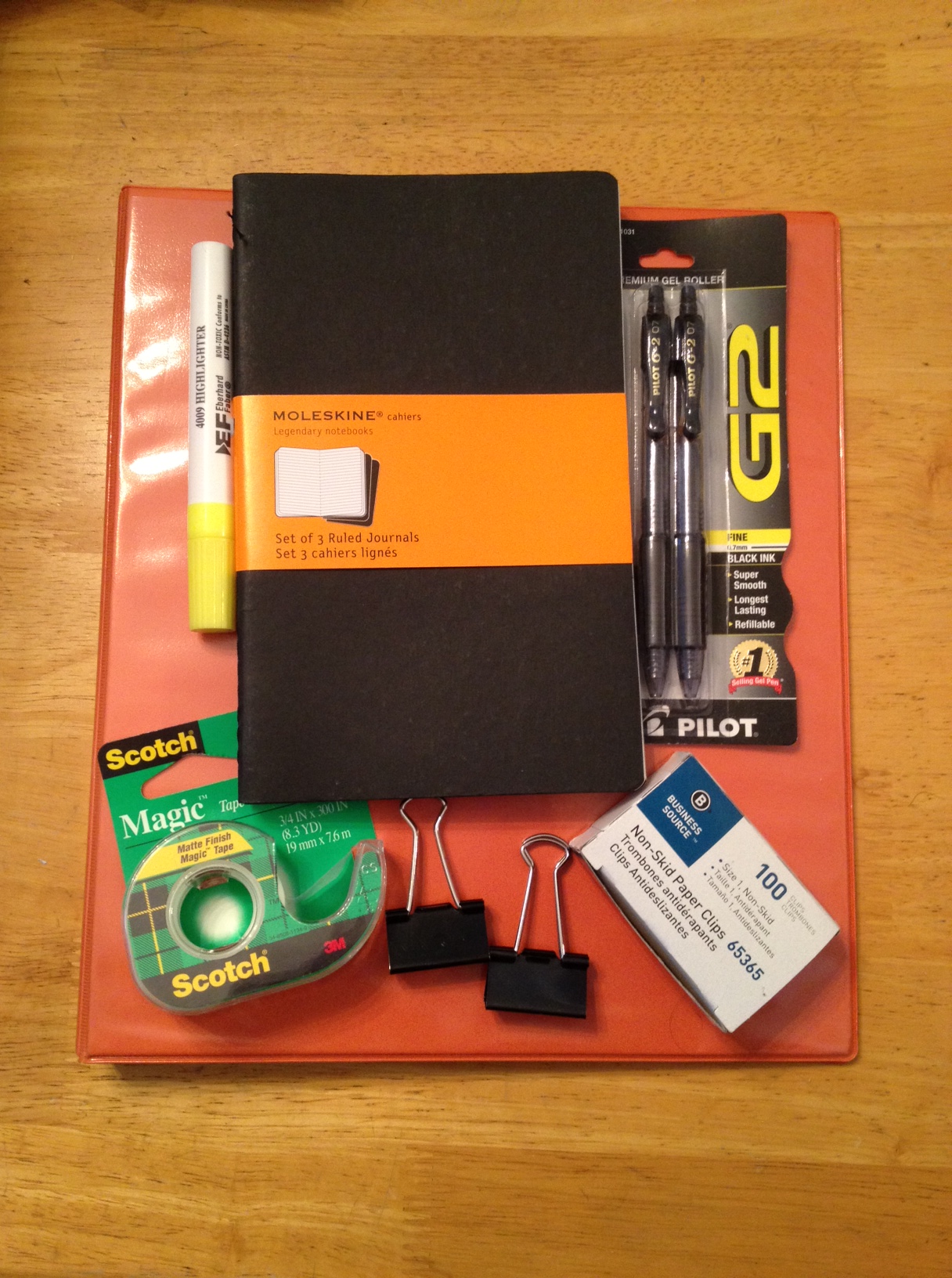
Some of my stash! (Photo; DY, 2013)
If you get a warm fuzzy feeling when you walk through the aisles of your local Staples or Office Depot, there’s a good possibility that you’re caught in the grip of a condition we might call school supplies nostalgia. If mere mentions of terms such as “Trapper Keeper” and “Crayola 64” trigger pangs of sentiment, then you’re really deep into it. And if you’re a parent whose school supply purchases for your kids are influenced by memories of your own pencil boxes and notebooks, well, perhaps we need to talk about counseling options.
School supplies nostalgia can happen to someone of any age, but those of us who went to grade school in the days before everything went digital are especially susceptible. Shopping for school supplies was part of our fall ritual, and our local retail stores would stock up on them in preparation for the annual onslaught.
If you have this condition, the good news is you’re not alone. Google “school supplies nostalgia” and you’ll see what I mean.
More than soggy sentiments
Childhood memories may be at the core of school supplies nostalgia, but there’s more to it than that. Crayons, pens, index cards, notebooks, and simple blank paper were among our earliest forays into creating, expressing, and preserving our emerging knowledge, ideas, and art. They served as open invitations to use our minds.
As the regimens of memorization, testing, and grading become a bigger part of our lives, it seems like those invitations are withdrawn from us. I fear that a lot of creative lights are snuffed out that way.
Try it out
So . . . perhaps the school supplies aisles aren’t just for kids.
If you’re a writer, artist, or other creative sort (or want to be!), try this out: The next time you want to do some thinking and brainstorming at your local coffee shop or library, leave your laptop at home. Instead, bring a notebook and pen and spend an hour or two jotting down thoughts, ideas, and lists or making drawings and doodles.
Maybe we all should put our gadgets away long enough to express ourselves on paper. A lined sheet of paper or ruled notebook allows us to preserve our thoughts and ideas in our own handwriting. A blank page or sketchbook invites us to draw, diagram, and imagine.
Before you know it, you’ve got your own portfolio of stuff, and you never had to worry about clearing a jam in the printer.
From blast offs to smartphone launches, from payloads to downloads

“We have lift off” — Gemini 8 heads for the sky (1966) (photo: NASA via Wikipedia)
Watching the launches and splashdowns of manned space missions is one of the shared experiences of being a kid during the 1960s. For many, it meant gathering with family members or schoolmates in front of a television, anxiously awaiting the successful blast off or the safe recovery of a space capsule and its heroic astronauts.
The minutes before a launch were full of excitement. As the countdown proceeded, we’d eagerly listen to newscasters talk about the mission’s duration and the spacecraft’s payload, in addition to what the astronauts were doing in the capsule to ready themselves.
The Mercury, Gemini, and Apollo space missions were designed to lead us to successful moon landings, and that they did in 1969. If you want to be reminded of the drama and excitement that accompanied this effort, then rent the 1983 film “The Right Stuff.” And take a look at this excerpt (about four minutes) of President Kennedy’s famous 1962 speech at Rice University:
Today, we don’t have that communal excitement about exploring space. We don’t show up to the breakfast table, work, or school the next day talking in breathless tones about a mission to the moon.
Instead, we talk excitedly about smartphone launches. We share recommendations about great new apps. And we await new versions of gadgets that will render our current ones, purchased just a year or two ago, “old.”
Yup, I marvel at what my laptop and iPad can do. And though I dislike cellphones, I bow to their remarkable capacities.
But we’ve also lost something in the way that our excitement over science and technology has become a more private affair, in some cases sharply limited to those who can afford the gadgets. Perhaps the pioneering space missions are destined to remain the stuff of childhood memories, but I lament the passing of shared awe and wonder over how great advances in scientific know-how can enrich our lives beyond our last download.
Time travel: Some favorite destinations

Remember “The Time Tunnel,” the short-lived but fascinating television time travel drama from the mid-60s? Every new episode would find scientists Tony Newman and Doug Phillips landing in a different historical setting, usually on the eve of some major event, such as the sinking of the Titanic, the Battle of Little Big Horn (General Custer and Crazy Horse), or the bombing of Pearl Harbor. (Unfortunately, they never could persuade folks that disaster loomed.) To this day, I credit that show for helping to stoke a lifelong interest in history and to fuel my imagination with thoughts of going back in time.
What if time travel was possible? What places and times would I want to visit? Here’s an off-the-top-of-my-head list, not exactly an exotic one, but it sure would be a fascinating set of journeys. Feel free to add yours in the comments!
***
New York City, 1880s — My favorite time travel novel, Jack Finney’s captivating Time and Again (1970), is set in early 1880s Manhattan. There’s a scene in the book when his protagonist, Si Morley, realizes that he made a successful journey back. It remains one of my most favorite reading moments, ever.
New York City, 1920s — I’d be at everything and anything by George Gershwin, Rodgers & Hart, and Cole Porter. I’d be at the jazz clubs of Harlem. I’d be at Yankee Stadium watching Ruth & Gehrig. I’d be hanging out in Greenwich Village. I’d also want to check out student life at New York University, my law school alma mater. The 1920s is one of my favorite decades, and NYC of that time would make for a grand visit.
New York City, post-war 1940s and early 1950s — I can’t imagine a better place to drink in the spirit of America’s post-war optimism. I’d also venture out of Manhattan to Ebbets Field in Brooklyn, where I’d watch Jackie Robinson break baseball’s modern color barrier. I’m sure I’d spend plenty of time and money at the dozens of used bookstores in the city. And yes, I’d hang out in the Village during this period, too.
Chicago, 1893 — Chicago hosted the Columbian Exposition World’s Fair. The photographs of it look stunning, a city bathed in light. It also marked Chicago’s arrival as a major city.
Chicago, 1920s — When I was a kid, one of my favorite books was Albert Harper’s Chicago Crime Book (1969), which told tales of Al Capone and other famous gangsters. Thus was born a fascination with Chicago’s Roaring Twenties.
San Francisco and Berkeley, California, mid-to-late 1960s — I’d like to experience the whole California Dreamin’ thing. I’d be the squarest person in Berkeley’s People’s Park, but at least I’d be able to take good pictures.
London, late 1880s — Yeah, I’d sleuth around the East End to discover the identity of Jack the Ripper. I’d be drawn to the sinister side of Victorian London. I’ve also read about the food carts of the era and would like to give them a try.
London, 1940 — London during the Battle of Britain and the Blitz. It’s such an iconic, defining, dramatic moment in British history. Just thinking about it has me imagining Edward R. Murrow’s radio broadcasts from London as the German bombs were falling around them.
Paris, 1920s — I probably wouldn’t stay long, but I’d want to check out that whole Left Bank scene and the Lost Generation. I’d hang out in Paris cafes and do a bit of writing. (Challenge: No outlets for my laptop.)
Washington D.C., 1861-65 — Washington during the American Civil War. Hot, miserable, and menacing. But fascinating nonetheless. And somehow I’d finagle a way to have a short chat with Abraham Lincoln.
Boston, Revolutionary Era — I live in a city where evidence of the early years of the American Revolution is all around us. How cool it would be to see Boston of that era, perhaps bumping into the likes of John Adams, Samuel Adams, and other remarkable figures of the day.
Salem, Massachusetts, 1600s — Will we ever know the full truth about the events surrounding the Salem Witch Trials? It would be fascinating to find out.
Ancient Athens — I’d follow Socrates as he traipses around the Athenian marketplace. I’d want to get some first hand lessons in how the ancient Greeks lived, and trace some of the origins of Greek mythology and philosophy.
Hawaii, 1920s — Among my treasured Hawaiian collectibles is a February, 1924 National Geographic magazine with 16 pages of incredible color illustrations of the Islands. I can only imagine seeing those sights in person! If I was on Maui during October 1926, I’d go to the hospital in the small town of Paia to say hi to the newborn baby who someday would be my mom. While on Maui, I’d take a train ride on the narrow-gauge Kahului Railroad.
Hawaii, 1950s — After WWII, Hawaii was making its way toward eventual statehood. Large passenger airplanes — still propeller-driven, as the jets wouldn’t arrive in the early 60s — now made air travel to the Islands a safe reality. The idea of Hawaii as America’s Pacific paradise was in full bloom.
Valparaiso, Indiana, early 1910s — Valparaiso University, my collegiate alma mater, was rescued by the Lutherans in the 1920s after a period of decline. Before that, however, it was a thriving, no-frills, secular college known as the “Poor Man’s Harvard” that provided collegiate, professional, and trade courses to young people who aspired to join America’s emerging middle class.
Hammond, Indiana, 1950s — Hammond was my hometown from grade school through high school, from the late 60s through late 70s. By then it was a city in decline, its jobs base shrinking due to the decline of steel mills and manufacturing in Northwest Indiana. But during the 50s it was a thriving small city and an emerging outer suburb of Chicago.
Airplanes — I would love to fly in two legendary, early passenger airplanes, the Ford Trimotor (late 1920s) and the DC-3 (mid 1930s).
Trains — How fun it would be to take the Pioneer Zephyr, one of the first modern diesel passenger trains, on its popular Chicago-to-Denver run during the 1930s.
***
I’m struck by the fact that this list doesn’t have much to do with my current work. Hardly anything about law, the labor movement, politics, and the like. Not much about war, either, despite that I read a lot about the Civil War, WWI, and WWII. I’m not sure quite what that says about my choices, but unless science develops affordable time travel during my lifetime, this is not a pressing matter.
Bookmarking middle age

Recently I showed how I’ve accepted the identity of “middle aged” when I bookmarked the Next Avenue website on my computer.
Click & add. Call it a form of Digital Age self-therapy.
Hosted by PBS, Next Avenue is a content-rich source of articles and blog posts containing information and advice especially for folks who have reached the age 50 threshold. Its main menu includes categories such as “Health & Well Being,” “Money & Security,” “Work & Purpose,” “Living & Learning,” and “Caregiving.”
I first clicked to the site with the grudging ‘tude of every 50+ guy who thinks of himself as being 25 at heart. Once I discovered what was there, however, I kept going back.
Finally, after repeated visits, I realized it was time to make the ultimate digital commitment: I bookmarked it, on multiple devices, no less.
Now and tomorrow
Next Avenue maintains a healthy focus on the present and the future. Its contents are immediately relevant to me. I can’t say that I follow all the sage advice provided — witness the cinnamon roll I polished off for breakfast the other day — but it’s there for the taking.
In addition, as someone on the younger end of Next Avenue‘s intended base audience (an increasingly unusual situation), it provides me with a preview of the years to come. We Americans, especially, are socially programmed to resist, even dread, anything to do with aging. But one welcomed aspect of my creeping emotional maturity is the realization that the experiences, insights, and stories of folks a generation ahead of us can yield a lot of helpful lessons.
 Musings of a Gen Joneser
Recent Comments