Old standards about great cities

A wonderful 1980s Book-of-the-Month Club music collection, Songs of New York
In my not-so-humble opinion, what separates a truly iconic city from many other fine places is that the great 20th century lyricists and composers wrote songs and music about them. They are the stuff of the Great American Songbook (and that of London and Paris, too).
Here are some of my favorite songs about New York, San Francisco, Chicago, London, and Paris. Sinatra versions predominate; he knew how to croon tunes about great cities.
Click, listen, watch, and enjoy.
***
When I decided to go to law school at NYU in New York City in 1982, I did so sight unseen. I didn’t have much money, so I evaluated law schools by studying their catalogs and consulting write-ups about them in published guidebooks. (This was pre-Internet, of course!) I finally saved up enough cash to visit New York for the first time, during the summer before starting law school. I came back knowing that I had made the right decision. Sinatra’s “New York, New York” quickly became my personal anthem, and it still gives me goosebumps to listen to it.
“Take Me Back to Manhattan” is a Cole Porter number often included in productions of Anything Goes. This version was performed by Judy Kaye for a 1980s collection, Songs of New York (pictured above).
True, “Rhapsody in Blue” is a musical composition, not a song. But as this video set to George Gershwin’s masterpiece will attest, it is a perfect ode to New York City. I can listen to it over and again.
The “Lullaby of Broadway” was written in 1935 and is now part of stage versions of 42nd Street. This is a great video of the 1980s Broadway production, starring Jerry Orbach (later of Law & Order) in the lead role, which I saw in 1984.
When I opted for law school in New York, it marked one of my early forks in the road. Before deciding to go east, I had looked very, very hard at schools in California and, especially, in the Bay Area. On occasion, but without regrets, I’ll wonder what if. “I Left My Heart in San Francisco” by Tony Bennett gets me nostalgic for a city I’ve only visited.
I grew up in northwest Indiana, right across the state border near Chicago. I took Chicago for granted back then, but today I appreciate it as a big, brawny, quintessential American city. “Chicago (That Toddlin’ Town)” is my favorite song about the Windy City, and no one does it better than Sinatra.
“My Kind of Town” is Sinatra’s other tribute to Chicago, and it’s a great song too.
“A Foggy Day (in London Town)” is part of the George and Ira Gershwin songbook, and it sounds especially fine with Ella Fitzgerald and Louis Armstrong doing the honors.
“A Nightingale Sang in Berkeley Square” is a wonderfully evocative song about London during the Second World War era, here performed by the incomparable Vera Lynn. It’s one of my favorites, one that I sing often in my weekly voice class and at open mic nights.
“I Love Paris” is another Cole Porter standard from the early 50s, just years after the end of the war. Sinatra captures the city’s beauty in this rendition.
***
What? No song about Boston, the city in which I’ve lived for over 20 years? Sadly, no. Boston has its attractions, but there’s no classic standard to mark it. I’ll have more to say about that in a future post.
Once upon a time, in a New York City not too far in the future…
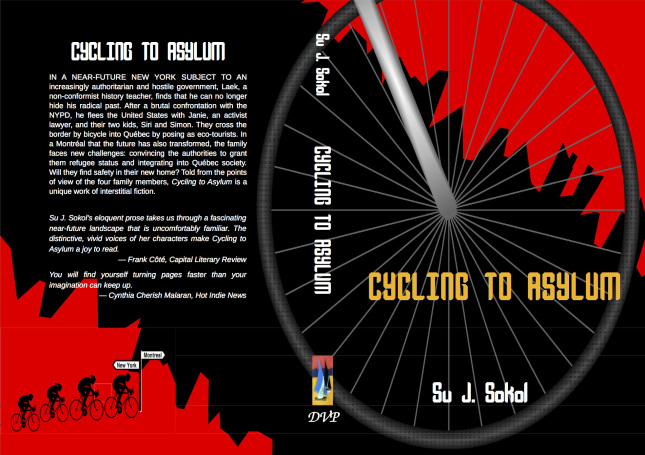
From sujsokol.com
I just finished a terrific novel, Su Sokol’s Cycling to Asylum (2014), described by the author as “the story of a family that flees a near-future New York City and crosses the border into Québec by bicycle to demand political asylum.” I’m going to be a bit lazy and let Su’s website synopsis do the work of describing its essence:
…[T]he novel is the story of a voyage, both an actual and personal/metaphorical one. This voyage is experienced differently by each protagonist and it is for this reason that it is told in alternating chapters, using the unique voice and perspective of each of the four main characters. These characters include Laek, a history teacher with a mysterious, radical past; Janie, an activist lawyer and musician; Siri, a tomboy with secrets; and Simon, a dreamy child addicted to violent screen games.
I’m pleased to report that Cycling for Asylum has drama and suspense, compelling characters sharing deep emotions, and a thought provoking political and social context, all sprinkled with clever detail and humor. I read the book slowly, over the course of many Boston subway rides. Its short chapters and compact, memorable story were perfect for that.
Concededly, I’m not an unbiased reader or reviewer. Su is a classmate of mine from NYU Law School, and many years ago she and her husband Glenn lived down the block from me in Brooklyn. During law school and throughout her career, Su has been a strong advocate for the disenfranchised and for social justice, a quality that informs her novel.
Su and I fell out of touch when I moved to Boston, but through Facebook we reconnected. I would learn that Su and Glenn moved their family from New York to Montreal about a decade ago. Earlier this year, Su was making a swing through the Boston area, and we enjoyed a delightful lunch along with her long-time friend (and book cover artist) Lin-Lin Mao. Here’s a photo that Lin-Lin took, with plenty of snow around us:

Photo: Lin-Lin Mao
During lunch, Su told me how important this kind of writing has become to her. That care is evident in Cycling to Asylum, her first published novel. For me, reading it was a fun little revelation. I’d long admired Su’s commitment as a public interest lawyer, a job that often requires the skills of a good story teller to put a client or cause in a favorable light. But a strong knack for advocacy doesn’t make one a novelist, as the world is besieged with wannabe writers holding law degrees! In Su’s case, however, I found myself taken by her ability to create interesting characters and to tell a story.
I’m not a literary critic; I either like a book or I don’t. I really liked this one. While riding on Boston’s Orange Line, it drew me into another world of interesting people and times, a journey for which I am very thankful.
Throwback Thursday: Discovering Jack Finney’s “Time and Again”

You may have to be a bookworm to fully appreciate a soggy, nostalgic Throwback Thursday post about, well, reading a book, but here it is: About 30 years ago, I discovered Jack Finney’s Time and Again (1970), an illustrated novel about a Manhattan advertising artist named Si Morley who is enlisted in a U.S. Government project experimenting with time travel.
No spoiler alerts are necessary to give you a preview. Let me first quote from the back cover of my paperback edition (pictured above): “Did illustrator Si Morley really step out of his twentieth-century apartment one night — right into the winter of 1882?” I’ll say no more about the story, except to say that if you love New York City and enjoy time travel stories, then this book is for you.
I discovered Time and Again in 1985. I had not heard of the book when I kept glancing at it during repeated visits to Barnes & Noble’s giant sale annex at 5th Avenue and 18th Street, but finally I decided to buy it. As I was reading along, soon I realized that it was becoming one of my favorite books. (It remains so.) Again, I’ll skip the details, but Chapters 7 and 8 provided some of my most cherished reading moments ever.
To grasp such a geeky memory, it helps to understand where I was in my life. In the fall of 1985, I had just graduated from NYU’s law school, I was living in Brooklyn, and I was working as a public interest lawyer in Manhattan. I had also become completely smitten with New York City. I doubt that I will ever again experience such deep affection for a place. If a big part of me will always be a New Yorker, then those early years in NYC will have a lot to do with it.
Time and Again spoke to that love of New York, and its story captivated me. Finney had a knack for writing the time travel tale — as his other books and short stories also attest — and he got it just right with this one. It may be as close to genuine time travel as I’ll ever get, a reading experience approached only by Stephen King’s 11/22/63 (2011). (In fact, in the Afterword to his book, King calls Time and Again “the great time-travel story.”)
So, if a tale of discovering olde New York is to your fancy, then you might give Time and Again a try. I think you’ll be glad you did. Don’t forget to close your eyes and see what Si Morley saw.
Bowing to my middlebrow appetite: Give me a good diner any day
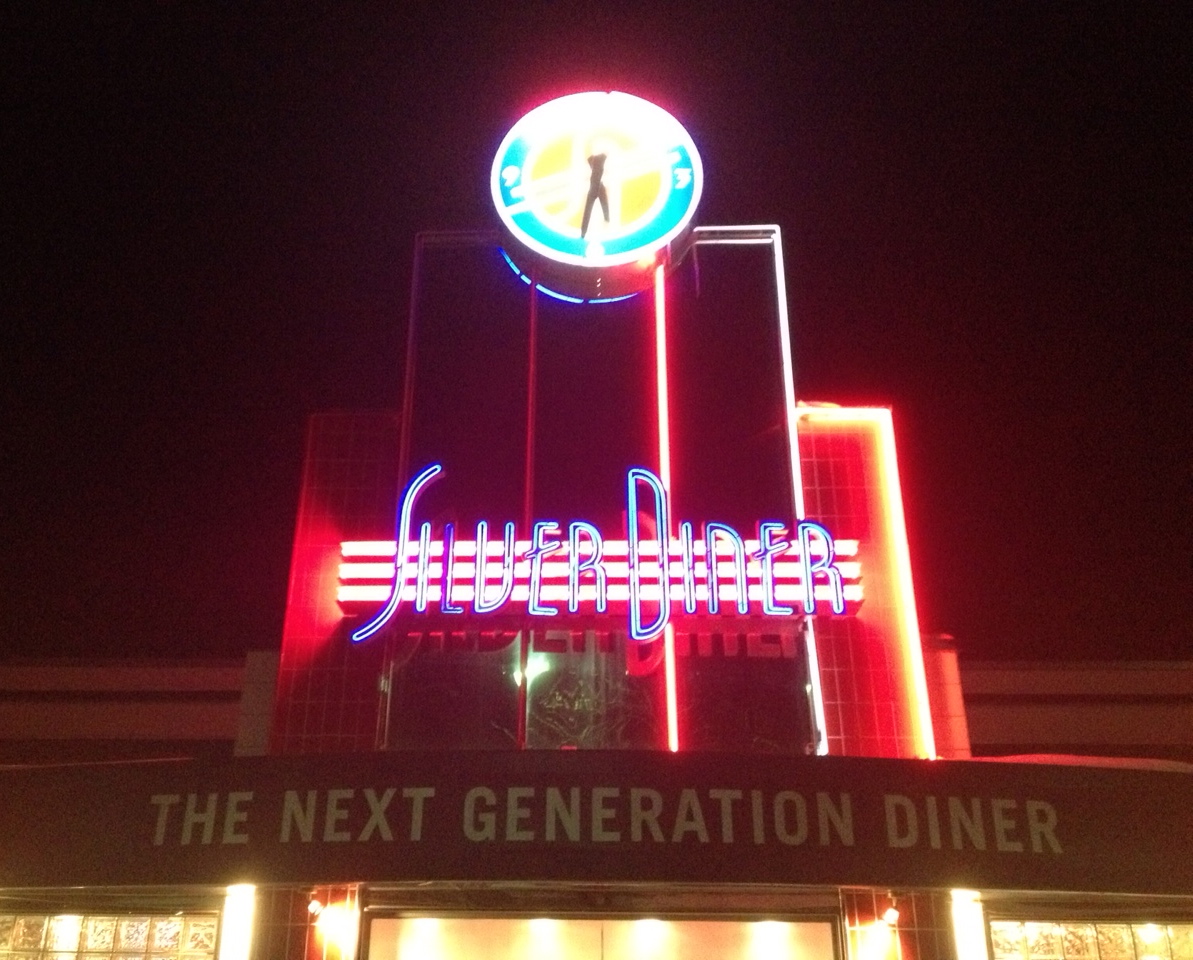
Silver Diner, Reston, Virginia (Photo: DY)
When it comes to food, my tastes are distinctly middlebrow. Fancy French meals? Nah. Pricey steakhouses? Ok, but I don’t crave them. A place setting with multiple forks, spoons, and glasses? Too confusing.
If there’s a type of restaurant that best captures my appetite, it’s a good quality diner, with a menu featuring sandwiches & burgers, comfort food entrées, salads without too much junk in them, and day-long breakfast offerings.
Oh, I can enjoy pizza and seafood. And Asian food agrees with me, as do many other ethnic cuisines.
But there’s something about diner fare that I just like.
Pictured above is the Silver Diner in Reston, Virginia, part of a small chain in the Washington D.C. metro region. When I visit friends in Northern Virginia, a meal at the Silver Diner is usually part of my stay. Breakfasts, burgers, dinner platters, desserts — all very good, at decent prices.

The Cozy Soup ‘n’ Burger, Broadway & Astor Place, NYC (Photo: DY)
When I moved to New York City in 1982, it seemed that diners were everywhere, especially in Manhattan! Many are simply gems, and my favorite is the Cozy Soup ‘n’ Burger on Broadway & Astor Place in Greenwich Village.
My law school pal Joel introduced me to the Cozy during our second year at NYU, and I was a regular customer throughout my years in New York. I still go there almost every time I’m in the city, sometimes twice! My order is usually the same: Turkey burger (I top it with ketchup and cole slaw), a cup of split pea soup (really awesome), and occasionally an order of rice pudding (rich & creamy).
Oh boy, this is making me hungry. And I’m writing this post here in Boston, where diner fare is scarce. You see, although Boston has its share of good eateries, it is woefully lacking in quality diners. I think a city has to be more of a 24-hour kind of place to support a multiplicity of diners, and that’s just not Boston.
I’m sure I’ll find something else to my liking. In the meantime, if the owners of the Cozy Soup ‘n’ Burger or Silver Diner want to open a restaurant close to my home or work, I pledge to be a loyal customer.
If you’ve got some time to kill…
As some of you know, I’ve been writing a professional blog, Minding the Workplace, for over six years. A lot of the material is heavier stuff, looking at employee relations, workplace bullying, employment law, psychological health at work, and so on. But on occasion I’ve written pieces with a lighter touch that may be of interest to readers here. I thought I’d dig into the archives of that blog and share a few of them:

Taking stock at midlife: Time for reading assignments? (2014) — “So, in the absence of these colleges for 40-year-olds (and beyond), how can we think and reflect upon our lives to date, our lives right now, and our lives to come? For those who, like me, sometimes turn to good books for guidance, let me introduce a thick anthology, Leading Lives That Matter: What We Should Do and Who We Should Be (2006), co-edited by Mark R. Schwehn & Dorothy C. Bass, both of Valparaiso University, my undergraduate alma mater.”
What now, not what if (2013) — “Currently stored on my DVR are a PBS program and a National Geographic docudrama about President Kennedy, both produced to coincide with the 50th anniversary of his assassination. Although I’m a devotee of history, I have a feeling that I won’t be watching them….That lesson was reinforced to me in Stephen King’s 2011 time travel epic, 11/22/63, which takes us back to the years leading up to the assassination of President Kennedy.”
The perils and pleasures of nostalgia, even about work?! (2013) — I get especially nostalgic about two work experiences. The first was my initial year as a Legal Aid lawyer in Manhattan, following my graduation from NYU’s law school….My second nostalgic focus: Returning to NYU after six years of legal practice as an instructor in its innovative first-year Lawyering Program….Both clusters of memories, however, gloss over the fact that I was years away from discovering my true passions as a teacher, scholar, and advocate. I was clueless about a lot of things, and not exactly on the leading edge of emotional maturity.”

August 1982: Next Stop, Greenwich Village (2012) — “This month, I find myself particularly nostalgic over events of 30 years ago, when I moved from Hammond, Indiana to New York City to begin law school at New York University, located in the heart of Greenwich Village. This was a pretty big deal for me. Although I had benefited greatly from a semester abroad in England during college at Valparaiso University, I was far from worldly and had never been to New York City before applying to NYU….Within a few days of my arrival, I would start classes in Vanderbilt Hall, the main law school building, on the southwest corner of Washington Square….”
Collegiate reflections: Studying the liberal arts (2012); Collegiate reflections: Working on the campus newspaper (2012) — “With Commencement season coming to a close at colleges and universities across the nation, I beg my readers’ indulgence as I use a short series of posts to reflect upon my own collegiate experience….”
Ch-ch-ch-changes: Some books to guide toward good transitions (2012) — As we turn the calendar to a New Year, I wanted to gather together some recommended titles for those who are engaged in or contemplating a major work or personal transition….If you’re in the midst of big changes, these books may prove a worthy investment in terms of your livelihood and well-being. I hope you find them helpful.
Does life begin at 46? (2010) — “Conventional wisdom, according to research, is wrong. True, we start off our adulthoods pretty happy and become increasingly disenchanted as middle age approaches. However, our outlook then gets better as we age. The Economist cites research studies to back up its proposition, overcoming the presumption that this is more Boomer-inspired babble about how 60 is the new 40.”
Embracing creative dreams at midlife (2010) — “Dreams die hard is something of an old chestnut, but having entered the heart of midlife, I am thankful that this often is true. I think especially of creative energies waiting to be tapped and unleashed, perhaps after some of life’s other priorities and responsibilities have been addressed, and pursued with the benefit of experience and maturity. Two long-time friends come to mind when I ponder this. Hilda Demuth-Lutze is a friend from college days at Valparaiso University (Indiana) who is the author of historical novels for young adults. Mark Mybeck is a friend going back to grade school in Hammond, Indiana, whose band, Nomad Planets, is creating a niche for itself in the Greater Chicagoland indie rock scene.”
Dreaming of spring training

Baseball season approaches! Meanwhile, if you’re wondering what the sidewalks look like in many residential areas of Boston, here’s one from my ‘hood. I snapped the photo on Sunday night, walking home from the subway. (Photo: DY, 2015)
During this winter of our discontent here in Boston, baseball season seems as far away as the moon. Perhaps that’s why I find myself waxing nostalgic about the game, thinking back to my boyhood years when I became a fan.
During my latter grade school years, I discovered baseball, both watching and playing. The watching was inspired by my 80-something grandfather, who was living with us in Northwest Indiana and enjoyed Chicago Cubs games on television. He didn’t speak much English, but he could follow the ballgames, and so after school and during summers, we’d often watch with him in our little TV room. Here’s the song that would open many a Cubs telecast:
The playing was by way of my friends, who were big sports fans. A few were on organized Little League teams, but for most of us baseball was a pick-up game played on the local parkway, with improvised diamonds. I was terrible at first, but I had fun and kept at it, to the point where I could hold my own hitting and fielding.
In fact, my affinity for the game grew quickly, and the slightest sign of spring became reason to get out my baseball glove and bat. Once the temperatures hit the 60s, I would be full of anticipation for the coming Cubs season and for our parkway ballgames. I’d check the newspaper for news about spring training and search out neighborhood pals to play catch. I also became a fan of tabletop baseball games that used statistical charts and cards to simulate the performances of real-life baseball players — the forerunners of today’s sophisticated computer and video games.
As I got older my focus on baseball waned. But after I graduated from law school, I rediscovered the game. I was in New York City by then, and in the mid-1980s it was still possible to get Mets grandstand seats for under $10. I shared a pair of season tickets with friends during the Mets 1986 World Series championship season, and it was a blast. I also joined fellow Legal Aid Society lawyers for weekly softball games in Brooklyn’s Prospect Park. Yup, those were good years.
Today, I’d be in better physical shape if I was still playing softball, instead of anticipating the start of fantasy baseball season and playing baseball board and computer games! Whatever. Until this snow starts to clear up, any manifestations of baseball around here will be virtual anyway.
From top dog to underdog: Why I’m pulling for Barnes & Noble

Recent B&N acquisitions
Not too long ago, Barnes & Noble was a big bad bully of the bookselling industry, pushing indie bookshops out of business across the country and swallowing up competitors like B.Dalton. For a while it jousted for top dog status with Borders, its main competitor in the superstore category.
But then along came Amazon, the biggest, baddest book selling behemoth of them all, armed with easy online click & ship ordering, the Kindle e-reader, and marketing savvy. Borders would go into a slow death spiral, finally crashing a few years ago. Barnes & Noble is now trying to survive as the only significant, national brick & mortar bookstore chain.
The top dog has morphed into the underdog.
Still and all, I very much hope that B&N makes it. I have always enjoyed walking into their stores, wondering what new discoveries await me, and exploring their huge selections. In addition to the shopping experience, B&N’s stores host author talks, meetings of writers’ circles and book clubs, and informal meet-ups. They are good for a community.
In addition to shopping at indie bookstores and, yes, Amazon at times, I’ve been making a conscious effort to buy more of my books, DVDs, and periodicals at B&N’s main store here in Boston. If it disappears, Boston will be without a major, high volume bookstore in the heart of the city, and that would be a genuine civic shame.
Me and B&N: The beginning
Barnes & Noble and I go way back. I first discovered it well before its superstore era, when the company was a plucky retailer, with stores in Manhattan and a fledgling mail-order business. As an undergraduate living in Indiana (1977-81), I sent away for their thick catalogs, and I would spend hours poring over the remainder listings in search of good bargains.
When I moved to New York for law school in 1982, my periodic walks from NYU’s Greenwich Village campus up to B&N’s twin retail stores on opposite sides of 5th Avenue at 18th Street became regular rituals. The east side location housed its flagship academic bookstore, offering mostly new non-fiction titles and textbooks at full sticker price. As a budget-conscious student, this made it better for browsing than for buying.
The west side storefront, however, was the site of B&N’s huge Sale Annex. It quickly became a personal treasure trove, with several floors of low-priced remainder books, discounted new books, and a generous used book section. At the risk of betraying more of my geekdom, I confess that my heart would start beating faster upon entering the store, in anticipation of the affordable goodies I might find there. I cannot guess how many hours I spent in that store during my 12 years in New York.
Right next to the Sale Annex was a large B&N music store. Here, too, I was overwhelmed by the choices. This was still the golden age for cassette tapes, and the music store seemed to have them all. At the time, my “stereo system” was the portable cassette player I had brought with me from Indiana, and I would wear out the batteries over and again playing my purchases there.
Enter the superstores
In the early 1990s, B&N made its big move, launching the superstores with their huge book selections, many shelves of periodicals, music and video offerings, and cafés selling beverages and food. They started in New York and soon expanded the concept nationally.
At that point, B&N became the bad guy, the Manhattan bully that was pushing small independent bookshops out of business. There was truth in the charges. With its thousands of titles and discounted best sellers, B&N simply offered much more than did its smaller competitors, and at lower prices for popular books. Borders would soon join the fray, and the two went head-to-head for a decade or so, while the indies took even more of a beating.
Among book lovers, the superstore vs. indie issue became political. Looking back, I recall being in a distinct minority among my liberalish social cohort in saying that I preferred the big superstores to the mom & pop bookshops.
These debates even helped to inspire a main storyline in the 1998 romantic comedy You’ve Got Mail, starring Meg Ryan as the owner of a small Manhattan bookstore and Tom Hanks as a senior executive for the superstore opening in the indie shop’s neighborhood. (It also features AOL as the e-mail platform. How things have changed!)
Fast forwarding……
My gosh, the superstore vs. indie discussion is largely passé, yes?! When it comes to bookselling today, it’s Amazon vs. Everyone Else. In fact, until recently it appeared that Barnes & Noble would go the way of Borders and disappear from the scene. In particular, B&N’s Nook e-reader has flopped as a competitor to Amazon’s Kindle, and losses from its e-book division have been a drag on B&N’s balance sheet. In addition, Amazon’s ubiquitous online presence has hastened the closure of many B&N stores across the country.
Among the departed are the main and annex stores on 5th Avenue at 18th Street. That breaks my nostalgic heart a little.
However, B&N has been making something of a comeback. It appears that a growing number of book buyers have recognized the importance of having brick & mortar bookstores around, and B&N has joined indie booksellers in enjoying a minor resurgence. In pure business terms, even its stock value has staged a recovery.
Until a year or so ago, I was buying most of my books from Amazon and keeping a Prime membership to guarantee fast delivery. However, ethical concerns over Amazon’s treatment of its warehouse workers have caused me to reduce my ordering from Amazon and to cancel my Prime account. (See this piece posted to my professional blog for a longer explanation.)
In the meantime, I’ve rekindled my enjoyment of visiting brick & mortar bookstores of all types, including small indies, used bookstores, and B&N’s superstores. Yup, click & ship is awfully handy, and online booksellers (including B&N and Amazon) are now networked with used bookstores across the country, making the hunt for elusive out-of-print titles much easier. Nevertheless, physical bookstores, where you can browse and discover and buy, are a joy for the mind and spirit and are part of an intelligent, healthy society.
Let’s hope that B&N and other bookstores are around for a long time. I look forward to giving them more of my business.
Throwback Thursday: Staying in New York (January 1985)

I saved this magazine cover from Dec. 1984; it’s displayed on a wall of my condo.
Thirty years ago, as I approached my final semester of law school at New York University, I accepted an offer to join the New York Legal Aid Society as a staff attorney after graduation. For me, it brought together two things near and dear to me: First, to work as a public interest lawyer; and second, to stay in New York City.
I had spent the previous summer working at a large commercial law firm in Chicago. Although the firm would extend an offer to return as a full-time associate attorney, I realized that my heart was not in corporate law and kindly declined. I wanted to work in the public interest sector, and so I applied for jobs across the country with legal services organizations, public defender offices, and a variety of other non-profit and public employers. Although NYU was very supportive of students who wanted to do public interest work, these jobs were in heavy demand among young (and not so young) do-gooder types. I knew that I had my work cut out for me.
My job search stretched across the country, but New York was my top destination by a huge margin. I had moved there from northwest Indiana to attend law school, and I fell fast and hard for the city. New York of the early-to-mid 80s was a city in transition, emerging from a previous decade steeped in crime, urban blight, and corruption. It was an awesome, gritty, sometimes overwhelming place to me.
In many ways, going to law school in New York was like a study abroad experience, in that I kept discovering its endless nooks and crannies on a shoestring budget. It was still possible to explore and enjoy many aspects of the city on the cheap, with an occasional splurge or two for a show or a nice dinner.
Anyway, good fortune would smile upon me, and I spent my final semester of law school knowing that my immediate future was set. I graduated in the spring, took the bar exam over the summer, and started at Legal Aid in the fall. Between being ousted from the NYU law dorm and my $20,000 starting salary, I was propelled into the apartment share hinterlands of Brooklyn. It would be many years before my paychecks yielded more disposable income, but at least I was in a city that captured so much of the world. Armed with subway tokens, travel guidebooks, and a credit card that I tried to use judiciously, I took a lot of New York “staycations.”
Yup, this takes me back some 30 years, and that realization does a number on me. Though concededly I was quite clueless about so many things back then, this was a very good chapter of my life. Sometimes, even memories filtered through rose-colored lenses of personal nostalgia can be pretty spot on.
Throwback TUESDAY: My last camping trip (1984)
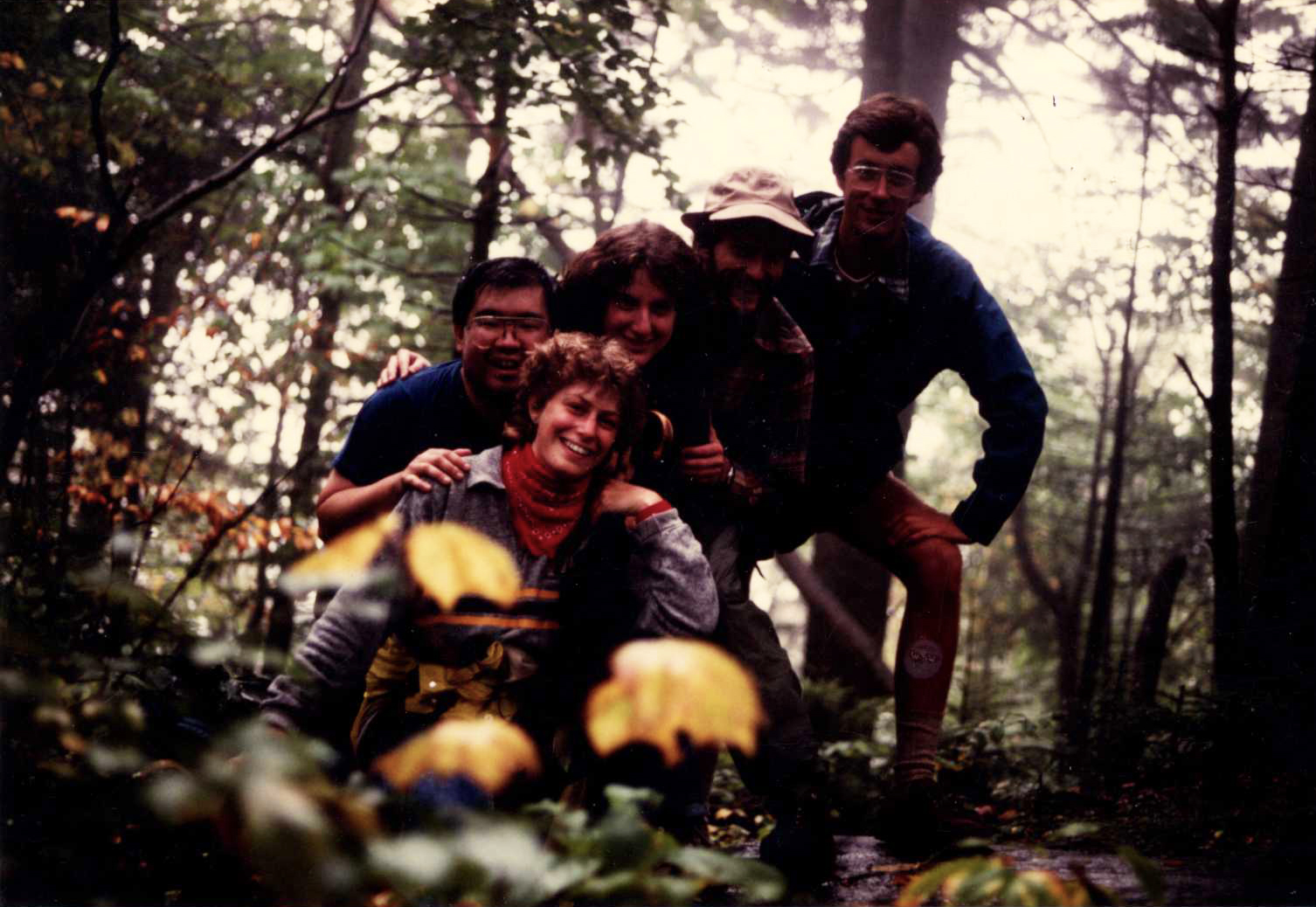
Front to back: Mo, DY, Rochelle, Patrick, and Mark. Talk about roughing it: We had no cell phones back then, so we couldn’t even try to order Chinese delivery. (Photo courtesy of Patrick Long, 1984)
The other day, my long-time friend and law school classmate Patrick sent me a couple of photographs taken thirty years ago, from a camping trip at the start of our third and last year at NYU law school. It was the beginning of the fall semester, and the onset of classes had triggered a bout of cabin fever so intense that five of us piled into Patrick’s car and headed for the Catskills.
This may sound like an odd thing for a law professor to be saying, but my reaction to the start of classes was so acutely resistant that even I — a budding city dweller in the making — was willing to forgo the niceties of the law school dorm in order to escape the world of casebooks and classes.
You see, unlike my outdoorsy law school friends, I was not a regular camper. Actually, I wasn’t a camper, period, and I haven’t been since then. It’s not that I’m a high maintenance traveler. In fact, between summer storm chase tours and countless trips to New York, I’ve stayed in places that won’t be listed in any premium travel guidebooks. But when it comes to accommodations away from home, I do strongly prefer (1) a bed to sleep in; and (2) indoor plumbing.
I don’t remember a lot about the trip itself, though I know that we all got along together just fine. I also seem to recall a couple of loud guys camping in an adjacent plot who had too much to drink on multiple nights, but maybe that’s just a ritual memory of every camping trip, whether it actually happened or not.
Anyway, after a few days in the wilderness, we folded our tents and returned to the urban jungle. Soon I got back into the law school swing of things, and it would prove to be a good and meaningful year, with some fun and laughter mixed in with the work.
Wow, it has been thirty years since my last year of law school. I’m sure the muse of nostalgia will cause me to write more about that time during the months to come.

No cable, so at least we could stare at the flames: Isn’t it wonderful how the discovery of fire made recreational camping possible? (Photo courtesy of Patrick Long, 1984)
Another quick trip to Manhattan

A throwback view — I want to name it “The Naked City” after the old movie and TV show — from my midtown Manhattan hotel room
I’ve been back in New York City this week to participate in a terrific conference, the annual workshop of the Human Dignity and Humiliation Studies network, sponsored and hosted by Teachers College of Columbia University. Among other things, I gave a talk on the quest to advance and nurture dignity at work. I’ll be posting more about that on my professional blog, Minding the Workplace.
During these all-too-brief trips to the city, I try to revisit favorite old haunts from my 12 years there. One of my stops was the famous Strand bookstore. Since my very first visit to New York in the summer of 1982, I’ve been there hundreds of times!
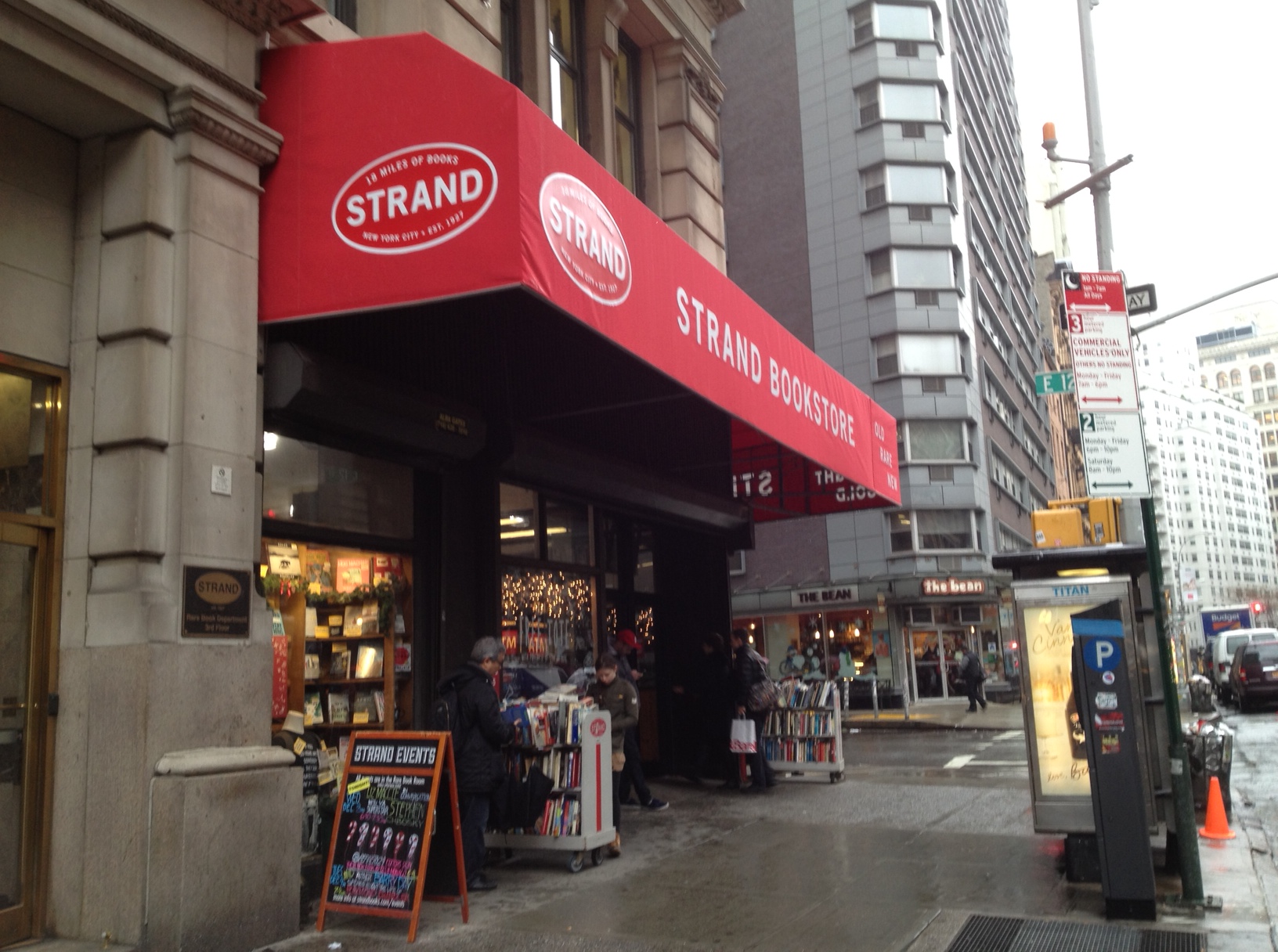
The Strand, my long-time bookstore mecca
When I lived in New York, one of my favorite ways to spend a free afternoon or evening was to go pick up a few discounted treasures at the Strand and then enjoy a hearty meal at the Cozy Soup ‘n’ Burger on Broadway & Astor Place. One of my law school pals (hey Joel!) introduced me to the Cozy some 30 years ago, and I’ve been making pilgrimages there since then. My usual order is a turkey burger (no fries) and a cup of their signature split pea soup. If it’s dinnertime, I also may splurge on an order of rice pudding.

The Cozy’s split pea soup with croutons…as good as soup can get.
Wednesday’s dinner was at La Palapa, a real deal Mexican restaurant on St. Mark’s Place in the East Village. My cousin Judy, a superb restauranteur, is a manager. Fortunately I can champion the food because it’s sooo good, not just because I have a dear family member who works there! Dining with cousins Al, Aaron, and one of their friends, I had this incredible, fall-off-the-bone pork shank dish with rice and plantains.

Tasted even better than it looks!
Cousin Judy and I also went to see a Broadway show, a top-notch performance of “On The Town,” the fresh, funny, and sharp revival of a 1944 musical about three U.S. Navy sailors enjoying a 24-hour leave in New York City.
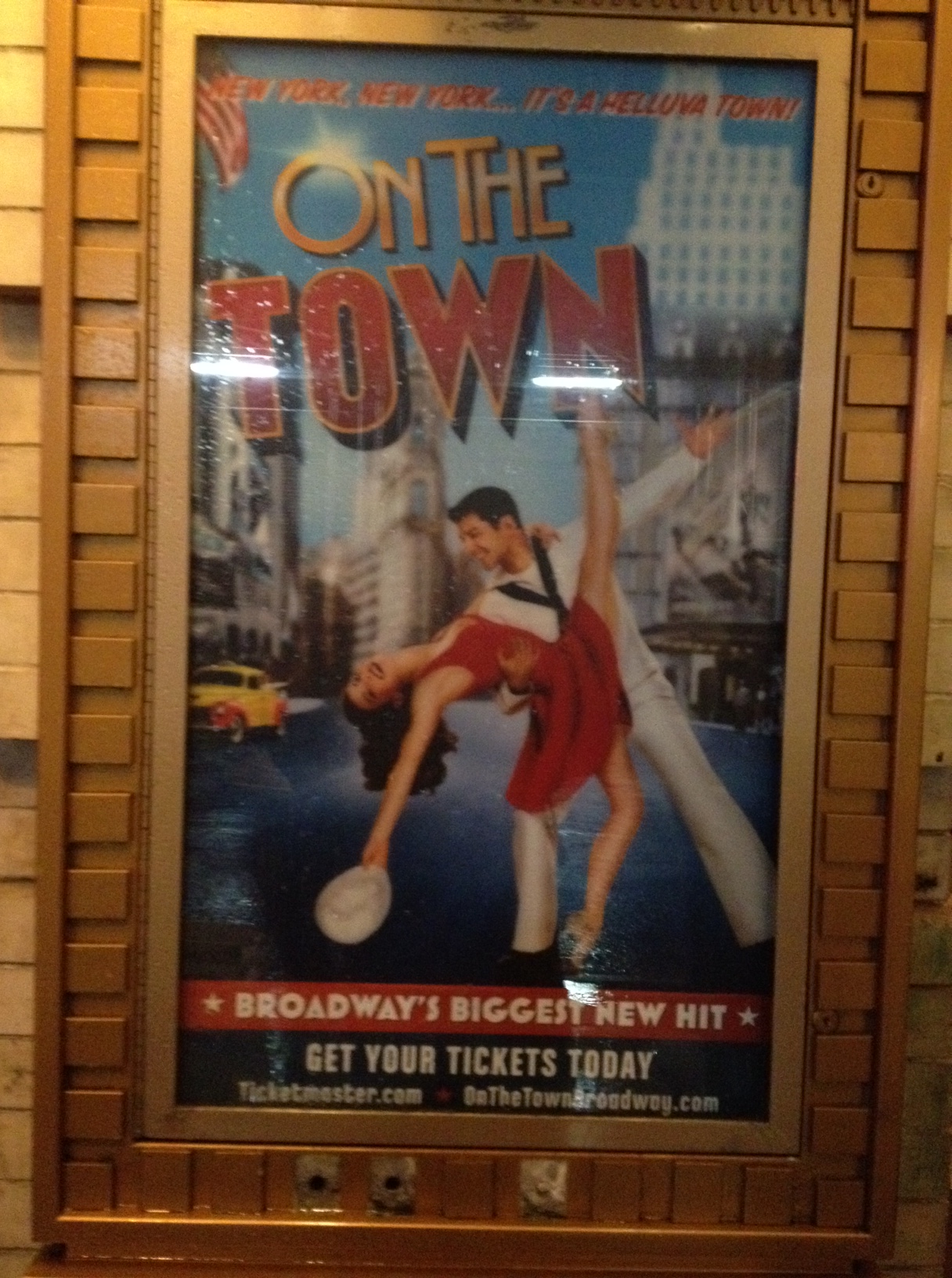
Outside the Lyric Theatre, NYC
This visit also overlapped with serious real-life events in New York. On Wednesday, a Staten Island grand jury opted not to indict a white police officer, Daniel Pantaleo, who had placed an unarmed and secured African American man, Eric Garner, in a fatal chokehold. Especially because the July incident was captured on videotape, the decision has sparked major protests in the city (and elsewhere). Here was the scene Wednesday night in Union Square at 14th Street in Manhattan.
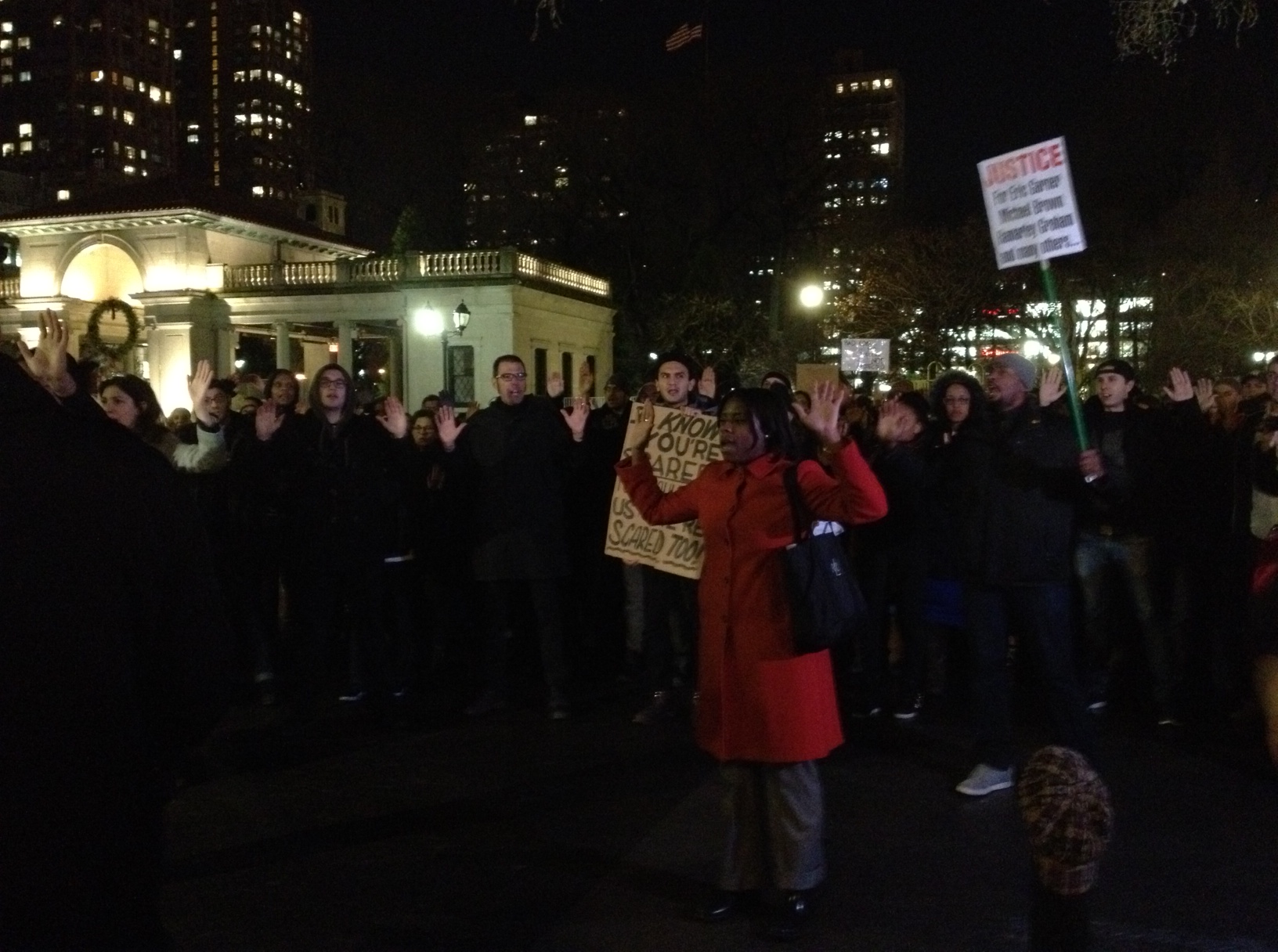
Protesting the grand jury decision in the Eric Garner killing, at Union Square, early Wed evening
 Musings of a Gen Joneser
Recent Comments