Synchronicity and A Foggy Day

Here’s the story behind this photograph: In July 2011, I participated in a law & mental health conference at Humboldt University in Berlin. On one of the conference days, all morning and into a lunch hour walk, I found myself humming one of my favorite Gershwin songs, “A Foggy Day (In London Town).” I simply couldn’t get it out of my head!
Well, with lunch hour coming to an end, I made my way back to the conference site, and as I turned the corner into the main university plaza, these two students were playing…yup…you guessed it. It sent a (good) chill up and down my spine…and earned the kids a few euros.
The phenomenon is called synchronicity, a pair of related events that do not appear to be causally connected. Some would call it a coincidence, but those who know of the theories of psychologist Carl Jung might well suggest that a more psychic element is at play. I would tend to agree. I’m not the most psychic or intuitive person around, but I’ve had these moments too often to write them off as products of chance.
What about you? Do you buy into the idea of synchronicity?
Holiday reflections: The end of limitless possibilities (and that’s good)

Rockefeller Center during NYC’s post-Christmas blizzard, 2010 (Photo: DY)
Like birthdays, end-of-year holidays can be a time for taking stock. However externally provided, these recurring milestones give us opportunities to look back, assess the present, and peer into the future.
Some four years ago, writer Judith Warner blogged for the New York Times about listening to her daughter sing the title song of the musical Fame:
…I heard Julia’s voice, stronger and more confident than mine: “I’m gonna live forever. I’m gonna learn how to fly. (High.)”
And one of those all-too-frequent choke-in-the-throat feelings came over me.
This was her song now. Not mine.
The sense of limitless possibility: hers. Vaulting ambition: hers. Anticipation, excitement, discovery, intensity: all hers.
Later in the piece, she laments, “This is the cruelty of middle age, I find: just when things have gotten good — really, really, consistently good — I have become aware that they will end.”
I hope that, for Warner’s sake, she was writing her blog post at a time when she was briefly caught in a down mood. But even her attempt to locate the silver lining sounded a bit sad:
There are trade-offs: intensity versus contentment, exaltation versus peace. And perhaps the best exchange of all: you trade in an idea of yourself for a reality that, if nothing else, can make you laugh.
Ack. Even the top benefit of her “really, consistently good” life today is the ability to chuckle at her current self.
I’m not quite sure why I’m using Warner’s piece as the foil in a holiday reflection (of all things), but obviously it has stuck with me. Although I won’t claim immunity from all of Warner’s lamentations about getting older, I now feel ready to write my response.
For me, among the genuine blessings of the passing of time have been authenticity and self-definition. I have been afforded the extraordinary privilege of being able to make choices — hundreds of millions of people in this world are not so fortunate. I have squandered some of that privilege, but thankfully a kernel of inner wisdom has helped me to narrow down the limitless possibilities, rather than struggling to keep them open.
As I see it, in making the right choices we find the “(a)nticipation, excitement, discovery, [and] intensity” that Warner has now reserved for her young daughter. When that happens, the would’ve beens and could’ve beens — i.e., the roads not taken — simply don’t matter as much.
I do know of those youthful feelings that Warner writes about. That sense of the world being your oyster, wrapped in a seemingly boundless optimism of things to come. I remember those days well, and sometimes I get nostalgic for them.
However, if I’m being honest with myself, I also must acknowledge piles of anxiety, insecurity, immaturity, and posturing (a kinder way of saying inauthenticity) that were very much a part of my twentysomething self and, umm, beyond. By no means do I assume that everyone of this age range is similarly afflicted, but those qualities were very much a part of me.
Okay, so today I’ve got a lot less hair, more paunch, and my knees creak, but I have a sense of what I’m supposed to be doing and that feels good. I now understand Joseph Campbell’s sage advice, follow your bliss. Campbell (1904-87), whose writings and lectures on mythology, faith traditions, and the world’s societies made him a singular authority on the human experience, suggested that following our bliss will lead us to the life paths that have been awaiting us. When we reach this point, opportunities and connections seem to materialize.
In a popular PBS series of interviews with Bill Moyers, Campbell replied to a Moyers question about whether “hidden hands” guide and facilitate our work once we’ve found our path:
All the time. It is miraculous. I even have a superstition that has grown on me as the result of invisible hands coming all the time — namely, that if you do follow your bliss you put yourself on a kind of track that has been there all the while, waiting for you, and the life that you ought to be living is the one you are living. When you can see that, you begin to meet people who are in the field of your bliss, and they open doors to you. . . .
As I suggested above, many people are not afforded this opportunity. If life is largely a fight to obtain food, clothing, and shelter, then it’s awfully hard to pursue one’s higher level aspirations.
But I’m guessing that most folks with the ability to read this have a degree of choice. Some may be struggling to find their purpose in life, or to recover from setbacks. For those dear readers, especially, here is what I wish for you at this holiday season: Opportunities to discover and follow your bliss, and the wisdom to do so.
***
Cross-posted with my professional blog, Minding the Workplace.
A dark and snowy night in Boston

Downtown Boston tonight: Corner of Washington & School streets, with the historic Old South Meeting House, center (Photo: DY)
Boston’s historic look & feel is one of its most appealing features. Much of the city’s colonial and early 19th century past is preserved for all to see. The photo above, for example, includes the Old South Meeting House, where rebellious colonists planned the Boston Tea Party in December 1773.
When an evening snowfall hits, this quality can become downright Old World, like something out of a Charles Dickens novel. The reference is fitting, as Dickens himself visited Boston twice, staying in the Parker House Hotel, not far from where I took this picture tonight. It’s likely that he crossed this very intersection during his visits.
These blends of atmosphere, sights, and history are among the reasons why I find older cities so appealing. For a brief moment, I can look around and transcend time.
The snowfall we’re experiencing right now has been unexpected in its intensity. It grew into a small storm that led to a lot of early school closings and many cancellations of events around the city. When I got home, I had some shoveling to do, which took a bit of the novelty out of the evening and made me doubly glad that I snapped the photo to preserve the moment.
Lifelong learning: Some free & inexpensive resources

Boston Public Library, Central Branch, main staircase (photo DY)
I’m a lifelong learning junkie, and perhaps you are, too. The world of adult education is somewhat stratified right now: If you want to earn a degree, it will cost you money, maybe a lot of it. On the other hand, if your main objectives involve independent learning, intellectual growth, and personal enrichment, your free and low-cost options are virtually limitless!
Let’s start with your public library. A treasure trove awaits, in big cities and small towns alike. Most libraries are now heavily invested in multi-media, offering DVDs and e-books in addition to print materials.
Of course, don’t forget “old” (heh) online standbys such as YouTube and Wikipedia. There’s a staggering amount of good stuff on both.
Beyond the most obvious candidates, you’ll discover so much more. Here’s a sampling:
Open Culture is a rich portal to all sorts of lifelong learning options, including free courses, movies & documentaries, and e-books. Dive in and start clicking around.
Coursera is a popular provider of MOOCs (massive open online courses), mostly free online courses on a wide variety of topics, led by faculty at leading universities around the world. Quality varies, but the price can’t be beat, and some of the offerings are top-notch.
The Great Courses, a commercial entity, offers professionally produced video courses on many topics, with heavy emphases on the arts, sciences, and humanities. I’ve enjoyed a number of their courses over the years. Word to the wise: Never pay full sticker price. Sales are ongoing, and the course(s) you want inevitably will be offered at significant discounts several times a year.
I’ve recently become a fan of Brain Pickings, a site “full of pieces spanning art, design, science, technology, philosophy, history, politics, psychology, sociology, ecology, anthropology, and more.”
For Gen Jonesers, Next Avenue is a great site, with a bevy of articles on topics such as health, personal finance, retirement, and caregiving. This is a bookmarked site for me; I visit it almost every day.
Independent adult education centers — typically found in larger cities — offer courses at reasonable tuition. Here in the Boston area, I’ve taken a weekly singing workshop at the Boston Center for Adult Education since the mid-1990s! (More on that in a later post…) Although I’ve never experienced them, two other centers that intrigue me are the School of Life in London and the Brooklyn Institute for Social Research.
University continuing education programs usually carry a higher price tag, but there are a lot of good offerings out there, and more are offering distance learning options.
Generally speaking, you’ll find online continuing education courses and free online seminars for virtually every learning niche and specialization. Keep searching away.
I know that some people have very strong feelings, pro and con, about e-reading devices such as Kindle, Nook, and Kobo. Given my druthers, I’d rather read from a book, but I find my Kindle especially useful when traveling. Anyway, my point is that there are tons of good books available via e-reader platforms, at little or no cost. If spending money on a device is beyond your budget, you may download free e-reader apps. You can then check out sites such as Project Gutenberg, which offers over 42,000 free e-books.
Friends, this doesn’t even scratch the surface, but I hope you’ll be inspired and excited by the possibilities.
Remember the Sears Christmas catalog?

Yes, I know that Christmas, or any other religious holiday for that matter, shouldn’t be all about receiving presents. But around this time of year, I can’t help thinking back to the days when the arrival of the Sears Christmas catalog — later called the Sears Wish Book — meant the beginning of the holiday season for kids across the country.
Sears is facing rough times right now, and it may not be long for this retail world. Back in the pre-digital age, however, brick & mortar stores found themselves competing with home delivery giants like Sears, which also had their own bustling retail outlets.
But no matter how big the Sears department store, it couldn’t compete with all the goodies in the Christmas catalog. I don’t think I was alone in spending hours turning the pages, daydreaming of what it would be like to have all those toys! For most of us, it was pure fantasy, but it fueled our imaginations in the process.
Here are a few pages from a 1966 edition I bought off of eBay a few years ago:

Remember the View-Master? It gave us vivid, color, stereo views of people, places, and stories from all over the world, courtesy of photo reels that turned with a small hand-operated lever. Nowadays, with Google and YouTube available to give us an endless array of photos and video, it may be hard to imagine just how cool it was to stare into a View-Master.

Many of the toys and accompanying marketing were very gender-specific. I spent a lot of time looking at the toys for boys, like the spy kits above and the GI Joe sets below.

Paging through this 1966 catalog, you might be stunned at the many toy guns and military playthings. Memories of the Second World War were very fresh, and the heaviest protests over Vietnam were a few years away.
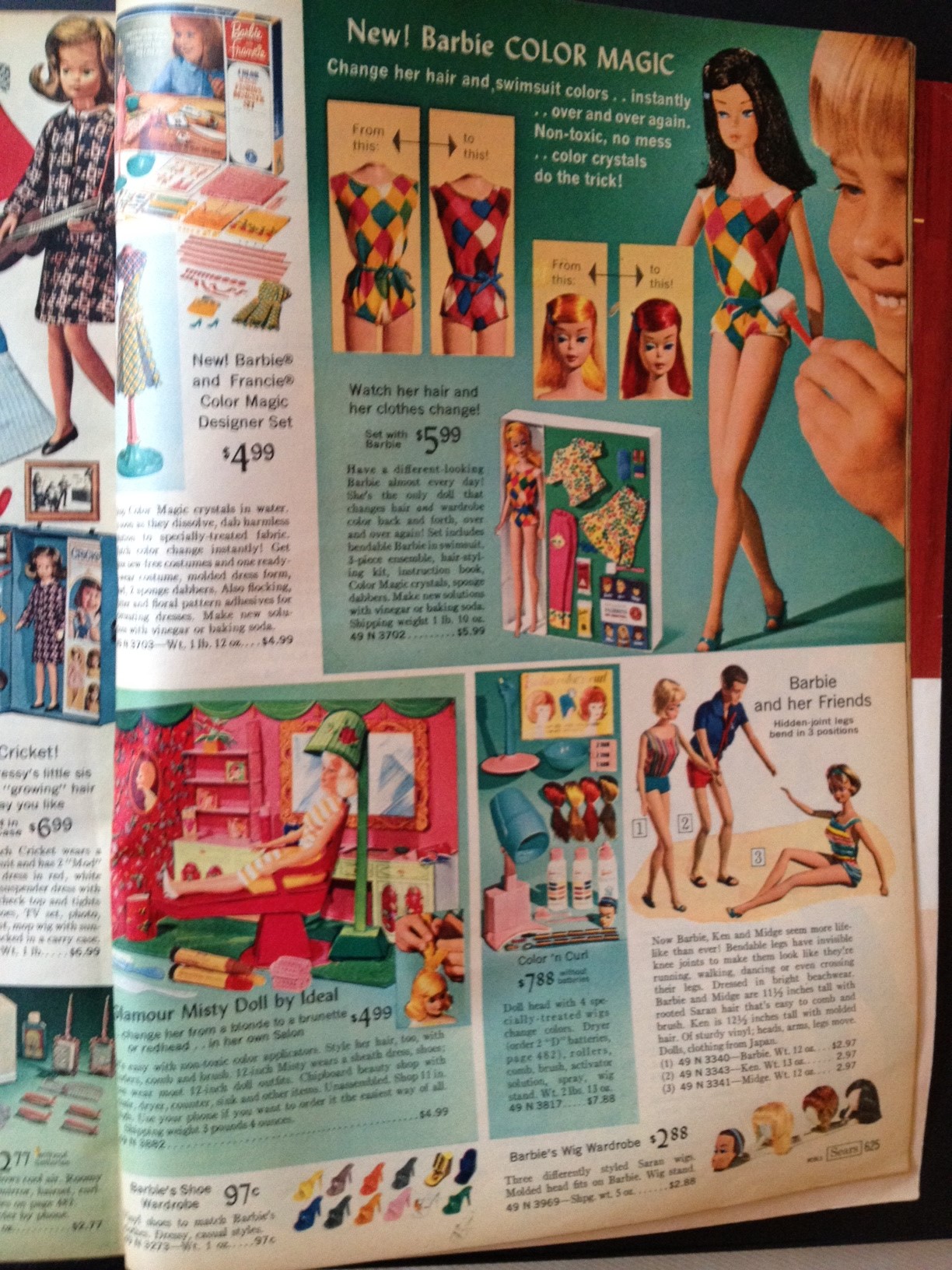
Of course, the girls had plenty of their own pages as well. Barbie was huge, as you can tell. It’s around this time that toys like the Easy Bake Oven appeared. I have to say I envied the girls for this one — the thought of making and consuming cakes and cookies at will was quite appealing!

Before cassettes, 8-track tapes, CDs, and now MP3s, we had records and early attempts at tape players. Here’s an example of the latter, and if you look closely you can read the names of some of the featured performing artists.
Today, Amazon probably is the heir to the big Sears catalogs that plopped onto our steps every few months. Like the Sears catalogs, it seems to have everything. Amazon is also, of course, the biggest threat to brick-and-mortar stores, including Sears.
But I’ll relegate debates over the social and economic desirability of these developments to other writings, and simply leave you with the memories of days of being lost in a child’s world of toys.
Ordering Chinese delivery: Hitting the Food Wall
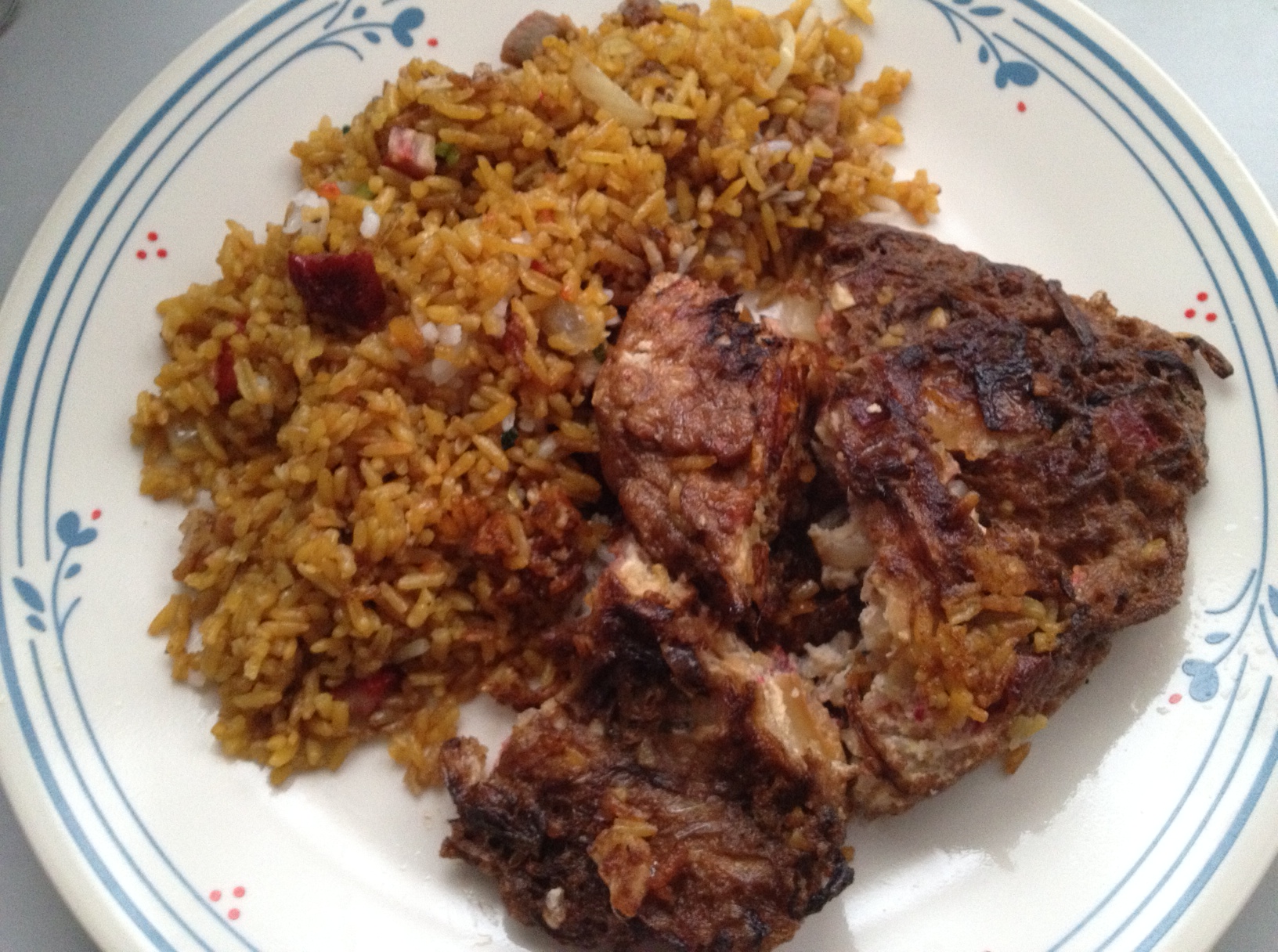
Delicious Chinese leftovers!
Ordering in Chinese food is one of my simple pleasures. Whether it’s after coming home from teaching an evening class, or during the weekend when a glance inside the fridge shows nothing resembling a meal, the ritual is basically this: Survey the menu, call in the order, wait for the delivery, and remove goodies from the bag.
Typically, one plate isn’t enough, so seconds follow. Then I close up the containers and pop the leftovers into the fridge for later meals.
I got hooked on Chinese delivery in law school. New York and Chinese food go hand in hand, and the local choices in NYU’s Greenwich Village neighborhood were abundant, tasty, and cheap. Even a modest order would yield several meals.
Today, my Chinese delivery venue of choice is called Food Wall, located in my Boston ‘hood of Jamaica Plain. I’m far from alone in this category. Val Wang featured Food Wall in her 2012 National Public Radio series on Chinese takeout places:
When you spend as much time inside of Chinese takeouts as I do, you start to notice some patterns. Like, every takeout has its regulars, people for whom the takeout is an essential part of their lives.
Food Wall in Jamaica Plain is one example. It has inspired something of a cult following. I walked up and down the street one afternoon asking people who work nearby how often they stop in. . . .
“At least once a week,” said Saul Cifuentes, owner of Beauty Masters Salon and Supply.
“Lately I’ve been going at least three to four times a week,” said Josiah Simmons of theVideo Underground.
James Norton of Revolution Bikes is trying to cut back, but “it used to be almost daily.”
None can top Fat Ram of Pumpkin Tattoo. He claims he’s eaten there “Eleven days a week for 10 years. It’s too much. Too much Food Wall. I hit the Food Wall.”
Pictured above is some very basic Cantonese fare from Food Wall: Egg foo young and fried rice. I usually opt for spicier Szechuan dishes, but not to worry, it’s good stuff. I cleaned that plate quickly.
College Daze: It’s finals time!

(Photo: DY, 2013)
With Thanksgiving in the rear view mirror, college students across America are studying for final exams and writing term papers. Even with the onslaught of technology over the decades, the ritual of gearing up for end-of-semester tasks remains largely the same. And for the procrastinators, it’s truly crunch time: That which has been ignored cannot be any longer.
Our late night “study hall”
I recall those days as an undergraduate at Valparaiso University in northwest Indiana very well. My favorite study hangout was the dining room of the Brandt Hall dorm where I lived. After the dinnertime meal service was over, it was kept open as a sort of impromptu study hall. Around finals time, several dozen students could be found reading, writing, and typing (on real typewriters, by the way) into the wee hours. Oh, there was plenty napping and chatting (often of the gallows humor variety) as well, not to mention late night coffee, sodas, and snacks courtesy of area donut shops and convenience stores.
My roommate, a super conscientious pre-med major, was not given to dining room studying. He spent his study hours at his desk or in the library. We’d usually watch the monologue of the Johnny Carson Show, after which he’d hit the hay. By contrast, my study day had just begun. Off I’d go to the dining room so he could get some sleep.
Come to think of it, the most self-disciplined students often avoided late nights in the Brandt Hall dining room. Those who joined us there rarely pulled all-nighters; it wasn’t necessary. Especially at finals time, the post-midnight shift in the dining room was largely the province of those of us who had put off those pesky term papers and heavy-duty reading assignments.
Beyond Brandt Hall
In these days before personal computers, having access to a typewriter was necessary for churning out those papers. I had a Smith-Corona electric typewriter, which I’d lug back and forth from my dorm room to the dining room.
But during my last two years of college, I worked as an editor of the college newspaper, The Torch. And in The Torch offices were two IBM correcting Selectric typewriters. IBM Selectrics were the Cadillacs of typewriters. Not only were they fast, but also they could correct errors without swapping out a cartridge or using Liquid Paper to paint over mistakes! For typing long seminar papers, the Selectrics were gifts from heaven.
During my senior year, some friends and I hatched a plan that would surely propel us to epic levels of academic concentration. We would drive into Chicago, thus removing ourselves from the usual campus distractions, and study at the public library there. So we piled into my gas guzzling Buick and made way for the Windy City.
We made the trip, but alas, we found new distractions — Chicago is quite festive around the holidays — and returned late that night with little to show in terms of productivity. Scratch one Saturday. So back to the Brandt Hall dining room for this guy.
Yikers!
Is it any wonder that I still experience academic anxiety dreams? You know, those dreams in which it’s the end of the semester, and you suddenly realize there’s a class you haven’t attended, studied for, or even thought of, for that matter. As in, The Class You Completely Blew Off??? Panic ensues when you can’t even remember the course title — though for me, it’s usually some vague heavy science or math class. Then, thank goodness, I usually wake up and realize, gratefully, that it was a dream.
Well, enough reminiscing; time to get back to work. I’m on the other side of this realm now, and facing me are two large piles of term papers that I haven’t jumped into yet. I’d better get moving, because in two weeks I’ll have the final exams to grade as well. ‘Tis the season!
The Winds of War: Over and again

Do you have a book, movie, or mini-series that you’ve read or watched over and again, and will continue to as long as you’re here on terra firma? I have several, and one of them is Herman Wouk’s The Winds of War, both the 1971 novel and the 1983 television mini-series adaptation.
The Winds of War starts in 1939, as war clouds are swirling about Europe. It follows the fortunes of the Henry family, headed by U.S. Navy officer Victor “Pug” Henry, along with his wife Rhoda, sons Warren and Byron, and daughter Madeline.
Joining them as major figures are famous Jewish author and retired professor Aaron Jastrow and his niece, Natalie, who are living in an Italian villa. Their journeys also become focal points. Also prominent is Pamela Tudsbury, a young British woman who travels the globe helping her father, foreign correspondent “Talky” Tudsbury, as well as foreign service officer Leslie Slote.
With the novel weighing in at some 880 pages, and the mini-series clocking in at seven hefty episodes, The Winds of War qualifies as a sweeping epic. It opens with Europe on the brink of another war, and it continues on through the Japanese attack on Pearl Harbor. Throughout the story, the major characters and others cross paths, move apart, face life-threatening danger, and fall in and out of love, in places as disparate as London, Berlin, Italy, Portugal, Washington D.C., Hawaii, and the Philippines, among many others.
Major historical figures such as Roosevelt, Churchill, Hitler, Mussolini, and Stalin all make their appearances. (In story turns that are somehow believable, our trustworthy, no-nonsense Captain Henry meets all of them.)

My introduction to The Winds of War came via the mini-series. I missed it when it first aired, but during a holiday trip home to see my family many years ago, I discovered it at a local video rental store and dove in.
Robert Mitchum stoically plays Pug Henry, with Polly Bergen as wife Rhoda. Among the Henry siblings, young Byron (Jan Michael-Vincent) is featured most prominently in the mini-series, along with Natalie Jastrow (Ali McGraw) and uncle Aaron (John Houseman), Pamela Tudsbury (scrumptious Victoria Tennant), Leslie Slote (David Dukes), scientist Palmer Kirby (Peter Graves), and German general Armin von Roon (Jeremy Kemp).
Contemporary reviews of the casting decisions were mixed, with Ali McGraw bearing the brunt of the criticism. However, the story lines were compelling and the cinematography won a well-deserved Emmy, among three garnered by the mini-series.
Now Winds is on DVD, and I’ve watched it at least a dozen times over the past ten years. You know how a character in a story just resonates with you? Well, for some reason I feel that way about multiple figures in Winds. I keep imagining myself in their world, living their adventures and challenges.
If you want more evidence of my obsession, here it is: I even tracked down a used copy of a “making of” published diary put together by publicist James Butler. It’s a cheaply produced, spiral-bound paperback featuring profiles of leading cast members and Butler’s reminiscences of filming Winds around the world in 1981. It’s an affectionate remembrance. For example, notwithstanding Ali McGraw’s uneven performance as Natalie Jastrow, we learn that she was a down-to-earth class act in working with the production crew and interacting with the public on location. And a lot of the guys had major crushes on her.
The photo above is a page from Butler’s on-location diary. At bottom left are Robert Mitchum and Victoria Tennant. At top right are director Dan Curtis and actor Howard Lang, who made for a pretty good Churchill.
And yes, I even have the mini-series soundtrack:

Wouk would complete his panorama of the Second World War in War and Remembrance, notable especially for its brutally authentic depictions of Nazi death camps. It, too, appeared first as a novel (1978), followed by a mini-series (1988-89) that included scenes filmed at Auschwitz. I’ve devoted repeat viewings and readings to Remembrance as well, but The Winds of War has captured my primary affection among Wouk’s two mega-works.
So, at some point during the next year, I’ll pull out the Winds DVDs, and lose myself in a tumultuous world of some 75 years ago.
What now, not what if
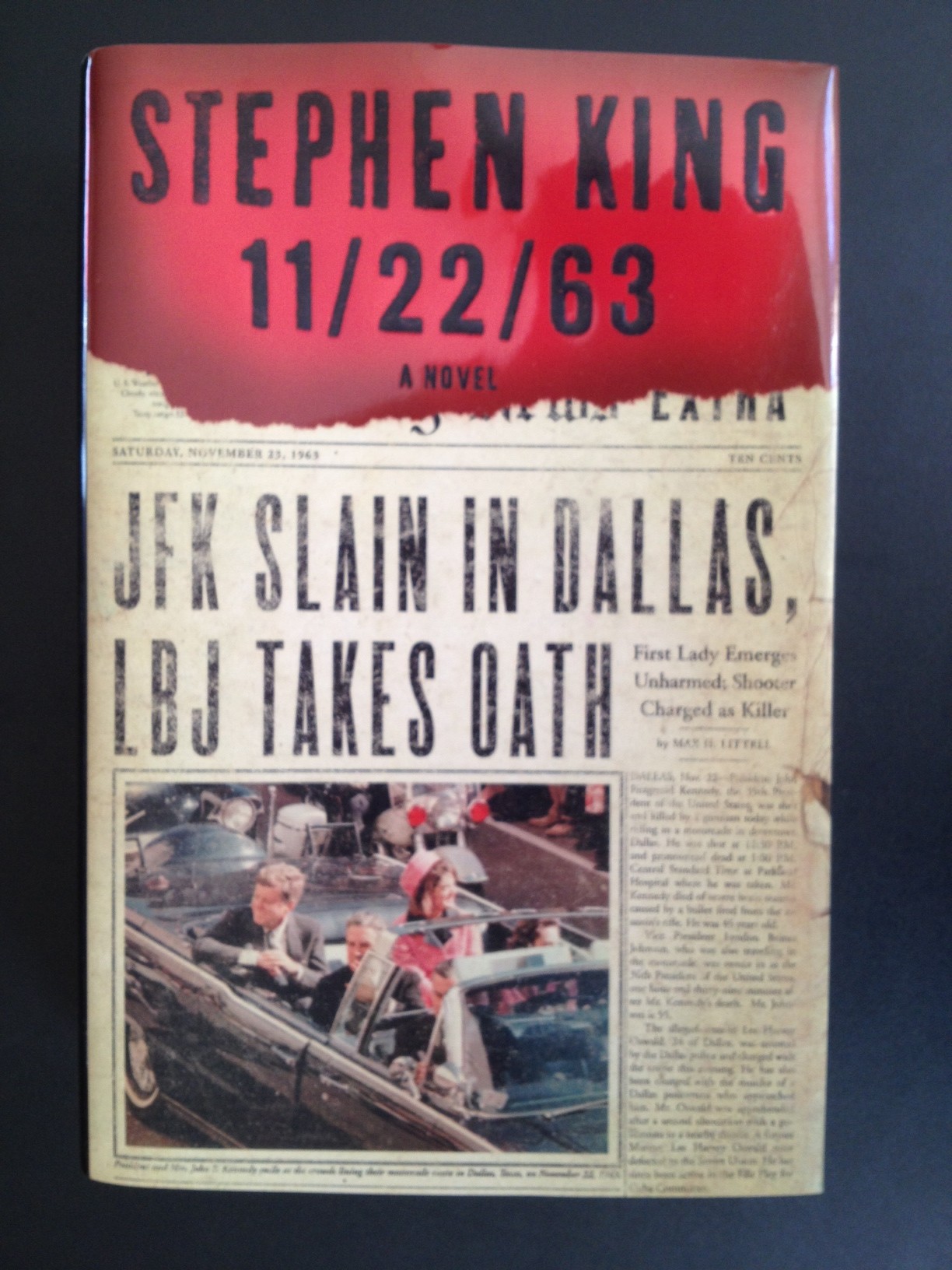
Currently stored on my DVR are a PBS program and a National Geographic docudrama about President Kennedy, both produced to coincide with the 50th anniversary of his assassination. Although I’m a devotee of history, I have a feeling that I won’t be watching them.
I was way too young to understand the tragedy of the assassination when it occurred. Today, however, I regard those events with a deep sense of loss and a light snuffed out. Kennedy’s three years in office were marked by large successes and failures, but he appeared to be hitting his stride by the time he met his demise in Dallas. The “what ifs” are both tantalizing and sad to contemplate. It is oh-so-tempting to imagine what might have been had he lived.
Nevertheless, watching television programs devoted to Kennedy and his death seems like wallowing in a past that cannot be changed. That lesson was reinforced to me in Stephen King’s 2011 time travel epic, 11/22/63, which takes us back to the years leading up to the assassination of President Kennedy. The main protagonist — a modern-day school teacher — learns that when we go back in time, our attempts to change the past may have unintended consequences.
Perhaps I shouldn’t be drawing such fundamental lessons from a bestselling novel, but I’ll take the chance. Even hardcore nostalgia addicts like me must recognize that what’s done is done. And to a generation raised with options, the what-ifs — the speculations over the roads not traveled — can consume us if we let them.
Rather, what counts is how we live today, including the measures we undertake to better our lives and those of others. This point applies in the realms of public affairs, our personal lives, everything. We take the world as it is and do our best to move forward. It’s the best choice we have.
***
This article is cross-posted with my professional blog, Minding the Workplace.
What are your geeky indulgences?

I’m not a wild spender, but I do have some geeky vices. One of them is books, and lately I’ve been seeking out volumes published by the Folio Society.
The Folio Society identifies classics of non-fiction and fiction and then produces them in beautiful hardcover editions, replete with slipcase. It also creates its own titles, such as the one pictured above, in the same handsome presentations.
The rub, as you might guess, is the price. The Folio Society offers a book club-style membership package, giving new members a choice among deeply discounted boxed sets, in return for an agreement to buy four more volumes. Unlike, say, the Book of the Month Club, these editions are very expensive, usually ranging between $60 and $100. Premium volumes and sets can run well into the hundreds of dollars.

Buying these lovely books at full price is a bit beyond my spending comfort zone. So I do the next best thing: I look for Folio volumes in used bookstores and on Amazon and eBay. There I’ll find Folio editions priced as low as $5, and averaging around $15-$30 — or about as much as I’d pay for a new hardcover book.
Over the past year or so, I’ve picked up about a dozen Folio volumes in this way, at a fraction of their original cost. And they look great on my personal library shelves.
So, do you have any geeky indulgences? Perhaps hobbies or collectibles made more affordable by smart spending and a little searching around? Feel free to share here or on Facebook where I’ll be linking this!
 Musings of a Gen Joneser
Recent Comments