An educator’s (minor) dilemma: What’s a calendar year?

With 2014 winding down to a close, a lot of folks are making end-of-year plans, assessing life events big and small during the past 12 months, and looking ahead to what may be on the horizon. Some may be engaging this process more formally: I recently wrote a piece for my professional blog on how writer and entrepreneur Chris Guillebeau suggests doing a personal, self-generated annual review.
As an academician and a lawyer, the idea of year-end, annual planning & evaluation has an inherent appeal to me. But here’s my minor dilemma: I’m not sure when my year ends!
At some point during law school, it dawned upon me that I should keep a schedule book. I was, after all, becoming a “professional,” and professionals have meetings and appointments. If I didn’t write them down, I risked forgetting them. So I went to the university bookstore and bought an academic year planner.
I’ve been using printed academic year planning books ever since, even during the six years I spent in full-time legal practice. Now that I’m in my 24th year of teaching, I’ve internalized the idea of a calendar year that runs roughly from July through June rather than January through December. Every May, I go to my favorite stationery store and pick up a weekly planner for the upcoming academic year.
So while much of the rest of the world is looking at December 31 as the end of their year, I feel like I’m right in the middle of mine.
As I said, it’s a minor dilemma.
But this does overlap with another more significant question, and that is how we frame and process spans of time in our lives. Some do it by the calendar, others by major life chapters, still others applying a mix of the two. It reflects how we order, sort, and package the notion of time in our lives.
For what it’s worth, I’m breaking my long-held pattern by doing a bit more reflecting and planning during this month and early January. Maybe I’m inspired by the periodicals and news sites doing their 2014 retrospectives, or by the ways in which the normal hurly-burly tends to slow down around the holidays. Regardless, during the weeks to come, I’m eager to devote some quality time to looking back and ahead.
Visiting Berlin during the Cold War

Berlin Wall (Photo: DY, 1981)
Twenty-five years ago, the Berlin Wall fell, marking a symbolic end to the Cold War. This week’s observances of that event have prompted memories of visiting Berlin in May 1981. A few weeks earlier, I had finished my final undergraduate semester at Valparaiso University’s study abroad program in England, and Berlin was among my stops on a whirlwind trip through parts of the European continent.
In 1981 the Cold War very much remained a defining element of international relations, and divided Berlin captured the heart of the era. Although I was but one of millions of tourists to the city during that time, it felt adventurous to be splitting off from my friends for a brief solo trip there.
I’ve included some of my grainy snapshots, temporarily plucked from my study abroad photo album.

Allied Checkpoint Charlie, Berlin (Photo: DY, 1981)
It was possible to get a one-day pass to travel from democratic West Berlin into Communist East Berlin. Via the Allied Checkpoint Charlie, you were processed through to the other side, under the watchful eyes of East German guards. You also had to exchange a minimum amount of money, and what you didn’t spend had to be “donated” to the East German government before crossing back to the west side.

East Berlin (Photo: DY, 1981)
Whereas life in the heart of West Berlin seemed loud and decadent, the streets of East Berlin felt lifeless under Communist rule — as drab and dreary as the photo above suggests.
There also wasn’t a lot to spend one’s money on; the (excellent) museums were free and food options were sparse. As my day in East Berlin drew to a close, I still had a fair amount of money left, and I didn’t want to simply hand it over to the East Germans. I thought I had lucked out when I spotted a bookstore, figuring I’d buy a book as a souvenir. However, the only title in English, displayed prominently for folks like me, was a hardcover edition of the complete works of Lenin. So I bought it! I would spend the rest of my European jaunt lugging around that big volume. Though I did bring it home with me, I cannot recall ever reading it before giving it away many years ago!

Reichstag building, Berlin (Photo: DY, 1981)
The specter of the Second World War was also very much present. I did a quick tour of the Reichstag building that housed the German parliament until 1933, when a fire of unknown origin prompted the Nazi government to suspend most of the individual rights contained in the nation’s constitution. I also visited the Olympic Stadium in which African American track and field star Jesse Owens won his gold medals, achievements said to have undermined the myth of Aryan superiority.

1936 Olympic Stadium, Berlin (Photo: DY, 1981)
I’m very glad that I made Berlin a stop on my European itinerary, but there was something about the city that made me uneasy. I think I felt the energy of so much terrible stuff happening there during the city’s 20th century life. I would return to Berlin in 2011 when I attended a conference at Humboldt University, and I couldn’t shake that disturbing sense even though it had changed dramatically. Some places just have a certain discomforting feel, you know?
Throwback Thursday: Dorm living

End of semester: Packing boxes in Brandt Hall, Valparaiso University, 1980
This morning I clicked on a Facebook posting from New York University, my legal alma mater, to a short piece about dorm living for law students. A photo of one of the NYU Law dorm rooms (see below) reminded me once again that many universities have upgraded their residence hall accommodations considerably since back in the day, especially in terms of private rooms and bathrooms. (Of course, this has contributed significantly to rising tuition costs, but that’s for a more serious post….) In any event, the article sent me into a brief trip down nostalgia lane.
Valparaiso University
In many ways, dorm living tends to look better mainly with the passage of time, at least when it comes to furniture, décor, and creature comforts. During college at Valparaiso University in Indiana, I lived in dorm rooms throughout my stay, first in Wehrenberg Hall, and then in Brandt Hall, two rather plain vanilla buildings built sometime during the 50s or 60s. The VU dorms were typical of undergraduate dwellings of their era, offering small shared rooms with pullout beds and bathrooms down the hall. During my last year of college, I qualified for a shared Brandt Hall first-floor room with a private bathroom, a nod to the fact that I was a good student who managed to stay out of trouble.
In the photo above, I’m standing in front of my desk. The boxes and papers to the right obscure the mattress of the pullout bed. I was packing my boxes at the end of the fall semester of my senior year, in anticipation of departing after the holidays for a final semester in England. My roommate Chris’s furniture configuration was exactly the same, the main difference being that he was a very disciplined and neat pre-med student who periodically and politely would push my growing piles of books and papers to my side of the invisible Mason-Dixon Line, as we jokingly called it. Every evening, when Chris would dutifully turn in after watching the Johnny Carson monologue, I would gather my books, papers, and — if necessary — typewriter to join other more nocturnal students in the cafeteria, which served as a nighttime study hall.
NYU
When I got to NYU in 1982, I had a much fancier address, Hayden Hall at 33 Washington Square West (yes, that Washington Square). The toney Greenwich Village exterior masked the spare accommodations similar to those of my collegiate days, with a few New York cockroaches tossed in as free bonuses. At the time, Hayden Hall was the primary dorm for first-year law students. A converted old hotel, it had a few interesting nooks and crannies in addition to the drab rooms. Its first floor cafeteria and TV room provided opportunities for breaks and socializing.
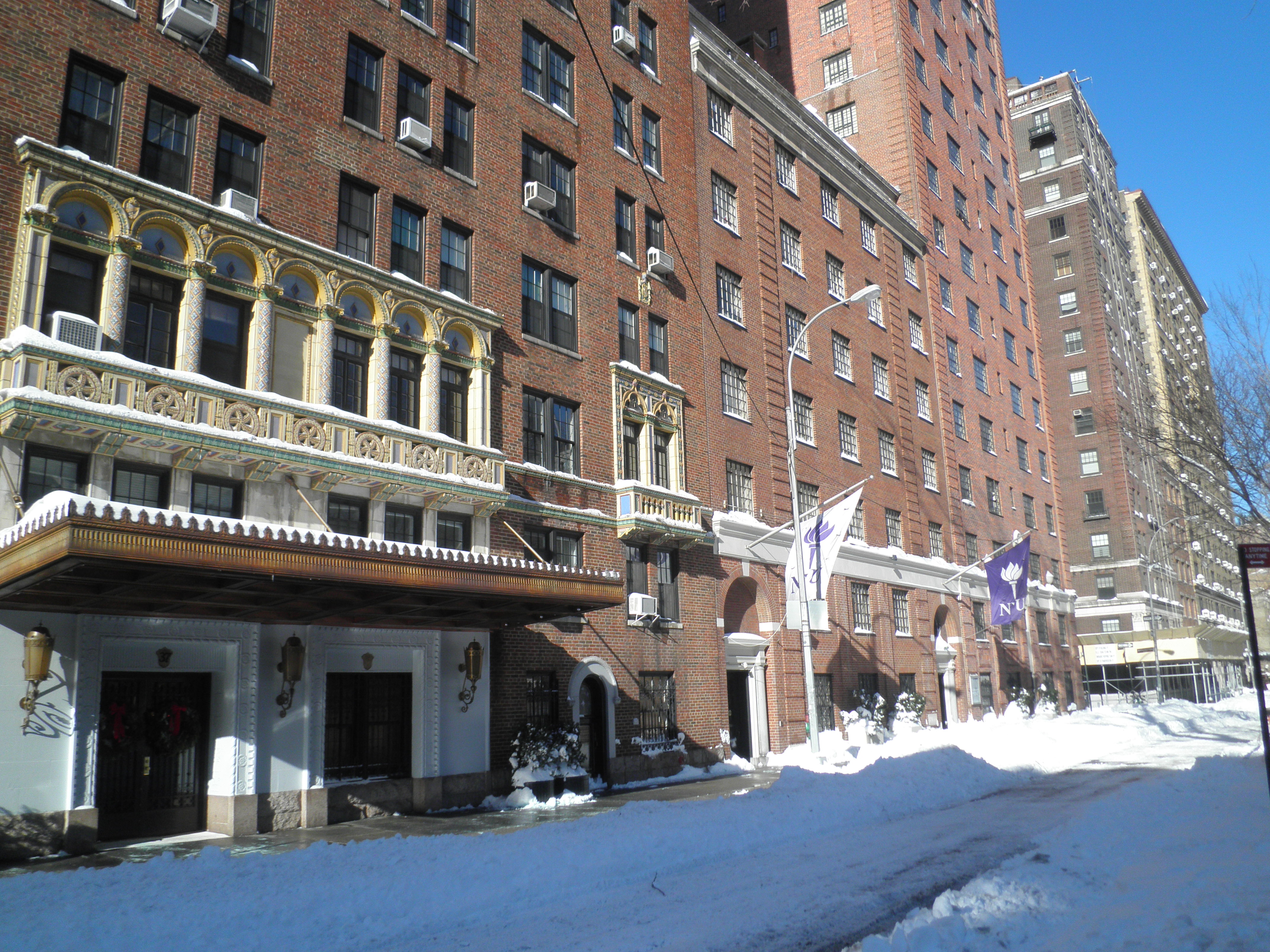
Modern view of NYU’s Hayden Hall (photo: DY)
I would spend my second and third years of law school living in NYU’s Mercer Street residence hall, a (then) brand-new building featuring small apartments with individual bedrooms and kitchenettes. While I didn’t do much cooking, the fridge and stove made it possible to store and heat up Chinese take-out and delivery morsels. With some physics-defying moving around of beds and furniture, apartment units could host pretty decent parties, replete with room for dancing to Michael Jackson, The Clash, and other 80s music artists. We also had waifs’ Thanksgiving and Christmas dinners for those of us too far or too broke to return home for the holidays. The Mercer dorm provided my nicest accommodations during 12 years in New York.
In fact, they remained among my nicest digs ever until I moved into my Jamaica Plain, Boston condo in 2003. For the longest time, I was satisfied with a sort of enhanced “grad student” standard of living. It took me until well into adulthood to do an upgrade!

A current NYU Law dorm room. (From http://blogs.law.nyu.edu/lifeatnyulaw/life-in-the-law-school-dorms/)
Throwback Thursday: That back-to-school feeling

By Samuel Morse (1835-36)
This time of year prompts those back-to-school feelings. I’m betting that for most people, memories of new school years are more emotionally laden than infused with any of the educational content of those first days back. Depending upon one’s experience, those memories may include doses of excitement, dread, enthusiasm, anxiety, or some combination thereof.
For me, the start of an elementary school year (K through 6 in my hometown district) felt like a leap into the unknown. It usually involved a new classroom teacher, a mix of familiar and new classmates, and speculation over what it meant to be in the next grade. Fortunately, my elementary school in Hammond, Indiana, featured old-fashioned, dedicated teachers. Some could be a little gruff on the outside, but all of them deeply cared about kids.
When it came to starting new levels of higher education, well, let’s just say that the term “new student orientation” still gives my stomach a small rumble, calling to mind those well-meaning but ultimately fruitless attempts to soothe rookie anxieties. It usually took me a year or two to find my comfort zone and cohort group. Once that occurred, I would greet the start of an academic year with a sense of purpose and belonging.
For example, during my final two years of college, I was a department editor of the college newspaper, which became my hangout and social outlet, not to mention a training ground in the art of writing clear prose. During my last two years of law school, I was active in student publications and various public interest law projects, as well as a cast member in the annual law student musical (a ton of fun), all of which became sources of friendships.
The painting above was the work of Samuel Morse, inventor (yup, Morse Code!), artist, and New York University professor. Portrayed on the left is the original 19th century NYU building on Washington Square (since torn down), where Morse had his faculty office. He placed the Gothic structure in a classical landscape to suggest the idea of the university as paradise.
Today I’m wise enough to know that such a paradise exists only in fantasy, but it’s a beautiful painting nonetheless. And though I have many concerns about the state of formal education here in the U.S., I can still get a tad sentimental about the start of a school year.
***
Related posts
Throwback Thursday: Studying for the New York bar exam, Summer 1985

If this gives you chills, then you’re probably a lawyer! (Photo of BarBri bar review book: DY, 2014)
During any given summer, thousands of newly-minted law school graduates are reaping the rewards of their toil with one final “gift” of a test: The bar examination of the state in which they intend to practice. With a few exceptions, one’s ability to practice law in a given state is dependent upon passing a grueling two or three day examination, consisting of batteries of brain-frying multiple-choice questions and essay questions that pose factual scenarios densely packed with legal issues to be analyzed.
To prepare for the bar exam, which most people take during the summer, one typically signs up for a bar review course. This is a crash course that features over a month of lectures and practice exam questions, interspersed with hours of studying legal rules and principles. Most bar review courses start right after graduation season and finish a few weeks before the bar exam itself, with the remaining time spent drilling and memorizing.
Every summer I encounter law students lugging around the thick paperbound law summaries published by bar review courses. As the weeks go by, their faces look more drawn and tired. Many of the men stop shaving and even the more fashion conscious women trudge around in sweatpants. They make for a pretty motley crew by the time exam week hits.
I remember that time oh-so-well. Twenty-nine summers ago, I was studying for the New York bar exam, reputed to be one of the toughest in the nation. The biggest challenge in studying for the NY exam was the vast number of legal subjects potentially covered on it. We had to stuff a lot of law into our heads and hope that it remained there at least through the two days of the actual test. For people like me, who assiduously took classes of intrinsic interest rather than courses that tracked the bar exam subjects, there was added misery in tackling subjects avoided during law school.
Furthermore, earlier that year, I had accepted an offer to work for The Legal Aid Society in Manhattan. I would be handling appellate-level criminal cases, which meant that the areas of law I needed to feel comfortable with boiled down to a handful of subjects. My motivation to learn, say, the rules of New York gift & estate taxation, was practically nil. (Especially with the salary I’d be earning and the people I’d be representing, neither I nor my future clients had much use for the subject.)
I spent the first few weeks dutifully going to the bar review lectures and trying to study each day, but I found the whole deal to be quite excruciating and my attention span wandered. As the weeks ticked down, however, I came to grips with the fact that I didn’t want to take this exam over again, so I’d best buckle down and give it my all. That I did. During the weeks preceding the exam, I basically camped out in the law clinic offices at NYU, where I had spent so much time in my final year of law school.
Of course, I also spent hours on the phone with law school classmates, sharing supposed insights on how to prepare for the exam, as well as gallows humor about our chances of passing. Many of my best friends from NYU were going to other states to practice, so I ran up a much higher phone bill than was prudent for a soon-to-be public interest lawyer.
I was assigned to take the exam in the ballroom of the Roosevelt Hotel in midtown Manhattan. By then I had moved out of NYU housing and was sharing an apartment in Brooklyn. I didn’t want to risk a subway delay, so I rented a room at the Vanderbilt YMCA, a manageable walk from the hotel.
The exam itself was every bit as challenging as I had imagined. My head was spinning throughout the two-day test, and when I finished, I honestly had no clear idea of whether I had passed or not. (One of the essay questions was about New York gift & estate taxation, and had I not spent an hour the night before with a one-page summary prepared by one of my law school classmates, I probably would’ve sat there in a stupor.) But I didn’t feel horrible about it, so I figured my chances were okay.
After the exam, I celebrated by going to Barnes & Noble and buying two books, the titles of which I recall to this day: William Shirer’s The Nightmare Years (the journalist’s account of being in 1930s Nazi Germany) and Tom Clancy’s first thriller, The Hunt for Red October. I treated myself to an extra night at the YMCA to read my new books in solitude. In the weeks that followed the bar exam, I was basically in a haze. Thank goodness I had that time to recoup before reporting for duty at Legal Aid after Labor Day.
***
In November I learned that I had passed the bar exam! It was good news all around in my office; all 12 or so Legal Aid colleagues who sat for the exam that summer also passed. I called the elementary school in Indiana where my mom taught kindergarten, and they gave her the good news over the intercom.
I celebrated by going to Barnes & Noble and buying another book, Mark Girouard’s Cities & People, a beautiful volume about urban social and architectural history — and a perfect complement to the love affair I was experiencing with New York City as a broke-but-happy Legal Aid lawyer.
Throwback Thursday: First Manhattan visit, Summer 1982
Thirty-two summers ago, I paid my first visit to New York City. The main occasion for my trip was to check out New York University, where I would be starting law school that fall.
While it may sound odd in this day and age for someone to say this, I had accepted NYU’s offer of admission sight unseen, based largely on its overall reputation and strong support for students who wanted to enter public interest law. You see, I also was pretty broke, and I didn’t have the funds to visit the law schools to which I was applying. Having opted happily for NYU from a distance, I wanted to preview the situation firsthand, so I scheduled a late June visit to New York City.
I reserved a room at the Vanderbilt YMCA on 47th Street. It was like staying in a youth hostel, reminiscent of my semester abroad in England the year before. Another adventure begins!, I thought to myself.
During my short trip, I spent a lot of time around NYU and its Greenwich Village surroundings. I discovered some of the cheap local eateries that would get a lot of my business during the years to come, I did some hanging out in Washington Square Park in the heart of the Village, and I paid my first of hundreds of visits to the remarkable Strand bookstore.
Of course, I also checked out NYU, including Vanderbilt Hall, the main law school building, and Hayden Hall, the residence hall where most first-year law students lived, both located right on Washington Square. I could feel the butterflies churning in my stomach in anticipation of what was to come, and a little voice inside me wondered if I was in over my head.
I did standard tourist stuff as well. Going up the Empire State Building. Taking a guided tour of the United Nations. Becoming bewildered by the city’s labyrinth of a subway system. (If you’ve ever been lost in the Dante-esque middle level of the West 4th Street stop in the Village, you know what I mean.)
My NYC recon trip confirmed that in terms of sophistication, I was a babe in the woods. I wasn’t totally unfamiliar with big cities, having grown up in northwest Indiana right outside of Chicago and having spent chunks of time in major European cities during my semester abroad. However, New York seemed overwhelming to me, ranging from its apparent vastness (in actuality, Manhattan is a mere island!) to its exorbitant prices. (Upon my return, I would report breathlessly to friends and family that a fancy ice cream place called Häagen-Dazs was charging one whole dollar for a small cone!)
Nevertheless, I also had a gut feeling that I was making the right choice. I knew that New York would fascinate me, and — nerves notwithstanding — I had a good feeling about my decision to attend NYU. My instincts would prove to be right. New York and NYU were the right places at the right time for me.
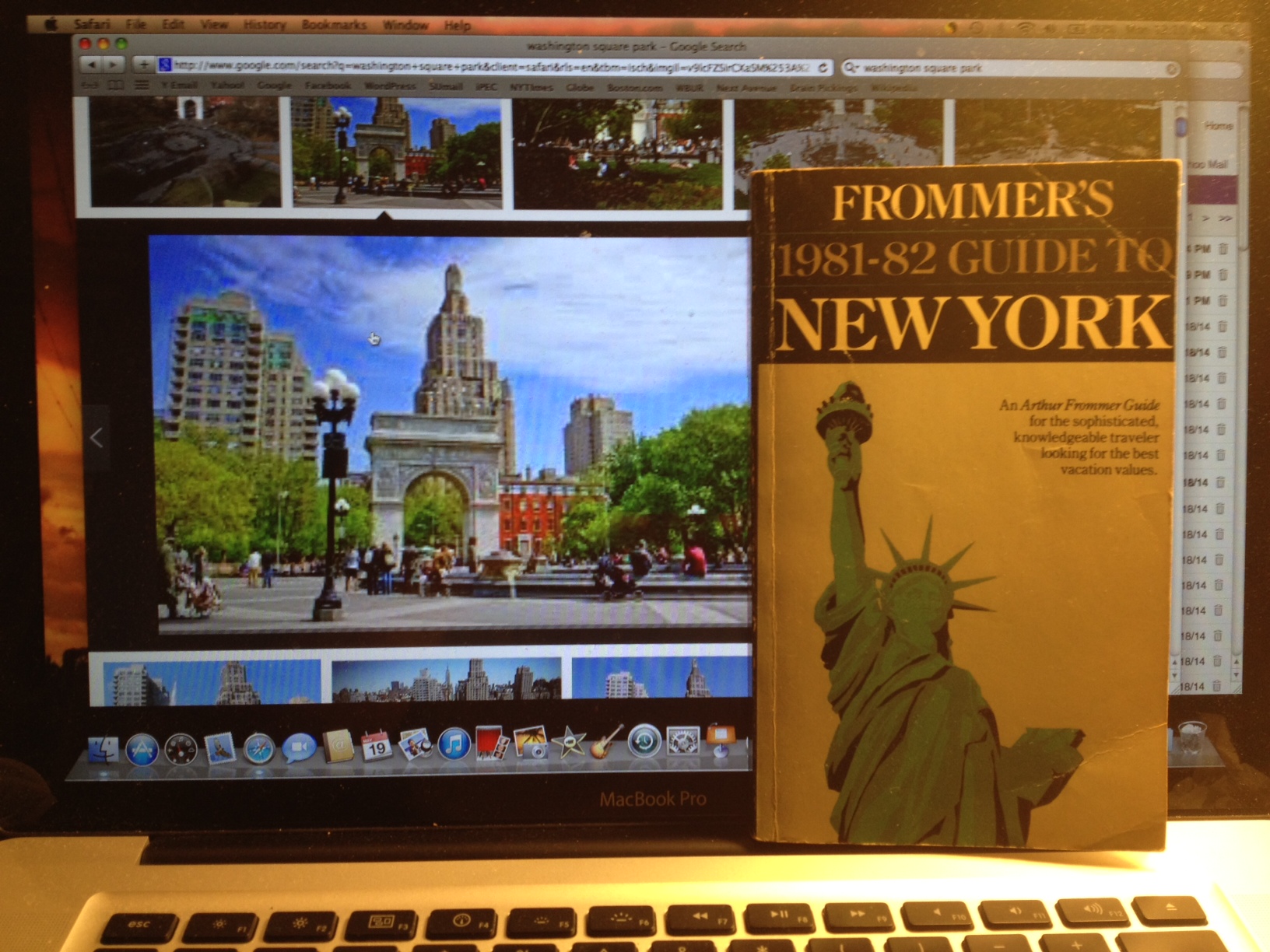
I didn’t take any photos of that visit, but I’ve held onto the guidebook I used to traipse around Manhattan. In Frommer’s 1981-82 Guide to New York, author Faye Hammel writes:
You should be advised that there is one dangerous aspect of coming to New York for the first time: not of getting lost, mobbed, or caught in a blackout, but of falling so desperately in love with the city that you may not want to go home again. Or, if you do, it may be just to pack your bags.
That quote captured how I would feel about New York for years. As would this song:
College graduation day, May 1981: Long ago and far away

Lucerne, Switzerland, May 1981
Over the weekend, one of my college classmates (that’s you, Jon!) posted on Facebook a quick little remembrance of our graduation day from Valparaiso University on May 17, 1981. Of course, the mere mention of that time triggered a bout of nostalgia, a chronic condition that is both my blessing and curse.
Now, I wasn’t actually at our Commencement, which is how the seemingly random inclusion of this grainy snapshot of Lucerne, Switzerland figures into the story. I had finished up my undergraduate career with a spring semester abroad in Cambridge, England, and I was spending three weeks traveling on the European continent with my friends. My graduation day was spent with fellow VU sojourners David, Joanne, and Liana in Lucerne, where we took a boat ride and finished up the day with dinner at a waterside café, from where I snapped this photo.
Study abroad was a very different experience back in the day. No Internet, e-mail, or smartphones. Our primary connection to friends & family back home was the postal service, which made the daily mail delivery an important event. As study abroad sites go, England is about as safe & secure as they come, but we truly felt like we were on a foreign adventure.
My biggest technological novelty was an ATM card from a local British bank. I didn’t own a credit card. In the house designated as the residence for men, our music system was a small portable cassette player that my friend Don had “borrowed” from the office of the school newspaper back at VU, where we both had spent many hours as collegiate news scribes.
As I noted last fall in a remembrance of my years at Valparaiso, that semester abroad was the most formative educational experience of my life. I know I’m not alone with this sentiment. Since 1991, our study abroad group has held reunions every five years, and each time over half of our group has attended. (In addition to the aforementioned study abroad classmates, they have included Anne, Hilda, and Kathy, who also subscribe to this blog!)
Looking at that photo and applying rose-colored glasses, it’s easy to lapse into thinking of those days as being carefree and without anxiety, softened by images of vagabonding around Europe. Truth is, I was full of uncertainties and very much a work in progress. I had sufficient wisdom back then to know that I was very, very fortunate to have that study abroad experience, but my inner focus was impatiently and continually on the future and what it might bring.
I’ve reached the age where the fading old Kodak snapshots from my semester abroad look like something from another era, and for good reason. It really was long ago and far away when I celebrated my college graduation with friends at that Lucerne café. For nostalgic beings like me, I’ll take it as a memory to be treasured.
Bearing Witness: Words of advice for my students (and others)

[Note: As a law professor at Suffolk University Law School, I’ve been serving as the founding faculty advisor to a new student-edited law journal, Bearing Witness: A Journal on Law and Social Responsibility. BW just published its second issue, and I contributed a short column of advice to the students in response to a request from the editors. I thought I’d share it here.]
When the editors of Bearing Witness invited faculty to contribute short pieces of advice for the second issue, I wasn’t sure what to offer. But then I started thinking about life in general, and suddenly the words came easier. Do not assume that I’ve done all these things right; rather, some of these points represent lessons learned. Here goes:
1. Living a fulfilling life beats living a mindlessly happy one. Just my opinion.
2. Pick your battles carefully, but don’t use that maxim as an excuse for never getting involved. The world is littered with people who always find reasons not to take a principled stand.
3. When it comes to people you want to be around, political affiliations may be important, but overall character and a sense of humor count for even more.
4. The years ahead will be very challenging ones for this world. Concerns about the economy, jobs, and the environment, to name a few, aren’t going away. Strive to contribute solutions.
5. Personal setbacks and hard times are never good, but they can teach us about resilience, recovery, and renewal.
6. A dose of self-promotion is often helpful toward success, but rather than constantly trying to impress people, let your work and deeds do most of your speaking for you. Avoid becoming one of those highly credentialed individuals whose greatest talent is “wowing” people in an interview.
7. The Golden Rule is hard to live by sometimes, but it’s a key to a better world.
8. If someday you reach a point where you have a group of friends going back 20 years or more, consider yourself blessed. Make those friends now, and in 20 years you’ll know what I mean.
9. All that stuff about finding your own way, choosing your own path, etc., may sound trite, but give it some hard thought. Few things are worse than living an inauthentic life.
10. Be accountable to yourself. Own up to your miscues and mistakes. It’s easier said than done, I know, but you’ll feel better about yourself in the long run.
11. Keep learning and growing. If someone wrote in your high school yearbook, “Stay the way you are! Don’t ever change!,” don’t take it literally.
12. Whether you loved law school, hated law school, or fell somewhere in between, you can use this knowledge to make a positive difference. Good luck!
Bloody politics
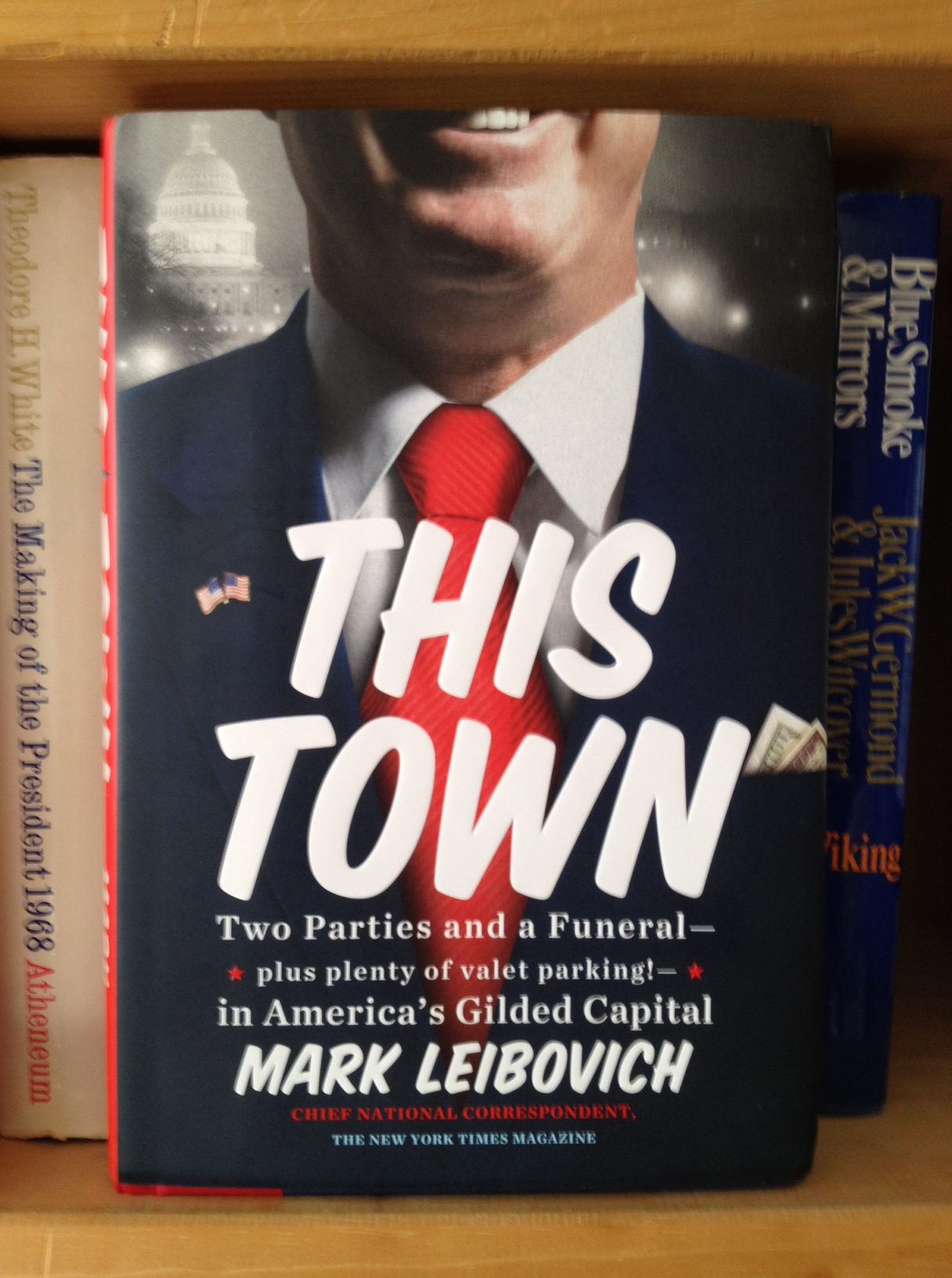
I just finished reading Mark Leibovich’s This Town (2013), a bestselling “insider” look at political life in the nation’s capital. It’s bitingly funny at times, as one might expect such a book to be, and it provides a fix for recovering political junkies like me.
It’s also a reminder of a path I chose not to take.
You see, reading about politics is a far cry from my aspirations of decades ago, when I was an ambitious student government pol in college and planned to go to law school as a springboard into the real thing. As an undergraduate at Valparaiso University in Indiana, I was elected to various student senate positions, and I volunteered regularly for political campaigns. I managed a successful upset campaign for a town board seat in northwest Indiana, and I served as an area coordinator for the 1980 independent presidential run of John B. Anderson.
Of course, I also was a political science major, and it so happened that the poli sci department at Valparaiso was comprised of dedicated teachers who stoked my fascination with politics. In particular, Professor James Combs, quite the political junkie himself, was teaching and writing up a storm about political communications, which played right into my obsession with campaigns and elections.
My interest in politics continued through law school and beyond. As a young lawyer during the late 1980s, I was an officer in a reform Democratic club in Brooklyn, and it served as a very on-the-ground introduction to the gritty realities of New York politics. (I recall discovering pages and pages of forged ballot access petition signatures filed by one of our opponents, marveling at their sheer chutzpah.)
But some 23 years ago, I stumbled my way into teaching. I returned to my legal alma mater, New York University, as an entry-level instructor in its innovative Lawyering skills program for first-year law students. I knew immediately that I enjoyed being an educator, and that experience turned out to be the start of an academic career. In fact, I’m now in my 20th year of teaching at Suffolk University Law School in Boston.
Today, I’m hardly removed from politics. My work in drafting and advocating for workplace bullying legislation puts me in regular contact with legislators and their staffs. Two years ago I finished a term as board chair of Americans for Democratic Action, a liberal policy advocacy organization based in D.C. And though my politicking these days is limited primarily to occasional campaign contributions, I follow electoral politics fairly closely.
But the world portrayed in Leibovich’s This Town, however embellished to attract more readers, is not for me. There are a lot of good, honorable people in politics, a fact we dismiss too easily in this cynical age. But politics is a bloodsport, and it requires a certain dispositional DNA to play the game for the long term without it becoming debilitating. When I think back to my collegiate ambitions, I now understand that I enjoyed reading and writing about politics more than being in the thicket of political life, even as the latter appealed more directly to my ego and insecurities at the time.
Okay, so the world of academe is hardly apolitical, and it can get as petty and nasty as any political brawl. (I sometimes quip that the real untold Biblical story is how God banished Adam & Eve to a faculty meeting as punishment for their transgressions.) That said, the focus of academic work itself is more on teaching, writing, and public education, and that’s more to my liking than the day-to-day work of political life.
Still, please do excuse me if I get a little charged every four years over news coverage about the Iowa caucuses or the New Hampshire primary. It remains neat stuff to me, albeit from a distance.
Lifelong learning: Some free & inexpensive resources

Boston Public Library, Central Branch, main staircase (photo DY)
I’m a lifelong learning junkie, and perhaps you are, too. The world of adult education is somewhat stratified right now: If you want to earn a degree, it will cost you money, maybe a lot of it. On the other hand, if your main objectives involve independent learning, intellectual growth, and personal enrichment, your free and low-cost options are virtually limitless!
Let’s start with your public library. A treasure trove awaits, in big cities and small towns alike. Most libraries are now heavily invested in multi-media, offering DVDs and e-books in addition to print materials.
Of course, don’t forget “old” (heh) online standbys such as YouTube and Wikipedia. There’s a staggering amount of good stuff on both.
Beyond the most obvious candidates, you’ll discover so much more. Here’s a sampling:
Open Culture is a rich portal to all sorts of lifelong learning options, including free courses, movies & documentaries, and e-books. Dive in and start clicking around.
Coursera is a popular provider of MOOCs (massive open online courses), mostly free online courses on a wide variety of topics, led by faculty at leading universities around the world. Quality varies, but the price can’t be beat, and some of the offerings are top-notch.
The Great Courses, a commercial entity, offers professionally produced video courses on many topics, with heavy emphases on the arts, sciences, and humanities. I’ve enjoyed a number of their courses over the years. Word to the wise: Never pay full sticker price. Sales are ongoing, and the course(s) you want inevitably will be offered at significant discounts several times a year.
I’ve recently become a fan of Brain Pickings, a site “full of pieces spanning art, design, science, technology, philosophy, history, politics, psychology, sociology, ecology, anthropology, and more.”
For Gen Jonesers, Next Avenue is a great site, with a bevy of articles on topics such as health, personal finance, retirement, and caregiving. This is a bookmarked site for me; I visit it almost every day.
Independent adult education centers — typically found in larger cities — offer courses at reasonable tuition. Here in the Boston area, I’ve taken a weekly singing workshop at the Boston Center for Adult Education since the mid-1990s! (More on that in a later post…) Although I’ve never experienced them, two other centers that intrigue me are the School of Life in London and the Brooklyn Institute for Social Research.
University continuing education programs usually carry a higher price tag, but there are a lot of good offerings out there, and more are offering distance learning options.
Generally speaking, you’ll find online continuing education courses and free online seminars for virtually every learning niche and specialization. Keep searching away.
I know that some people have very strong feelings, pro and con, about e-reading devices such as Kindle, Nook, and Kobo. Given my druthers, I’d rather read from a book, but I find my Kindle especially useful when traveling. Anyway, my point is that there are tons of good books available via e-reader platforms, at little or no cost. If spending money on a device is beyond your budget, you may download free e-reader apps. You can then check out sites such as Project Gutenberg, which offers over 42,000 free e-books.
Friends, this doesn’t even scratch the surface, but I hope you’ll be inspired and excited by the possibilities.
 Musings of a Gen Joneser
Recent Comments