Coffee and me
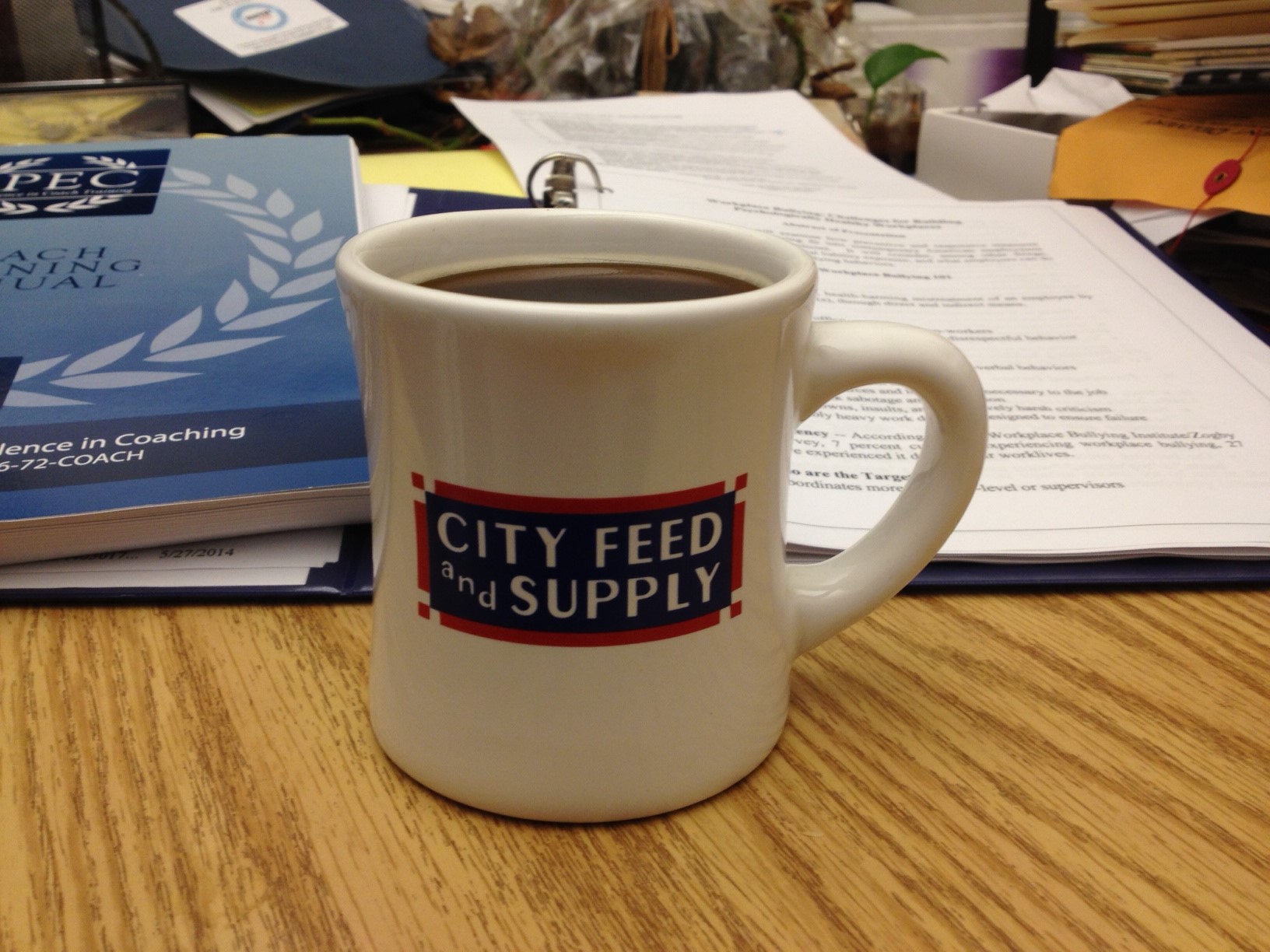
Every so often, I feel moved to blog about coffee. The hearty brew is a daily part of my life. Today I consume coffee for a variety of reasons. Its caffeinated punch (no decaf for me, thank you), aroma, and taste all count for me. Plus, there’s something about the aesthetics of being a coffee drinker that appeals to me.
I was a latecomer to the coffee thang. I didn’t drink it regularly until my mid-thirties, and it’s no mere coincidence that I became a tenure-track faculty member around then! That late night cup (or two) helped me get through a lot of heavy-duty initial class preps and exam grading.
But I’m not exactly a coffee connoisseur — while a fresh, organic blend is always nice, in a pinch I’m happy to swill whatever is served at local convenience stores.
Home and office
At home, most of my coffee comes from the City Feed and Supply store in my Boston neighborhood of Jamaica Plain. They sell assorted blends of Equal Exchange fair trade, organic coffee, all of which brew up nicely in my ordinary drip coffee maker.
I don’t know whether this is a good thing or not, but I’ve reached a point where I can enjoy coffee well into the evening hours and experience the caffeine kick, without being rendered an insomniac for the night.
At work, a couple of years ago I bought a Keurig coffee maker for our office suite, and I usually pop in a K-cup every day. It’s not as good as the homebrewed stuff, but it’s fast, convenient, and relatively inexpensive.
Café culture
One might think that my job as an academic affords plenty of opportunities to work or relax in cafés and coffeehouses, but I’ve found that to be illusory when meetings and other obligations pile up. Still, I want to make more time for this. I can be quite productive in such settings, with my laptop or iPad in front of me and some coffee and a morsel on the side.
Until I read this piece about the history of Boston’s café culture by Magda Romanska, I had no idea that the city enjoyed such a rich history with coffee and coffeehouses. Here are a few snippets:
- “Although the first man known to bring knowledge of coffee to North America was Captain John Smith in 1607, who was familiar with coffee, thanks to his travels in Turkey, the first-ever coffeehouse in America was actually opened in Boston by John Sparry. As Boston city records indicate, in October 1676 John Sparry was ‘aproued of by the select men to keepe a publique house for sellinge of Coffee.’”
- “Throughout the seventeenth and eighteenth centuries, Boston was the metropolis of the Massachusetts Colony and the social center of New England, so it is no surprise that the most prominent coffeehouses were established here in Boston.”
- “The Boston Tea Party of 1773 was planned in one such coffeehouse, the Green Dragon, known by historians as the ‘Headquarters of the Revolution.’ Located at that time on Union Street in Boston’s North End, the Green Dragon was a meeting place for the Freemasons, who used the first floor. The Green Dragon’s basement was used by several secret Revolutionary groups.”
Pretty cool, huh?
I’ve got no grand insights here. I’ve noticed a lot of Facebook postings about coffee lately, and apparently they rubbed off on me. Time for a refill.
Beautiful music in the city streets and subways
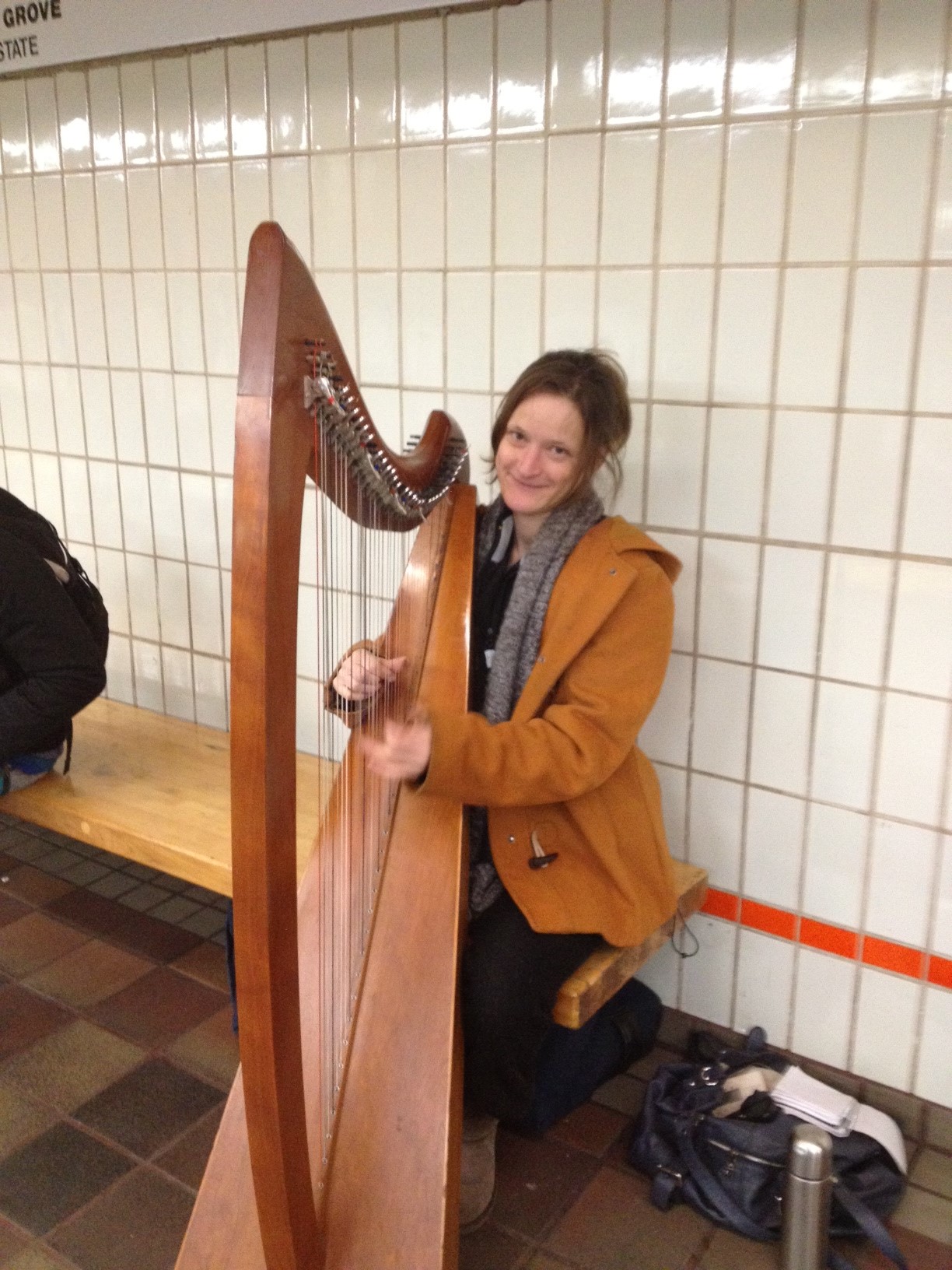
Harpist Alàis Lucette, playing on a Boston T platform (Photo: DY, 2014)
Nearly every day, I travel from my Boston neighborhood of Jamaica Plain to the downtown via the “T,” the local shorthand for the subway. During rush hours especially, the Downtown Crossing stop is crowded and loud, and all too often the human vibes throw off major amounts of impatience and stress.
If I’m lucky, however, I’ll step off the train and hear the lovely sounds of classically trained harpist Alàis Lucette, who sometimes sets up there and helps to calm the nerves of frazzled subway travelers going to and fro. (You may listen to samples of her music and order her CD here.) There is something eminently civilizing about soothing music that cuts through the noise of mass transit.
When I lived in New York City and made my daily subway commute from Brooklyn into Manhattan, on occasion there was a violinist who would make his way through the subway. While some interruptions in the subway can be irritating, this fellow was a welcomed distraction and instantly put me in a better mood for the morning.
I’ve been living in cities all my adult life. I should be over the “novelty” of talented musicians playing in the streets and subways. But I can’t help it, it’s often still a treat to me, especially when the music takes me to a better place in my mind.
In fact, I remember well the first time I heard and saw street musicians in full playing mode. After a collegiate semester abroad in England, I met up with some classmates in Paris, and we took the obligatory stroll through the Latin Quarter. It was filled with lively street music on a beautiful May evening. Perhaps this betrays how sheltered I had been in my NW Indiana upbringing, but I was absolutely taken by the idea that folks would just set up on the street and start playing!
So here’s to those gifted makers of music who add joy and civility to metropolitan life. We city dwellers are indebted to them!
Libraries are a geek’s paradise

Bates Hall reading room, 2nd floor, Boston Public Library, Central Branch (photo: DY, 2011)
I love libraries. Over the years they have served as both workshop and sanctuary for me, and the most beautiful libraries embody an almost sacred quality.
The Central Branch of the Boston Public Library, located in the city’s Back Bay neighborhood on Copley Square, is one of my favorite places. The McKim building of the Central Branch, the site of the photos here, is deservedly a tourist attraction.

The gorgeous Abbey Room, used for book readings and other events, 2nd floor. (Photo: DY, 2011)
You might think that my affinity for libraries is all about my being an academic. However, in my experience most professors prefer to work in their offices or homes, rather than join the masses in a public or university library.
In fact, when I peer around the stunning Bates Hall reading room of the McKim building, few of the denizens “look” like professors — that is, assuming that profs have a giveaway appearance! Instead, I see a lot of young folks and adults from varying walks of life, at least based on the books, papers, and gadgets they have piled about them.

John Singer Sargent Gallery, 3rd floor (Photo: DY, 2011)
You won’t see many books in these pictures! The McKim building houses the research collection, which for the most part can be accessed only by request. The lending library adjoins the McKim building — it is big and serviceable but not nearly as architecturally appealing.

The library’s Italianate courtyard, peaceful and lovely. (Photo: DY, 2011)
Today’s lending libraries are a multimedia treat for borrowers. Books, DVDs, audiotapes, and even e-books are now part of the treasure trove. Especially for folks on a tight budget, a library card can be a ticket to adventure, enlightenment, and entertainment. That $25 bestseller at the bookstore? It’s free to read from the library! (And if you read the first chapter and find that the book doesn’t float your boat, it doesn’t cost a cent to return it — unless you’re like me and return it overdue.)
And at some libraries, you can even refuel with some coffee and a morsel, though it’ll cost you.
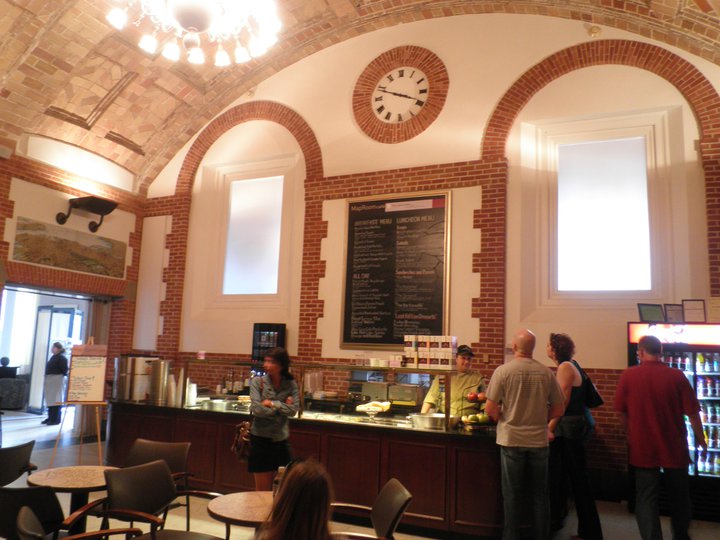
Map Room cafe, serving tasty sandwiches, soups, and pastries. And, of course, lots of coffee. (Photo: DY, 2011)
For researchers and writers working on their latest articles and books, libraries are repositories of accumulated knowledge. Even if one isn’t doing research at the library, it provides a place of solitude to contemplate the task at hand. When I sit at the long tables at the Boston Public Library and imagine what other patrons are working on, I feel a quiet sense of shared purpose among our diversity of projects.
When I depart from the library and step out into the heart of the city, it feels like I’ve left a contemplative, cloistered space to rejoin the hurly-burly of urban society. I happen to like cities, so that’s not a bad thing for me. But it does make me look forward to my next visit to the library.

McKim building’s Copley Square entrance (Photo: DY, 2011)
A dark and snowy night in Boston

Downtown Boston tonight: Corner of Washington & School streets, with the historic Old South Meeting House, center (Photo: DY)
Boston’s historic look & feel is one of its most appealing features. Much of the city’s colonial and early 19th century past is preserved for all to see. The photo above, for example, includes the Old South Meeting House, where rebellious colonists planned the Boston Tea Party in December 1773.
When an evening snowfall hits, this quality can become downright Old World, like something out of a Charles Dickens novel. The reference is fitting, as Dickens himself visited Boston twice, staying in the Parker House Hotel, not far from where I took this picture tonight. It’s likely that he crossed this very intersection during his visits.
These blends of atmosphere, sights, and history are among the reasons why I find older cities so appealing. For a brief moment, I can look around and transcend time.
The snowfall we’re experiencing right now has been unexpected in its intensity. It grew into a small storm that led to a lot of early school closings and many cancellations of events around the city. When I got home, I had some shoveling to do, which took a bit of the novelty out of the evening and made me doubly glad that I snapped the photo to preserve the moment.
Ordering Chinese delivery: Hitting the Food Wall
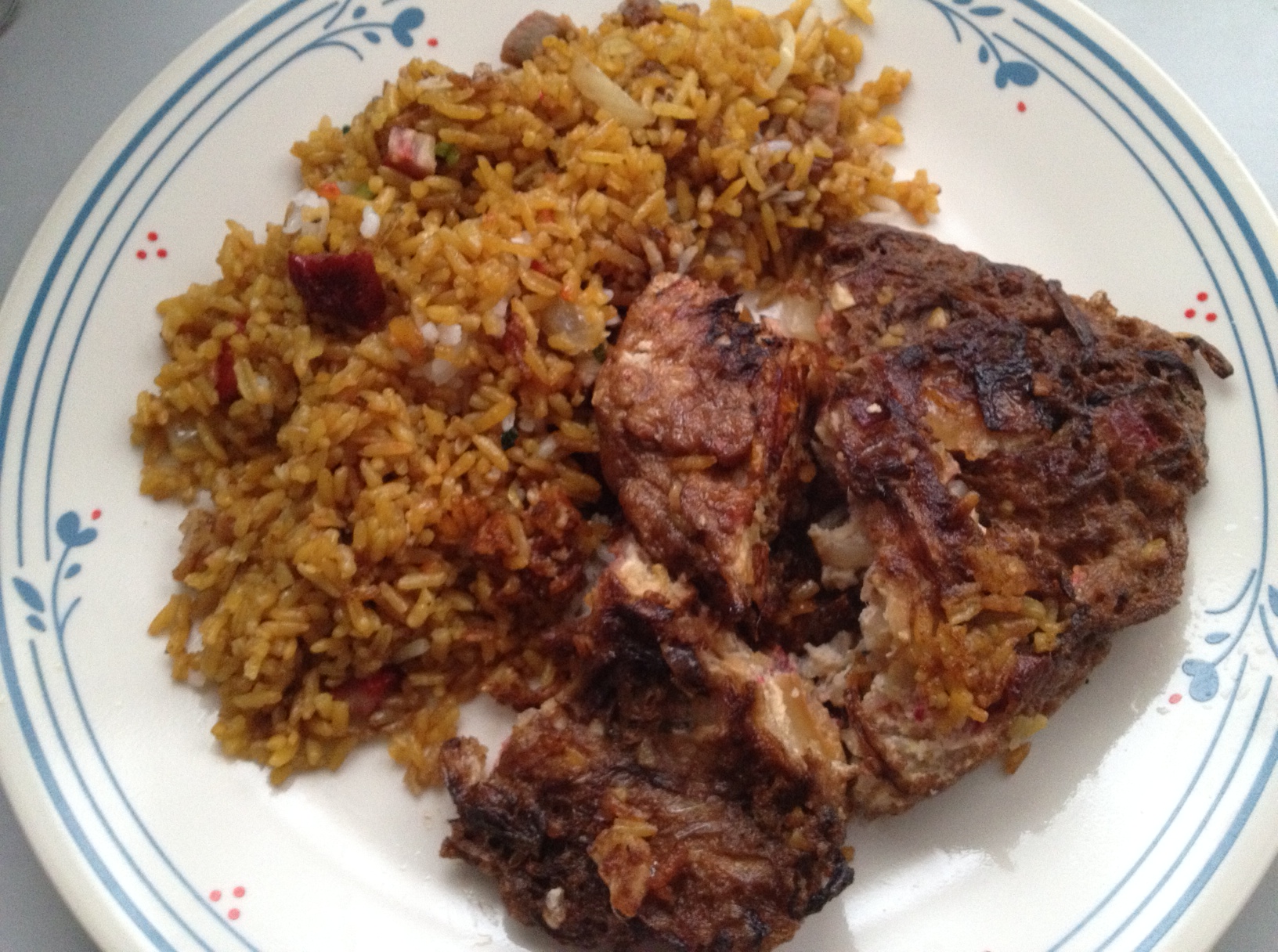
Delicious Chinese leftovers!
Ordering in Chinese food is one of my simple pleasures. Whether it’s after coming home from teaching an evening class, or during the weekend when a glance inside the fridge shows nothing resembling a meal, the ritual is basically this: Survey the menu, call in the order, wait for the delivery, and remove goodies from the bag.
Typically, one plate isn’t enough, so seconds follow. Then I close up the containers and pop the leftovers into the fridge for later meals.
I got hooked on Chinese delivery in law school. New York and Chinese food go hand in hand, and the local choices in NYU’s Greenwich Village neighborhood were abundant, tasty, and cheap. Even a modest order would yield several meals.
Today, my Chinese delivery venue of choice is called Food Wall, located in my Boston ‘hood of Jamaica Plain. I’m far from alone in this category. Val Wang featured Food Wall in her 2012 National Public Radio series on Chinese takeout places:
When you spend as much time inside of Chinese takeouts as I do, you start to notice some patterns. Like, every takeout has its regulars, people for whom the takeout is an essential part of their lives.
Food Wall in Jamaica Plain is one example. It has inspired something of a cult following. I walked up and down the street one afternoon asking people who work nearby how often they stop in. . . .
“At least once a week,” said Saul Cifuentes, owner of Beauty Masters Salon and Supply.
“Lately I’ve been going at least three to four times a week,” said Josiah Simmons of theVideo Underground.
James Norton of Revolution Bikes is trying to cut back, but “it used to be almost daily.”
None can top Fat Ram of Pumpkin Tattoo. He claims he’s eaten there “Eleven days a week for 10 years. It’s too much. Too much Food Wall. I hit the Food Wall.”
Pictured above is some very basic Cantonese fare from Food Wall: Egg foo young and fried rice. I usually opt for spicier Szechuan dishes, but not to worry, it’s good stuff. I cleaned that plate quickly.
Time travel: Some favorite destinations

Remember “The Time Tunnel,” the short-lived but fascinating television time travel drama from the mid-60s? Every new episode would find scientists Tony Newman and Doug Phillips landing in a different historical setting, usually on the eve of some major event, such as the sinking of the Titanic, the Battle of Little Big Horn (General Custer and Crazy Horse), or the bombing of Pearl Harbor. (Unfortunately, they never could persuade folks that disaster loomed.) To this day, I credit that show for helping to stoke a lifelong interest in history and to fuel my imagination with thoughts of going back in time.
What if time travel was possible? What places and times would I want to visit? Here’s an off-the-top-of-my-head list, not exactly an exotic one, but it sure would be a fascinating set of journeys. Feel free to add yours in the comments!
***
New York City, 1880s — My favorite time travel novel, Jack Finney’s captivating Time and Again (1970), is set in early 1880s Manhattan. There’s a scene in the book when his protagonist, Si Morley, realizes that he made a successful journey back. It remains one of my most favorite reading moments, ever.
New York City, 1920s — I’d be at everything and anything by George Gershwin, Rodgers & Hart, and Cole Porter. I’d be at the jazz clubs of Harlem. I’d be at Yankee Stadium watching Ruth & Gehrig. I’d be hanging out in Greenwich Village. I’d also want to check out student life at New York University, my law school alma mater. The 1920s is one of my favorite decades, and NYC of that time would make for a grand visit.
New York City, post-war 1940s and early 1950s — I can’t imagine a better place to drink in the spirit of America’s post-war optimism. I’d also venture out of Manhattan to Ebbets Field in Brooklyn, where I’d watch Jackie Robinson break baseball’s modern color barrier. I’m sure I’d spend plenty of time and money at the dozens of used bookstores in the city. And yes, I’d hang out in the Village during this period, too.
Chicago, 1893 — Chicago hosted the Columbian Exposition World’s Fair. The photographs of it look stunning, a city bathed in light. It also marked Chicago’s arrival as a major city.
Chicago, 1920s — When I was a kid, one of my favorite books was Albert Harper’s Chicago Crime Book (1969), which told tales of Al Capone and other famous gangsters. Thus was born a fascination with Chicago’s Roaring Twenties.
San Francisco and Berkeley, California, mid-to-late 1960s — I’d like to experience the whole California Dreamin’ thing. I’d be the squarest person in Berkeley’s People’s Park, but at least I’d be able to take good pictures.
London, late 1880s — Yeah, I’d sleuth around the East End to discover the identity of Jack the Ripper. I’d be drawn to the sinister side of Victorian London. I’ve also read about the food carts of the era and would like to give them a try.
London, 1940 — London during the Battle of Britain and the Blitz. It’s such an iconic, defining, dramatic moment in British history. Just thinking about it has me imagining Edward R. Murrow’s radio broadcasts from London as the German bombs were falling around them.
Paris, 1920s — I probably wouldn’t stay long, but I’d want to check out that whole Left Bank scene and the Lost Generation. I’d hang out in Paris cafes and do a bit of writing. (Challenge: No outlets for my laptop.)
Washington D.C., 1861-65 — Washington during the American Civil War. Hot, miserable, and menacing. But fascinating nonetheless. And somehow I’d finagle a way to have a short chat with Abraham Lincoln.
Boston, Revolutionary Era — I live in a city where evidence of the early years of the American Revolution is all around us. How cool it would be to see Boston of that era, perhaps bumping into the likes of John Adams, Samuel Adams, and other remarkable figures of the day.
Salem, Massachusetts, 1600s — Will we ever know the full truth about the events surrounding the Salem Witch Trials? It would be fascinating to find out.
Ancient Athens — I’d follow Socrates as he traipses around the Athenian marketplace. I’d want to get some first hand lessons in how the ancient Greeks lived, and trace some of the origins of Greek mythology and philosophy.
Hawaii, 1920s — Among my treasured Hawaiian collectibles is a February, 1924 National Geographic magazine with 16 pages of incredible color illustrations of the Islands. I can only imagine seeing those sights in person! If I was on Maui during October 1926, I’d go to the hospital in the small town of Paia to say hi to the newborn baby who someday would be my mom. While on Maui, I’d take a train ride on the narrow-gauge Kahului Railroad.
Hawaii, 1950s — After WWII, Hawaii was making its way toward eventual statehood. Large passenger airplanes — still propeller-driven, as the jets wouldn’t arrive in the early 60s — now made air travel to the Islands a safe reality. The idea of Hawaii as America’s Pacific paradise was in full bloom.
Valparaiso, Indiana, early 1910s — Valparaiso University, my collegiate alma mater, was rescued by the Lutherans in the 1920s after a period of decline. Before that, however, it was a thriving, no-frills, secular college known as the “Poor Man’s Harvard” that provided collegiate, professional, and trade courses to young people who aspired to join America’s emerging middle class.
Hammond, Indiana, 1950s — Hammond was my hometown from grade school through high school, from the late 60s through late 70s. By then it was a city in decline, its jobs base shrinking due to the decline of steel mills and manufacturing in Northwest Indiana. But during the 50s it was a thriving small city and an emerging outer suburb of Chicago.
Airplanes — I would love to fly in two legendary, early passenger airplanes, the Ford Trimotor (late 1920s) and the DC-3 (mid 1930s).
Trains — How fun it would be to take the Pioneer Zephyr, one of the first modern diesel passenger trains, on its popular Chicago-to-Denver run during the 1930s.
***
I’m struck by the fact that this list doesn’t have much to do with my current work. Hardly anything about law, the labor movement, politics, and the like. Not much about war, either, despite that I read a lot about the Civil War, WWI, and WWII. I’m not sure quite what that says about my choices, but unless science develops affordable time travel during my lifetime, this is not a pressing matter.
 Musings of a Gen Joneser
Recent Comments