A door stopper of a look at Stephen King’s body of work

I stumbled upon George Beahm’s The Stephen King Companion (2015) at one of the local bookstores earlier this week. After checking out the table of contents and skimming a few chapters, I knew I was going to buy it. This is an exhaustive (just under 600 pp.) examination of King’s body of work and life, and a much needed update of Beahm’s original 1989 edition. You don’t have to be a fanatic devotee of King’s books to appreciate this volume; earnest fandom will do.
If you want to gauge the influence of, and regard for, a contemporary writer, check out whether others are writing books and articles about the author that go beyond reviews of their latest work. If the answer is yes, it means that their work — however “popular” or grounded in a certain genre — has achieved a certain literary quality. There are plenty of writers who continually churn out bestsellers. Few of them, however, inspire others to write books and articles about their books. J.K. Rowling has achieved this status with Harry Potter and Co. The late Stieg Larsson has managed to do so with only three books, his Millennium trilogy crime novels published posthumously.
And then, of course, there’s Stephen King. Here’s a snippet of what I wrote about King’s work last November:
On Facebook I have had exchanges with friends on the question of who is our generation’s Charles Dickens, and King’s name comes up quickly and enthusiastically. . . . King’s work is much more than a generational passing fancy. Like that of Dickens, people will be reading his stuff for many decades to come.
What distinguishes these authors from other writers of best sellers is that their work has a level of intellectual depth — perhaps with a psychological, social, historical, or philosophical angle — that invites commentary, speculation, and discussion.
So . . . let’s say you’re an avid reader who, like me, has trouble sticking with the classics or the “Great Books.” But you also may not want to spend your time on books that are here today, gone tomorrow. If Shakespeare, the ancient Greek philosophers, Jane Austen, or even Dickens aren’t commanding your attention span, then you could do much worse than spending quality time with modern authors whose work has invited commentary, speculation, and discussion.
Origins of book geekdom

This Facebook meme from Buzzfeed caught my attention over the weekend, leading with the tagline “Your dream was to have a gigantic library in your home when you grew up.”
Now, I have to admit that I was not a classic child bookworm. In fact, my reading tastes as a kid were far from being “literary,” and once I got beyond the storybooks our parents would read with us, I resisted just about any type of fiction. In grade school, I preferred books about history, trains, planes, tornadoes, and science. As I went into high school and then college, books about sports and politics appeared on my radar screen. In college I would discover horror, mystery, and suspense novels.
It wasn’t until well until my adult years, in any case, when I started referring to my book collection as a personal library. This was due in part to the fact that the (then cheap) Brooklyn apartment shares I lived in didn’t lend themselves to the use of such lofty labels. But as the dozens of books grew into the hundreds of books, a library they were becoming.

These memories were tapped the other day when I received the latest catalog from bookseller Edward R. Hamilton, a company that has been in business for many decades, specializing in sales of remaindered books. When I was in college, I would pore over their book catalogs in search of bargains that would stretch the dollars I saved up from working at a local drugstore chain. Several times a year, I would make my selections ever-so-carefully, write them down on the order form, and mail it away. I then eagerly waited for my books to be delivered.
Growing up in northwest Indiana, there wasn’t much in the way of bookstores. A major shopping mall had these tiny, hole-in-the-wall B.Dalton and Waldenbooks stores, but their selections were limited. Mail order booksellers like Edward R. Hamilton and Barnes & Noble (then exclusively based in New York City) were a revelation. I would actually feel my pulse race when their hefty catalogs arrived.
Of course, today it’s all different, with book buying options galore. And now that I live in Boston — a city tailor made for book lovers — the local choices are plentiful, even in this era of decline for brick-and-mortar bookstores.
Year two at Hogwarts

Last week I finished Harry Potter and the Sorcerer’s Stone, the first in the series. A few days ago I started in on book two, Harry Potter and the Chamber of Secrets. As I wrote a few weeks ago, I’ve never been one for fantasy literature. But I’m now comprehending what the Harry Potter hype has been all about. J.K. Rowling is a brilliant, clever, imaginative, and socially intelligent story teller. And going from book one to two, I am bearing witness to her growth as a writer.
Of course, I may be biased because the stories are placed in a school setting. Hogwarts is basically a junior high and high school boarding institution, albeit a quite unusual one. But because of ongoing references to specific books and courses — a wonderfully imagined “curriculum” on Rowling’s part — it also feels like a sort of Cambridge or Oxford for junior apprentice witches and wizards.
I don’t know if I’ll read the entire series straight through, but I’m betting that I will finish the books by sometime in the fall. It’s fun to lose myself in that world, so I’ll savor the stories rather than speed through them. No need for a Nimbus two thousand here.
***
I may be just embarking on year two at Hogwarts, but in real life I’m finishing another academic year. Grading final exams and papers isn’t nearly as bad as taking them, but nevertheless I still manage to summon the procrastinatory habits that served me so well steadily in college and law school. This has been an exhausting semester for reasons that have little to do with my courses or students — let’s just say that the internal politics and drama of academic institutions can be very draining and unnecessary — so I will be happy to close it out.
On a local note, we’re finally seeing some real spring weather here in Boston. I shot the picture below on late Wednesday afternoon. It’s right outside my subway stop in Jamaica Plain, and after exiting the station I sat down on one of the benches and did a bit of reading and catching up on e-mails. For a while I forgot about the pile of exams and papers awaiting me!

Will I ever again be a Mad Scientist?
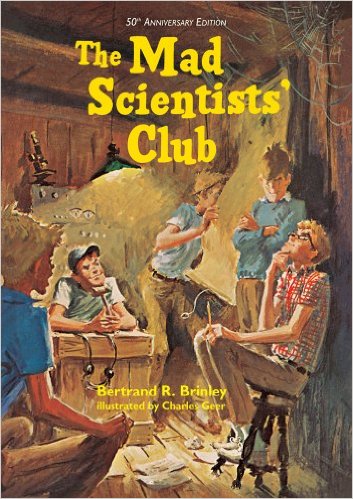
One of my favorite boyhood books was Bertrand R. Brinley’s The Mad Scientists’ Club (1965), a collection of short stories about a group of young science geeks in the fictional town of Mammoth Falls. The boys of the club used their scientific know-how to get in and out of various adventures. They had a clubhouse, scientific equipment scrounged up from here and there, and enough outdoor gear to support their explorations.
With stories like “The Strange Sea Monster of Strawberry Lake,” “Night Rescue,” and “The Big Egg,” The Mad Scientists’ Club takes us back to a time when kids created their own fun, without having every hour scheduled and coordinated by adults. The unstructured time enabled children to improvise and imagine. More often than not, they, nay, we managed to do so without getting into too much trouble!
Grade school years are a wonderful time to stoke curiosities about science, and The Mad Scientists’ Club captures that fascination. But I know that things have changed. Today, I’m afraid, keyboards, screens, and smartphones might overcome the exploratory instincts of yore.
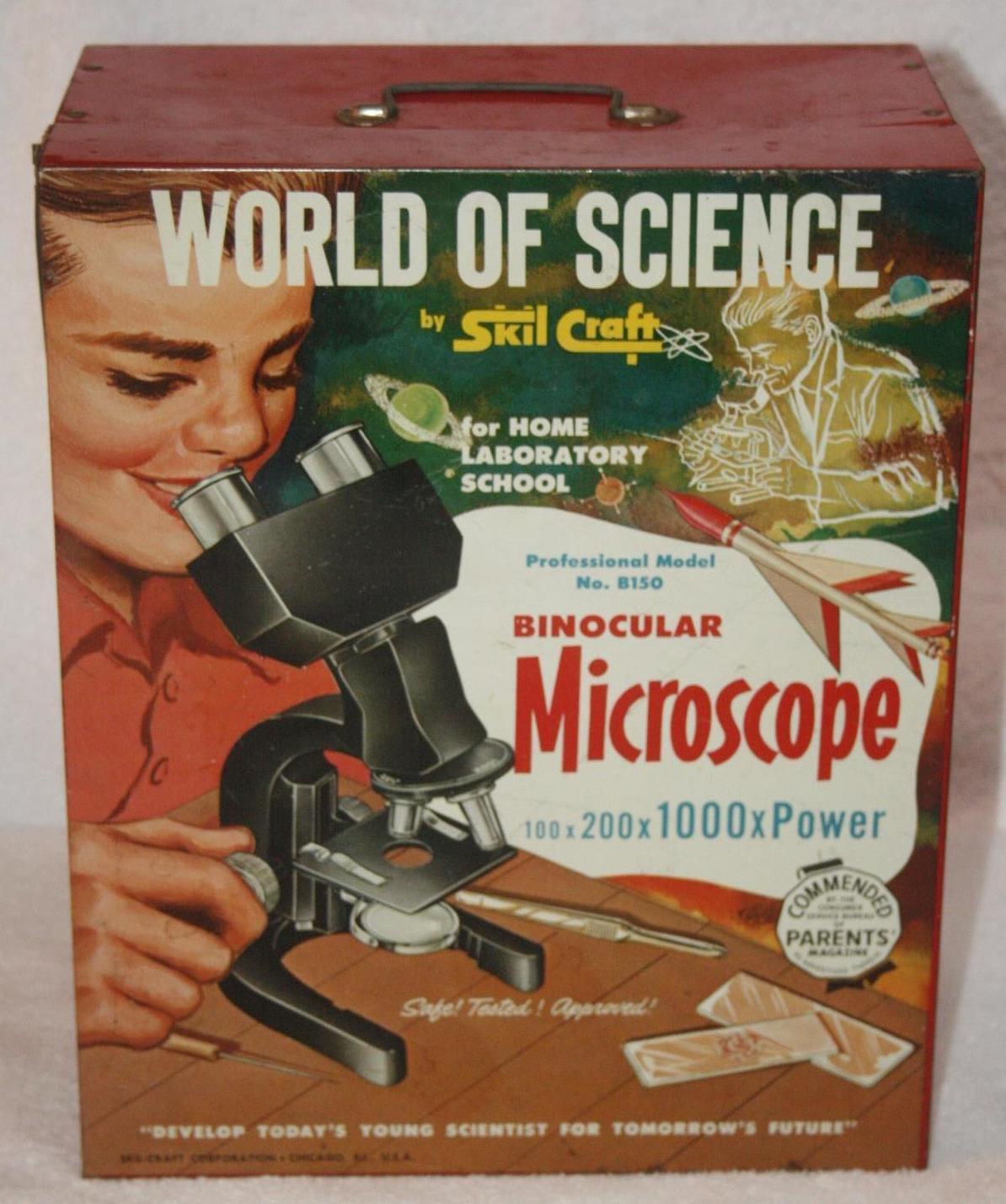
I caught the science bug early. My first view was to the skies. I became interested in astronomy early in grade school. This was, after all, the early heyday of America’s space program, and our young imaginations were filled with wonder over what might exist above. What would it be like to travel in a space capsule? Is there life on Mars? Do UFOs exist?
Soon my fascination turned toward the invisible, and those curiosities required a microscope. A birthday present in the form of a student microscope (much like the one pictured above) brought enough magnifying power to observe the activities of one-celled animals — protozoa — such as amoeba and paramecia. I read up on early pioneers such as Anton van Leeuwenhoek, the 17th century Dutch scientist who used his own hand-crafted microscopes to explore the world of microorganisms.
The microscope gave me many hours of fun exploration, especially when I made slides filled with stagnant water, blood, tiny brine shrimp, plant cuttings, and other objects. The cheap metal case that came with the microscope opened to form my own little lab in the bedroom I shared with my brother Jeff.

I think it’s more than nostalgia for my childhood — which wasn’t nearly as dramatic or exciting as that portrayed in The Mad Scientists’ Club — that has caused me to go online at times to price out student microscopes and biology kits. I live within walking distance of a pond where I could collect all sorts of specimens to view through a microscope, and I sometimes wonder if I could lose myself in a hobby that appeals to the little kid in me.
For now, I’ve got plenty of good stuff to keep me busy, and I’m not sure where I’d find the time to add another hobby. But I’ll definitely keep this on my radar screen.
Adult student enrolling in Hogwarts

Many years ago, my long-time friends the Driscolls gave me the first two books in the Harry Potter series. Give them a try, they said. All five family members were big Harry Potter fans, and they thought that I might enjoy the books.
I did give the first book, Harry Potter and the Sorcerer’s Stone (known as Harry Potter and the Philosopher’s Stone in the U.K.), at least a half-hearted try. But after a couple of chapters, I put it aside. I’ve never been into the fantasy genre, and despite the legion of grown-up Harry Potter aficionados, I just couldn’t see what the big deal was all about.
Fast-forward to this week. It dawned on me that I’ve read rave comments about the Harry Potter series from favorite writers, ranging from Stephen King to Brené Brown, praising the stories and their insights on the human condition. I’ve also admired author J.K. Rowling for her down-to-earth demeanor and sense of social responsibility. So I posted on Facebook that I was thinking of giving Sorcerer’s Stone another try, and several friends share effusive praise for the books.
(Slight spoilers ahead…)
I’m now about 100 pages into Sorcerer’s Stone. Folks have cautioned me that it’s a little slow going at first, that the set-up takes a while to build, and that the story won’t start to sparkle until later in the book.
And yet, I already find it charming, engaging, and very, very clever. Of course, as someone steeped in workplace anti-bullying work, I couldn’t help but to pick up on the bullying themes in Harry’s life with the Dursley family. Now Harry is preparing to enter Hogwarts, and I’m excited for him. With Hagrid’s help, he is picking out his school supplies. Rowling captures beautifully the anticipation and nerves that go with starting a new school.
I haven’t read many fantasy or children’s books, but I can tell a great storyteller from an okay one, and this early foray into Harry Potter’s world is enough to show me that Rowling is a brilliant writer. Her ability to create vivid detail and her sense of empathy and humor come through from the start.
Being something of an Anglophile, I love the little references to London, including the Underground and Platform Nine and Three-Quarters at the King’s Cross rail station. As someone who has been around schools and public transportation all my adult life, maybe I’m already identifying with parts of the story!
On Facebook, one of my friends suggested that I suspend my grown up reader’s worldview and let the inner child in me enjoy the stories. The only problem is that I didn’t like to read fiction as a child. I emphatically preferred non-fiction, and my 11-year-old self would’ve rebelled at having to read the Harry Potter stories. Even today, I estimate that some 80 percent of my personal library is non-fiction.
No, mine is more a tale of arrested reading development. Call me a late bloomer, but it’s a twist that I’ve had to go deep into adulthood to be “ready” for the Harry Potter series.
It may take me another week to finish Sorcerer’s Stone, as lately, I haven’t been one to rush through novels and stories. But I’ve already got Harry Potter and the Chamber of Secrets ready to go, so it appears that I am matriculating into Hogwarts as an adult student. Better late than never.
Server down + St. Pat’s Day = Playing hooky
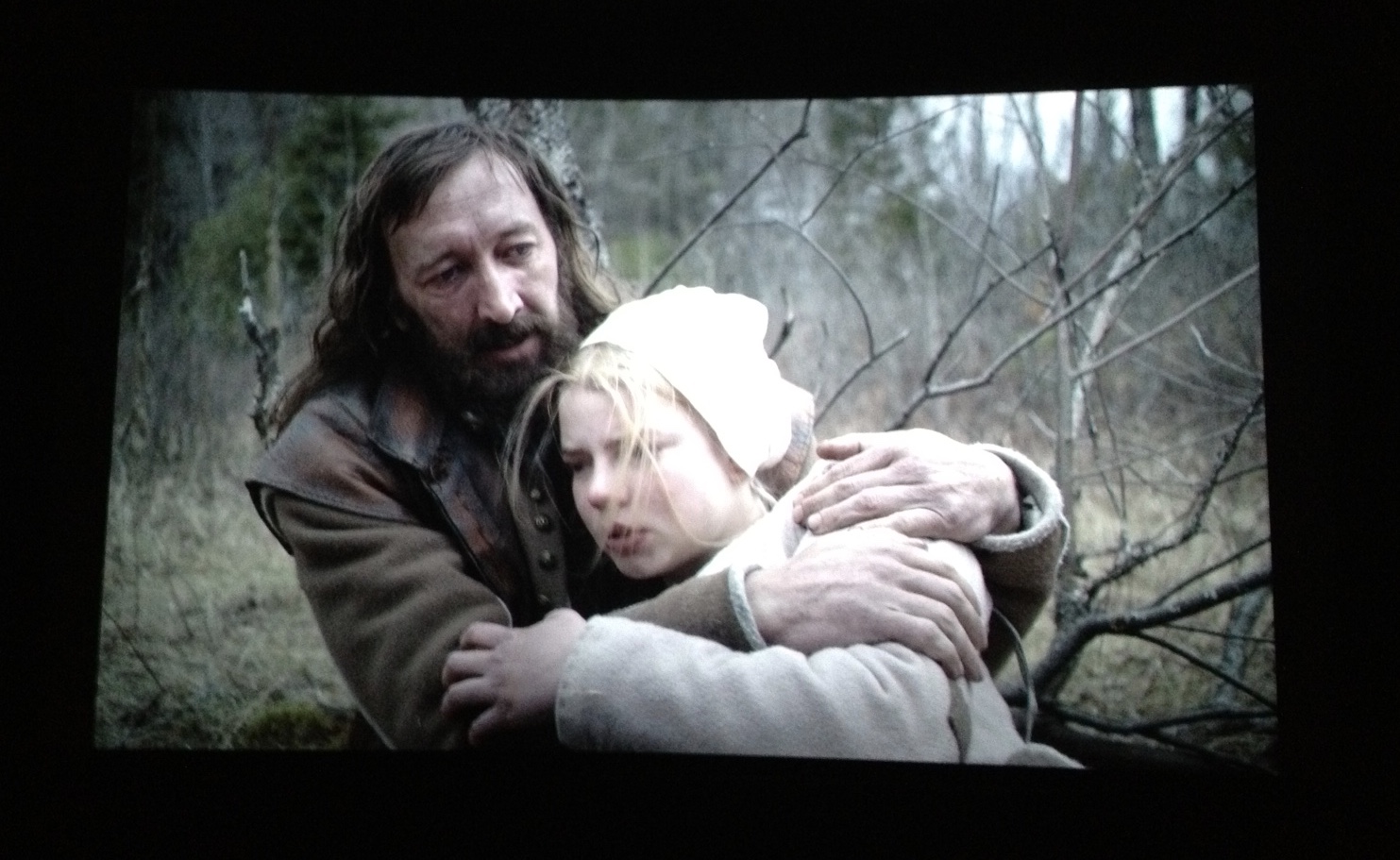
Not to be seen alone, in my case, completely so!
It’s spring break week at my university, and I’ve been using the time to get caught up on a variety of writing projects and other commitments. Yesterday I intended to dive into edits of a couple of articles I’m working on, but the university server was down and I couldn’t access the files I needed. It was St. Patrick’s Day anyway, so I figured, why not take the afternoon off? And that I did.
It started with a matinee viewing of “The Witch,” a chilling film set in 1630s New England, some 60 years before the infamous Salem Witch Trials. Here’s how IMDB describes it:
William and Katherine lead a devout Christian life, homesteading on the edge of an impassible wilderness, with five children. When their newborn son mysteriously vanishes and their crops fail, the family begins to turn on one another. ‘The Witch’ is a chilling portrait of a family unraveling within their own fears and anxieties, leaving them prey for an inescapable evil.
Pictured above are the father, William (Ralph Ineson), holding his oldest daughter, Thomasin (Anya Taylor-Joy). The cast is excellent, with Taylor-Joy delivering an especially exceptional performance.
Please don’t be concerned that I was disturbing fellow movie goers by snapping that photo with my iPhone camera. You see, there was no one else in that theatre. (That’s a first for me.) Although “The Witch” has received strong reviews, it has been out for a while, and I guess St. Pat’s revelers were in no mood to watch a movie that might cause them to feel guilty about their earthly behaviors.
After the movie, I walked over to the nearby Brattle Book Shop, my favorite used bookstore in the Greater Boston area, and found a few affordable goodies, including a couple of gifts for friends. I visit the Brattle at least once a month, sometimes more often. When the weather is decent, their big draw is an array of outdoor book carts in their adjoining lot, containing thousands of wonderful bargains priced at $5, $3, and $1.
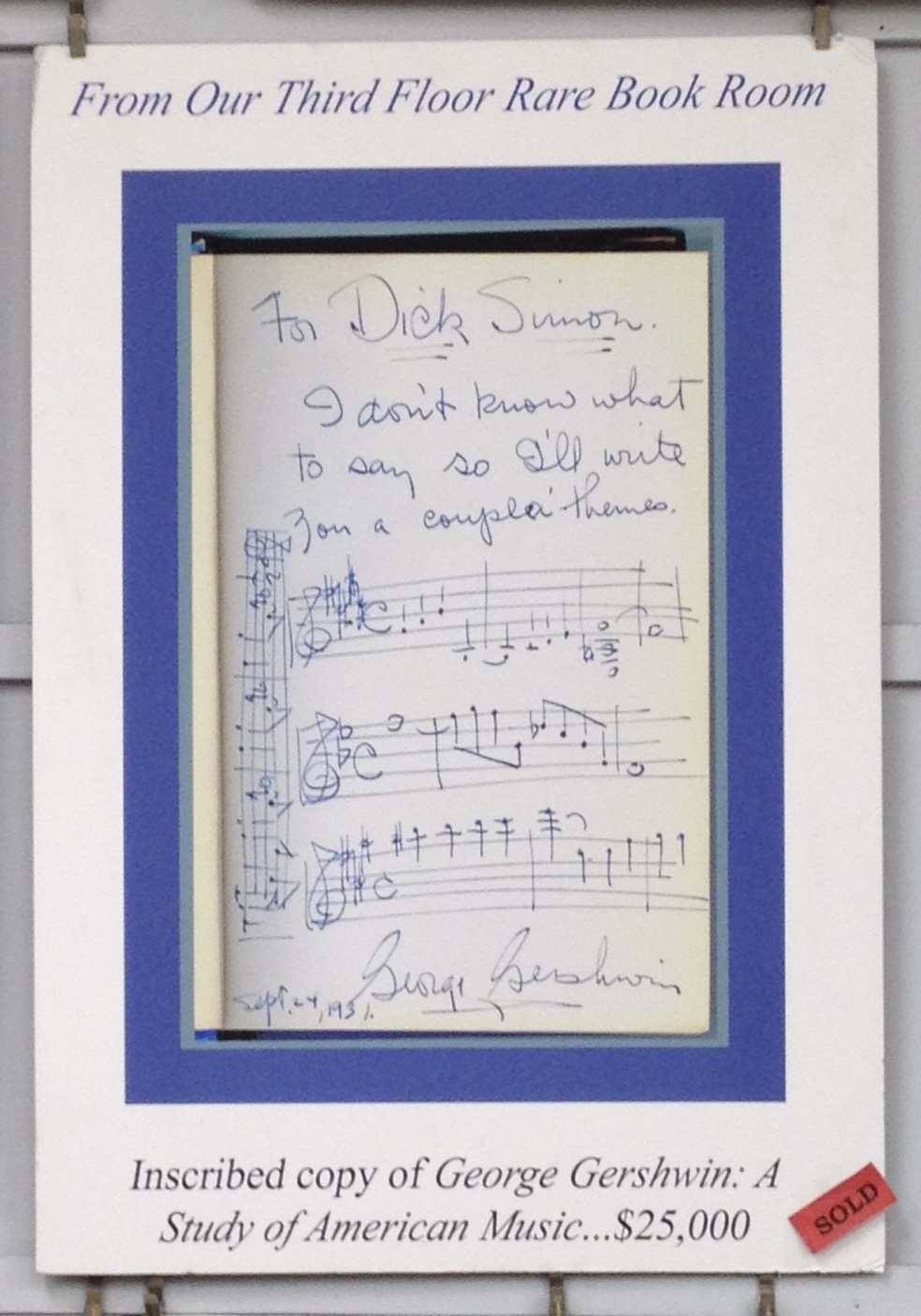
However, higher end collectors will also find plenty of treasures in their rare book room. Here’s a photo of an item they sold for a tidy sum. Nope, despite my love of anything Gershwin, I was not the buyer. (I’m opting to pay my mortgage this year instead.) But I did pick up a couple of songbooks with selections from that era for only five bucks a pop. Not a bad deal if I say so myself.
Herman Wouk at 100

Celebrated writer Herman Wouk has reached the century mark, and he has just published what he tells us is his final book, a slim autobiographical sketch titled Sailor and Fiddler: Reflections of a 100-Year-Old Author (2016).
I cannot claim familiarity with Wouk’s full body of work, but two of his signature novels, The Winds of War (1971) and War and Remembrance (1978), and the pair of award-winning television mini-series they spawned (in 1983 and 1988-89, respectively) have profoundly shaped my understanding of the Second World War. I know that I am not alone in saying this, especially among those of my generation.
The Winds of War starts in 1939, introducing us to the Henry family, headed by U.S. Navy officer Victor “Pug” Henry, along with his wife Rhoda, sons Warren and Byron, and daughter Madeline. Joining them as major figures are famous Jewish author and retired professor Aaron Jastrow and his niece, Natalie, who are living in an Italian villa. Their journeys also become focal points. Also prominent are Pamela Tudsbury, a young British woman who travels the globe helping her father, foreign correspondent “Talky” Tudsbury, as well as foreign service officer Leslie Slote.
Winds finds Europe on the brink of another war, and it proceeds on through the immediate aftermath of the Japanese attack on Pearl Harbor. War and Remembrance picks up where Winds leaves off, continuing with the stories of the Henrys and the Jastrows. But it quickly gets much darker. Remembrance uses its characters to cover the broad sweep of the war, including the Holocaust, which is portrayed in horrific, vivid detail. The mini-series includes brutal depictions of Nazi death camps, with many scenes actually filmed at Auschwitz.
Both stories continually weave in defining political and diplomatic figures of the day, including Roosevelt, Churchill, Hitler, and Stalin, as well as many of the war’s prominent military officers.
Thanks in part to the great success of the mini-series, The Winds of War is better known to a lot of people. However, in Sailor and Fiddler, Wouk — a WWII Navy veteran — informs us that War and Remembrance was the story he had to tell.
I confess that I have immersed myself in both stories to a point of obsession, and I have learned valuable life lessons from their leading characters and lot of history from the books and the mini-series. I consider Winds and Remembrance to be the epic tales of the war era, Homeric in scope, and richly American in perspective.
If Wouk had produced nothing but these books, then I would consider his life a special one. But that is not the case. He has been a prolific writer and led a rewarding, full life. And at 100 years old, he still had enough gas in the tank to write this neat little book about his life.
I often say that if we want to live good lives, then we can learn from the stories of good people who are our seniors. Herman Wouk is a prime example.

Bookplates

I’ve been writing a lot about books over the past couple of weeks, and I’m about to inflict more of the same on you, dear readers. As I mentioned last week, I have decided to pare down my book collection, with a goal of donating or giving away some 500-750 books during 2016.
I also decided to put a little stamp of ownership on the books I’ve decided to keep. I recently ordered a pile of bookplate stickers, pictured above, from a quick-print mail order shop. I’ve wanted to do something like this for some time. While I’m at it, I’m starting to catalog these books into subject matter categories in a simple Word file.
The academic and lifelong learning geek in me likes the idea of having a personal library. Some of these books are relevant to my work, but a solid majority of volumes cover other interests. With non-fiction, history, sports, and politics are among my favorite subject areas. With fiction, I lean toward mysteries, suspense, thrillers, and stories with historical themes.
I keep telling myself that I’ll tackle more of the classics when I have more time, but I may be fooling myself, as I’ve been saying this for decades. While I’m willing to work through some pretty tough stuff for work and specific learning projects, I am not the most tenacious leisure reader! Which means that Shakespeare, Dickens, and Tolstoy, among others, inevitably fall victim to Stephen King or John Grisham. But they, too, will receive their bookplates, as I’m not giving up on them.
Books: The challenge of thinning out the herd

City-Wide Friends of the Boston Public Library book sale (photo: DY)
Four times a year, the City-Wide Friends of the Boston Public Library holds a used book sale at the Central Branch to raise monies for their support of the city’s public library system. Usually I stop by in search of bargains for my personal library. But I went to this weekend’s sale with another mission in mind: To donate a dozen of my books.
Yes, folks, although I continue to obtain new books at a regular pace, I am making a concerted effort to thin the herd. Inspired and guided by Japanese “tidying” expert Marie Kondo (author of the bestselling The Life-Changing Magic of Tidying Up), I am trying to pare down my book collection from around 2,000 to a more manageable 1,200 or so.
Kondo recommends decluttering by category, in roughly this order: (1) clothing; (2) books; (3) papers; (4) miscellany; (5) items of sentimental value. The first was easy. I sorted out my extraneous clothing in a few hours. Fashion — as anyone who knows me in person will attest — is not on my radar screen. I’ve donated several bags of clothes and tossed a lot of stuff that had been hanging around.
But now I’m tackling my books, and to be honest, it will take me the rest of the year to donate, give away, and otherwise reduce the piles of books in my possession. During 2016, I’ve culled about 100 books.
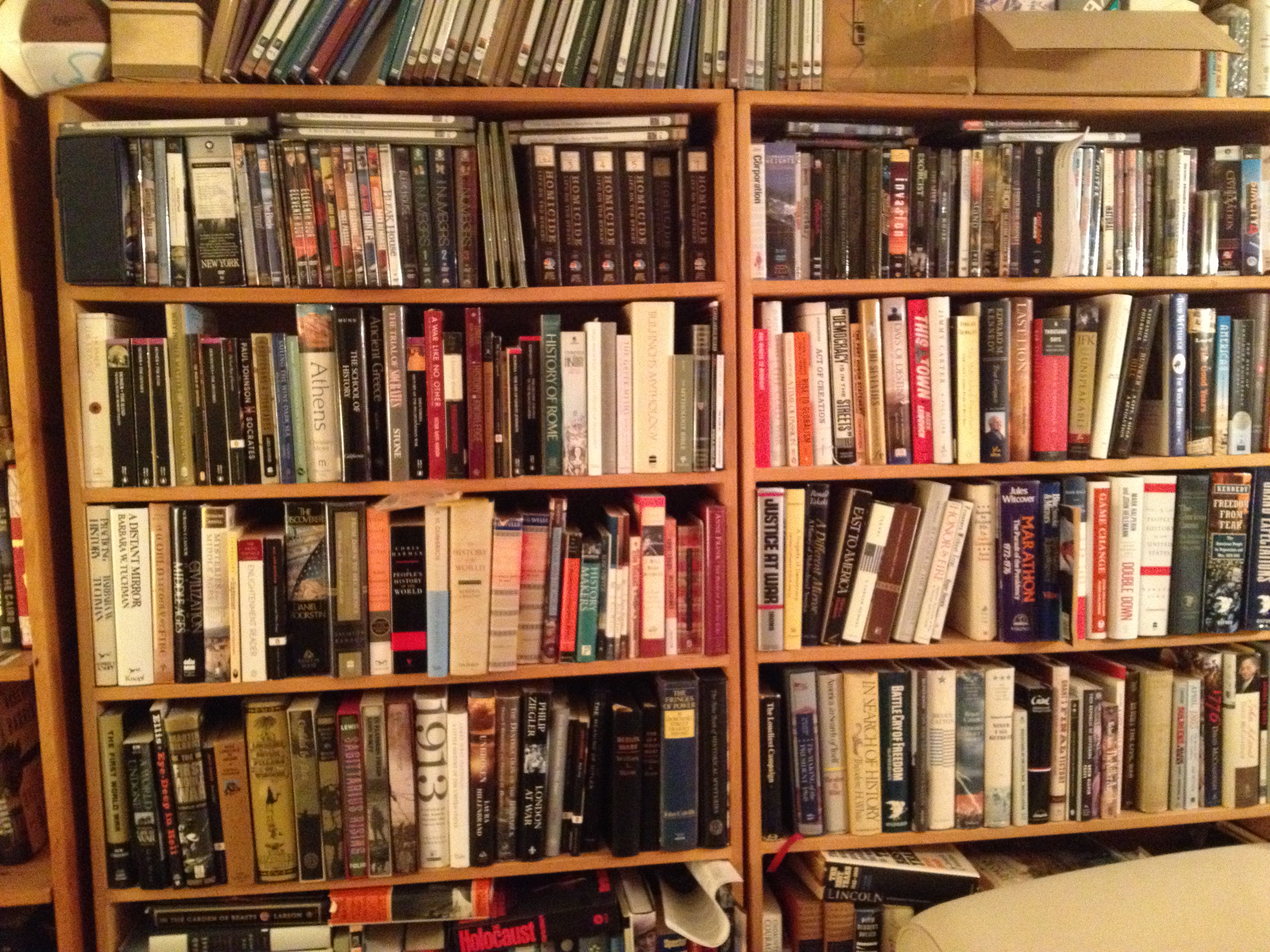
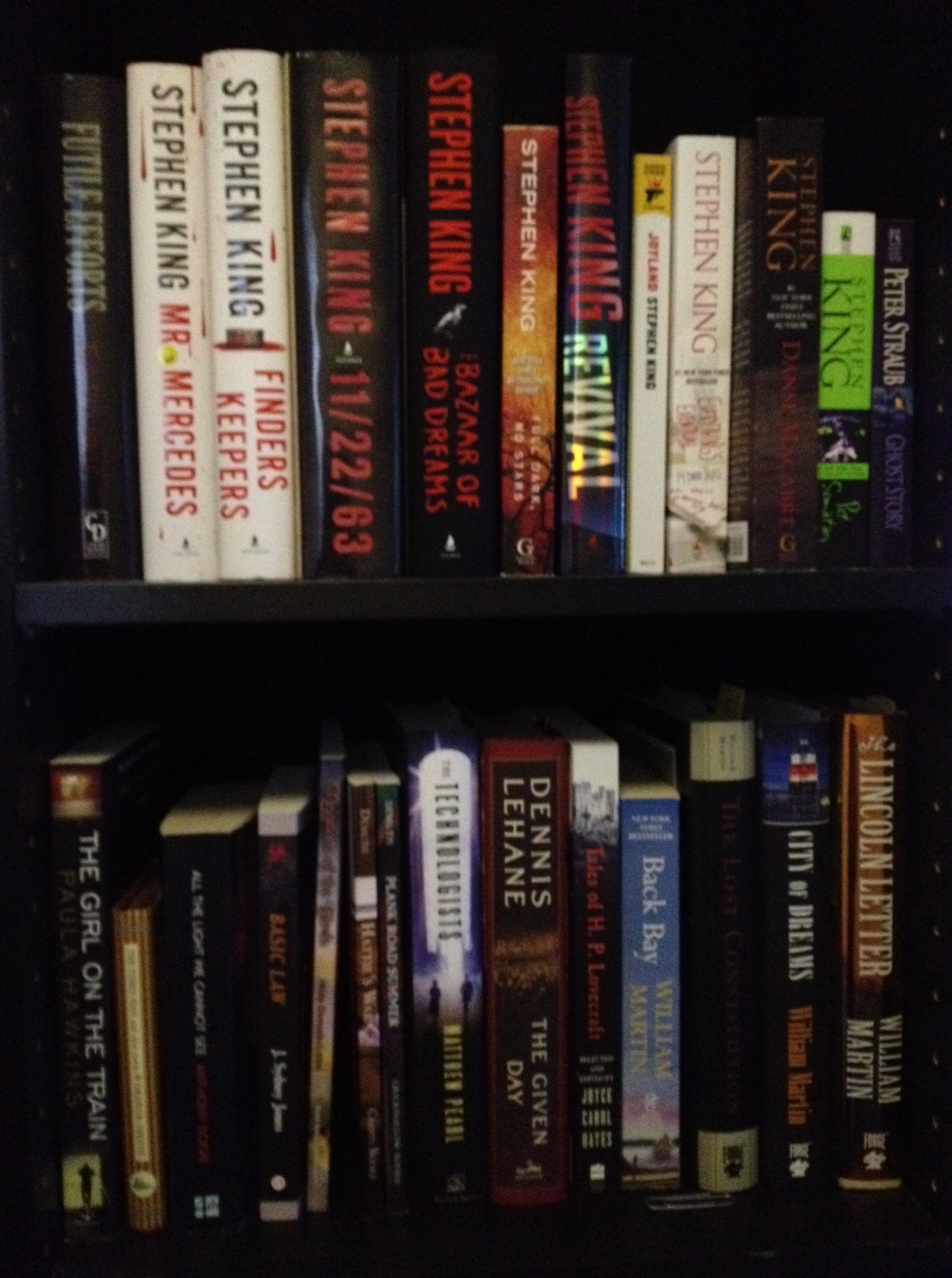
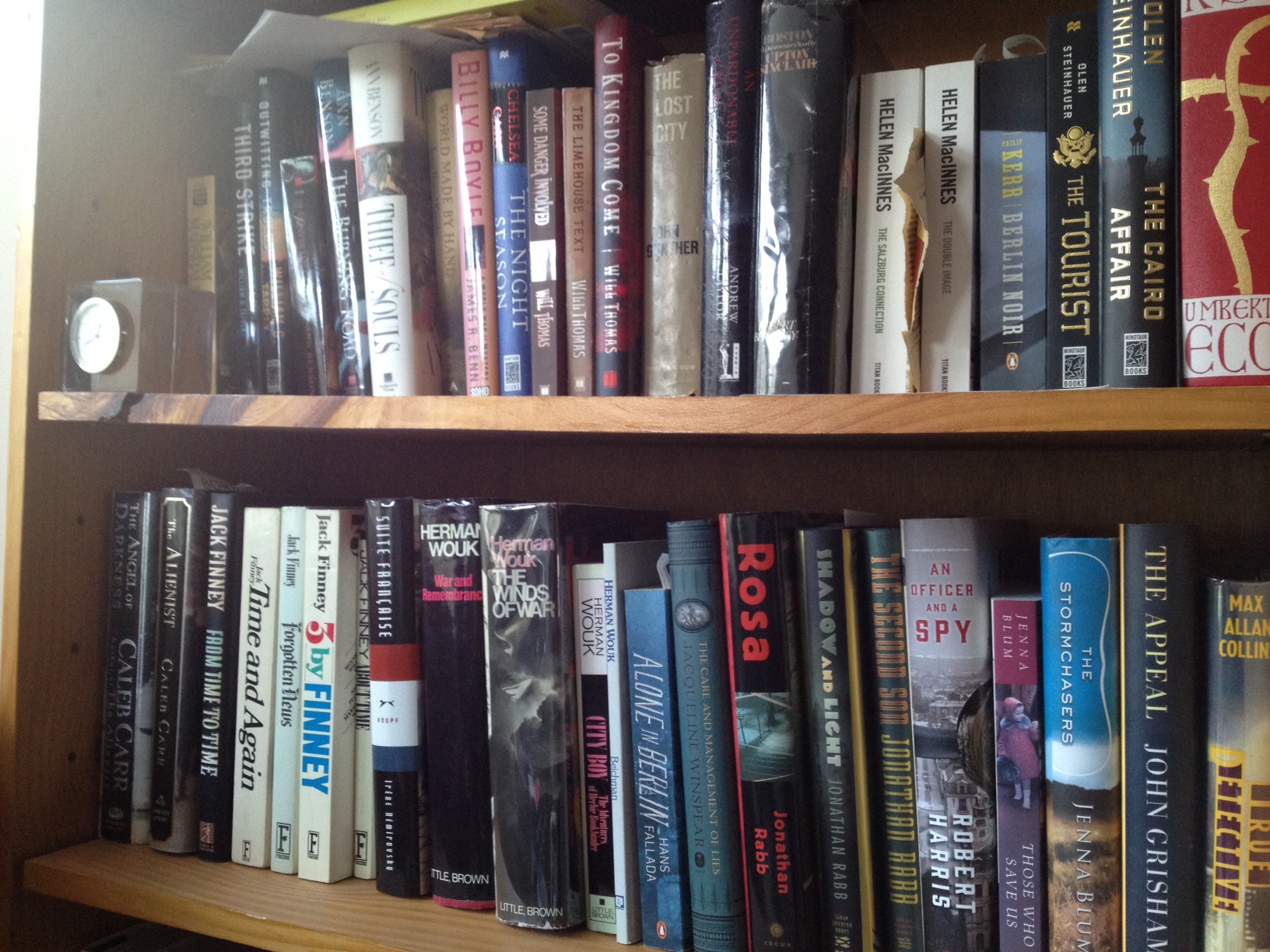
Why am I doing this? Well, as you can see from photos of some of my bookshelves below, my space at home has basically run out. (It’s worse at my university office.) But more importantly, I am facing the fact that I bought many of these books under a hazy assumption that I would have eons of time to (1) read even the books I’m only casually interested in, and (2) pursue a virtually endless array of writing projects. Now that I’m in my mid-fifties, I know that will not be the case.
Kondo recommends keeping only those books that bring us joy, but that’s an unrealistic standard for me. (Uh, books about workplace bullying and toxic work environments don’t exactly fit that description, but they allow me to do my job.) Instead, I’m simply asking myself what I’m likely to read, re-read, and use during the next couple of decades. I must make choices.
And so I will. It’s not easy; I do have emotional attachments to books. Most of the volumes in these photos are keepers, and many have been with me through multiple moves. But I am taking pleasure in giving away books that may be sources of enlightenment, entertainment, and enjoyment to others. There are a lot more to come.


Book-of-the-Month Club: Can a middlebrow icon remake itself in an era of endless choices?

I recently learned that the venerable Book-of-the-Month Club was relaunched last fall, with a fully web-driven membership system and a considerably streamlined set of book offerings.
For those of you who don’t know about the original Book-of-the-Month Club, a brief explanation is in order. BOMC was founded in 1926, the brainchild of some New York ad agency guys who saw a commercial opportunity that tapped into America’s embrace of mail order and the reading appetite of its emerging, upwardly mobile middle class.
People typically became BOMC members by answering a magazine ad or a direct mail invitation. The Club’s marketing hook was an initial membership package that allowed you to pick several books from the club’s catalog and pay a negligible sum at the outset. However, you also had to fulfill a membership agreement, which meant buying a specified number of books at club prices within the next two years.
Every month, members would receive a packet in the mail, containing a flyer describing the editors’ main selection for that month, a short catalog describing alternate and back list selections, and a reply card. If you did nothing, the main selection would be sent to you. You could also use the reply card to indicate that you didn’t want the main selection or to order alternate and back list selections. (Folks who frequently overlooked the reply card deadlines might find themselves with a growing pile of unwanted books. Surely a steady share of BOMC sales were the result of these oversights!)

In the days before superstores like Barnes & Noble and, later, online sellers like Amazon, BOMC offered a way to bring good books into your home with minimal hassle, screened by reviewers who had discerning eyes for the reading tastes of middlebrow America. Over the years, BOMC assembled various panels of judges to evaluate and select books for its catalog, some of whom were accomplished authors in their own right. During the Club’s heyday, serving as a BOMC selection committee judge carried some prestige within mainstream publishing circles.
Commercially speaking, BOMC was a very big deal to authors seeking to broaden their readership. Main selection status equalled a stamp of approval by a trusted brand and a guarantee of higher sales. BOMC favored quality fiction and non-fiction for a general, intelligent audience, while largely avoiding books that might be considered tawdry or cheesy. Its marketing campaigns played on such appeal and the idea of building a good home library, while usually managing to avoid lapsing into higher-level snobbery.
Among some stuffier types, however, this combination of commercial advertising and middlebrow reading tastes prompted derision of the whole enterprise (and by implication, perhaps, of its customers). Nevertheless, the Book-of-the-Month Club elevated America’s literary intelligence on the whole by bringing good books to a growing swath of the American population.
Predictably, the appearance of larger, brick and mortar bookstores and the emergence of Internet booksellers would spell trouble for the Book-of-the-Month Club. I was an off-and-on member from the 1980s through the early 2000s, and I witnessed its steadily declining commercial and cultural significance in shaping reading appetites. Sometime in 2014, BOMC was folded into another commercial book club and disappeared as a brand name. Very few people took notice, perhaps marking an unsurprising end to a 20th century phenomenon.
By the time BOMC left from the scene, there were at least four big problems with its service, beyond the obvious competitive challenges in the digital marketplace: First, its prices were high compared to other mass booksellers, especially with hefty shipping & handling charges added. Second, it took forever for the books to be delivered. Third, the quality of its book production had deteriorated, to the point where a BOMC edition felt and looked like a cross between a hardcover book and a trade paperback edition. Finally, BOMC had abandoned its popular practice of using literary judges to help make its selections, which made it seem like a more crass commercial enterprise than a literary “club.”

Then last fall, BOMC quietly reappeared. Its owner, Bookspan, has relaunched the Club as a fully online enterprise, using a streamlined subscription model rather than a membership package followed by reply cards. Here’s the new approach as described on their website:
As a Book of the Month Member, you will receive an email on the 1st of each month announcing our New Selections. One of these New Selections will be pre-selected for you and placed in your “box.” You will have until the end of the 10th day of the month to review the monthly selections and decide whether you want to keep the book that was pre-selected for you, select a different book, or add additional books to your box. If you do not change your selection, the book we selected for you will be shipped to you after the 10th day of the month along with any other books you have added to your box.
Instead of paying individually set prices for the books, members are charged a flat membership fee:
Book of the Month offers three membership plan options: 1-month, 3-month, and 12-month. The cost of the 1-month plan is $16.99 per month, the 3-month plan is $38.97 ($12.99 per month), and the 12-month plan is $119.88 ($9.99 per month).
So basically, every month during the course of your membership, you get a choice of five books, with the primary selection automatically shipped unless you opt for one or more of the others.
In a world of seemingly endless consumer choices, BOMC is following what seems to be a counterintuitive business approach. It is saying, in essence: Among the thousands of books published each month, we will provide you with a curated selection of five noteworthy titles and allow you to pick one of them at a discounted price.
Can fewer reading choices make us happier? Consider psychologist Barry Schwartz’s “paradox of choice” theory, asserting that an overabundance of choices can lead to greater dissatisfaction and inertia. In other words, we may become overwhelmed by the options before us. Hmm, maybe there’s something to be said for being offered a choice among five books that stood atop a thoughtful screening process?
If you’ve read this far, then you may have guessed that I’m giving the new BOMC a try. Recently I signed up for a three-month membership, with my first book choice being Nick Stone’s The Verdict (2015), a smart legal thriller set in London. I didn’t know about this title beforehand, but the BOMC reviewer’s description grabbed my attention. I just started the book, and it seems like a good one!
Sometimes counterintuitive approaches work. If book lovers like me can be persuaded to sign up, then maybe BOMC has a fighting chance. I can say that with the arrival of my first selection, the main problems with the old BOMC appear to have been addressed: The books are competitively priced, books are shipped promptly on a designated date, and the hardcover volumes are of good quality. Also, BOMC is once again using literary judges (along with some book-loving celebs) to help make and tout its selections.
Can this leaner reincarnation of a middlebrow icon succeed? We shall see. In the meantime, I’m looking forward to next month’s selections.
***
Of possible interest
For an interesting look at America’s popular reading tastes, this Books of the Century website lists bestsellers and BOMC selections during the 20th century.
For a more detailed history of the BOMC during the pre-Internet years, check out Janice A. Radway, A Feeling for Books: The Book-of-the-Month Club, Literary Taste, and Middle-Class Desire (1997).
***
March 2016 addendum: I’ve enjoyed this reincarnated version of BOMC so much that I signed up for a full year’s subscription. I like what they’re doing with this and look forward to future selections.
 Musings of a Gen Joneser
Recent Comments