Binge viewing and the triumph of the small screen
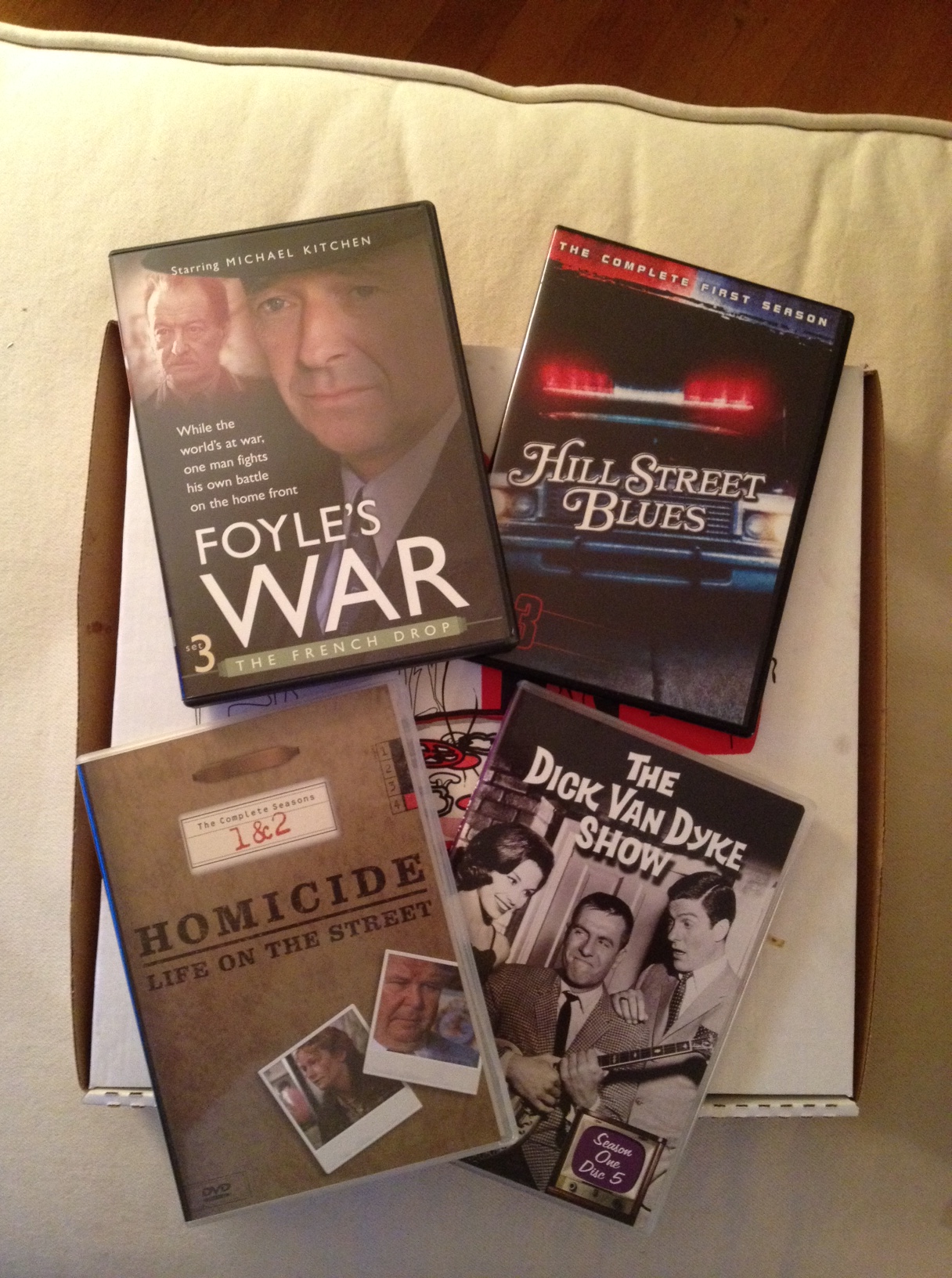
DVDs and pizza, a classic combo
The availability of inexpensive VCRs and, later, DVD players may have changed the way we watch movies, but it took newer technologies plus superb writing, acting, and production talent devoted to the small screen to revolutionize the way we watch television.
The Wire. Downton Abbey. Breaking Bad. Mad Men. Homeland. The Sopranos. Friday Night Lights. The whole bunch of great British detective series on PBS, such as Prime Suspect and Foyle’s War. The list goes on and on.
While this list may be a bit short on comedy (though I’m told that The Big Bang Theory is a winner), the number of superb one-hour drama series available to viewers today is almost overwhelming. And with the availability of low-cost DVD players, DVR recording, and subscription services such as Netflix and Hulu, we can set aside weekends or holidays to “binge view” old and new favorites.
If you want, you can follow a day of Jack Bauer fighting the bad guys (24) practically in real time. Or, you can watch the entire mission of the starship U.S.S. Enterprise (Star Trek) over the course of several compressed weekends.
A few of mine…
I’ve enjoyed many of the programs already mentioned (Breaking Bad and The Sopranos being the most glaring exceptions), but here are a few more good ones over the years, including some network shows and oldies:
- The Adventures of Young Indiana Jones, covering the life of Indiana Jones as a kid and young man, growing up in Princeton, New Jersey, and then leaving home to fight in the First World War. Each episode is a mini-movie and a fun history lesson.
- David Simon’s Homicide: Life on the Street preceded his masterpiece, The Wire. But this earlier Baltimore cop series starring Andre Braugher, Yaphet Kotto, Richard Belzer, and a first-rate cast of others, stands on its own as excellent drama.
- The short-lived but very suspenseful Jericho, starring Skeet Ulrich, about a small town defending itself against an apocalyptic takeover of the U.S.
- BBC America has offered some great police dramas, including Broadchurch, Whitechapel, and Ripper Street.
- Numb3rs is a quirky network crime show featuring David Krumholtz as a brilliant math professor who applies his skills to solving crimes, with Rob Morrow as his FBI agent brother. It’s good, formulaic fun, with appealing characters, that ran for six seasons.
- Unfortunately, only the first two seasons of the pioneering 1980s cop series, Hill Street Blues, were released on DVD. I’m guessing that low sales didn’t justify releasing the rest of the run. But seasons 1 and 2 are excellent.
- I love the last two seasons of The West Wing, featuring the twilight of the Bartlet Administration and the Santos-Vinick campaign. The story arcs completely feed the political junkie in me!
- I’m looking forward to binge-viewing China Beach, the Vietnam War drama starring the most awesome Dana Delany as nurse Colleen McMurphy, that ran in the late 80s through early 90s.
Yeah, I’m partial to crime dramas!
Comedies, too
If classic sitcoms are your thing, there are plenty of options as well. What about the oft-brilliant Dick Van Dyke Show? Or the homespun humor of the Andy Griffith Show? Maybe more recent standouts such as MASH, Cheers, or Taxi?
Personally, I’ve found that sitcoms don’t work as well for binge viewing, but they’re great for delivering a welcomed dose of humor and levity after a long day.
Compare/contrast
Between the core of network standouts, a host of quality productions for cable, PBS, and now streaming video, the small screen offerings make us think twice before we plunk down $10 a ticket to see a so-so movie and pay a ransom for popcorn and a drink.
How spoiled are we with all of these offerings?
Well, if you’re of a certain age (which includes most readers of this little blog), then think back to the popular network television shows of the 1970s and early 1980s.
‘Nuff said. For small-screen fans, these are the good ol’ days.
Time travel: Some favorite destinations

Remember “The Time Tunnel,” the short-lived but fascinating television time travel drama from the mid-60s? Every new episode would find scientists Tony Newman and Doug Phillips landing in a different historical setting, usually on the eve of some major event, such as the sinking of the Titanic, the Battle of Little Big Horn (General Custer and Crazy Horse), or the bombing of Pearl Harbor. (Unfortunately, they never could persuade folks that disaster loomed.) To this day, I credit that show for helping to stoke a lifelong interest in history and to fuel my imagination with thoughts of going back in time.
What if time travel was possible? What places and times would I want to visit? Here’s an off-the-top-of-my-head list, not exactly an exotic one, but it sure would be a fascinating set of journeys. Feel free to add yours in the comments!
***
New York City, 1880s — My favorite time travel novel, Jack Finney’s captivating Time and Again (1970), is set in early 1880s Manhattan. There’s a scene in the book when his protagonist, Si Morley, realizes that he made a successful journey back. It remains one of my most favorite reading moments, ever.
New York City, 1920s — I’d be at everything and anything by George Gershwin, Rodgers & Hart, and Cole Porter. I’d be at the jazz clubs of Harlem. I’d be at Yankee Stadium watching Ruth & Gehrig. I’d be hanging out in Greenwich Village. I’d also want to check out student life at New York University, my law school alma mater. The 1920s is one of my favorite decades, and NYC of that time would make for a grand visit.
New York City, post-war 1940s and early 1950s — I can’t imagine a better place to drink in the spirit of America’s post-war optimism. I’d also venture out of Manhattan to Ebbets Field in Brooklyn, where I’d watch Jackie Robinson break baseball’s modern color barrier. I’m sure I’d spend plenty of time and money at the dozens of used bookstores in the city. And yes, I’d hang out in the Village during this period, too.
Chicago, 1893 — Chicago hosted the Columbian Exposition World’s Fair. The photographs of it look stunning, a city bathed in light. It also marked Chicago’s arrival as a major city.
Chicago, 1920s — When I was a kid, one of my favorite books was Albert Harper’s Chicago Crime Book (1969), which told tales of Al Capone and other famous gangsters. Thus was born a fascination with Chicago’s Roaring Twenties.
San Francisco and Berkeley, California, mid-to-late 1960s — I’d like to experience the whole California Dreamin’ thing. I’d be the squarest person in Berkeley’s People’s Park, but at least I’d be able to take good pictures.
London, late 1880s — Yeah, I’d sleuth around the East End to discover the identity of Jack the Ripper. I’d be drawn to the sinister side of Victorian London. I’ve also read about the food carts of the era and would like to give them a try.
London, 1940 — London during the Battle of Britain and the Blitz. It’s such an iconic, defining, dramatic moment in British history. Just thinking about it has me imagining Edward R. Murrow’s radio broadcasts from London as the German bombs were falling around them.
Paris, 1920s — I probably wouldn’t stay long, but I’d want to check out that whole Left Bank scene and the Lost Generation. I’d hang out in Paris cafes and do a bit of writing. (Challenge: No outlets for my laptop.)
Washington D.C., 1861-65 — Washington during the American Civil War. Hot, miserable, and menacing. But fascinating nonetheless. And somehow I’d finagle a way to have a short chat with Abraham Lincoln.
Boston, Revolutionary Era — I live in a city where evidence of the early years of the American Revolution is all around us. How cool it would be to see Boston of that era, perhaps bumping into the likes of John Adams, Samuel Adams, and other remarkable figures of the day.
Salem, Massachusetts, 1600s — Will we ever know the full truth about the events surrounding the Salem Witch Trials? It would be fascinating to find out.
Ancient Athens — I’d follow Socrates as he traipses around the Athenian marketplace. I’d want to get some first hand lessons in how the ancient Greeks lived, and trace some of the origins of Greek mythology and philosophy.
Hawaii, 1920s — Among my treasured Hawaiian collectibles is a February, 1924 National Geographic magazine with 16 pages of incredible color illustrations of the Islands. I can only imagine seeing those sights in person! If I was on Maui during October 1926, I’d go to the hospital in the small town of Paia to say hi to the newborn baby who someday would be my mom. While on Maui, I’d take a train ride on the narrow-gauge Kahului Railroad.
Hawaii, 1950s — After WWII, Hawaii was making its way toward eventual statehood. Large passenger airplanes — still propeller-driven, as the jets wouldn’t arrive in the early 60s — now made air travel to the Islands a safe reality. The idea of Hawaii as America’s Pacific paradise was in full bloom.
Valparaiso, Indiana, early 1910s — Valparaiso University, my collegiate alma mater, was rescued by the Lutherans in the 1920s after a period of decline. Before that, however, it was a thriving, no-frills, secular college known as the “Poor Man’s Harvard” that provided collegiate, professional, and trade courses to young people who aspired to join America’s emerging middle class.
Hammond, Indiana, 1950s — Hammond was my hometown from grade school through high school, from the late 60s through late 70s. By then it was a city in decline, its jobs base shrinking due to the decline of steel mills and manufacturing in Northwest Indiana. But during the 50s it was a thriving small city and an emerging outer suburb of Chicago.
Airplanes — I would love to fly in two legendary, early passenger airplanes, the Ford Trimotor (late 1920s) and the DC-3 (mid 1930s).
Trains — How fun it would be to take the Pioneer Zephyr, one of the first modern diesel passenger trains, on its popular Chicago-to-Denver run during the 1930s.
***
I’m struck by the fact that this list doesn’t have much to do with my current work. Hardly anything about law, the labor movement, politics, and the like. Not much about war, either, despite that I read a lot about the Civil War, WWI, and WWII. I’m not sure quite what that says about my choices, but unless science develops affordable time travel during my lifetime, this is not a pressing matter.
 Musings of a Gen Joneser
Recent Comments