On being a college sports fan: A waif’s journey
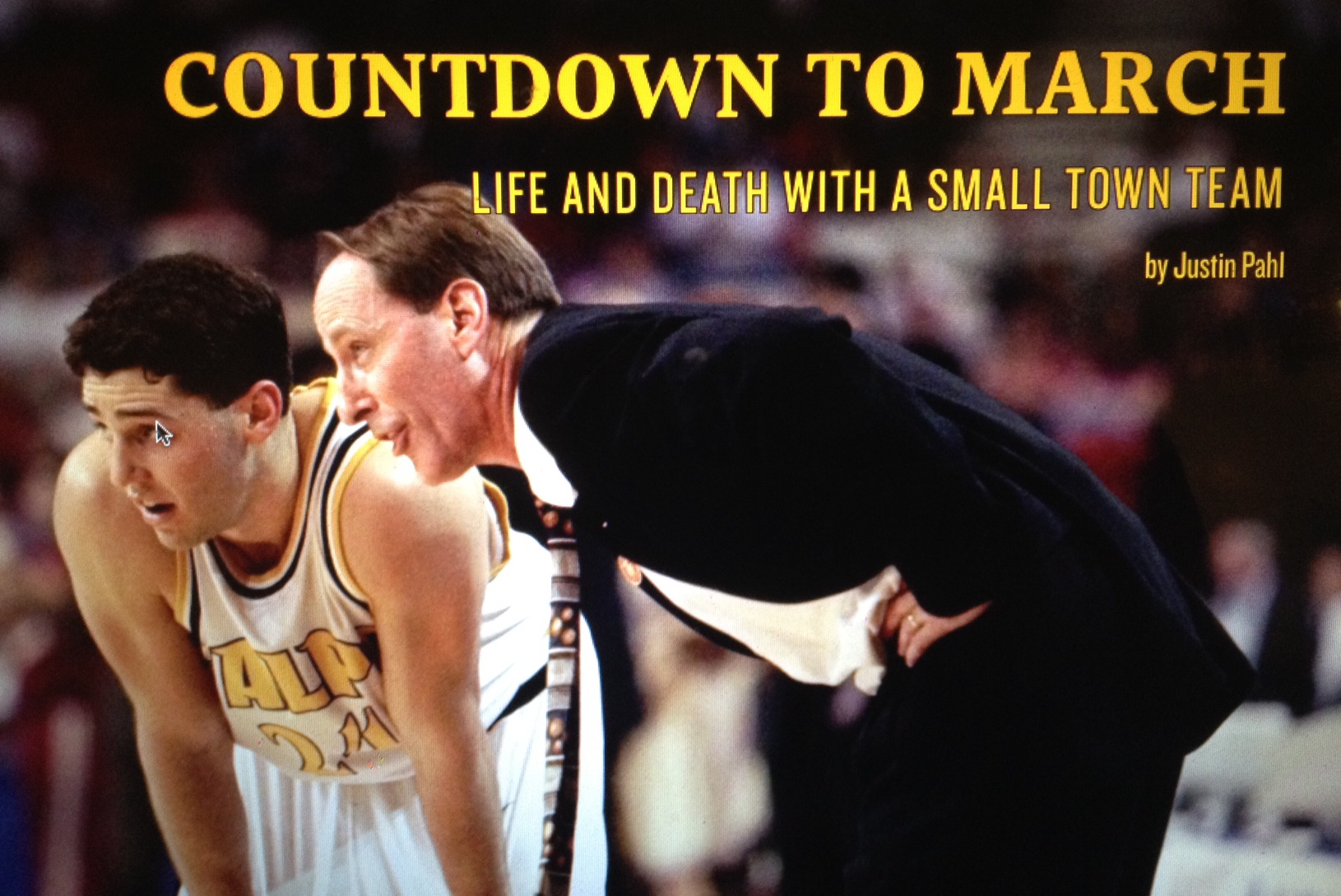
From SBNation.com
Although I’m a moderately serious sports fan, and I’ve been associated with a good number of colleges and universities over the years, I’ve never attended a school with a big-time sports program. On the pro side, I’ve maintained my strong affinity for Chicago teams (Cubs, Bears, and Bulls, oh my!), and been a fair-weather fan of the New York Mets (mid-80s), New York Knicks (80s-early 90s), and New England Patriots (Brady-Belichick era). However, when it comes to college basketball and football, I’ve been something of a waif.
I’ve been writing a lot about my college and law school experiences lately, so let’s take them from a sporting angle.
Starstruck and Bobcats
I received a very good classroom education at Valparaiso University, but its intercollegiate sports teams during the late 70s and early 80s were lackluster and not a big focus of campus life. VU had just made the jump to Division 1 basketball, and those early teams struggled for respectability. I went to only one game, against then-No. 1 ranked DePaul University, led by All American forward (and future NBA All Star) Mark Aguirre. When DePaul walked onto the court for warm-ups, the VU fans stood up — not to applaud or to jeer, but rather because we were starstruck that a top-ranked team was in our midst. The game itself played out as one might expect.
My next educational port of call was New York University for law school. During the early to mid 20th century, NYU enjoyed national success in both basketball and football circles, but by the time I arrived in 1982, intercollegiate sports had been de-emphasized to the point of irrelevance. It would relaunch its men’s basketball program at the Division 3 level during the mid-80s. They quickly assembled some good teams, even reaching the national championship game in the early 90s, and have remained competitive since then.
Each year I lived in New York, I would go to a few NYU hoops games, usually alone. D3 hoops games aren’t a big draw with the rest of Manhattan at your fingertips. Or maybe it was hard to get excited about a college team whose mascot is named after the library’s card catalog (Bobst Library Card Catalog, or Bobcat for short).
As for NYU’s football team, it remained undefeated throughout my years in the city, holding steady at 0-0. (Ba dum.)
Irrational fandom
Over the years, I’ve kept my affinity for Notre Dame football — a product of having grown up in Northwest Indiana. Fandom can be irrational; I’m neither Catholic nor a Notre Dame alum!
Because a dear friend is an Annapolis graduate (Class of 1953), I root for the Navy Midshipmen as well. Had some weird twist of fate ever led me to the Academy, I would’ve lasted about a week before getting booted out for continually questioning orders, so go figure.
During the 2000s, the University of Hawaii had a string of successful, fun-to-watch, pass happy teams, and I enjoyed pulling for them. The highlight of that run was an undefeated regular season in 2007, culminating in a Sugar Bowl appearance.
For reasons I can’t explain, I also follow from afar (usually by checking the box scores) the powerhouse Division 3 football team at the University of Mount Union in Ohio. Although they’ve been stymied in the national championship game in recent years by nemesis Wisconsin-Whitewater, they have compiled some of the most remarkably dominant seasons in the history of collegiate football.
Back to Valpo
As for college basketball, well, I’m now rooting for Valparaiso(!), which has become a very competitive mid-major D1 team since my days there. The foundation was set seventeen years ago, when the Crusaders enjoyed a storybook season, topped off by a trip to the 1998 NCAA tournament and a Cinderella run to the Sweet Sixteen. Its star player was guard Bryce Drew, the coach’s son, who hit a legendary, buzzer beating 3-point shot to upset powerhouse Ole Miss in the first round:
Drew followed his collegiate glory with a solid stint in the NBA. He is now the Valparaiso head coach, and when VU makes an appearance on one of the ESPN stations, I’ll often watch or record the game. They made the NCAA tournament this year, losing in the opening round to Maryland in a close game.
This month, SB Nation ran an excellent long form piece by Justin Pahl, son of a former VU faculty member, who wrote about growing up with the emerging, underdog VU basketball program during the 1990s. It’s a very good story about life and sports in a small, Midwestern university town. I took a screen shot and pasted it in above.
Dreaming of spring training

Baseball season approaches! Meanwhile, if you’re wondering what the sidewalks look like in many residential areas of Boston, here’s one from my ‘hood. I snapped the photo on Sunday night, walking home from the subway. (Photo: DY, 2015)
During this winter of our discontent here in Boston, baseball season seems as far away as the moon. Perhaps that’s why I find myself waxing nostalgic about the game, thinking back to my boyhood years when I became a fan.
During my latter grade school years, I discovered baseball, both watching and playing. The watching was inspired by my 80-something grandfather, who was living with us in Northwest Indiana and enjoyed Chicago Cubs games on television. He didn’t speak much English, but he could follow the ballgames, and so after school and during summers, we’d often watch with him in our little TV room. Here’s the song that would open many a Cubs telecast:
The playing was by way of my friends, who were big sports fans. A few were on organized Little League teams, but for most of us baseball was a pick-up game played on the local parkway, with improvised diamonds. I was terrible at first, but I had fun and kept at it, to the point where I could hold my own hitting and fielding.
In fact, my affinity for the game grew quickly, and the slightest sign of spring became reason to get out my baseball glove and bat. Once the temperatures hit the 60s, I would be full of anticipation for the coming Cubs season and for our parkway ballgames. I’d check the newspaper for news about spring training and search out neighborhood pals to play catch. I also became a fan of tabletop baseball games that used statistical charts and cards to simulate the performances of real-life baseball players — the forerunners of today’s sophisticated computer and video games.
As I got older my focus on baseball waned. But after I graduated from law school, I rediscovered the game. I was in New York City by then, and in the mid-1980s it was still possible to get Mets grandstand seats for under $10. I shared a pair of season tickets with friends during the Mets 1986 World Series championship season, and it was a blast. I also joined fellow Legal Aid Society lawyers for weekly softball games in Brooklyn’s Prospect Park. Yup, those were good years.
Today, I’d be in better physical shape if I was still playing softball, instead of anticipating the start of fantasy baseball season and playing baseball board and computer games! Whatever. Until this snow starts to clear up, any manifestations of baseball around here will be virtual anyway.
I’m still writing about (drum roll, please) snow

Sunday a.m., looking down my street while the wind gusts
Dear readers, you’re about to be treated to another entry about the weather here in Boston. We’ve got our fourth consecutive weekly Big Snowstorm, two of them blizzards. Winter Storm Neptune (snowstorm 4/blizzard 2 if you’re counting) has been unfolding before our very eyes this weekend.
I wish I could claim that I’ve turned the snowbound days into productive work activity, but it’s only partially true. The weather geek in me keeps an eye on the TV weather coverage, even if it’s becoming repetitive. Snow here, snow there, snow everywhere — and plenty of wind gusts, too. This is, after all, a weather pattern of historic proportions, and we’ll be talking about it for years. Hey, this ain’t nothin’ compared to the big ones back in ’15……
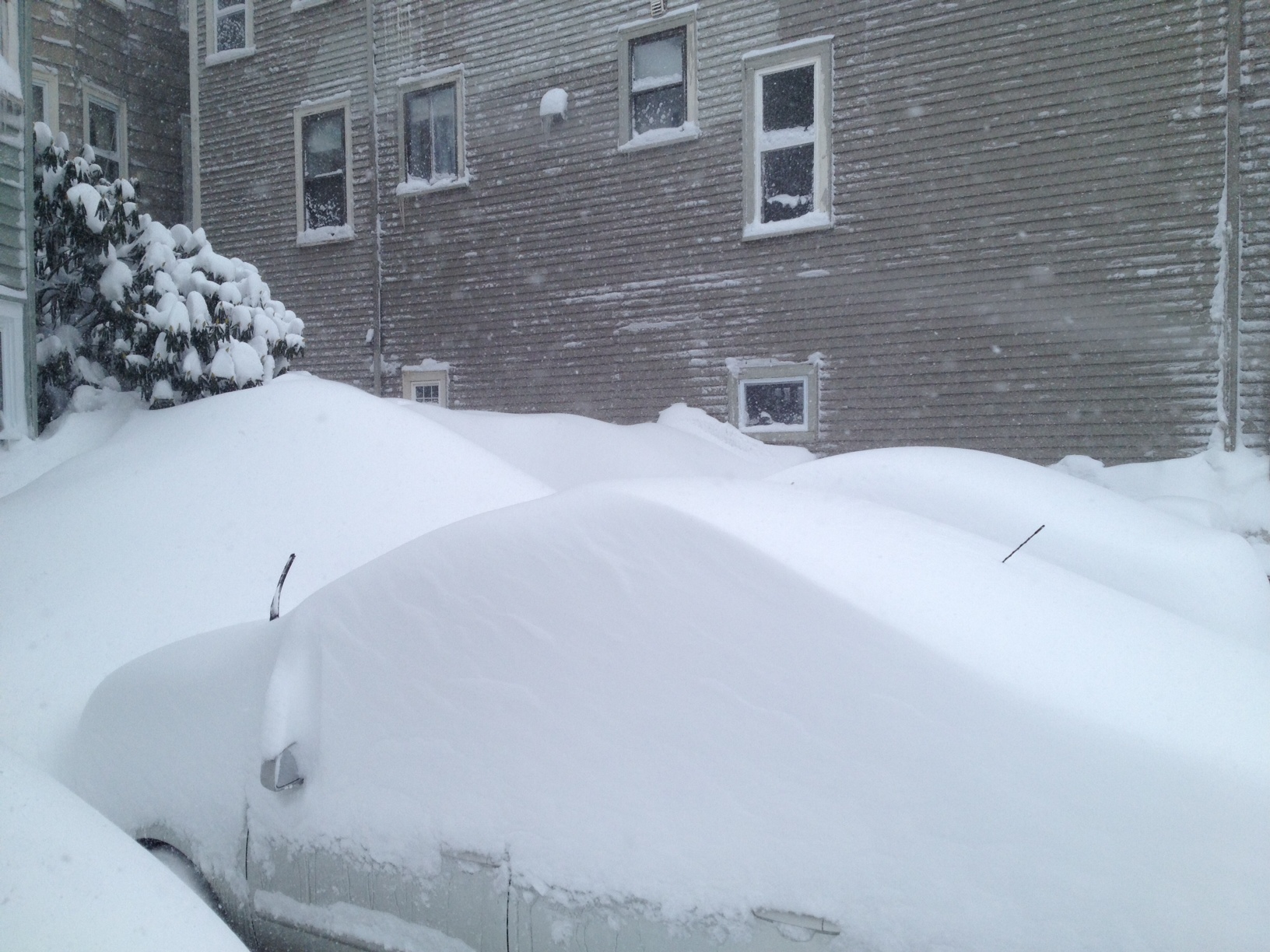
Sunday a.m., neighborhood snowmobiles
The local transit authority announced that the subway, buses, and commuter rail will be operating on, to put it gently, adjusted schedules on Monday, after being shut down completely today. My university decided to hold classes, which means that a lot of students, faculty, and staff will be having somewhat adventurous sojourns into downtown Boston. I’ll be among them!
I’ll also have a little soreness in this middle aged body tomorrow, thanks to my largely futile efforts at snow shoveling today. Fortunately, I was able to hire a couple of guys who were earning extra cash with a snowblower and a snowplow truck. They did in a few minutes what would’ve taken me…never mind…I wouldn’t have finished. That said, even the snowblower had trouble pushing through mounds of snow where the sidewalk was supposed to be.
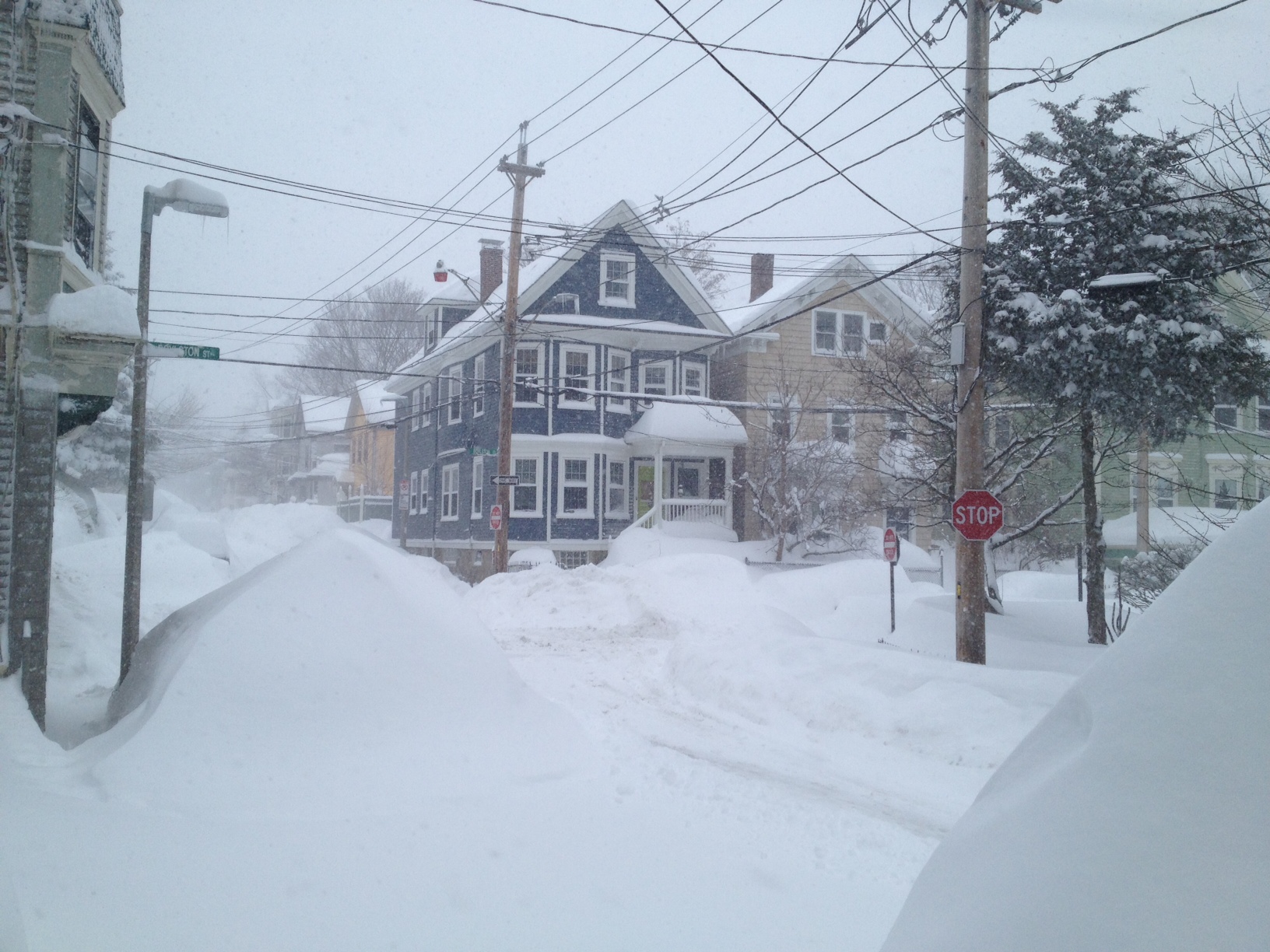
Sunday a.m., corner intersection
I did manage to watch some TV, including the latest episode of The Americans, one of the best one hour dramas around right now. I also watched an ESPN streamed college basketball game featuring my undergraduate alma mater, Valparaiso University, overcoming a half-time deficit to beat Wisconsin-Milwaukee, the latest win in a surprisingly strong season. VU’s basketball team wasn’t much to speak of while I was a student. But its fortunes have improved considerably since then, to the point where VU now ranks among the better mid-major Division I hoops programs.
As I finish off this blog post, I’m missing a 40th anniversary special for Saturday Night Live. It realize that it’s an iconic Generation Jones television show, premiering in 1975. SNL has had its moments — for me “Da Bears” skits and Tina Fey’s Sarah Palin impersonations are brilliant — but overall I find its humor misses as often as it hits. Maybe I’ll catch it another time, perhaps during a future snowstorm.
Throwback Thursday: Steve Anderson’s “Retro Football Games”

Those who want to play a game of simulated football today are likely to fire up Madden Football on their video game systems or check the status of their fantasy football teams. But before these brands of fake football became all the rage, gridiron fans who wanted to coach their very own teams could opt from a rich variety of board and electronic football games.
For a grand stroll through these offerings, check out Steve Anderson’s Retro Football Games (2014), an illustrated look at vintage tabletop football games from the last century. It’s a beautifully done book, featuring hundreds of games, ranging from very simple recreations of the sport, to complex statistical simulations that incorporate actual player performances and play calling options. Interspersed with the photographs and brief descriptions are short sections on football trivia and collectibles.
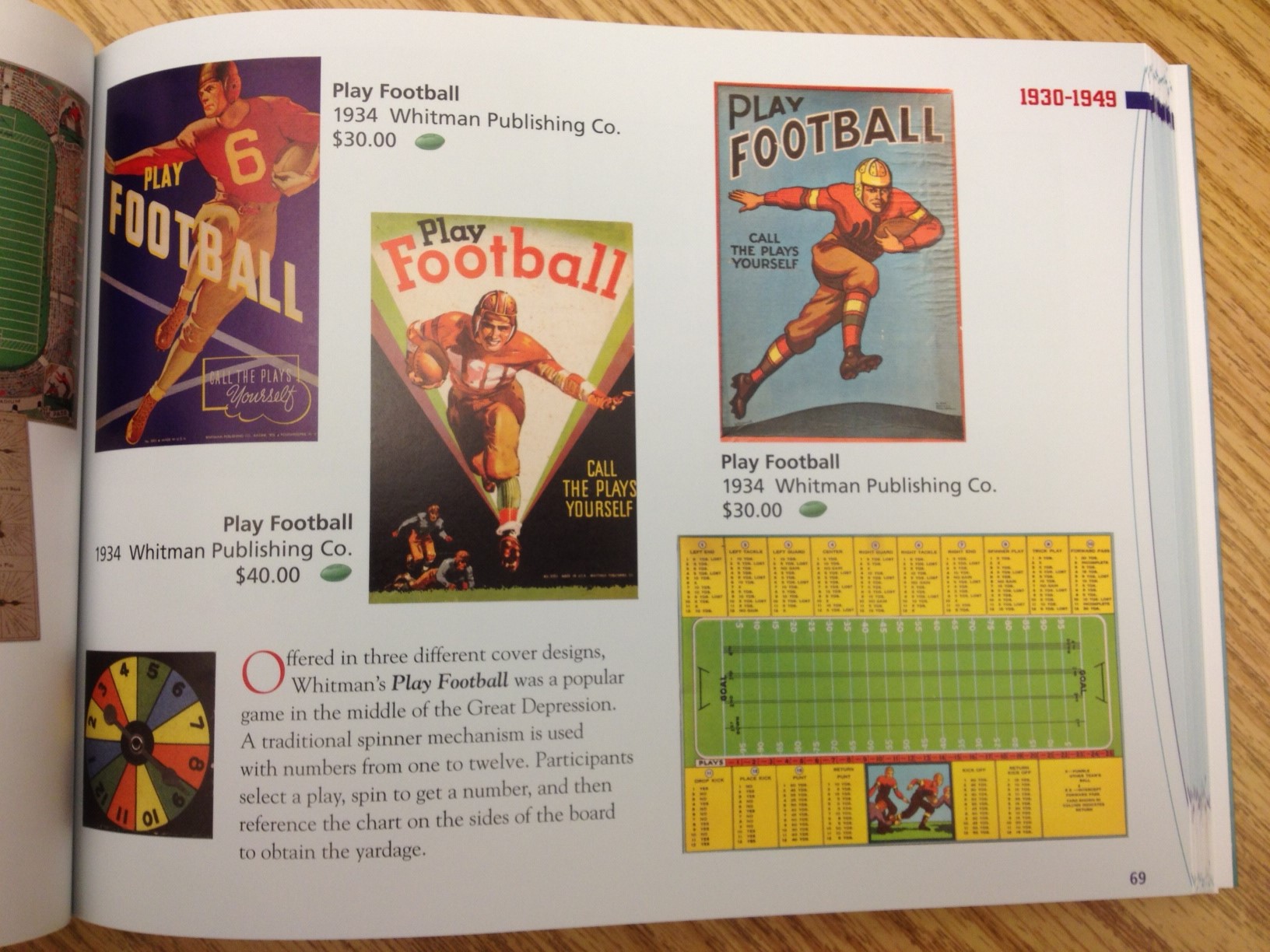
The Whitman Play Football game from the 1930s is an example of a simpler version of tabletop football. It’s activated by a spinner, with the play results obtained from the game board.
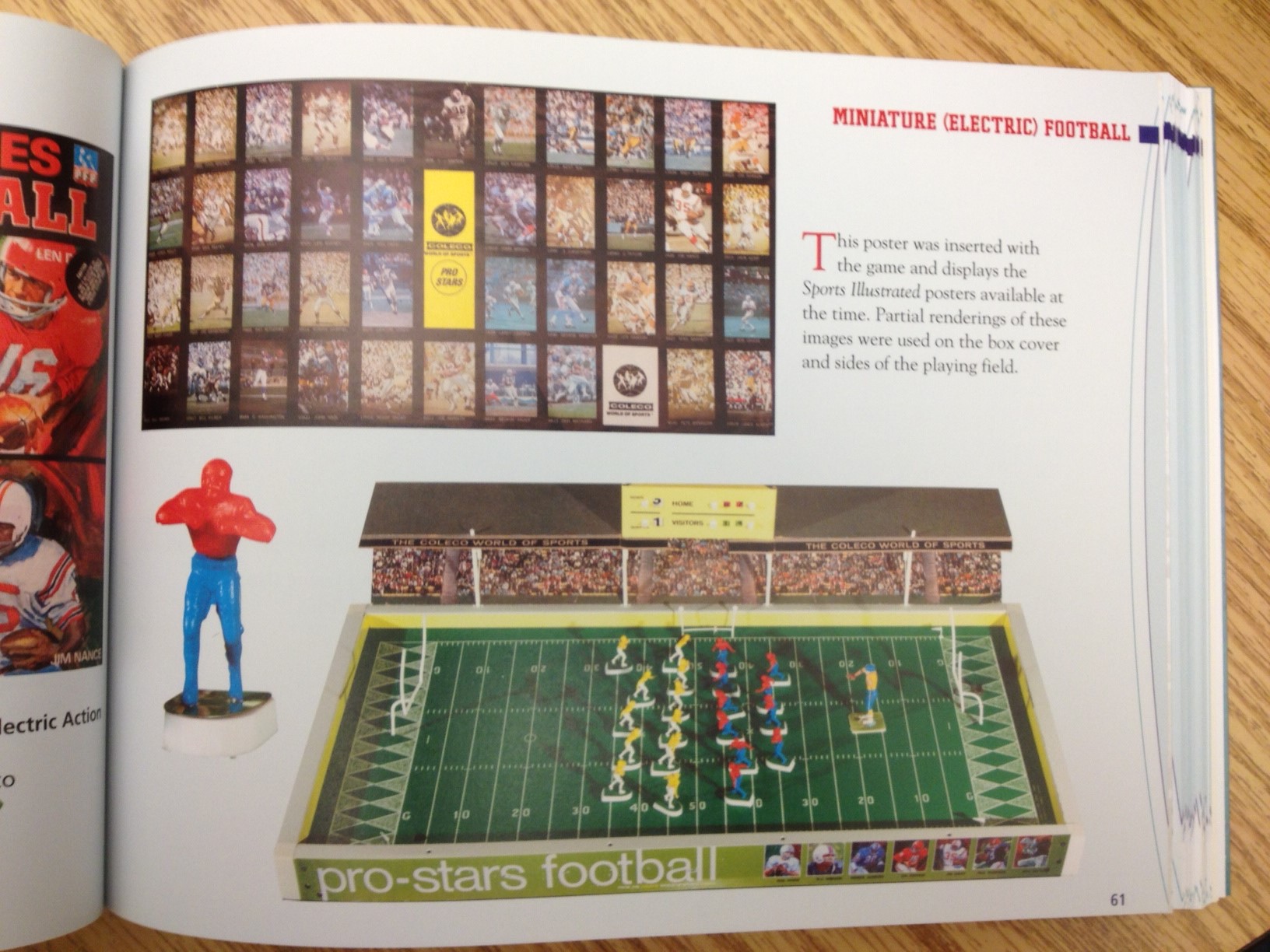
If you were a young fan in the 60s or 70s, it’s very possible that you played some brand of electric football. A vibrating field and quarterback figures who could “throw” a tiny felt football were the supposed keys to the plastic players executing their plays, but for many of us the results included mainly wrong-way runs and errant passes.

Eventually tabletop football became more complex and sophisticated, with game systems that used real player performances translated into player cards and roster sheets with statistical ratings that would be taken into account when determining play results. No longer did you have to imagine your star player overwhelming the opposition based on generic result charts like the Whitman game. Instead, games like APBA Football would allow you to pick your lineups and plot game strategies.
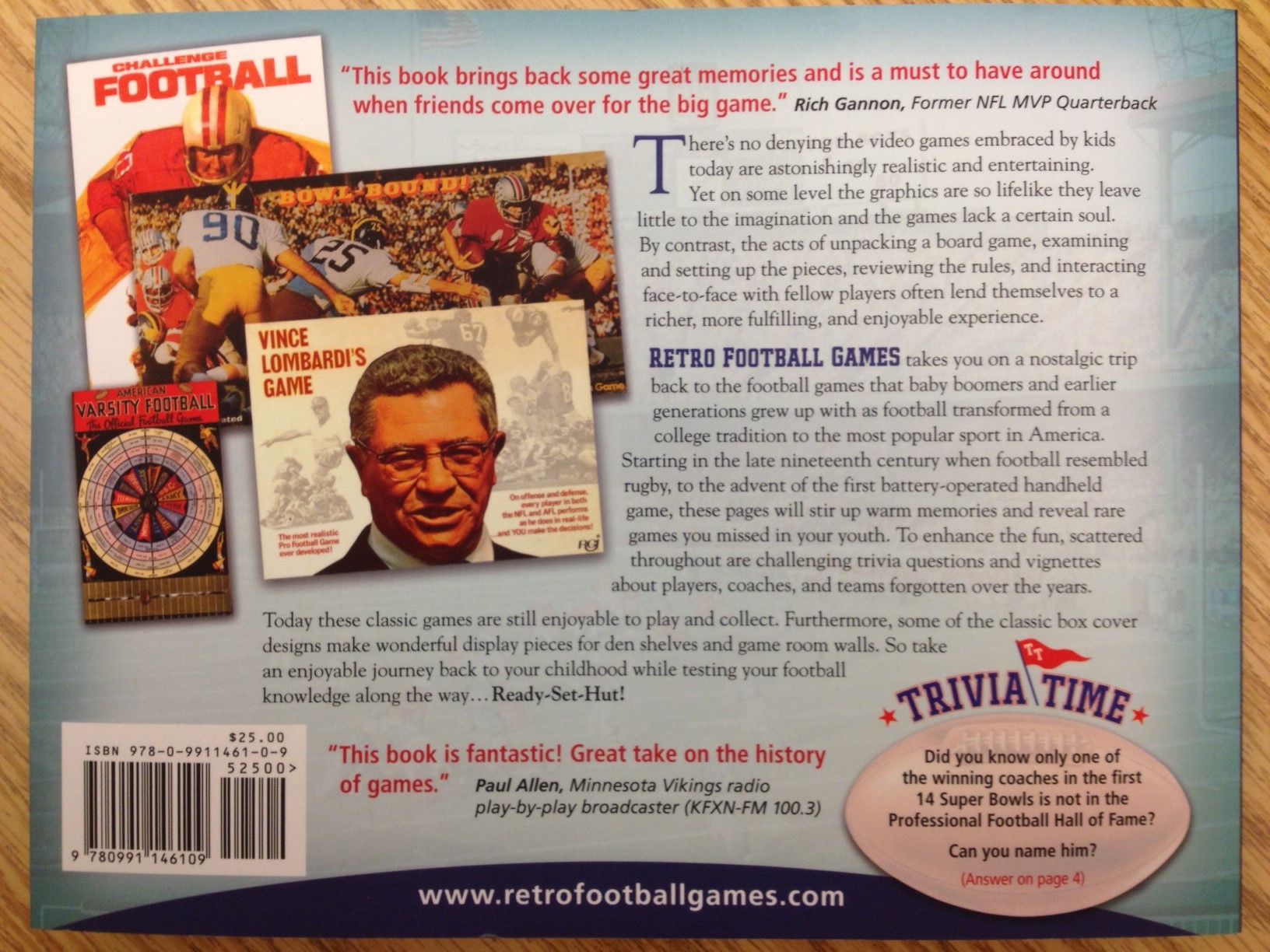
Steve’s book arrives just as the current football season is in full swing. Especially for those who grew up during this era, it’s nostalgic eye candy and a fun read. For more information and ordering details, go to his website, here.
***
For more fun
Tabletop football is not dead — far from it! In fact, buoyed by consistent demand from a lot of guys around my age, many of these games continue to be offered, with new offerings popping up all the time. There’s also an active after-market on e-Bay and sites dedicated to tabletop sports games, such as this popular site on Delphi. In addition, the second issue of a new tabletop sports zine, One for Five, features a cover package including descriptions of currently available football games.
All photos (including the blurry ones): DY, 2014
Summer means…football pre-season magazines!

Especially after I whined about the brutal winter we experienced here in Boston, it may seem odd that the summer months fill me with anticipation for the start of fall football season. But I can’t help it — I’ve been a football fan since junior high school — so around this time of the year I start checking the magazine stands for the usual rush of pre-season pro and college football previews.
I’m more into the pro game than the college game, but I load up on pre-season mags for both, as well as a fantasy football guide or two.
On the pro side, I’ve been devoted to the Chicago Bears since I started to follow the game, over a decade before the awesome, wondrous 1985 championship season. When a Bears game is televised here in Boston, I make every effort to watch it. I still get psyched when they win, and I get a tad down when they lose. Since moving to Boston in 1994, I’ve also become a fair weather New England Patriots fan. It’s easy to root for the Pats when they are Super Bowl contenders practically every season! I don’t know what I’ll do when coach Bill Belichick and quarterback Tom Brady call it quits, however.
On the college side, it’s Notre Dame for me. Growing up in NW Indiana, I couldn’t help but gain an affinity. Although I’m neither Catholic nor a Notre Dame alum, I’m drawn into the whole Notre Dame football mystique. I also root for the University of Hawaii and Navy, even though I have no official connections to either of those schools! Fandom is not logical.
Personally, I’ve never attended a big name football school. Valparaiso University, my undergraduate alma mater, is known more for its successful mid-major basketball program than for its football team. New York University, my law school alma mater, hasn’t played the game in decades, although early in the last century NYU had a significant football program.
On the fantasy football side, my Jamaica Plain Storm won its league in 2012 and generally has been pretty competitive. I pay moderately serious attention to my fake football team. Such are the priorities of willfully prolonged adolescence.
Derby-Pie, baseball bats, and a Gatsby-esque hotel in Louisville
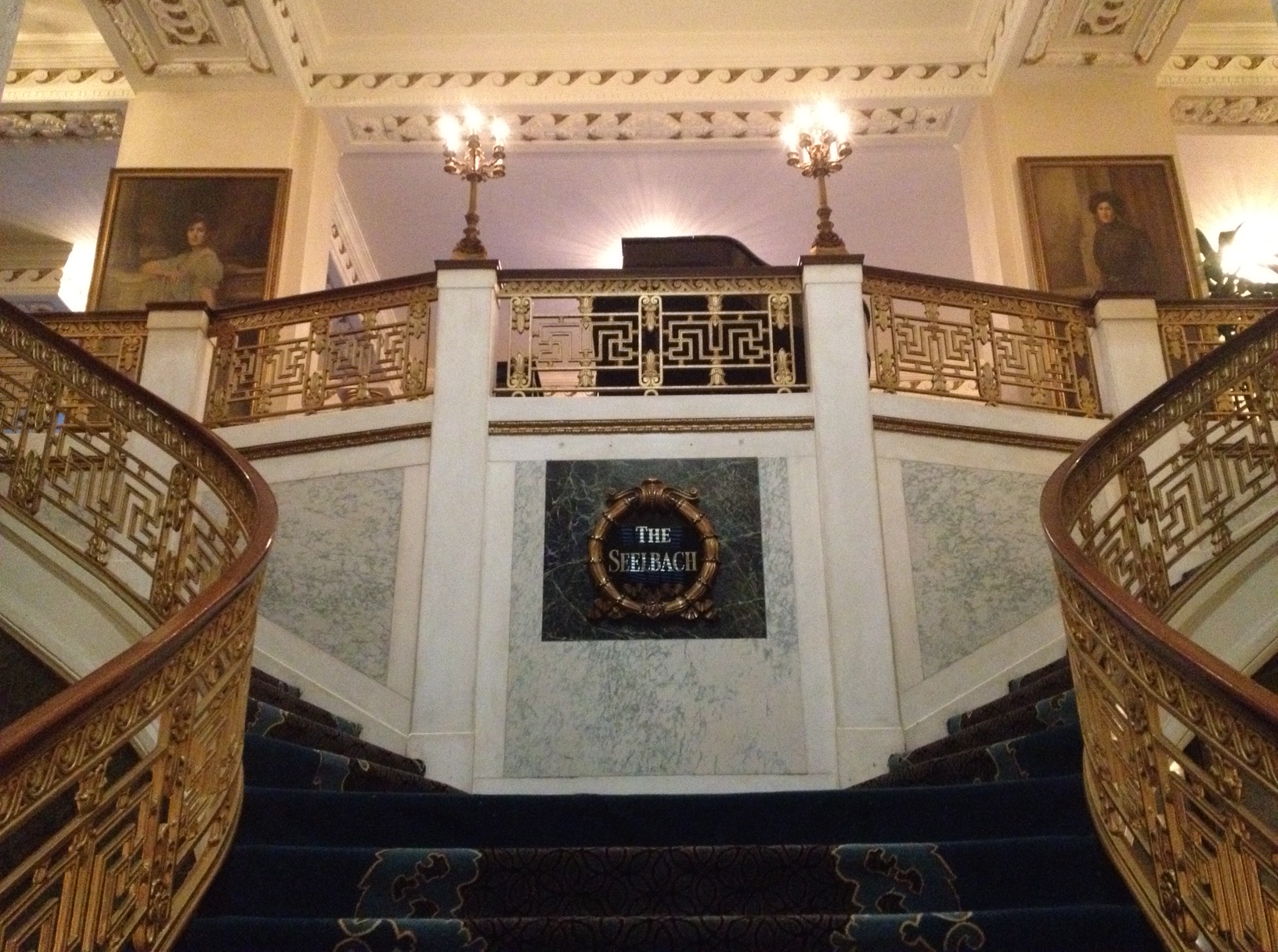
Featuring Scott, Big Al, and maybe a ghost or two (photo: DY, 2014)
I was reminded how travel is one of the benefits of my work when I made a quick trip to Louisville, Kentucky to speak last Friday at a continuing legal education program sponsored by the University of Louisville’s Brandeis School of Law.
It was my first visit to this historic old riverboat city, and I hope that I’ll be able to return for a longer one.
Seelbach Hotel
The conference was held at the Seelbach Hilton Hotel in downtown Louisville. I’m sufficiently clueless about interior aesthetics that I rarely notice much about hotels I stay in, but the Seelbach is a beautiful place with lots of history. F. Scott Fitzgerald spent time there and was so taken by it that he used the hotel as the setting for Tom and Daisy Buchanan’s wedding in The Great Gatsby. Prohibition era gangster Al Capone was a frequent visitor as well.
And as befits any classic old hotel, ghost sightings have been reported at the Seelbach. Local history expert Nicholas Howard writes:
The first ghost sighting was in 1987 when a cook spotted a woman in a blue dress with long dark hair walk into the elevator and disappear; the catch was the doors were closed the whole time. A maid spotted the same woman the same day. With some investigating, it is believed she is the spirit of a woman that died there in 1931. . . .
A guest in 1985 also called the desk saying she felt something rubbing her legs when she got into her bed; nothing was ever found in the room. There are also reports of guests TVs being turned on in the middle of the night, the air conditioners coming on and reports of an old woman roaming the halls.
Baseball bats
I believe the first time I ever heard of Louisville was in connection with baseball bats. You see, “Louisville Slugger” is the name of an iconic brand of baseball bat, and the company still has its headquarters in the city. Walking along Main Street, you’ll see Louisville Slugger plaques and baseball bats making for the “Walk of Fame.” As a baseball fan, I got a big kick out of this!
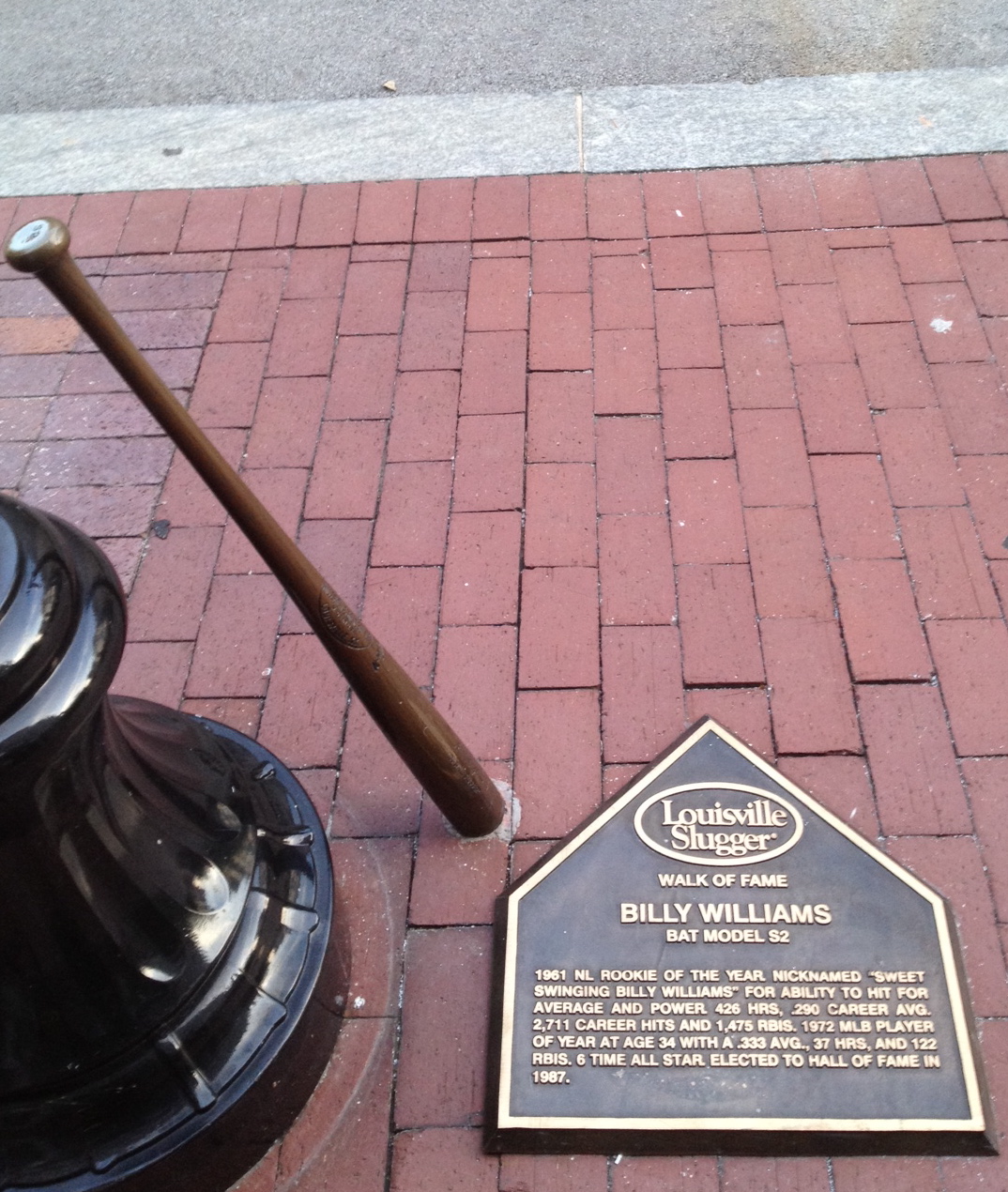
Honoring Hall of Fame outfielder Billy Williams, one of my favorite Chicago Cubs (photo: DY, 2014)
Derby-Pie
The conference organizers hosted a lovely dinner for program speakers at the Bristol Bar & Grill, and the highlight for me was a local dessert known as Derby-Pie, which I can best describe as a sort of walnut & chocolate chip pie with a flaky crust.

From derbypie.com
Derby-Pie is one of the best desserts I’ve ever tasted! On a plate in a dimmed dining room, it looks like just another dessert, but after one bite…
Throwback Thursday: Playing baseball and discovering “dinosaur bones” on Baring Parkway

Baring Parkway, Hammond, Indiana (Cropped & magnified version of photo originally taken by Edwin Rivera — thanks Edwin, and blame the blurs on me!)
Baring Parkway makes up two big rectangular plots of grass and trees in the Woodmar neighborhood of Hammond, Indiana, the small northwest Indiana city where I grew up. For me and many others during the late 60s and early 70s, it was our baseball diamond, football field, and — on one occasion — archeological dig.
Fields of dreams
Some of my best memories of those days are of playing pick up baseball games with improvised rules and teams made up of guys who showed up on any particular afternoon or early evening. It was slow pitch hardball; a batter could strike out but couldn’t wait out a walk. If we didn’t have enough players for full teams, a ball hit to an uncovered part of the outfield was considered an automatic out. There were no fences, so a home run had to be earned by hitting the ball far and running fast. (Umm, my home runs were few and far between.)
I spent chunks of five or six summers playing in those pick up games on Baring Parkway. When I started, I was pretty terrible. I could barely hit the ball, and my fielding skills were pretty bad too. Early on, if there was an odd number of players, I’d be designated the “official catcher,” which meant that I caught the slow lob pitches for both teams and didn’t get to bat. 😦 But I was becoming quite a baseball fan, so I stuck with it, enough so that I could hold my own at bat and in the field. Such improvements are the little things that can build a kid’s self-confidence.
Baseball was still America’s national pastime. Although I don’t want to over-romanticize those days, a love of the game was very much a part of the culture of this gritty little industrial city. Youth baseball leagues were very popular, and a fair number of future high school and even college standouts cut their teeth that way.
Our Baring Parkway games harbored no such sporting ambitions. We played for the fun of it, and by and large, the experience delivered. Furthermore, we mostly got along with each other, with only an occasional disagreement blowing up into fisticuffs.
The photo above shows a lush green park. Our makeshift baseball diamonds made Baring Parkway less picturesque, with carved out bases and basepaths pockmarking the landscape. But on a nice summer day, you could see kids enjoying themselves with a game of baseball, which I think was a good tradeoff.
Football was less popular those days, but occasionally we’d turn a stretch of the Parkway into a makeshift gridiron. We played both touch and tackle varieties, adding necessary rules such as minimum counts before a defender could rush the passer (“one Mississippi, two Mississippi…”). We usually played without safety equipment, but I cannot recall any injuries of note other than some bumps and bruises.
In search of dinosaurs
One early fall — I’m pretty sure as we were starting the 6th grade — a big utility company dug up much of the Parkway to do some work on the underground pipes. This meant a temporary suspension of its use as a playing field, but what we discovered there caused us to shelve our growing obsession with sports.
Unlike today, when fences, orange tape, and big signs will warn people (er, kids) to stay away, we could simply walk right into the work site. I cannot recall who first ventured into the excavation area, but I remember how quickly the news traveled among our small group of friends: There are lots of bones down there, as in bones from big animals.
And so we went, with small shovels and garden tools in hand, during early evenings and the weekends when the workers weren’t on site. And we dug up these big bones and all thought, whoa, I wonder if these are dinosaur bones???!!! We took bags of them to show & tell at our grade school, breathlessly speculating about whether they were the remains of giants that once roamed the planet.
Well folks, it turns out that none of our archeological discoveries will be found at your local natural history museum. Indeed, the fact that we also dug up rusty horseshoes at the site should’ve told us that we weren’t on the trail of a mighty T-Rex. But our excitement over this discovery allowed us to suspend disbelief, and also would make for a good childhood memory along the way.
Kids and unstructured time
Back in the day, a childhood for a someone born into America’s emerging middle class or robust working class came with free time, especially during summers after the school year ended. Sure, for some there were activities such as scouting, church groups, organized sports, and the like, but overall our days didn’t seem quite as packed as those of today’s young folks.
Although I’m not a parent, I understand how modern child raising often involves a lot more structured, adult-supervised activities than we saw with earlier generations. Still, it saddens me a bit that the kind of self-organized play that we engaged in on Baring Parkway is less and less of a typical kid’s experience. This was an era when parents (usually moms) could tell their kids to go outside and play, and about the only mild concern was whether you’d be home in time for dinner. Yup, times have changed.
Jack Kerouac’s homebrewed tabletop baseball game
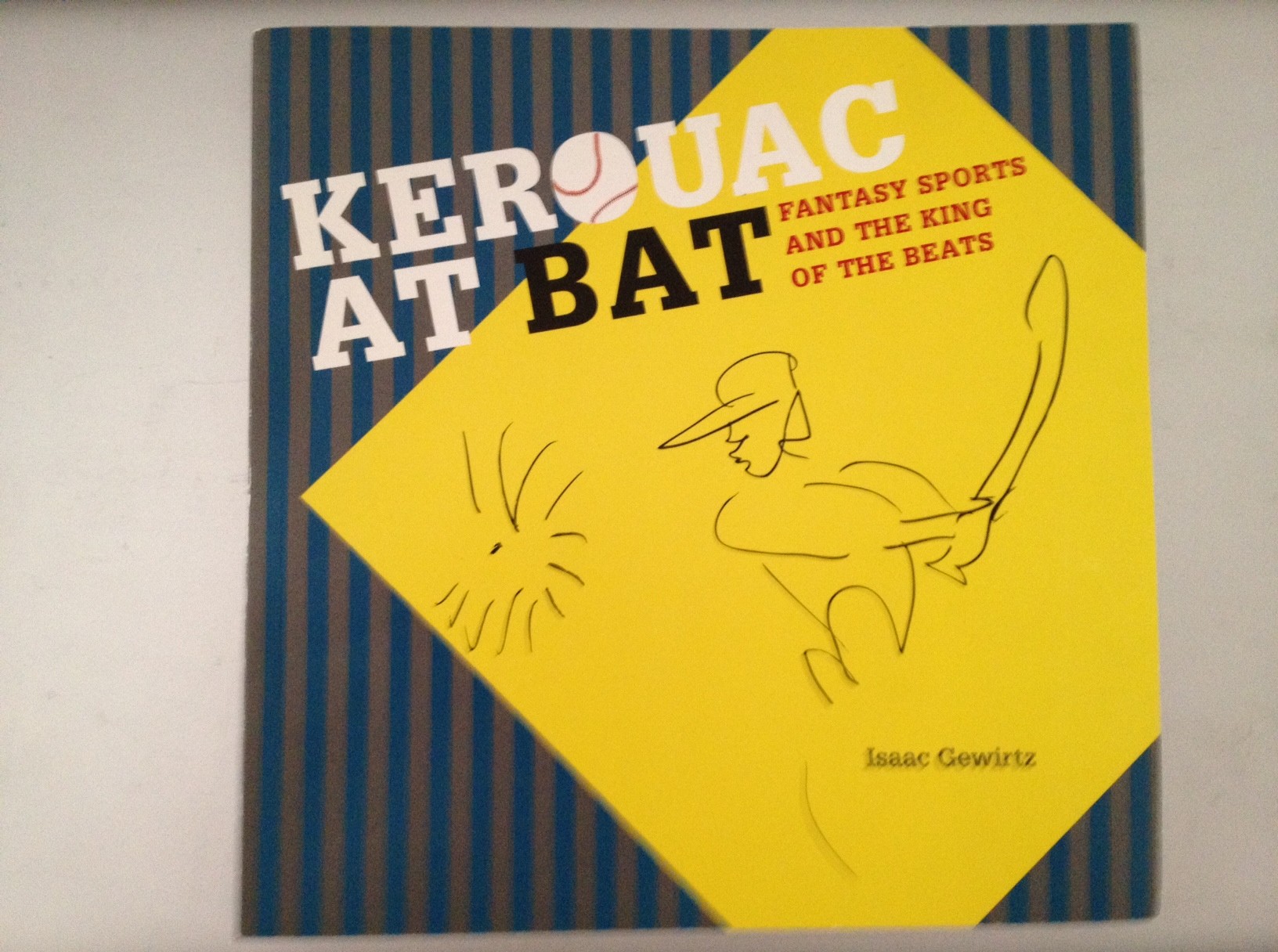
You may be familiar with Jack Kerouac (1922-1969) as the author of novels (e.g., On the Road) and poetry that established him as an iconic figure of the Beat Generation. But did you also know that he was a big sports fan who blended a love of baseball and a rich imagination to create a homebrewed tabletop baseball game? The game featured a league of fictitious teams and ballplayers that he played for years, well into his adulthood.
With baseball season moving into full swing, I’m delighted to highlight Isaac Gewirtz’s Kerouac at Bat: Fantasy Sports and the King of the Beats (2009), a colorful 100-page book about Kerouac’s fantasy sports world, including plenty of photos of Kerouac’s own baseball game and the voluminous league records he maintained. The book is published by the New York Public Library (Gewirtz is a curator there), and it’s listed in the NYPL’s online catalog.

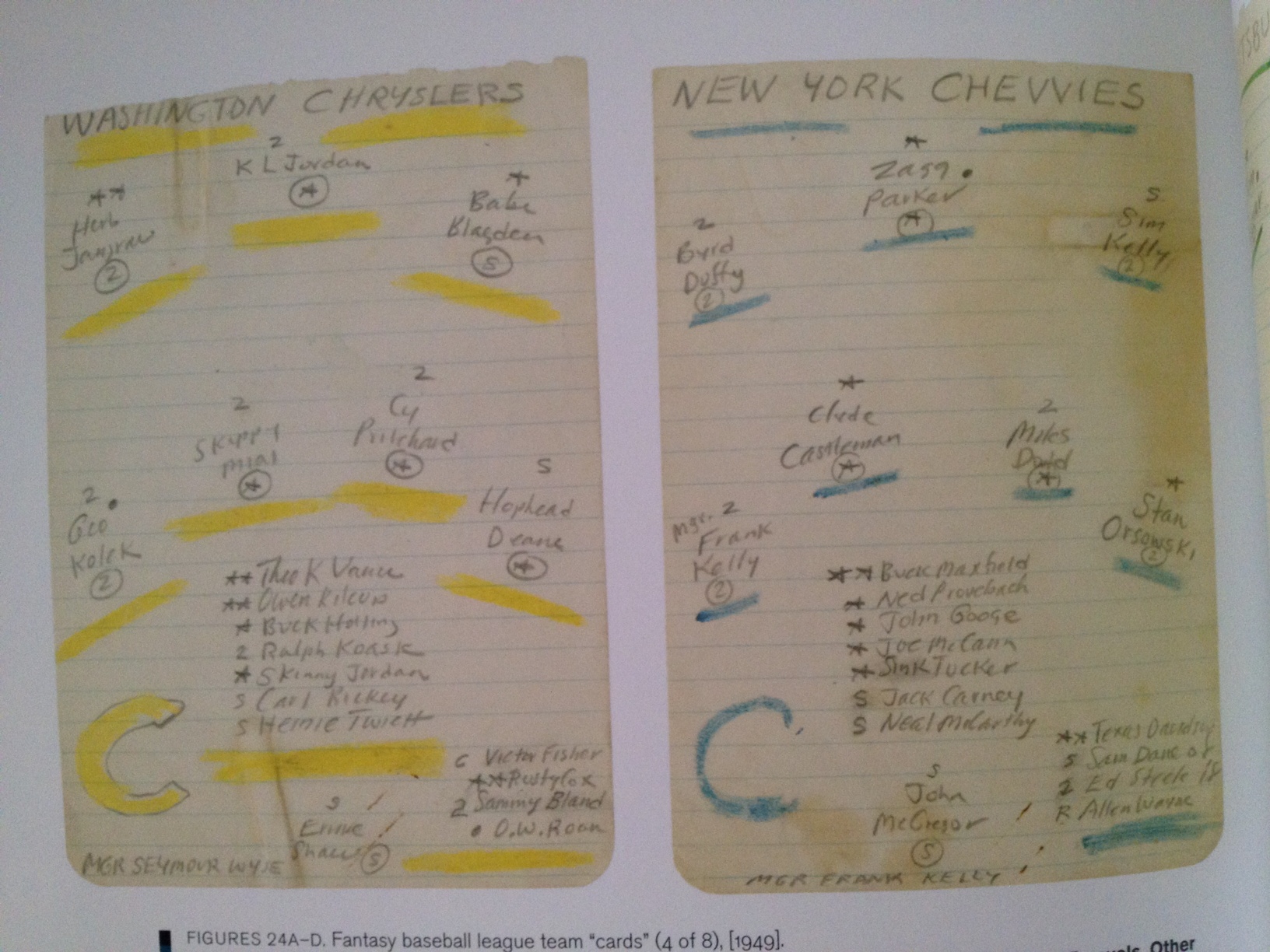
Through his game, Kerouac created his own fictitious world of baseball, proceeding from season to season. During the earlier years of his baseball league, he named his teams after car brands:
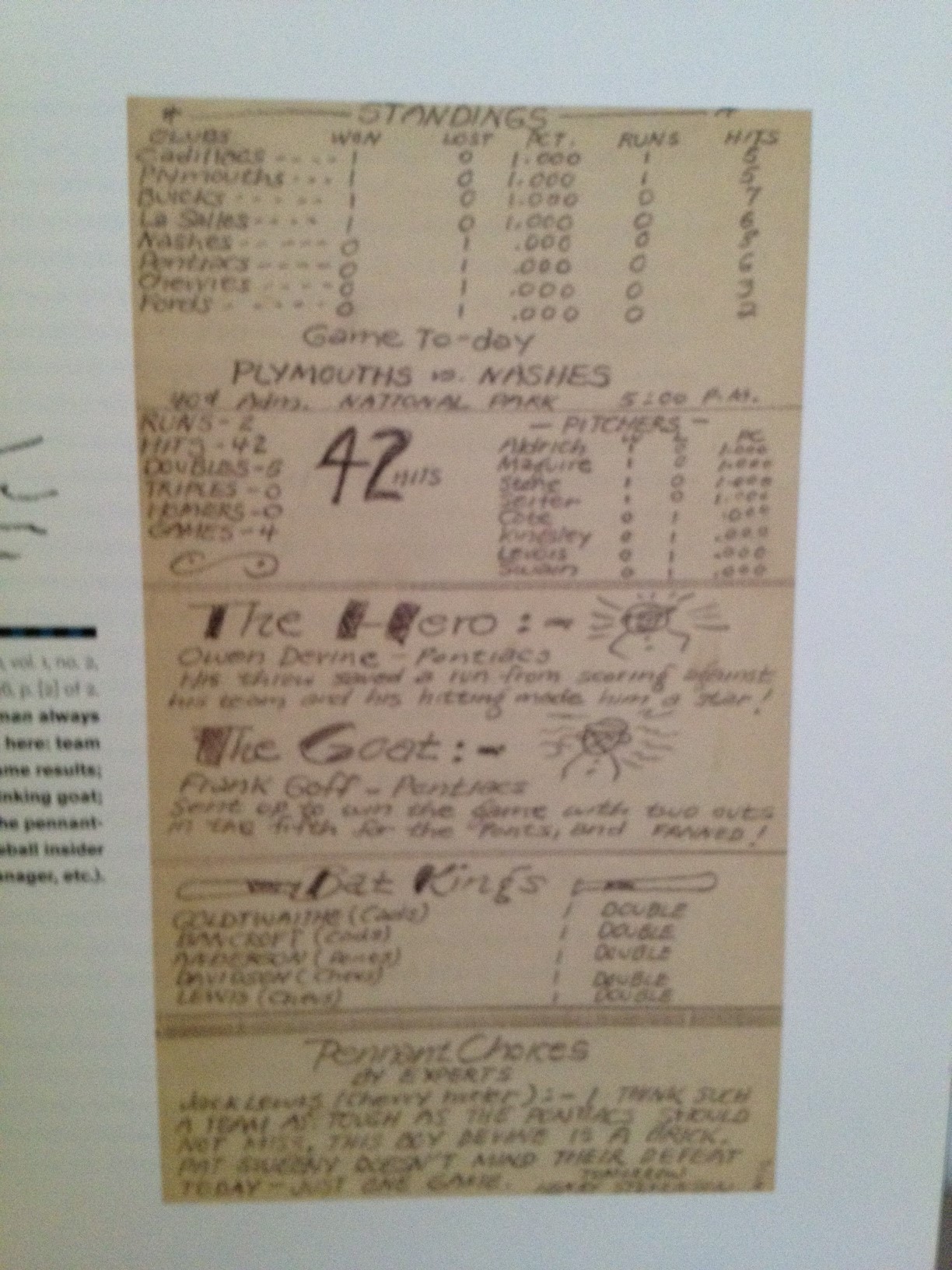
Kerouac added journalistic touches to his baseball league. Here’s a write-up of early-season league action, including the nascent standings and a game summary:
Kerouac’s game slightly preceded the arrival of dozens of commercially marketed baseball board games, such as APBA and Strat-O-Matic, in which players recreate the performances of real-life major leaguers via game engines that blend assorted charts, player performance cards or rosters, and activators such as dice or spinners. Computer and videogame platforms have now brought baseball simulations into the digital age. (For those who want to check out the contemporary tabletop sports simulation scene, the Tabletop Sports game forum on Delphi is a good starting place.)
Perhaps newspaper reporter and APBA baseball fan Kenneth Heard is following in Kerouac’s footsteps with his terrific personal blog, Love, Life and APBA Baseball, in which he mixes game and league summaries with personal stories and observations about life.

Vintage edition of the APBA baseball game (From apbagames.com)
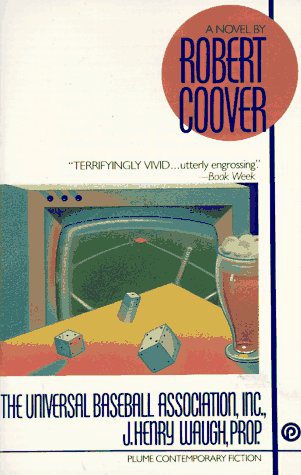
Kerouac’s fictitious tabletop baseball world also preceded Robert Coover’s The Universal Baseball Association, Inc., J. Henry Waugh, Prop. (1968), the tale of a man who invents his own cards & dice baseball game and becomes lost in the life of his fictitious baseball league. It’s considered a minor classic and one of the best books about the dramatic pull of baseball.
I’ve been playing tabletop sports games since I was in grade school. Last year I played the 1969 Chicago Cubs schedule on the iPad version of Out of the Park baseball. I was attempting to reverse the fortunes of a favorite team that, in real life, slumped badly at season’s end and lost the division title to the New York Mets, the eventual World Series champs. (I’m afraid that my management of the digital Cubs resulted in a much worse record!)
But I digress! You see, it comes easily for those of us who, like Kerouac, enjoy recreating a favorite sport with the mind’s eye. Even if we lack his gift for writing novels, we can build a world of legendary sports accomplishments on our tabletops.
Pssst, buddy, wanna buy some “investment grade” baseball cards from the late 80s?

It is impossible to overestimate how truly worthless these cards happen to be
In my basement storage area, I have a trunk full of investment grade mostly worthless baseball cards from the late 1980s. In retrospect, it’s good that I was barely squeezing out a living as a public interest lawyer in New York, because if I had any more money to spend at the time, it’s possible I would’ve sunk it into buying even more baseball cards.
I know I’m not alone in this. During the mid to late 80s, grown men of various means spent a lot of money accumulating huge collections of cardboard with pictures of baseball players. Some, like me, dreamed that their prized acquisitions eventually would skyrocket in value, like so many vintage baseball cards from earlier in the century.
In fact, I even joined something called the Baseball Card Society, run by a fellow in New York who sent us “members” monthly packets of easily obtained new and recent baseball cards at premium prices, accompanied by “investment” letters and booklets that made this all sound like a serious and profitable business.
I wonder if famed economist John Kenneth Galbraith would’ve written about baseball card “investors” like me had he ever updated his humorous little book, A Short History of Financial Euphoria (1990), in which he detailed, among other things, the maniacal Dutch speculation over tulips during the 1630s.
Baseball card valuation 101
To understand the roots of the baseball card craze, let’s talk valuation. The value of baseball cards typically boils down to several key factors:
(1) Condition, condition, condition — A perfectly centered, mint condition baseball card is the ideal collectible.
(2) Subject — For baseball cards, it usually means the player depicted. The card of a popular future Hall of Famer is more valuable than a reserve player.
(3) Rookie — The term “rookie card” refers to the first time a player is depicted on a baseball card. Rookie cards are coveted by collectors.
(4) Scarcity — Less is more from a value standpoint, either because few were printed, or — in the case of so many baseball cards produced during the 50s, 60s, and 70s — because mom tossed them out when junior grew up and left the house.
Please keep these in mind as I boast a bit about my baseball card collection.
Showing off my “portfolio”
I begin with one of my most brilliant and bold speculative moves: My small pile of mint condition 1988 rookie cards of future Hall of Famer journeyman ballplayer Gregg Jeffries. I bought these beauties for a mere $5 each from…the Baseball Card Society! (Turns out they were a steal — from me!)

But aside from the occasional misses, there were the sure things. Like cards of superstars such as Mark McGwire, Jose Canseco, Barry Bonds, Rafael Palmiero, Roger Clemens, and more!!! Great players compiling epic statistics, all headed to the Hall of Fame, yes?!?!? Thank goodness I’ve got dozens of mint condition cards of each, including rookie cards. Forget the lottery; these babies are my ticket to the good life!!!
But…WHOOPS…these players and others ran into that performance-enhancing drug problem. Now their cards are worth as much as losing scratch tickets.
And there’s another big problem: The scarcity factor is a little, well, problematic. Even had these guys racked up their big numbers without the use of supplements, ever-expanding numbers of baseball card companies were pumping out millions upon gazillions of cards.
Consequently, there probably are enough Mark McGwire baseball cards out there to give a box of them to every person in the world. Even if every human being in India (plus their former lives) suddenly wanted to collect 1980s baseball cards, supply would still exceed demand.
Heave ho?
It’s about time I took a look at these boxes and boxes of baseball cards. Some, mainly the older ones from my childhood, and a few other cards that I bought smartly, have value. But the rest — including most of those late 80s cards — are worth next to nothing. Sounds like a late spring project, but until then, if you’d like a great deal on some vintage collectibles, leave a comment here and I’ll get right back to you.
Spring training: It’s time for “Who’s Who in Baseball”

My ongoing mind-over-matter battle with the winter elements has been buoyed by the annual arrival of Who’s Who in Baseball, a collection of lifetime records of active major league baseball players, at bookstores and magazine stands. The appearance of Who’s Who means that no matter how bad the winter has been, spring and baseball are not far away.
In addition, Who’s Who has a much deeper meaning to guys (yes, mostly guys) who grew up following their favorite big league teams and players back in the day. As you can see from the cover of the current edition, Who’s Who has been around forever. The 1972 edition pictured next to it goes back to my junior high days, when we followed baseball religiously.
Although baseball statistics are now big business — practically everything about the game that can be measured with numbers appears in print or online somewhere these days — the basic format of Who’s Who hasn’t changed much over the decades. A devoted Who’s Who reader from the 1970s could look at the page below from the 2014 edition and instantly recognize where it came from.
And oh, how we’d study those pages! I’m not alone in saying that even if I can’t remember what I had for lunch yesterday, I can still rattle off baseball stats from 40+ years ago. Who’s Who had a lot to do with that.
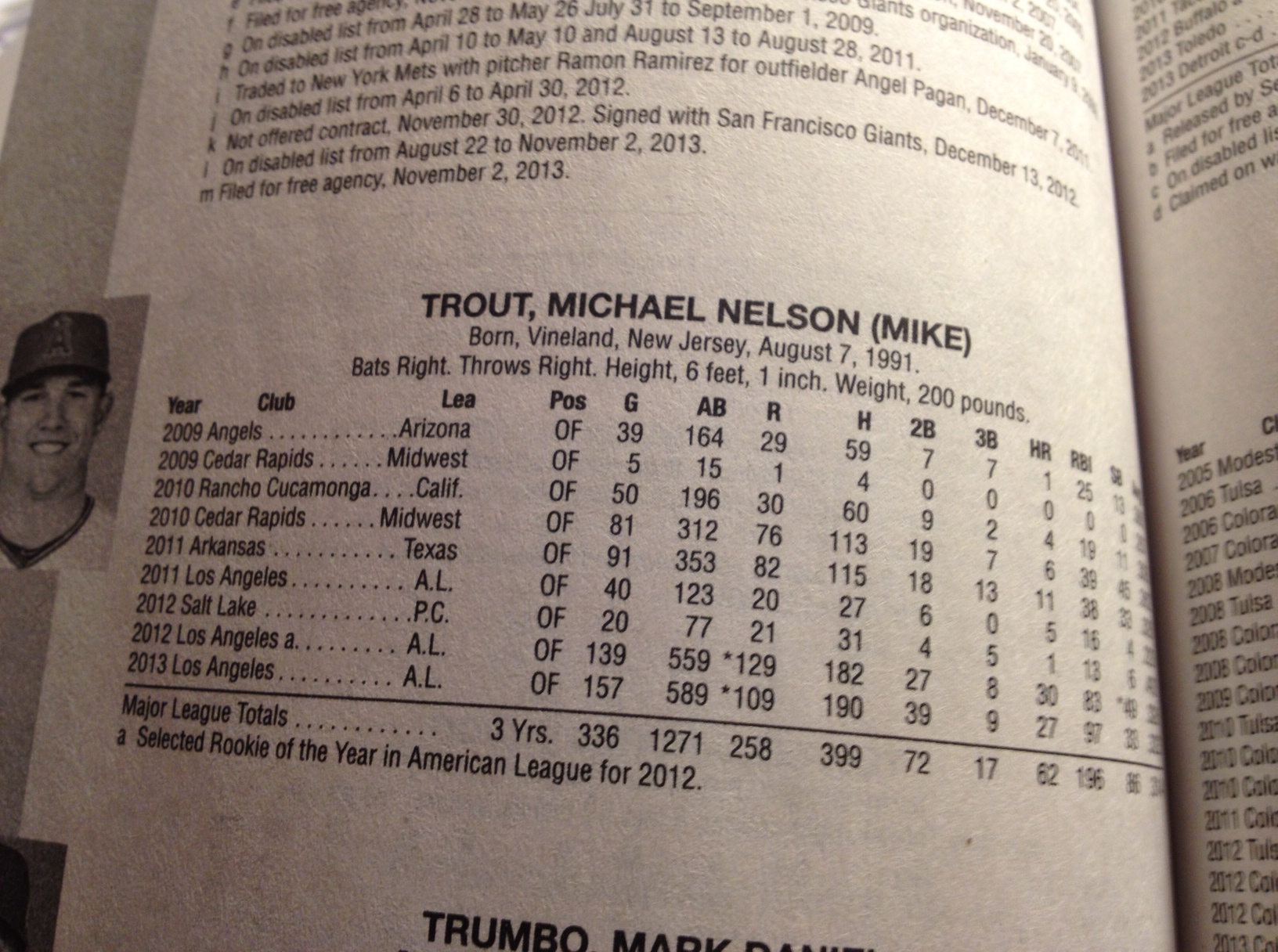
Fantasy baseball wasn’t around back in those days. But some of us played dice-and-charts statistical board games like APBA, Strat-O-Matic, Statis-Pro, Extra Innings, and Gil Hodges Pennant Fever, which allowed us to recreate player performances on our tabletops. These games were the precursors to computer and video sports simulation games today, and Who’s Who in Baseball was a key source toward informing us which players to draft for our pre-digital fantasy baseball squads.
The baseball stats explosion notwithstanding, I don’t need to know, say, how many times a guy grounded into a double play with two strikes on him. Hey, I’m a fan, not a big league manager. Instead, it’s more fun to flip through the pages of Who’s Who to trace players’ careers and to immerse myself in old-fashioned, plain vanilla stats like home runs, batting averages, wins, and ERA.
Enough snow. Play ball!
***
APBA and Strat-O-Matic are still in business, offering both board and computer versions of their baseball games. Even in this digital era, sports board game devotees form a hardy bunch, featuring a lot of Generation Jones members! I’ll have more to say about that hobby in a future post.
 Musings of a Gen Joneser
Recent Comments