Big Apple Thanksgiving
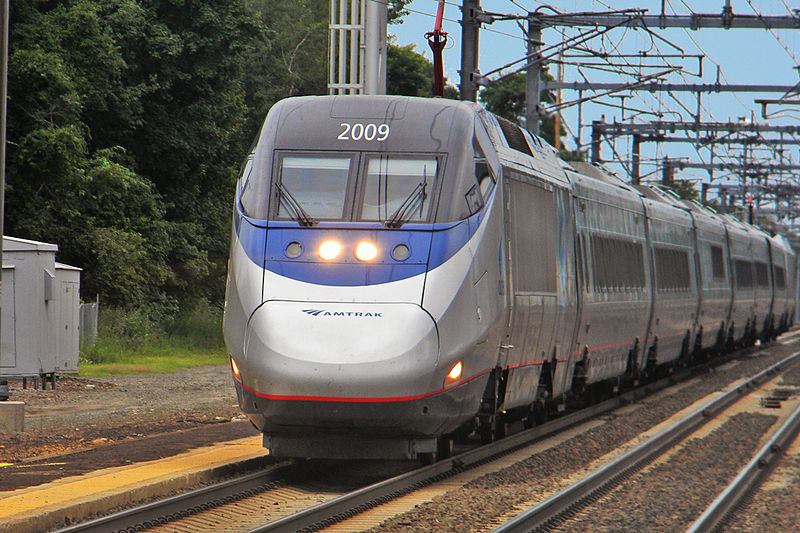
Amtrak Acela Express train between Boston and NYC (Photo courtesy of Shreder 9100 at en.wikipedia)
Later this week, I’ll be hopping on an Amtrak train from Boston to New York City for the welcomed annual ritual of Thanksgiving dinner with family and friends.
What began over a decade ago as an impromptu gathering of cousins and dear friends has become a tradition: The same home in Brooklyn, with a steady cast of about a dozen regulars, a mix of adults and fast-growing kids. A fulsome, traditional Thanksgiving menu (and it’s always amazing). People congregating in the kitchen as the food is prepared. An evening feast — this is New York, after all, we tend to eat later. During dessert, some migrate to another room to play guitars and sing (a lot of 60s and 70s stuff), while others hang out at the dinner table and talk, and the kids go off to do their things.
You know what’s odd? As far as I can recall, we’ve never taken any pictures. That’s why I had to snag a picture of the Amtrak train to illustrate this blog post! Among our group of late Boomers through Millennials, with smartphones abounding, Thanksgiving dinner has never been a photo op. Hey, maybe we don’t need to post photos to our social media pages to remind us about what this gathering means.
Of course, I also enjoy walking around New York City during the holidays. I’m not big on the festivities — during the 12 years I lived there, I never even went to the Macy’s Thanksgiving Day parade(!) — but there is something about New York during this time that activates my nostalgia buttons.
For some reason I have an especially sharp memory of my first Thanksgiving in New York. It was during my first year of law school, and several of us waifs from the Midwest decided that we would make our own Thanksgiving dinner. However, it became clear that no one had actually ever done this before when we learned that you cannot start to defrost a turkey on Thanksgiving morning and expect it to be ready to eat later in the day. So we did what many New Yorkers do and splurged on a nice restaurant for our holiday dinner.
Given that my cooking skills have not dramatically improved over the decades, it remains a good thing that my Thanksgiving role is more about enthusiastic consumption than preparation. Such is my happy place at the table. Here’s wishing a bountiful meal and great company for you, too.
Throwback Thursday: Studying for the New York bar exam, Summer 1985

If this gives you chills, then you’re probably a lawyer! (Photo of BarBri bar review book: DY, 2014)
During any given summer, thousands of newly-minted law school graduates are reaping the rewards of their toil with one final “gift” of a test: The bar examination of the state in which they intend to practice. With a few exceptions, one’s ability to practice law in a given state is dependent upon passing a grueling two or three day examination, consisting of batteries of brain-frying multiple-choice questions and essay questions that pose factual scenarios densely packed with legal issues to be analyzed.
To prepare for the bar exam, which most people take during the summer, one typically signs up for a bar review course. This is a crash course that features over a month of lectures and practice exam questions, interspersed with hours of studying legal rules and principles. Most bar review courses start right after graduation season and finish a few weeks before the bar exam itself, with the remaining time spent drilling and memorizing.
Every summer I encounter law students lugging around the thick paperbound law summaries published by bar review courses. As the weeks go by, their faces look more drawn and tired. Many of the men stop shaving and even the more fashion conscious women trudge around in sweatpants. They make for a pretty motley crew by the time exam week hits.
I remember that time oh-so-well. Twenty-nine summers ago, I was studying for the New York bar exam, reputed to be one of the toughest in the nation. The biggest challenge in studying for the NY exam was the vast number of legal subjects potentially covered on it. We had to stuff a lot of law into our heads and hope that it remained there at least through the two days of the actual test. For people like me, who assiduously took classes of intrinsic interest rather than courses that tracked the bar exam subjects, there was added misery in tackling subjects avoided during law school.
Furthermore, earlier that year, I had accepted an offer to work for The Legal Aid Society in Manhattan. I would be handling appellate-level criminal cases, which meant that the areas of law I needed to feel comfortable with boiled down to a handful of subjects. My motivation to learn, say, the rules of New York gift & estate taxation, was practically nil. (Especially with the salary I’d be earning and the people I’d be representing, neither I nor my future clients had much use for the subject.)
I spent the first few weeks dutifully going to the bar review lectures and trying to study each day, but I found the whole deal to be quite excruciating and my attention span wandered. As the weeks ticked down, however, I came to grips with the fact that I didn’t want to take this exam over again, so I’d best buckle down and give it my all. That I did. During the weeks preceding the exam, I basically camped out in the law clinic offices at NYU, where I had spent so much time in my final year of law school.
Of course, I also spent hours on the phone with law school classmates, sharing supposed insights on how to prepare for the exam, as well as gallows humor about our chances of passing. Many of my best friends from NYU were going to other states to practice, so I ran up a much higher phone bill than was prudent for a soon-to-be public interest lawyer.
I was assigned to take the exam in the ballroom of the Roosevelt Hotel in midtown Manhattan. By then I had moved out of NYU housing and was sharing an apartment in Brooklyn. I didn’t want to risk a subway delay, so I rented a room at the Vanderbilt YMCA, a manageable walk from the hotel.
The exam itself was every bit as challenging as I had imagined. My head was spinning throughout the two-day test, and when I finished, I honestly had no clear idea of whether I had passed or not. (One of the essay questions was about New York gift & estate taxation, and had I not spent an hour the night before with a one-page summary prepared by one of my law school classmates, I probably would’ve sat there in a stupor.) But I didn’t feel horrible about it, so I figured my chances were okay.
After the exam, I celebrated by going to Barnes & Noble and buying two books, the titles of which I recall to this day: William Shirer’s The Nightmare Years (the journalist’s account of being in 1930s Nazi Germany) and Tom Clancy’s first thriller, The Hunt for Red October. I treated myself to an extra night at the YMCA to read my new books in solitude. In the weeks that followed the bar exam, I was basically in a haze. Thank goodness I had that time to recoup before reporting for duty at Legal Aid after Labor Day.
***
In November I learned that I had passed the bar exam! It was good news all around in my office; all 12 or so Legal Aid colleagues who sat for the exam that summer also passed. I called the elementary school in Indiana where my mom taught kindergarten, and they gave her the good news over the intercom.
I celebrated by going to Barnes & Noble and buying another book, Mark Girouard’s Cities & People, a beautiful volume about urban social and architectural history — and a perfect complement to the love affair I was experiencing with New York City as a broke-but-happy Legal Aid lawyer.
Heaven is a used bookstore

Brattle Book Shop, downtown Boston, exterior (Photo: DY, 2014)
Over the weekend I made an extended pitstop at the Brattle Book Shop in downtown Boston. I was reminded once again how used bookstores have been a place of happy sanctuary to me, going back to my early adult years.
The Brattle, pictured above, is one of America’s oldest bookstores, and it’s one of my favorites. Inside, you’ll find two floors of used books and review copies, plus a top floor of rare books. Outside, at least when the weather is okay, you’ll find shelves and carts of discounted used books, marked at $5, $3, and $1. Lots of the $5 books are quality volumes that would be a boon to many a personal library, and there are plenty of great bargains among the $3 and $1 offerings as well.
The discounted books outside draw me in. The weekend stop, for example, started with a discovery from one of the $3 carts, The World of Charles Dickens (1997), a colorful, illustrated guide to Dickens’ works and times, by London popular historian and Victorian crime expert Martin Fido.
But then I went inside. Uh oh. Let’s just say that the books I found on adult education and on psychology ran up the bill to considerably beyond three dollars. They may have been real “bargains” as measured by their original prices, but they lightened my wallet nevertheless.
Favorite haunts
Especially with the decline of brick & mortar bookshops, I’m delighted and appreciative that Greater Boston still supports used bookstores. In addition to Brattle, Commonwealth Books, Raven Used Books, and the basement level of Harvard Book Store are among the stores that offer plenty of used book treasures.
Elsewhere in the U.S., the Strand in Manhattan, Powell’s in Chicago, and Moe’s in Berkeley are favorite haunts. (Not surprisingly, all are within close proximity of one or more major universities.) During a recent trip to New Orleans, I was delighted to find several used bookstores in the French Quarter. And on those fortunate occasions when I’ve traveled to England, I’ve always been on the lookout for used bookstores.
New York
New York City’s used bookstores hold a special place in my heart. By the time I moved there, its famous “Book Row” on 4th Avenue was no more. But during my years in New York (1982-94), the Strand was a classic, creaky, and vast used bookshop. I visited regularly as a law student, and during my stretch as a perpetually broke Legal Aid lawyer, I would make pilgrimages there on paydays when I felt (very temporarily) flush. The Strand has done some upscale remodeling in recent years and now sells a lot of new titles along with its storehouse of used books. Nonetheless, it remains a standard stop during my New York visits.
Another favorite was the Barnes & Noble Annex on 5th Ave. and 18th Street, across the street from the original B&N flagship store (which recently closed). The Annex was a multi-floored wonder, full of remaindered and heavily discounted new titles and used books. B&N would shutter the Annex sometime after I moved to Boston. I recall that when I discovered it had closed, I felt like a small piece of my New York life was gone too.
Book sale in a tent
The origins of my enjoyment of rummaging through piles of used books trace back to the summer after my first year of college. I was spending the summer at home in northwest Indiana, and my mom had clipped from the Chicago Tribune a small notice about a big used book sale in Wilmette, Illinois.
Later I would learn that the book sale was an annual, week-long fundraising event organized by the Chicagoland chapter of the Brandeis University women’s committee. It was legendary among many bibliophiles across the country, some of whom would rent camping vehicles to drive there and load up on good books for the year.
Anyway, I did the 90-minute drive to check it out. When I arrived, I could scarcely believe my eyes. The sale — offering some 250,000 used books(!) — was held in a huge tent that covered a big stretch of a mall parking lot. I spent just about every bit of spare change I had to my name. I filled several bags of books, and a few days later I would return to buy even more. Though I felt too silly to call it as such, this marked for me the beginning of a personal library.
Apparently some form of this book sale survives to this day. Hopefully others are deriving the same pleasure of visiting it and loading up on great discoveries. Maybe, like me, it will fuel a lifelong devotion.
“Grand Central”: Postwar stories from one of the old familiar places
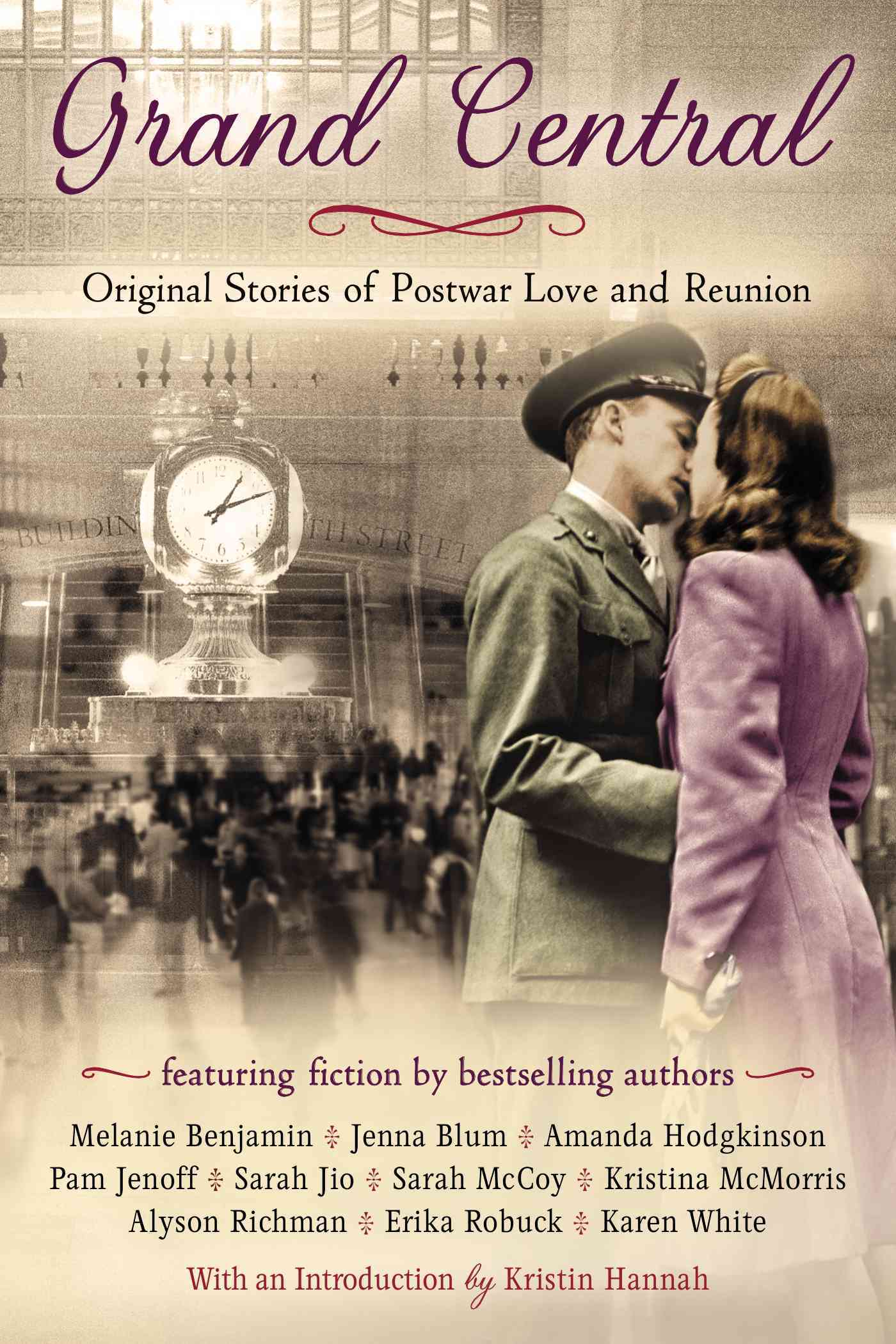
I’ve just started reading Grand Central: Original Stories of Postwar Love and Reunion (2014), a newly-released anthology of short stories by ten writers, with the iconic train station playing a role in each one. Last night I read “The Lucky One” by Jenna Blum, author of two very successful novels, Those Who Save Us and The Stormchasers. I count Jenna among my dear friends, so perhaps I’m biased, but if her contribution is a harbinger of things to come, I’m in for a treat.
I began with Jenna’s story because, well, I saw it as sort of a test. WWII. Train station. Love and reunion. In the wrong hands, such a collection could easily become a soggy nostalgia fest, conjuring up images of a couple having a final embrace before the one left behind runs along the departing train. Because I’m a big fan of Jenna’s work, I figured her story would give me an idea of what to expect.
Jenna’s “The Lucky One” is about a Jewish concentration camp survivor who works at Grand Central’s famous Oyster Bar restaurant. He sees a customer who looks like his late mother. . . .
Enough said. I’ll simply opine that “The Lucky One” is a superb, knowing, heartfelt contribution from a writer whose ability to tell a great story with nuanced emotional intelligence is one of her distinguishing gifts. It also is the work of someone who learned about the Holocaust by interviewing survivors for Steven Spielberg’s Survivors of the Shoah history project. Jenna has infused a lot of historical understanding into her short story.
Okay folks, I know I’m betraying my own limitations when I confess that I cannot recall ever diving into a volume of short stories with a cover showing a couple kissing in a train station! But I will be the loser if I don’t spend more time with this one. And I have a strong feeling that the next time I step into Grand Central Station, some of these tales will come to mind.
Throwback Thursday: First Manhattan visit, Summer 1982
Thirty-two summers ago, I paid my first visit to New York City. The main occasion for my trip was to check out New York University, where I would be starting law school that fall.
While it may sound odd in this day and age for someone to say this, I had accepted NYU’s offer of admission sight unseen, based largely on its overall reputation and strong support for students who wanted to enter public interest law. You see, I also was pretty broke, and I didn’t have the funds to visit the law schools to which I was applying. Having opted happily for NYU from a distance, I wanted to preview the situation firsthand, so I scheduled a late June visit to New York City.
I reserved a room at the Vanderbilt YMCA on 47th Street. It was like staying in a youth hostel, reminiscent of my semester abroad in England the year before. Another adventure begins!, I thought to myself.
During my short trip, I spent a lot of time around NYU and its Greenwich Village surroundings. I discovered some of the cheap local eateries that would get a lot of my business during the years to come, I did some hanging out in Washington Square Park in the heart of the Village, and I paid my first of hundreds of visits to the remarkable Strand bookstore.
Of course, I also checked out NYU, including Vanderbilt Hall, the main law school building, and Hayden Hall, the residence hall where most first-year law students lived, both located right on Washington Square. I could feel the butterflies churning in my stomach in anticipation of what was to come, and a little voice inside me wondered if I was in over my head.
I did standard tourist stuff as well. Going up the Empire State Building. Taking a guided tour of the United Nations. Becoming bewildered by the city’s labyrinth of a subway system. (If you’ve ever been lost in the Dante-esque middle level of the West 4th Street stop in the Village, you know what I mean.)
My NYC recon trip confirmed that in terms of sophistication, I was a babe in the woods. I wasn’t totally unfamiliar with big cities, having grown up in northwest Indiana right outside of Chicago and having spent chunks of time in major European cities during my semester abroad. However, New York seemed overwhelming to me, ranging from its apparent vastness (in actuality, Manhattan is a mere island!) to its exorbitant prices. (Upon my return, I would report breathlessly to friends and family that a fancy ice cream place called Häagen-Dazs was charging one whole dollar for a small cone!)
Nevertheless, I also had a gut feeling that I was making the right choice. I knew that New York would fascinate me, and — nerves notwithstanding — I had a good feeling about my decision to attend NYU. My instincts would prove to be right. New York and NYU were the right places at the right time for me.
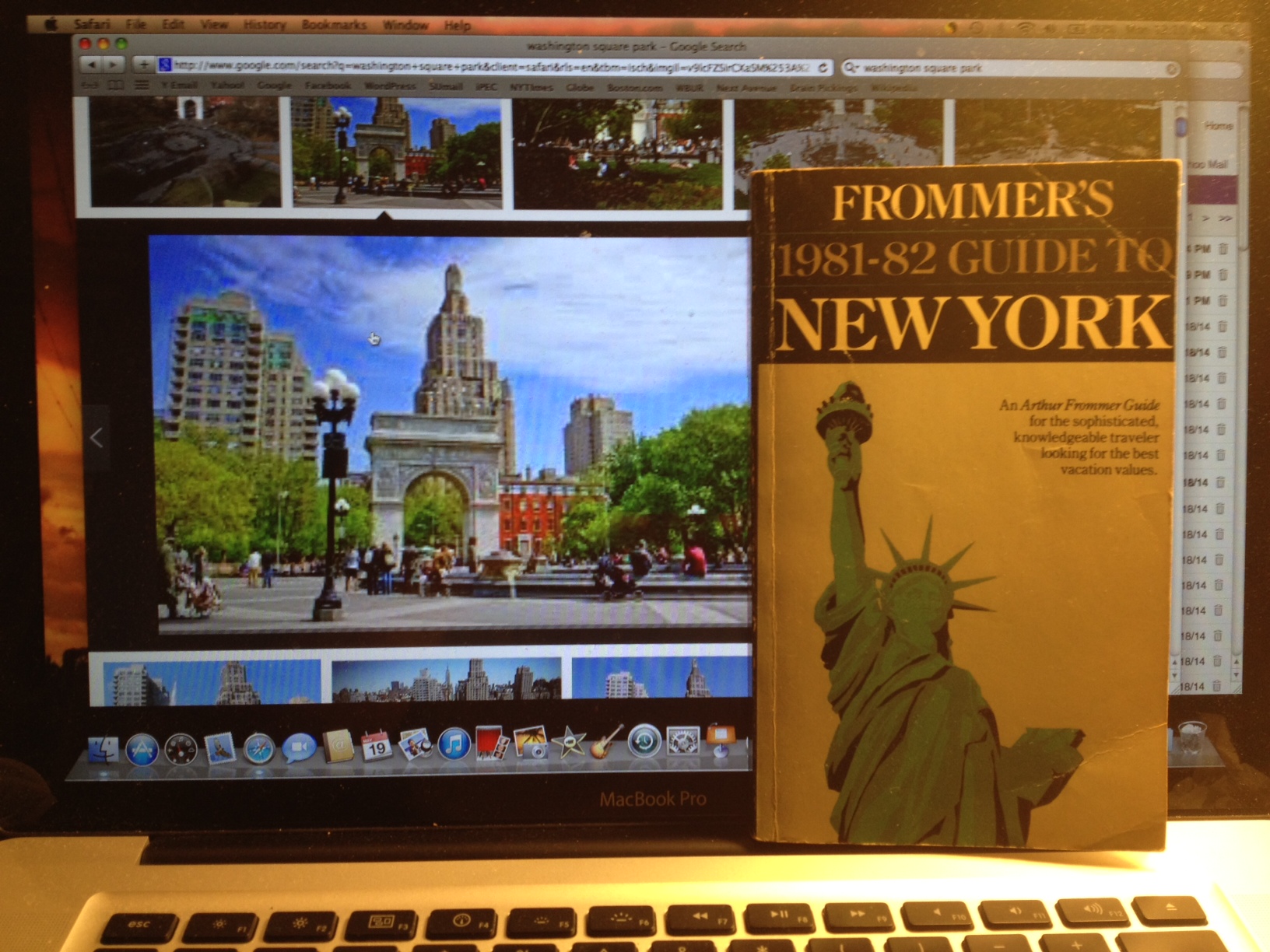
I didn’t take any photos of that visit, but I’ve held onto the guidebook I used to traipse around Manhattan. In Frommer’s 1981-82 Guide to New York, author Faye Hammel writes:
You should be advised that there is one dangerous aspect of coming to New York for the first time: not of getting lost, mobbed, or caught in a blackout, but of falling so desperately in love with the city that you may not want to go home again. Or, if you do, it may be just to pack your bags.
That quote captured how I would feel about New York for years. As would this song:
Music and memories
 Music and memories. We hear an old pop tune on the radio or MP3 player and it quickly summons memories — good, bad, in-between — about a chapter of our life we associate with that music. Are there any stronger connections between popular culture and our life experiences?
The Andrews Sisters or Glenn Miller and The Greatest Generation. The Beatles or Motown and classic Baby Boomers. Music can be an instant on switch to a personal nostalgia channel.
Gen Jonesers and pop music
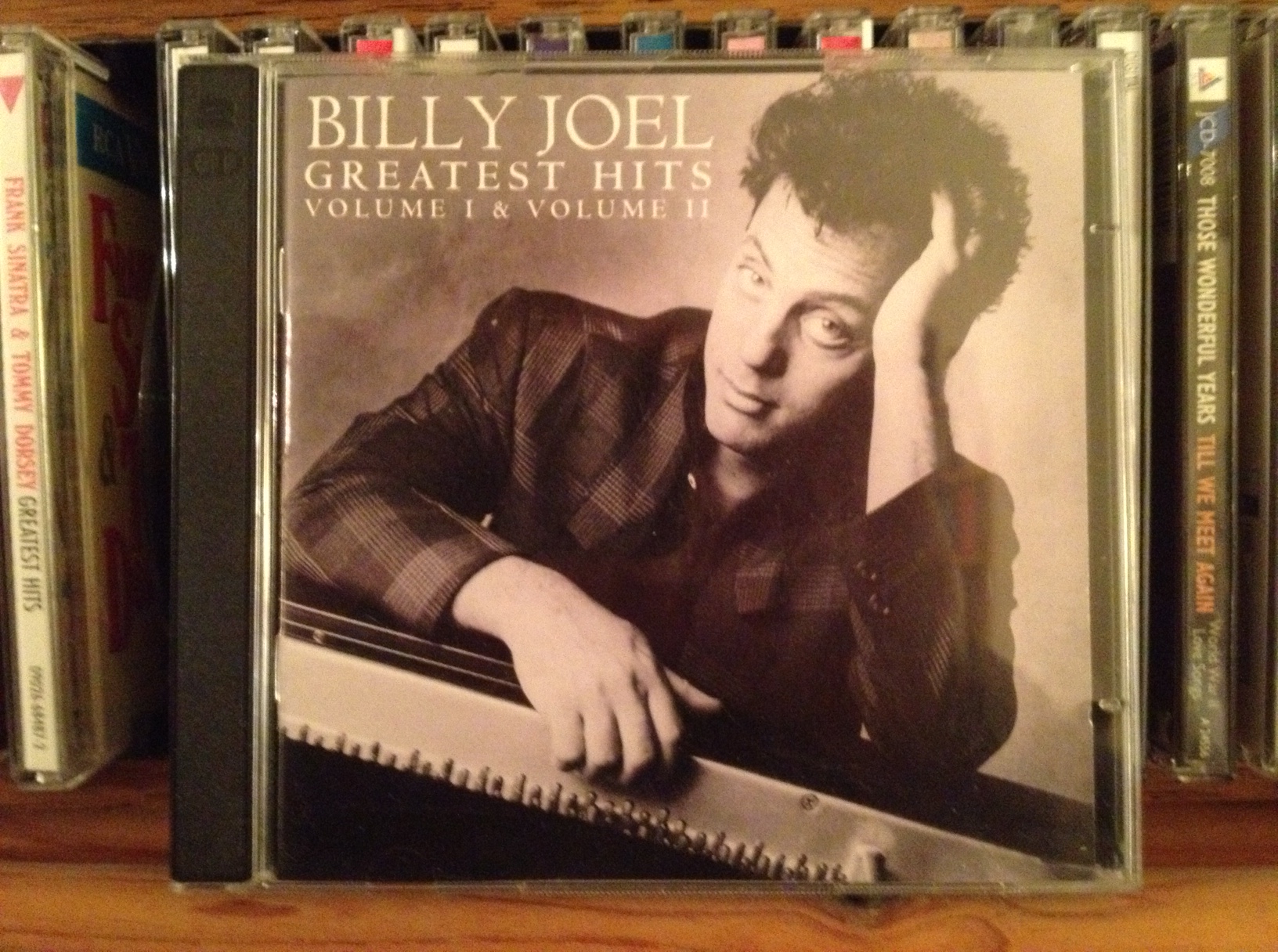
For many Generation Jonesers, Billy Joel provides a body of memory-making music. The songs contained in volumes I and II of his Greatest Hits album were especially popular during my college and law school years (late 70s through mid 80s). When I listen to them in the rough order of their release as singles, I’m treated to a year-by-year “mind’s eye” trip down memory lane.
Among the 25 songs in the album, my favorites are “Piano Man,” “New York State of Mind,” “You May Be Right,” “Allentown,” “Tell Her About It,” “Uptown Girl,” and “The Longest Time.”
But they’re not on the list because they’re necessarily the best songs, objectively speaking. No, I include them mainly because I associate memories with each. Overall, they capture a meaningful time in my life when I was finishing college in Indiana and moving to New York for law school. In fact, it’s hard for me to listen to the album for its own sake, because the memories connected with those songs are so sharp.
Given my druthers, I prefer the popular music of the first half of the last century to the stuff that followed. Yup, I’m more likely to listen to Frank Sinatra than to The Clash, though I enjoy both. In any event, I know I’m not alone among my peers when I turn on that 80s “oldies” station and fill with memories.
A song and a smile
Associations between music and memories can run deep, into the recesses of minds otherwise harder to reach. About ten years ago, I was part of a group that gave short vocal concerts at senior homes. At one of our little gigs, I sang a classic from the World War II era, “A Nightingale Sang in Berkeley Square.” Here’s a lovely Vera Lynn rendition:
While I sang, a resident of the home grew the sweetest smile on her face. The way her eyes lit up, I could tell that the song resonated with her, that it touched some part of her experience. After our show was over, I thought I’d say hello and went over to her. But my effort to strike up a friendly chat quickly revealed that she was non-responsive to verbal messages, that she had withdrawn back to the place that likely led to her to be living in a senior home.
It was a quick lesson: Music could reach her in a way that ordinary conversation could not. And it could still cause her to smile.
Ordering Chinese delivery: Hitting the Food Wall
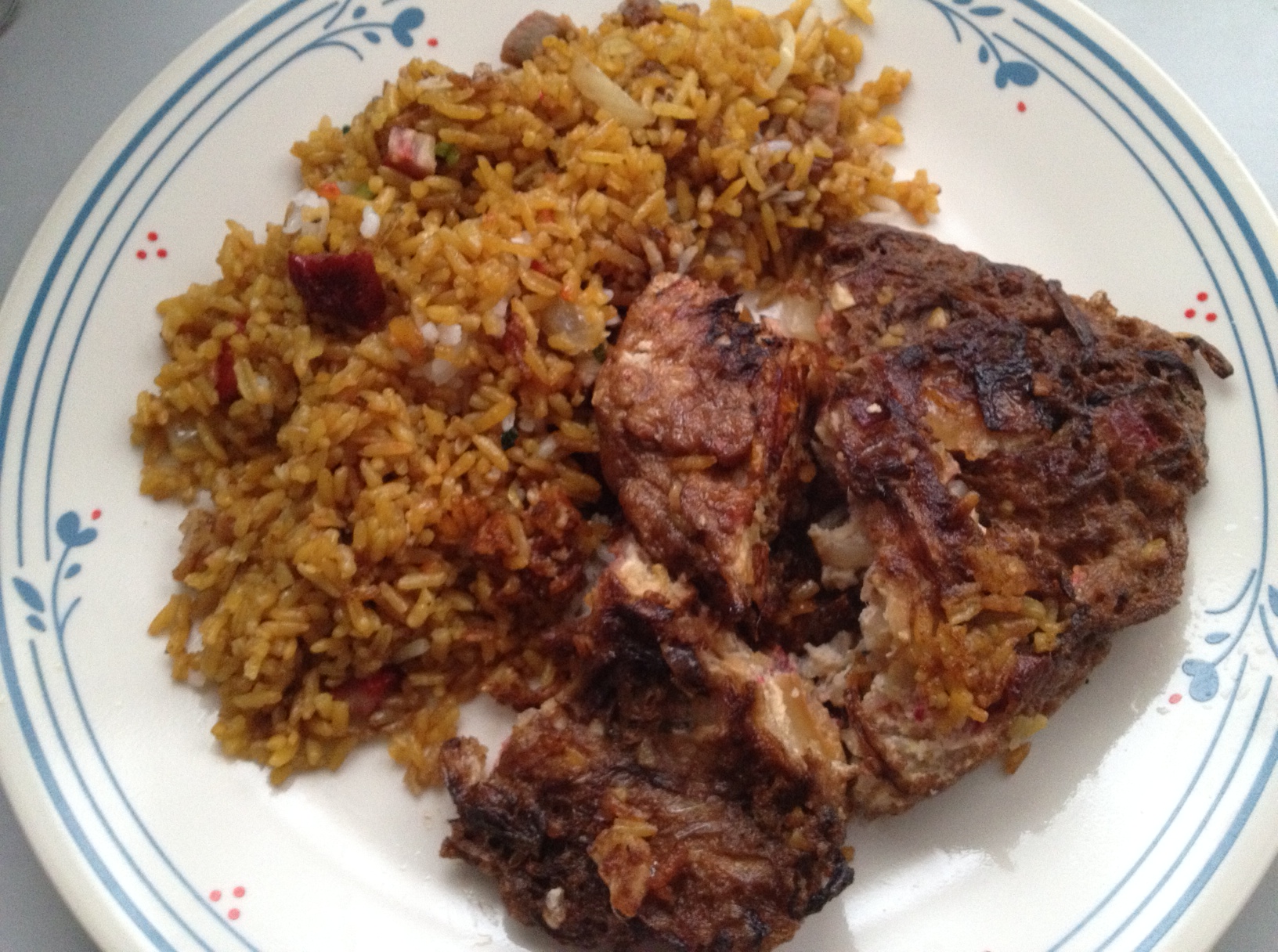
Delicious Chinese leftovers!
Ordering in Chinese food is one of my simple pleasures. Whether it’s after coming home from teaching an evening class, or during the weekend when a glance inside the fridge shows nothing resembling a meal, the ritual is basically this: Survey the menu, call in the order, wait for the delivery, and remove goodies from the bag.
Typically, one plate isn’t enough, so seconds follow. Then I close up the containers and pop the leftovers into the fridge for later meals.
I got hooked on Chinese delivery in law school. New York and Chinese food go hand in hand, and the local choices in NYU’s Greenwich Village neighborhood were abundant, tasty, and cheap. Even a modest order would yield several meals.
Today, my Chinese delivery venue of choice is called Food Wall, located in my Boston ‘hood of Jamaica Plain. I’m far from alone in this category. Val Wang featured Food Wall in her 2012 National Public Radio series on Chinese takeout places:
When you spend as much time inside of Chinese takeouts as I do, you start to notice some patterns. Like, every takeout has its regulars, people for whom the takeout is an essential part of their lives.
Food Wall in Jamaica Plain is one example. It has inspired something of a cult following. I walked up and down the street one afternoon asking people who work nearby how often they stop in. . . .
“At least once a week,” said Saul Cifuentes, owner of Beauty Masters Salon and Supply.
“Lately I’ve been going at least three to four times a week,” said Josiah Simmons of theVideo Underground.
James Norton of Revolution Bikes is trying to cut back, but “it used to be almost daily.”
None can top Fat Ram of Pumpkin Tattoo. He claims he’s eaten there “Eleven days a week for 10 years. It’s too much. Too much Food Wall. I hit the Food Wall.”
Pictured above is some very basic Cantonese fare from Food Wall: Egg foo young and fried rice. I usually opt for spicier Szechuan dishes, but not to worry, it’s good stuff. I cleaned that plate quickly.
Da Bears (1985 ed.)

I’m not obsessed, really.
So the Chicago Bears are playing the Green Bay Packers on Monday Night Football tonight. This inevitably means that I’ll have at least one or two memories about my favorite sports team of all time, the 1985 Chicago Bears.
Across the nation, but especially in the Chicagoland area, a large cohort of middle aged men (and some women, too!) carry with them a fierce, nostalgic devotion to a football team that has etched a permanent place in their hearts and minds. That devotion can be activated in a millisecond, whenever names like “Payton,” “McMahon,” “Ditka,” “Singletary,” “Danimal,” “Mongo,” or “The Fridge” are uttered, or when a sports broadcast plays a snippet of a very bad rap video, “The Super Bowl Shuffle.”
The 1985 Chicago Bears are regarded as one of the top two or three teams in National Football League history. They dominated the regular season with a 15-1 record. They then trounced the Los Angeles Rams and New York Giants in the playoffs, before thoroughly, utterly flattening the New England Patriots in the Super Bowl. It’s not just their won-loss record that matters; it’s how they won, with a tightly controlled offense and the most dramatic, overpowering, fun-to-watch defense the game has ever seen.
It’s a team that gave back to the Windy City its swagger, years before Michael Jordan would lead the Bulls to six NBA championships. It’s a team full of memorable characters and stories.
A memorable year for me, too
Memories good and bad rarely stand in isolation. I have no doubt that my devotion to this team connects to where I was at that time in my life. I had just graduated from NYU Law School, and I was fulfilling my wish of working as a public interest attorney, practicing at the Legal Aid Society in Manhattan.
I shared an apartment in Brooklyn, earned a little over $20,000 (not much even by 1985 standards, especially in New York), and was absolutely smitten with the wonders of New York City. It was a rougher town during those days, and the decade was marked by a high crime rate and the arrival of crack cocaine. But one could still enjoy city life on a meager budget.
In the meantime, my longstanding affinity for Chicago sports teams — having grown up in Northwest Indiana — had not disappeared. By following the newspapers and Sports Illustrated, and by watching the Bears games that were televised on the East Coast (via a foil-enhanced black & white TV set), I watched that magical season unfold.
In addition to collecting the stuff pictured above, somewhere in a storage trunk I’ve saved the Chicago Tribune edition from the day after the Super Bowl victory. One of the headlines is etched in my mind: “Bears Bring It Home.”
Time travel: Some favorite destinations

Remember “The Time Tunnel,” the short-lived but fascinating television time travel drama from the mid-60s? Every new episode would find scientists Tony Newman and Doug Phillips landing in a different historical setting, usually on the eve of some major event, such as the sinking of the Titanic, the Battle of Little Big Horn (General Custer and Crazy Horse), or the bombing of Pearl Harbor. (Unfortunately, they never could persuade folks that disaster loomed.) To this day, I credit that show for helping to stoke a lifelong interest in history and to fuel my imagination with thoughts of going back in time.
What if time travel was possible? What places and times would I want to visit? Here’s an off-the-top-of-my-head list, not exactly an exotic one, but it sure would be a fascinating set of journeys. Feel free to add yours in the comments!
***
New York City, 1880s — My favorite time travel novel, Jack Finney’s captivating Time and Again (1970), is set in early 1880s Manhattan. There’s a scene in the book when his protagonist, Si Morley, realizes that he made a successful journey back. It remains one of my most favorite reading moments, ever.
New York City, 1920s — I’d be at everything and anything by George Gershwin, Rodgers & Hart, and Cole Porter. I’d be at the jazz clubs of Harlem. I’d be at Yankee Stadium watching Ruth & Gehrig. I’d be hanging out in Greenwich Village. I’d also want to check out student life at New York University, my law school alma mater. The 1920s is one of my favorite decades, and NYC of that time would make for a grand visit.
New York City, post-war 1940s and early 1950s — I can’t imagine a better place to drink in the spirit of America’s post-war optimism. I’d also venture out of Manhattan to Ebbets Field in Brooklyn, where I’d watch Jackie Robinson break baseball’s modern color barrier. I’m sure I’d spend plenty of time and money at the dozens of used bookstores in the city. And yes, I’d hang out in the Village during this period, too.
Chicago, 1893 — Chicago hosted the Columbian Exposition World’s Fair. The photographs of it look stunning, a city bathed in light. It also marked Chicago’s arrival as a major city.
Chicago, 1920s — When I was a kid, one of my favorite books was Albert Harper’s Chicago Crime Book (1969), which told tales of Al Capone and other famous gangsters. Thus was born a fascination with Chicago’s Roaring Twenties.
San Francisco and Berkeley, California, mid-to-late 1960s — I’d like to experience the whole California Dreamin’ thing. I’d be the squarest person in Berkeley’s People’s Park, but at least I’d be able to take good pictures.
London, late 1880s — Yeah, I’d sleuth around the East End to discover the identity of Jack the Ripper. I’d be drawn to the sinister side of Victorian London. I’ve also read about the food carts of the era and would like to give them a try.
London, 1940 — London during the Battle of Britain and the Blitz. It’s such an iconic, defining, dramatic moment in British history. Just thinking about it has me imagining Edward R. Murrow’s radio broadcasts from London as the German bombs were falling around them.
Paris, 1920s — I probably wouldn’t stay long, but I’d want to check out that whole Left Bank scene and the Lost Generation. I’d hang out in Paris cafes and do a bit of writing. (Challenge: No outlets for my laptop.)
Washington D.C., 1861-65 — Washington during the American Civil War. Hot, miserable, and menacing. But fascinating nonetheless. And somehow I’d finagle a way to have a short chat with Abraham Lincoln.
Boston, Revolutionary Era — I live in a city where evidence of the early years of the American Revolution is all around us. How cool it would be to see Boston of that era, perhaps bumping into the likes of John Adams, Samuel Adams, and other remarkable figures of the day.
Salem, Massachusetts, 1600s — Will we ever know the full truth about the events surrounding the Salem Witch Trials? It would be fascinating to find out.
Ancient Athens — I’d follow Socrates as he traipses around the Athenian marketplace. I’d want to get some first hand lessons in how the ancient Greeks lived, and trace some of the origins of Greek mythology and philosophy.
Hawaii, 1920s — Among my treasured Hawaiian collectibles is a February, 1924 National Geographic magazine with 16 pages of incredible color illustrations of the Islands. I can only imagine seeing those sights in person! If I was on Maui during October 1926, I’d go to the hospital in the small town of Paia to say hi to the newborn baby who someday would be my mom. While on Maui, I’d take a train ride on the narrow-gauge Kahului Railroad.
Hawaii, 1950s — After WWII, Hawaii was making its way toward eventual statehood. Large passenger airplanes — still propeller-driven, as the jets wouldn’t arrive in the early 60s — now made air travel to the Islands a safe reality. The idea of Hawaii as America’s Pacific paradise was in full bloom.
Valparaiso, Indiana, early 1910s — Valparaiso University, my collegiate alma mater, was rescued by the Lutherans in the 1920s after a period of decline. Before that, however, it was a thriving, no-frills, secular college known as the “Poor Man’s Harvard” that provided collegiate, professional, and trade courses to young people who aspired to join America’s emerging middle class.
Hammond, Indiana, 1950s — Hammond was my hometown from grade school through high school, from the late 60s through late 70s. By then it was a city in decline, its jobs base shrinking due to the decline of steel mills and manufacturing in Northwest Indiana. But during the 50s it was a thriving small city and an emerging outer suburb of Chicago.
Airplanes — I would love to fly in two legendary, early passenger airplanes, the Ford Trimotor (late 1920s) and the DC-3 (mid 1930s).
Trains — How fun it would be to take the Pioneer Zephyr, one of the first modern diesel passenger trains, on its popular Chicago-to-Denver run during the 1930s.
***
I’m struck by the fact that this list doesn’t have much to do with my current work. Hardly anything about law, the labor movement, politics, and the like. Not much about war, either, despite that I read a lot about the Civil War, WWI, and WWII. I’m not sure quite what that says about my choices, but unless science develops affordable time travel during my lifetime, this is not a pressing matter.
 Musings of a Gen Joneser
Recent Comments