College Daze: It’s finals time!

(Photo: DY, 2013)
With Thanksgiving in the rear view mirror, college students across America are studying for final exams and writing term papers. Even with the onslaught of technology over the decades, the ritual of gearing up for end-of-semester tasks remains largely the same. And for the procrastinators, it’s truly crunch time: That which has been ignored cannot be any longer.
Our late night “study hall”
I recall those days as an undergraduate at Valparaiso University in northwest Indiana very well. My favorite study hangout was the dining room of the Brandt Hall dorm where I lived. After the dinnertime meal service was over, it was kept open as a sort of impromptu study hall. Around finals time, several dozen students could be found reading, writing, and typing (on real typewriters, by the way) into the wee hours. Oh, there was plenty napping and chatting (often of the gallows humor variety) as well, not to mention late night coffee, sodas, and snacks courtesy of area donut shops and convenience stores.
My roommate, a super conscientious pre-med major, was not given to dining room studying. He spent his study hours at his desk or in the library. We’d usually watch the monologue of the Johnny Carson Show, after which he’d hit the hay. By contrast, my study day had just begun. Off I’d go to the dining room so he could get some sleep.
Come to think of it, the most self-disciplined students often avoided late nights in the Brandt Hall dining room. Those who joined us there rarely pulled all-nighters; it wasn’t necessary. Especially at finals time, the post-midnight shift in the dining room was largely the province of those of us who had put off those pesky term papers and heavy-duty reading assignments.
Beyond Brandt Hall
In these days before personal computers, having access to a typewriter was necessary for churning out those papers. I had a Smith-Corona electric typewriter, which I’d lug back and forth from my dorm room to the dining room.
But during my last two years of college, I worked as an editor of the college newspaper, The Torch. And in The Torch offices were two IBM correcting Selectric typewriters. IBM Selectrics were the Cadillacs of typewriters. Not only were they fast, but also they could correct errors without swapping out a cartridge or using Liquid Paper to paint over mistakes! For typing long seminar papers, the Selectrics were gifts from heaven.
During my senior year, some friends and I hatched a plan that would surely propel us to epic levels of academic concentration. We would drive into Chicago, thus removing ourselves from the usual campus distractions, and study at the public library there. So we piled into my gas guzzling Buick and made way for the Windy City.
We made the trip, but alas, we found new distractions — Chicago is quite festive around the holidays — and returned late that night with little to show in terms of productivity. Scratch one Saturday. So back to the Brandt Hall dining room for this guy.
Yikers!
Is it any wonder that I still experience academic anxiety dreams? You know, those dreams in which it’s the end of the semester, and you suddenly realize there’s a class you haven’t attended, studied for, or even thought of, for that matter. As in, The Class You Completely Blew Off??? Panic ensues when you can’t even remember the course title — though for me, it’s usually some vague heavy science or math class. Then, thank goodness, I usually wake up and realize, gratefully, that it was a dream.
Well, enough reminiscing; time to get back to work. I’m on the other side of this realm now, and facing me are two large piles of term papers that I haven’t jumped into yet. I’d better get moving, because in two weeks I’ll have the final exams to grade as well. ‘Tis the season!
Revisiting my collegiate alma mater

Valparaiso University, Indiana: This building once housed The Torch, the campus newspaper, and WVUR, the campus radio station. (Photo: DY, 2012)
“The past is obdurate. It doesn’t want to change.”
So we are told in Stephen King’s 2011 time travel epic, 11/22/63, which takes us back to the years leading up to the assassination of President Kennedy. The main protagonist — a school teacher — learns that even when we go back in time, the past mightily resists our attempts to change it.
I have no idea if time travel and changing the past are even possible, so I’ll put my fascination with the subject aside to make a more accessible point: We may not be able to change the past, but we can change how we regard it. Historians revisit the past practically every day, and not infrequently they alter and sometimes substantially revise our perceptions of it. At times, subsequent events and reflections contribute to those changed understandings.
This occurs even more frequently at a personal level. In fact, that’s what I’d like to explore here, by taking a look back at my undergraduate alma mater, Valparaiso University (also known as “Valpo” or simply VU) in northwest Indiana. For readers unfamiliar with it, Valpo is a small-to-medium sized Lutheran-affiliated school, noted for its strong liberal arts curriculum and attention to undergraduate education. Most students live on or near the campus, which is located on the outer edges of the small city of Valparaiso.
If relationships with institutions over time could be described in Facebook-like terms, mine with Valpo would get the “It’s complicated” tag, without question! Indeed, this topic reminds me of how our emotional ties with institutions can be quite powerful and evolve over time.
College days
In 1981, I graduated from Valpo with a B.A. degree and a political science major. During my time there, I was a very engaged student. I did well academically, worked as a department editor of the weekly campus newspaper, and served in various student government positions. I also spent a life-changing study abroad semester in England.
Taking all that into account, one might reasonably assume that I enjoyed an idyllic, residential, Midwestern-style collegiate experience. But for many years I harbored attitudes toward VU that alternated between resentment and anger, grounded in grievances about its limited political, social, and racial diversity and its lack of national renown.
Now, let’s be honest here. It’s not as if I arrived at the VU campus in 1977 with a very cosmopolitan personal history. I was born and raised in Northwest Indiana. A handful of family trips to visit relatives in Hawaii were the closest things in my life to “multicultural experiences.” In addition, I started college as a Republican, and my political opinions were a hodgepodge of reactive, inconsistent thinking. Although I had endured racial taunts growing up in Indiana neighborhoods, I wasn’t exactly a trailblazer for civil rights.
However, my worldview was changing, and by the time I graduated, Valpo’s campus culture wasn’t as good a fit for me. My work for the campus newspaper, The Torch, was especially enlightening. I wrote dozens of articles for it, including some hefty investigative pieces about campus life. It served as my primer to the insular wackiness that characterizes many university cultures and decision making processes, though at the time I erroneously attributed these traits uniquely to VU. (Believe me, I since have been corrected on that point!) My writing for the paper also gave me a closer look at some of the diversity issues at VU, and I became acutely aware of how black students experienced the predominately white campus and surrounding community.

Valparaiso University, Indiana: Brandt Hall dormitory where I lived during my sophomore, junior, and senior years. (Photo: DY, 2012)
By the time I graduated from Valpo, I was disenchanted with it and blamed it for all the things that it was not. Throughout college I had planned on going to law school, and eventually I began to see it as an opportunity to sink roots into a different part of the country. Despite many rewarding college experiences and friendships, I was determined to put Valparaiso way back in my rear view mirror.
When, some 10 years after graduation, I received from VU a detailed questionnaire for “diverse” alumni/ae about their student experiences, I filled it out and added a long letter explaining some of my answers. I was very blunt. Looking back, I regret the tone of my responses, but at the time, I saw it as an opportunity to unload.
Decamping for the East Coast
Predictably, the lion’s share of my law school applications were filed at schools on the two coasts. Originally I had designs on heading to California, and the Bay Area seemed especially hospitable to my evolving left-leaning political views. But ultimately I opted to head east to New York University, located in the heart of Manhattan’s Greenwich Village. It was the right move, both at the time and in retrospect.
New York quickly became my Wonder City. NYC of the 80s was a more raw and edgy place than it is today, but it also was possible to enjoy it on a shoestring budget. Its many bookstores, revival movie houses showing old classics, and endless array of ethnic eateries were among the offerings that competed for my attention.
I have lived on the East Coast since the early 1980s, first in New York City, and now in Boston. Given the past 30 years, it’s fair to say that I am more city boy than country boy, though at times I think that it might be nice to live in a traditional “college town.” In any event, while I have long described myself as an “East Coast person,” I now understand and appreciate that I am the product of many different places.
Valpo revisited: More than rose-colored glasses
My moves aside, my Valparaiso story didn’t end with faded images in the rear view mirror. Rather, I have experienced a gradual but in some ways significant change in how I regard that past. Perhaps the rose-colored glasses of time have contributed to that change, but it’s more than that.
You see the people in the photo below? We were together for a memorable spring 1981 semester in VU’s study abroad center in Cambridge, England. There were about 20 of us in all. We have reunions every five years, and each time over half of our group has attended. The photo was taken at our 2011 reunion. I count a good number of these folks as lifelong friends, and I value my associations with all of them.
How many other study abroad groups hold reunions every five years? That question, and my knowing answer (very few), have played an important role in changing my relationship with my alma mater.
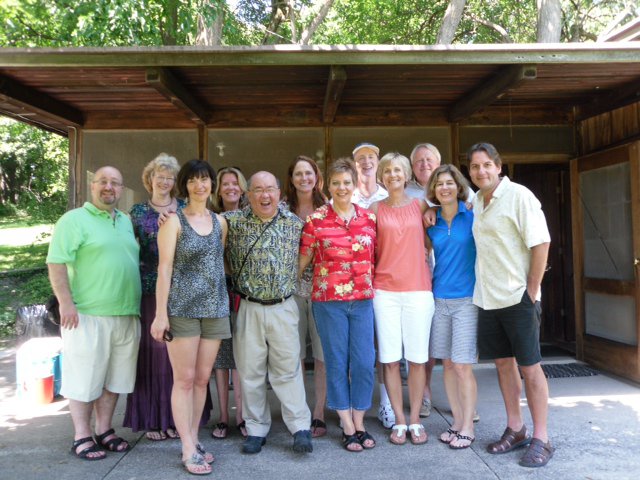
Summer 2011: The 30th year reunion of our study abroad group. (Photo courtesy of Anne Walsh Gorski)
A few years ago, I realized that my attitudes toward Valpo were changing. It wasn’t due to a conscious effort on my part, nor had I forgotten the issues I had with the school. Rather, I was beginning to appreciate what it had given to me.
Most importantly, I have continuing friendships that were forged during those years. They have evolved, matured, and renewed over the decades, and they manifest themselves in ways ranging from periodic get-togethers, to back-and-forth e-mails, to playing in fantasy sports leagues. And through the Internet (and social media in particular), I now count among my friends a fair number of folks I knew only casually during our student days.
In addition, I received an excellent classroom education at VU. I have been a teacher in higher education settings for over 20 years. As a law professor, I’ve seen the undergraduate results of many types of colleges and universities. I now understand that the academic experience at Valparaiso compares well with any of them.
In fact, I likely underestimated VU’s higher ed street cred as a student. In the various reputational surveys and assessments of colleges and universities that started to become popular in the late 1980s, Valpo has fared quite respectably.
Working on The Torch honed and developed my writing skills in ways that continue to deliver today. Any success I have at writing for a less specialized audience — especially via my Minding the Workplace blog — has direct roots in that experience. The Torch also served as the wider social base I didn’t have during my first two years of college. (Suffice it to say that some of us practically lived in The Torch offices.)
Lastly, the study abroad semester I spent in England was the most formative educational experience of my life. So much of my personal culture and the way I live today can be traced back to those five months overseas. My natural penchant for nostalgia notwithstanding, I generally do not yearn to relive even the best experiences of my life. My semester abroad is an exception; I would access Stephen King’s time travel wormhole in a heartbeat to revisit that experience.
My writing for VU periodicals didn’t stop with The Torch. In 1996, I penned a long essay about my study abroad experience in England for the university’s literary and current affairs journal, The Cresset. More recently, I published an article titled “Workplace Bullying and Ethical Leadership” in the VU business school’s Journal of Values-Based Leadership.
A different view
The issues I had with Valpo as a student and recent graduate were legitimate, and some remain relevant to the school today. But with the gifts of hindsight and maturity, I am grateful for many of my collegiate experiences and for the related friendships and opportunities that are a part of my life now.
I’ll leave it to the physicists to determine if we can change the past, but I know from experience that we can change how we think about our own. Sometimes, as here, those changes can be good ones.
 Musings of a Gen Joneser
Recent Comments