A delightful book browsing pleasure

I received a terrific gift recently, a copy of the latest edition of Bartlett’s Familiar Quotations. (18th ed., 2012). It’s a behemoth of a book, clocking in at just over 1,500 pages.
It’s also a browser’s delight, a history lesson and time machine, and an exemplar for writers in how to turn a phrase. Here’s a very random sampling:
- “Every human being is an archeological site” (Luc Sante, The Factory of Facts, 1998)
- “A Pretty Girl Is Like A Melody” (Irving Berlin, Ziegfeld Follies, 1919)
- “Books, the children of the brain” (Jonathan Swift, A Tale of the Tub, 1704)
- “Nobody’s as powerful as we make them out to be” (Alice Walker, The Third Life of Grange Copeland, 1970)
- “You will find rest from vain fancies if you perform every act in life as though it were your last” (Marcus Aurelius, Meditations)
- “If we do not lay out ourselves in the service of mankind whom shall we serve?” (Abigail Adams, Letter to John Thaxter, 1778)
- “Uncommon valor was a common virtue” (Chester Nimitz, Of the Marines at Iwo Jima, 1945)
- “It is far, far better and much safer to have a firm anchor in nonsense than to put out on the troubled seas of thought” (John Kenneth Galbraith, The Affluent Society, 1958)
- “Man, if you gotta ask you’ll never know” (Louis Armstrong, Reply when asked what jazz is)
- “O world, I cannot hold thee close enough!” (Edna St. Vincent Millay, God’s World, 1917)
…and so, so much more. Buy, borrow, or be gifted a copy and enjoy.
***
Many thanks to Tom and Phyllis Schaaf for the kind gift that inspired this blog post!
Brooklyn, 1985

In a New York Times real estate section piece last week, Alison Gregor spotlighted beautiful Brooklyn Heights. While I enjoyed the photos of this picturesque, historic neighborhood, what caused me to sit up straight were the real estate prices:
Depending on their size and the number of bathrooms they have, studio co-ops go for around $350,000 to $400,000; one-bedrooms for $450,000 to $750,000; two-bedrooms for $950,000 to $1.35 million; and three-bedrooms for $2.3 million to $3.2 million . . . .
. . . Rentals range from $2,000 to $4,000 a month for one-bedroom apartments; $2,500 to $6,500 for two-bedrooms; and $5,000 to $10,000 for three-bedrooms . . . .
Good grief. Brooklyn Heights has long been considered the borough’s jewel in the crown, thanks to its first-rate housing stock, wonderful urban vistas, and close proximity to Manhattan. But those housing numbers are staggering.
The price tags sent me into a nostalgic spin, recalling when I moved to Brooklyn in 1985, days after graduating from law school. . . .
Park Slope, here I come
With law school coming to a close in the spring of 1985, my days in the NYU residence hall were numbered. Late that semester, I was apprised of a possible apartment share in the Park Slope neighborhood of Brooklyn.
The Slope, as it was known (and probably still is), was a neighborhood “in transition” during an early period of gentrification in Brooklyn that seemed inevitable as Manhattan housing prices climbed steeply. I had accepted a position as a Legal Aid lawyer in lower Manhattan, starting at the princely salary of $20,000. Brooklyn was the most viable option in terms of convenience and price.
I agreed to join two others in renting a three-bedroom apartment in the top half of a brownstone owned by a young couple. Our monthly rent, to be split three ways, was $1,000. Yup, $1,000, split three ways.
Of course, the low monthly rent didn’t exactly make me Legal Aid’s version of Donald Trump (who, by the way, was coming into prominence right around then). The overall cost of living was high, and I was paying back student loans to boot.
Rough around the edges, but still good
Today Park Slope is home to well-to-do professionals and a fair share of celebrities, but back then it was a mix of long-time locals, farsighted buyers and speculators, and younger non-profit types priced out of Manhattan.
Overall, the streets closer to Prospect Park (another New York showpiece by Frederick Law Olmstead) were fancier and safer. Away from the park, the dicier things could get. I was mugged twice in Park Slope during my nine years there, and lots of other Slope denizens shared similar tales of criminal victimhood.
But no matter, this was during the heart of my love affair with New York. I enjoyed it on a shoestring, while dealing with its occasional hazards. And after three years of being a Manhattanite during law school, I explored parts of the wondrous Borough of Brooklyn, a place with as rich a history and variety of humanity as any in America.
My neighborhood’s in-transition status also meant that affordable eateries could still be found, albeit varying greatly in quality. I recall one diner on now-fancy Seventh Avenue, doors from the subway station, that served a thoroughly mediocre meatloaf platter, replete with imitation mashed potatoes and canned green beans. Taste aside, it was a filling match for my public interest lawyer’s budget, and so I ate there often after work.
Although the draw of Manhattan remained strong, I spent a fair share of my time in the Slope and its environs. Among other things, the area featured a neat little bookshop, a popular video store, and a dumpy but serviceable movie theatre. Soon after I moved there, I became active in a local reform Democratic club and volunteered for several campaigns.
Of course, the aforementioned Prospect Park was a wonderful draw. From the late spring through the early fall, lawyers and staff from our Legal Aid office would play weekly softball games there. It also was a great place for a walk with a friend or a slow afternoon with a book in hand.
Pictured above
The photo above shows the hardcover edition of Thomas Boyle’s Only the Dead Know Brooklyn (1985). It is the first entry in an entertaining crime trilogy featuring police detective Francis DeSales.
The real star of the book and the series, however, is the changing nature of Brooklyn, circa 1980s. I devoured Only the Dead when it first came out, and it helped me to understand the culture(s) of the borough, wrapped around a well-told story. It was also a fun read that nailed some of the details of living there, such as the view from the F train as it passed over the mega-polluted Gowanus Canal.
It has now been over 20 years since I’ve lived in Brooklyn. That chapter of my life seems like that of another epoch, no small milestone for someone whose nostalgic instincts can make events of decades ago feel like yesterday. Maybe it’s time to pull Only the Dead off the shelf and see how it reads many years later.
When crime novels, espionage thrillers, and mysteries connect us to favorite places
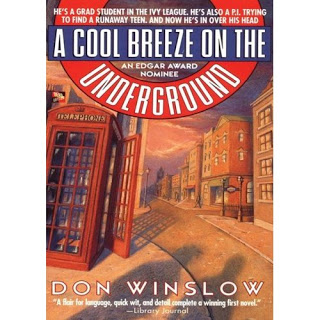
I just reread a book that I first encountered some 20 years ago, Don Winslow’s A Cool Breeze on the Underground (1991). Winslow has established himself as an entertaining, edgy writer of crime and mystery novels, and this was his very first.
The protagonist is a young private detective named Neal Carey. Early in the book, we learn how Neal’s hardscrabble upbringing during the 60s and early 70s New York City led him to become part of a secretive detective agency that achieves difficult results for high powered clients. Although not expressly stated in the novel, the primary story is set in the summer of 1976, and there’s a connection to that year’s Presidential campaign.
I found Neal to be an endearing character when I read the book 20 years ago, and I felt even more so this time around. In addition to becoming a savvy P.I. at a young age, he’s a scholar in the making, enrolled in an English literature graduate program at Columbia University. Some of the implausibilities of this scenario are overcome by the charming way it fits into the main plot, which eventually takes him to London.
I love the book’s uses of New York and London. The more familiar the reader is with these cities, the more vivid the story becomes, whether it’s grabbing a burger at the legendary Burger Joint in Manhattan, or navigating the labyrinths of London’s Underground subway system.
Winslow’s references to specific places send me off on my own journeys in those cities, today with more nostalgia than my during first reading. For example, one scene puts Neal at London’s Embankment along the River Thames:
Neal paid the cabbie and started across the pedestrian walkway on the bridge. The view up and down the Thames was one of his favorites. It might be the best spot to see London, he thought, and he stopped about halfway across to take it in.
This vista includes “a postcard view” of “Big Ben and the Houses of Parliament,” as well as the “stretched Victoria Embankment.”
I have to put the book down to drink in this passage. That’s my own favorite view of London, and I’ve made a point of crossing that footbridge during every one of my visits there!
For me, therein lies the appeal of so many crime novels, espionage thrillers, and mysteries: They take me back to places I know and enjoy, sometimes even prompting me see them in a different way, with scenes woven into plots full of suspense and intrigue.
In fact, the right location can lift a so-so plot for me. If a story is set in a place I don’t know, it better be a compelling tale to keep my attention!
In the U.S., New York is my favorite setting for mystery and suspense tales. Chicago, Boston, New Orleans, Hawaii, and Washington D.C. also appear on my list. When it comes to international intrigue, give me London, Cambridge and Oxford, Paris, and major cities in Austria and Germany, the latter especially if we’re talking about historical stories.
When it comes to fiction, I confess that I’m not a devotee of serious literature. Rather, this is my favorite genre, and when good stories are placed in cities I’ve come to know and love, it’s an added treat.
A geek’s inquiry: Can you own too many books?
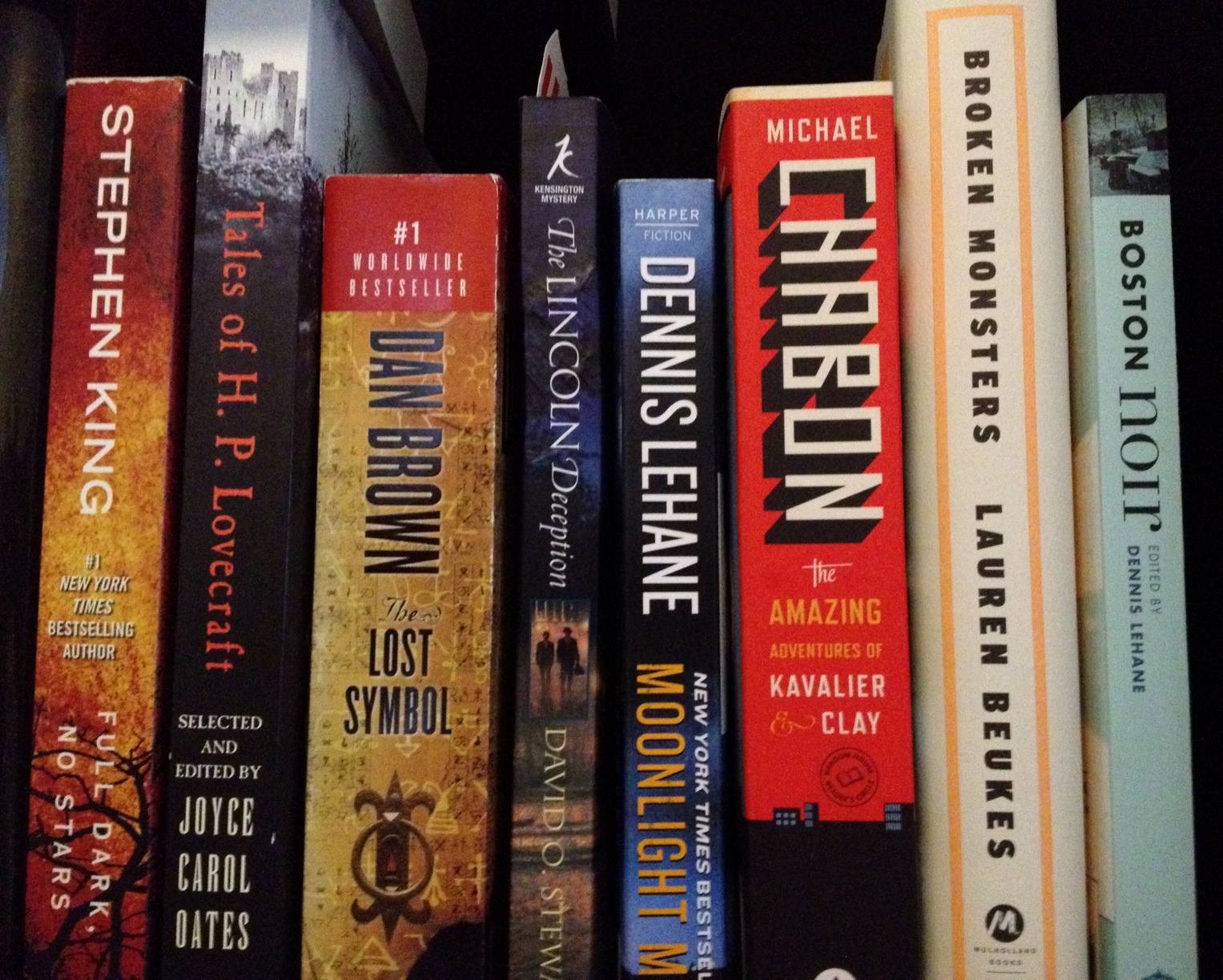
Some leisure reading
Some 12 years ago, when I was in the market to buy a condo in Boston, perhaps my biggest priority was that my new home had to accommodate bookshelves, as in every room save the bathroom and kitchen. My broker was amused. She had facilitated many sales in Greater Boston, but never before had she worked with someone who was so attentive to wall space for placing bookshelves.
During every one of my several moves over the years, more and more books seem to come along. Although I’ve given away many hundreds of books, the number of volumes in my personal library inevitably grows.
Concededly, I can’t keep up with my new treasures. My rate of acquisition outpaces my ability to read. As I wrote a few months ago, if I suddenly had to stop buying books, I would have enough unread volumes to keep me happily engaged for years.
Ken Kalfus and the laments of book buyers
In last week’s New Yorker, writer Ken Kalfus reflects upon the thoughts that swirl in the minds of mature book shoppers, including that mound of unread volumes at home:
I want to buy a book—perhaps it’s a specific book, identified in a review or mentioned by a friend, or perhaps simple intellectual restlessness has put me in the mood to browse a bookstore shelf and find something new. As I descend to the streets of the city where I live, I recall that many fine unread books remain on my overstocked shelves at home. I’m aware of them every hour of the day, even when I look up from the book I’m currently reading. They remind me of promises made to read them when they were bought; some of these promises are now decades old. My shelves also hold certain already-read volumes that deserve a careful, more mature rereading. I should turn back.
I sometimes wish I had that capacity to feel the smallest twinge of conscience about buying another book. But like a favorite dog or cat when it comes to food, I seem to be missing an “off” switch when I walk into a bookstore or shop online. I consider it an act of supreme willpower to walk away (or log off) empty-handed.
Returning to the question
Okay, so let’s get back to the question. Can you own too many books?
In terms of pure physics, I suppose the answer is yes. I mean, if you’re trying to fit 800 square feet of books into a 750 square foot apartment, then you’ve got a problem.
I’ve also read of apartment dwellers so loaded up with books that they’ve had to pay contractors to reinforce the floors, lest their library cause a collapse of epic and life-threatening proportions. Maybe it’s time to ease the burdens on the infrastructure instead.
Otherwise, well, umm, er…I’m not sure.
Ken Kalfus may feel some unease over his neglected purchases, but I find comfort in gazing at my bookshelves and seeing volumes both read and unread. They gently suggest that many old and new adventures await, and all I have to do is pull one off the shelf and open the cover.
Summer reading 2015

Wonderful caption to the Dennis Stock photo: “The great promise of summer reading is the pleasure of total absorption”
Summer reading is a term that catches my fancy every year. It calls to mind images of reading a good book on the beach or in a hammock, with a beverage at one’s side and without a care in the world. (Cue up Seals & Crofts, “Summer Breeze.”) Problem is, I don’t spend a lot of time on beaches, and the small yard of my three-unit condo building contains no hammock, at least the last time I looked.
Summer reading also conjures up a certain type of book, one that appears on erudite lists of, well, suggested summer reading. However, despite the photo above, I actually can’t tell you what staffers for The New Yorker have on their summer reading lists, because I took a quick look and realized that our tastes are, uh, different. But hey, it makes for a nice screenshot.
So what does summer reading mean to me? As an educator, it’s mostly about time to read books that I may put aside during a busy academic year, sometimes with a seasonal twist.
Earlier this week I finished David McCullough’s The Wright Brothers (2015). I’ve raved about it so many times to Facebook pals that probably half of them have unfriended me by now. It’s one of the most enjoyable books I’ve read in recent memory. (For more extended praise, see this piece from my Minding the Workplace blog).

Perhaps McCullough has triggered a summer leaning towards Americana. I’m now reading Hattie’s War (2014), by Hilda and Emily Demuth, a historical novel for younger readers set during the American Civil War. Here’s how the Demuth sisters describe their book:
In 1864 Milwaukee, eleven-year-old Hattie Bigelow, who is more interested in baseball than in sewing circles and other women’s efforts to support the Union cause, loses her back yard to a garden for the new Soldiers’ Home and rebels against her family’s expectations in a society transformed by the Civil War.
Hilda is a dear friend going back to our student days at Valparaiso University. A high school English teacher and novelist, she gave me a copy of her latest when I met up with her and her family during their recent pitstop in Boston. The first clue that I’d like Hattie’s War comes right in the opening scene, with kids playing baseball. It contains a neat little detail revealing that the Demuth gals did their homework in understanding the vintage rules of the game. I can’t claim to be a young reader, but I’m enjoying the book a lot.

The baseball theme continues as well, in the form of John Feinstein’s Where Nobody Knows Your Name: Life in the Minor Leagues of Baseball (2014). It profiles the lives of players, managers, and umpires in baseball’s highest level of minor leagues, called AAA or Triple-A.
Feinstein is one of our best sports chroniclers, and he’s done a great job of capturing both the ongoing draw of the game and the realities of professional baseball played one tantalizing, frustrating step short of the major leagues. So close, but yet so far certainly applies here.

Eventually my reading will break away from the North American continent. Later this summer, I’m presenting a paper at a law and mental health conference in Vienna, Austria. I’ll want to read up on a city that I haven’t seen since a quick visit during my collegiate semester abroad. In addition to a travel guidebook or two, I’m considering crime novels by Frank Tallis (A Death in Vienna, 2005) and J. Sydney Jones (The Empty Mirror, 2009), set in the turn of the last century.
Because I am somewhat undisciplined and impulsive when it comes to pleasure reading, this is not the last word on the matter. At least one of Stephen King’s recent books will likely enter the picture, and maybe one of Alan Furst’s atmospheric thrillers set in WWII-era Europe.
There’s one book, a big bestseller right now, that I’ve been carrying around but just can’t seem to crack: Marie Kondo’s The Life-Changing Magic of Tidying Up (2014). It’s about the “Japanese art of decluttering and organizing,” a talent that I’ve managed to avoid despite my Japanese heritage. Especially when it comes to work, I tend to be the type who creates order from, and makes sense of, what may appear to be cluttered pieces. Alas, this can produce ferocious piles of books and papers, and I’m not good at tossing. Whatever.

A cool breeze in the neighborhood

SW Corridor Park, Jamaica Plain, Boston (photo: DY, June 2015)
It was such a pleasure to be outside today. Originally I decided to go into downtown Boston, but after weighing the long mass transit delays caused by some weekend track work on the Orange Line (my subway line into the downtown), I opted for a walk around part of my Jamaica Plain (JP) neighborhood, with a couple of planned pitstops.
It was a great decision. The weather was perfect: Sunny, 70s, with a cool breeze.
Boston’s history of urban planning and design is one of big hits and big misses. Among the former is the Southwest Corridor Park, a stretch of parkway that runs roughly parallel to the Orange Line tracks. I decided to take a walk along the park before cutting up an intersecting street toward the shops and eateries of JP.

SW Corridor Park, Jamaica Plain, Boston (photo: DY, June 2015)
As you can see, it’s a really nice, picturesque walk. On the right are a man and his dog. As I approached, I said hi to the doggie, and he turned out to be a happy pooch. JP is a very animal friendly neighborhood, and this little guy was only one of several canines I encountered on my afternoon walk.

Shy but friendly doggie, SW Corridor Park, Jamaica Plain, Boston (photo: DY, June 2015)
Many moons ago, JP used to be a suburb of Boston. This short stretch of the park below may represent what the neighborhood looked like generally before it became more urbanized. Looking at the photo, it’s hard to believe that subway and rail lines are dug out on the left and that a city street is on the right.

SW Corridor Park, Jamaica Plain, Boston (photo: DY, June 2015)
I eventually walked out of the park and up a street toward the heart of JP. My first stop was Papercuts, JP’s new and only standalone bookstore. I wrote about this great little indie bookshop back in December. Today I picked up a couple of paperbacks, Joan Didion’s The Year of Magical Thinking (2005) and George Orwell’s Down and Out in Paris and London (1933).
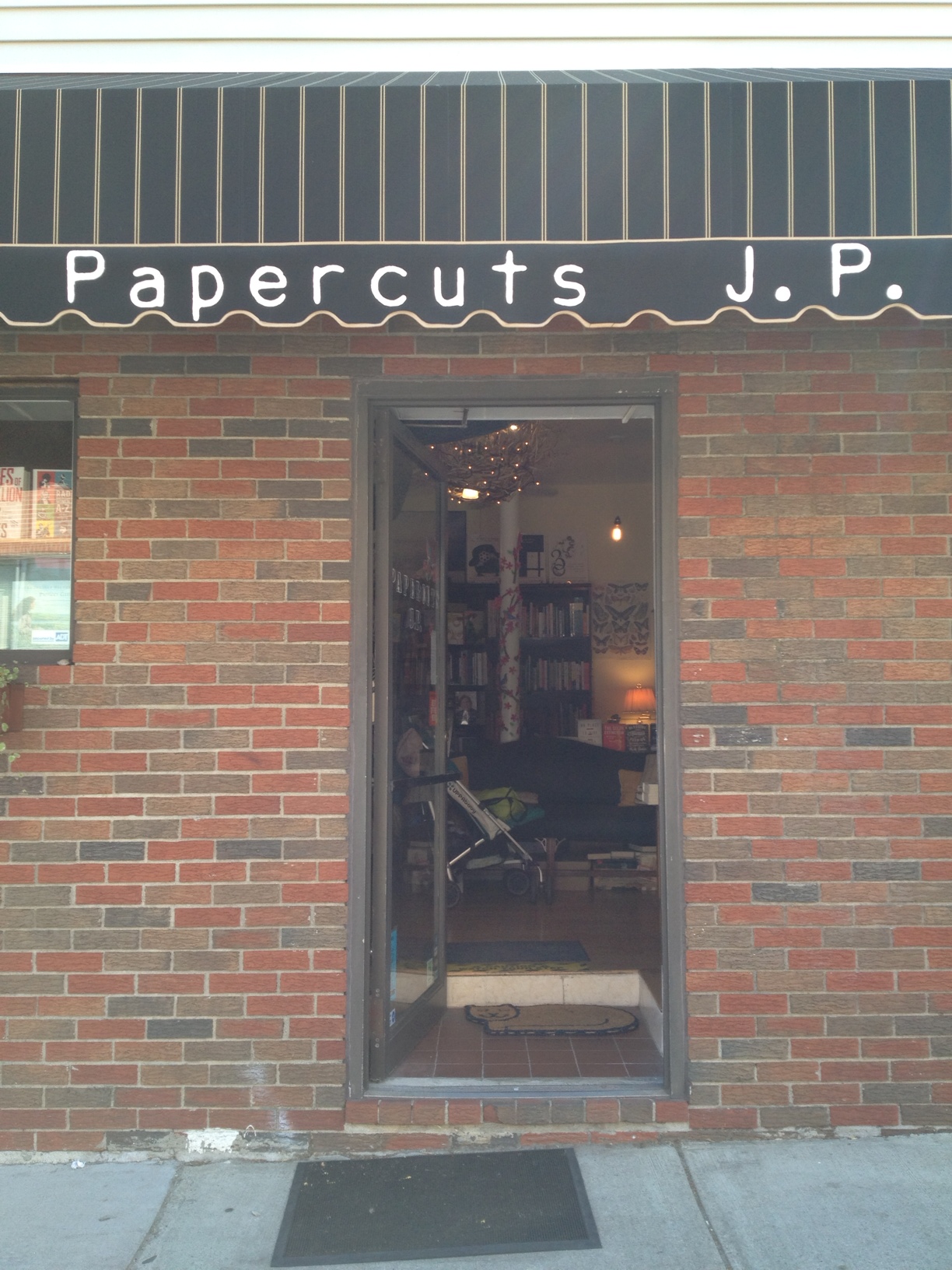
Papercuts J.P. bookstore, Jamaica Plain, Boston (photo: DY, June 2015)
Next came a late lunch at the City Feed & Supply on Centre Street. (The City Feed’s original, smaller store is just seconds away from my condo.) I opted for a soup & sandwich, featuring the jerk chicken soup pictured below and half of a Cuban sandwich. Both were delicious.
I spent some time at City Feed enjoying my food, catching up on e-mails via my iPad, and reading the Sunday newspaper.

Jerk chicken soup, City Feed & Supply on Centre Street, Jamaica Plain, Boston (photo: DY, June 2015)
Then it was time to walk back home. I pretty much reversed course, except when I got to the Southwest Corridor Park, I stuck to the paved areas running alongside the grass and the dirt pathway.
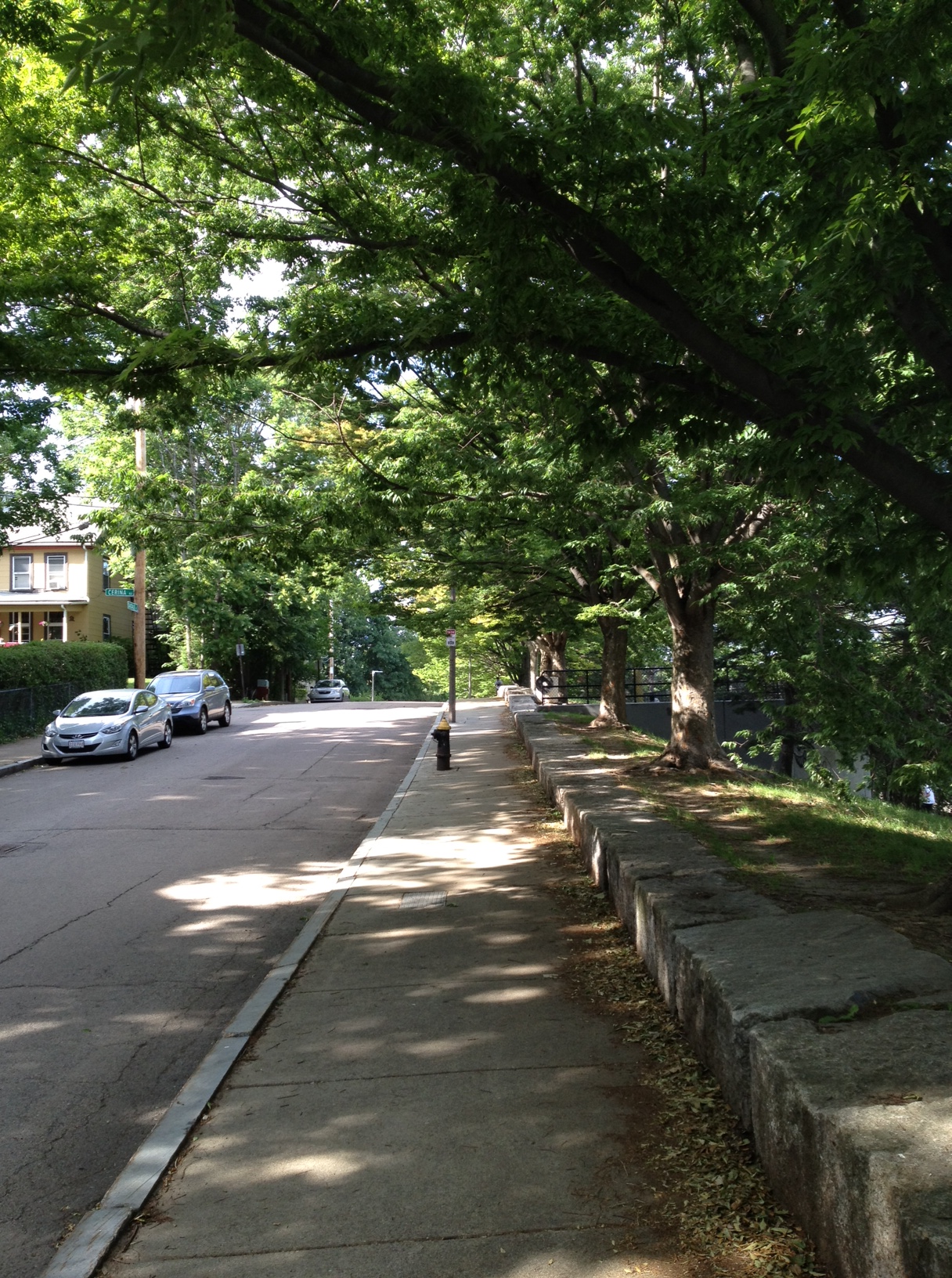
Sidewalk along SW Corridor Park, Jamaica Plain, Boston (photo: DY, June 2015)
I had intended to be a bit more productive today, but I’ll get some work done tonight — uh, at least after watching the NBA Finals on television.

SW Corridor Park, Jamaica Plain, Boston (photo: DY, June 2015)
Heaven for a history geek: A David McCullough book talk

Not a great photo, but a wonderful book talk
One of the best things about living in Boston is that a lot of authors do book talks here, including many great writers of history. I just got back from one of them, a talk by historian David McCullough about his latest book, The Wright Brothers (2015), a story of brothers Orville and Wilbur Wright, who invented and flew the first successful airplane in 1903.
McCullough spoke in Cambridge as part of the Harvard Book Store speaker series to a packed house at the First Parish church.
McCullough is one of America’s foremost popular historians, and he is one of my personal favorites. His love of history pervades his books and his public appearances. In addition to being a master storyteller in print, his gravelly but gentle voice and a contagious enthusiasm for his subject matter add a magical quality to a talk or documentary.
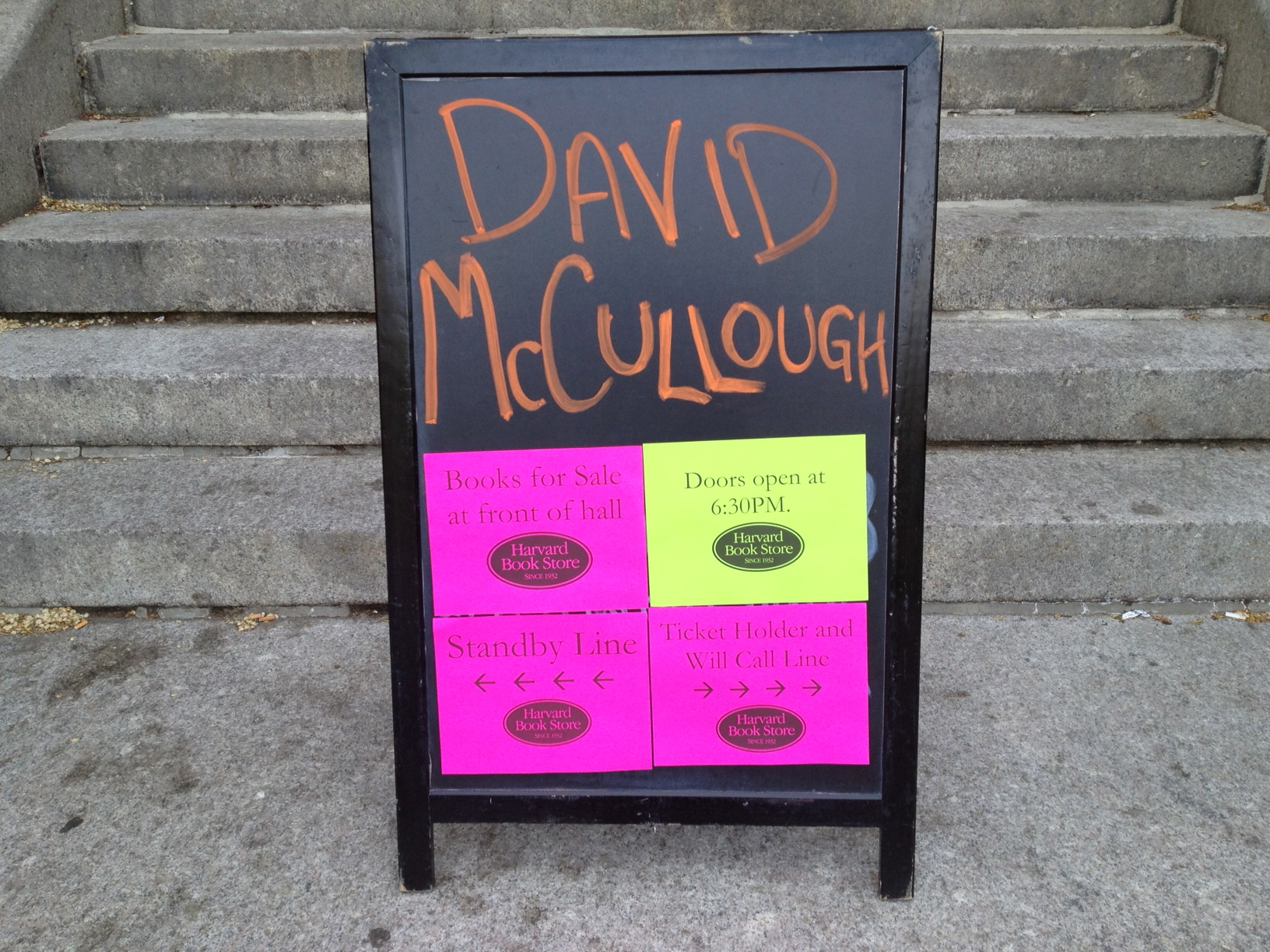
The ticket holders line stretched for over a block!
McCullough confessed that before he started his research, he knew little of the Wright Brothers’ story beyond the basics: Two brothers, owners of a bicycle shop in Dayton, Ohio, would go on to build and fly the first successful airplane, flown at Kitty Hawk, North Carolina.
However, as he dug into their story, he learned about how Orville and Wilbur were raised in very modest surroundings by a missionary father who believed very strongly in the power of reading, how their sister Katharine strongly influenced and supported their work, and how an intense devotion to teaching themselves the science and mechanics of flight led to their success.
It is clear that McCullough came to admire his subjects, for both their intelligence and their character. The Wright Brothers, he made clear during his talk, had the right stuff. He allowed himself to make broad connections, suggesting that great history is not just about politics and war. He compared the brilliant inventiveness of the Wright Brothers to that of composer George Gershwin.
During his prepared remarks and a lively Q&A, McCullough waxed eloquent about the importance of historical literacy. He said that history can be a “wonderful antidote” to the hubris of our present era. He noted that developments we take for granted today may be regarded as breakthroughs many years from now, adding that prognosticating about the future may be futile. “There’s no such thing as the foreseeable future,” he quipped.
David McCullough is a national treasure, as exemplified by tonight’s audience thanking him with long, warm rounds of applause and a standing ovation. It was just so much fun to be in the presence of this great historian and storyteller.
Once upon a time, in a New York City not too far in the future…
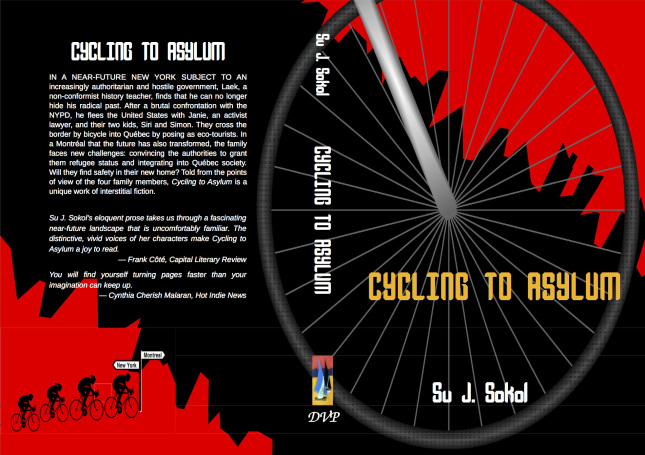
From sujsokol.com
I just finished a terrific novel, Su Sokol’s Cycling to Asylum (2014), described by the author as “the story of a family that flees a near-future New York City and crosses the border into Québec by bicycle to demand political asylum.” I’m going to be a bit lazy and let Su’s website synopsis do the work of describing its essence:
…[T]he novel is the story of a voyage, both an actual and personal/metaphorical one. This voyage is experienced differently by each protagonist and it is for this reason that it is told in alternating chapters, using the unique voice and perspective of each of the four main characters. These characters include Laek, a history teacher with a mysterious, radical past; Janie, an activist lawyer and musician; Siri, a tomboy with secrets; and Simon, a dreamy child addicted to violent screen games.
I’m pleased to report that Cycling for Asylum has drama and suspense, compelling characters sharing deep emotions, and a thought provoking political and social context, all sprinkled with clever detail and humor. I read the book slowly, over the course of many Boston subway rides. Its short chapters and compact, memorable story were perfect for that.
Concededly, I’m not an unbiased reader or reviewer. Su is a classmate of mine from NYU Law School, and many years ago she and her husband Glenn lived down the block from me in Brooklyn. During law school and throughout her career, Su has been a strong advocate for the disenfranchised and for social justice, a quality that informs her novel.
Su and I fell out of touch when I moved to Boston, but through Facebook we reconnected. I would learn that Su and Glenn moved their family from New York to Montreal about a decade ago. Earlier this year, Su was making a swing through the Boston area, and we enjoyed a delightful lunch along with her long-time friend (and book cover artist) Lin-Lin Mao. Here’s a photo that Lin-Lin took, with plenty of snow around us:

Photo: Lin-Lin Mao
During lunch, Su told me how important this kind of writing has become to her. That care is evident in Cycling to Asylum, her first published novel. For me, reading it was a fun little revelation. I’d long admired Su’s commitment as a public interest lawyer, a job that often requires the skills of a good story teller to put a client or cause in a favorable light. But a strong knack for advocacy doesn’t make one a novelist, as the world is besieged with wannabe writers holding law degrees! In Su’s case, however, I found myself taken by her ability to create interesting characters and to tell a story.
I’m not a literary critic; I either like a book or I don’t. I really liked this one. While riding on Boston’s Orange Line, it drew me into another world of interesting people and times, a journey for which I am very thankful.
If you had to stop buying books today, how long would it take to read through your home library?

Looking at some of my books
Those of you who enjoy shopping for books are invited to ponder this question with me: If you had to stop buying books today, how long would it take to read (or re-read) through the goodies already in your personal library?
In my case, I estimate over a decade, assuming I’d be working during that time. Even if I found myself under house arrest with a court order not to have cable, I’d still have at least several years of good reading in front of me.
Having a collection of books sufficient to dub a “library” means a lot to me. I’ve never cared much about furniture, interior design, clothes, kitchen gadgetry (ask some of my friends about my dishwasher story), and most other home accoutrements. However, having bookshelves filled to the brim…well…that’s my idea of material success. I haven’t counted my books at home, but I estimate they number around 2,000, with a healthy chunk — maybe a third — being at least somewhat work-related.
Now, as far as getting around to reading them, well, this is a problem. I work pretty hard, and a lot of my reading is related to various writing and research projects, which means using non-fiction books and articles mainly as resources, not cover-to-cover reads. That brainwork can leave me a little fried, and at the end of the day I might prefer to watch a good TV show or a movie.
I keep telling myself that all the unread books will wait for retirement, whatever and whenever that is, as I don’t intend to ever truly “retire.” If I am so blessed to have more leisure time 10 or 15 or 20 years down the line, then I will enjoy many pleasant hours with my library.
Nevertheless, I don’t want to wait that long to dive into many of these good books, so I’ll have to continue to find ways to sneak some quality reading time into my life.
In the meantime, the books are on shelves, or sometimes in piles. That’s okay. They are my inanimate friends, and more than a few have sentimental value to me. I can look at some of my favorite books and immediately recall stories associated with them. Such is a life grounded in geekdom, but I consider myself fortunate in that regard.
Throwback Thursday: Discovering Jack Finney’s “Time and Again”

You may have to be a bookworm to fully appreciate a soggy, nostalgic Throwback Thursday post about, well, reading a book, but here it is: About 30 years ago, I discovered Jack Finney’s Time and Again (1970), an illustrated novel about a Manhattan advertising artist named Si Morley who is enlisted in a U.S. Government project experimenting with time travel.
No spoiler alerts are necessary to give you a preview. Let me first quote from the back cover of my paperback edition (pictured above): “Did illustrator Si Morley really step out of his twentieth-century apartment one night — right into the winter of 1882?” I’ll say no more about the story, except to say that if you love New York City and enjoy time travel stories, then this book is for you.
I discovered Time and Again in 1985. I had not heard of the book when I kept glancing at it during repeated visits to Barnes & Noble’s giant sale annex at 5th Avenue and 18th Street, but finally I decided to buy it. As I was reading along, soon I realized that it was becoming one of my favorite books. (It remains so.) Again, I’ll skip the details, but Chapters 7 and 8 provided some of my most cherished reading moments ever.
To grasp such a geeky memory, it helps to understand where I was in my life. In the fall of 1985, I had just graduated from NYU’s law school, I was living in Brooklyn, and I was working as a public interest lawyer in Manhattan. I had also become completely smitten with New York City. I doubt that I will ever again experience such deep affection for a place. If a big part of me will always be a New Yorker, then those early years in NYC will have a lot to do with it.
Time and Again spoke to that love of New York, and its story captivated me. Finney had a knack for writing the time travel tale — as his other books and short stories also attest — and he got it just right with this one. It may be as close to genuine time travel as I’ll ever get, a reading experience approached only by Stephen King’s 11/22/63 (2011). (In fact, in the Afterword to his book, King calls Time and Again “the great time-travel story.”)
So, if a tale of discovering olde New York is to your fancy, then you might give Time and Again a try. I think you’ll be glad you did. Don’t forget to close your eyes and see what Si Morley saw.
 Musings of a Gen Joneser
Recent Comments