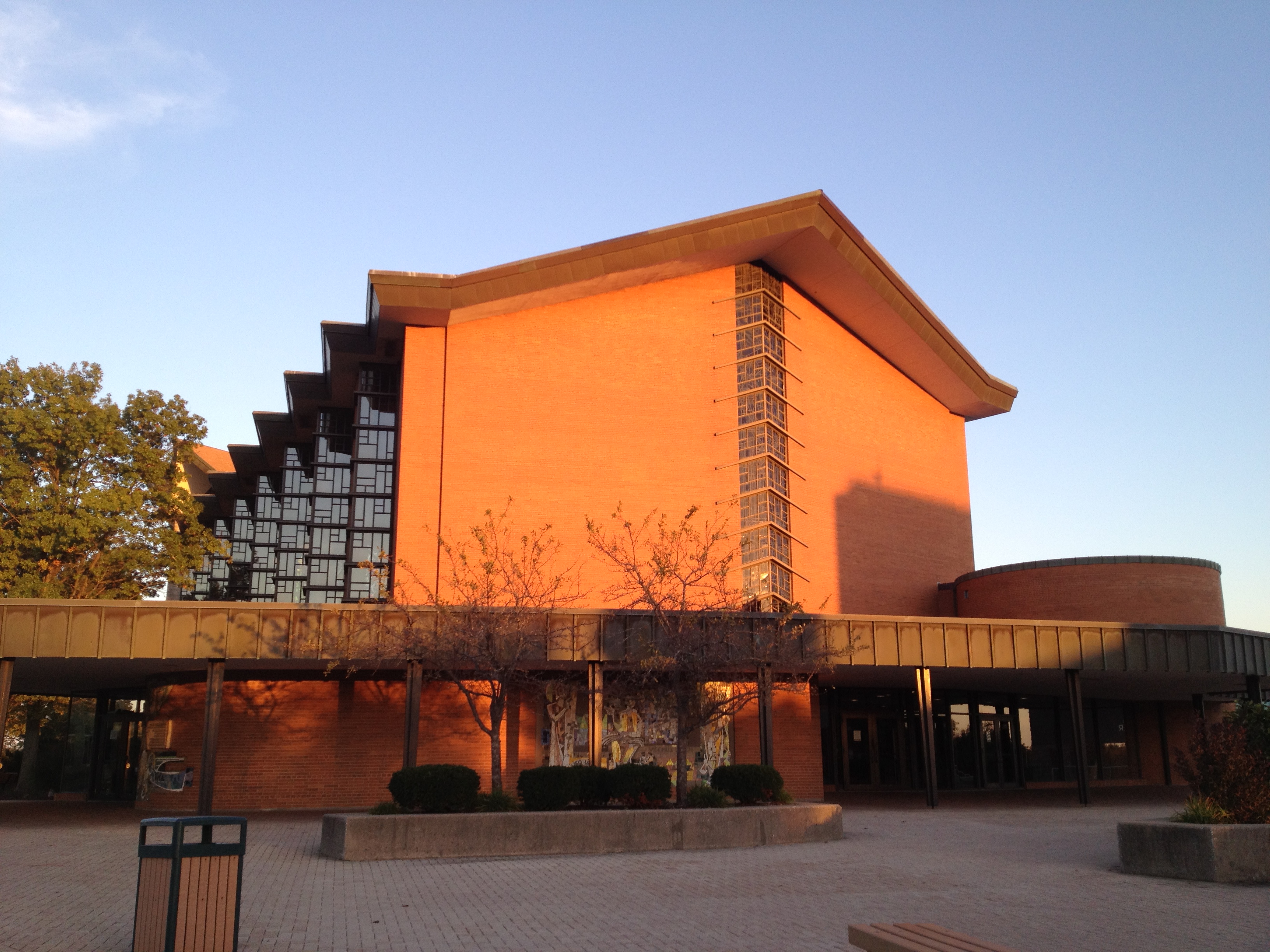
Valparaiso University’s Chapel of the Resurrection at sunset, Fall 2016 (photo: DY).
I spent much of last week attending a conference on psychological health and safety in the workplace, held at the University of Washington in Seattle. Mostly because of my terrible sense of direction (even with Siri and Google maps at my disposal), I saw a lot of this large, beautiful campus. I imagined how lovely it must be to walk these grounds every day as a student.
Furthermore, traipsing around this college campus activated my strong sense of nostalgia for my own undergraduate years at Valparaiso University in northwest Indiana. So if you have a few minutes, please indulge this trip down memory lane….
The modern VU presents an appealing campus and aligns the downtown of a small city that has come a long way since my student days. But when I matriculated in the fall of 1977, the city of Valparaiso was considered to be on the far outskirts of the Chicagoland region. It felt like something of an outpost.
The campus itself was in great need of repairs and upgrades, with a lot of old, ramshackle structures actively used to hold classes, host cultural and sporting events, and house faculty offices. I can now romanticize about the overall shabbiness of the place, but in truth, much of the physical plant was a showpiece of deferred maintenance.
Its rundown appearance aside, Valparaiso University of that time delivered a quality classroom education, thanks to many dedicated, able professors who cared about helping undergraduates of widely varying levels of maturity find their ways forward. Although few were prolific scholars (punishing teaching loads made sure of that), many were true intellectuals.
Two aspects of my VU years were especially meaningful and life changing: Serving as a department editor of The Torch (VU’s student newspaper), and spending my final semester at VU’s study abroad center in Cambridge, England. In addition, Valparaiso planted seeds of many friendships that are now lifelong.
These elements would infuse the heart of a 2017 essay, “Homecoming at Middle Age,” which contains deeper remembrances of, and reflections on, my VU years. The process of writing the piece — inspired by several weeks spent on campus during a research sabbatical the year before — clarified the long-term meaning of my college years in gratifying ways. Rather than trying summarize all of that, I’ll simply invite you to click here for the published version in The Cresset, VU’s long-time review of literature, the arts, and current events.

Literary origins
More recently, I have found the college experiences of some close VU schoolmates to be much more interesting than my own. Among other things, I see in their VU days a clear path to creative and literary passions that animate them to this day.
Sorting through a box of mementoes recently, I unearthed an issue of The Darkling Thrush, an indie literary magazine published by VU pals as an alternative to the university-funded undergraduate journal. In the era before desktop publishing programs would offer their multiple fonts, templates, and fancy graphics, publications like The Darkling Thrush had a definitely home brewed look. I don’t know if the term zine was in use during the early 1980s, but this lovingly photocopied and stapled publication certainly qualified for the label.
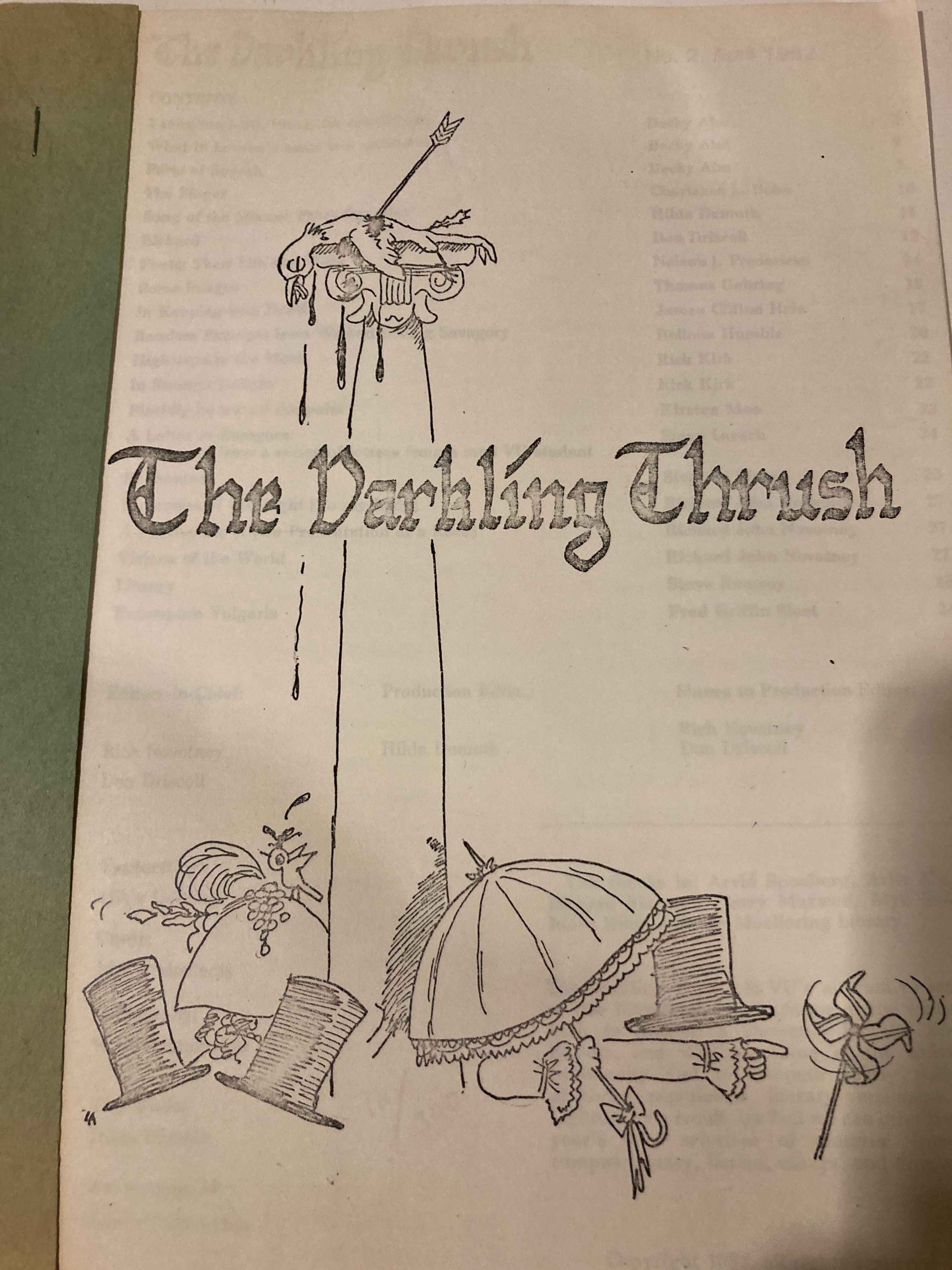
Photo: DY

Photo: DY
And talk about origin stories! The table of contents and editorial masthead — click the photo on the right — listed names of several dear friends whose literary interests still burn brightly. To wit:
Hilda Demuth-Lutze has authored several published volumes of historical fiction, with her next work coming out soon. Rich Novotney is a published author with several promising works of fiction in progress. Jim Hale became a reporter at a couple of daily newspapers. (I suspect that a creative writing project or two may come from Jim as well.) Don Driscoll has long been a discerning and prolific reader of fiction and history, and he is often asked to comment on drafts written by our friends.
***
By comparison, you won’t see my byline in any campus literary journal from our VU days. Unlike my more cultured schoolmates, I was not a very intellectual collegian, nor did I want to be one. I greeted literature and the fine arts with a Philistine phalanx of resistance so strong that even my awakening semester abroad in England could barely make a dent. Why, I protested, should we bother with a Shakespeare play or an art museum, when we can hang out and talk about our favorite TV show theme songs instead? (I’m happy to report that my cultural tastes have expanded and matured since then.)
Overall, I was a striver, not a scholar. I worked hard to get good grades because I wanted to go to law school, with plans to pursue a career in public interest law and politics. Happily, the law school part worked out very well. A year after graduating from VU, I would pack my bags for New York City to pursue my law degree at New York University. But omigosh, I was a pretty callow young man when I made my way to the East Coast.
***
Among my VU friends mentioned above, Hilda and Rich are working on book projects with the university as a featured location. I’ve seen from their posted Facebook comments and photos describing recent visits to the VU campus that those days of yore carry a lot of meaning for them.
Perhaps like me, but with literary panache, they are writing in part to more deeply understand the meaning of our collegiate years and those early chapters of our lives generally. I know that writing the 2017 reflection on my VU days was so clarifying that I closed the piece this way:
We cannot change the past, but subsequent events, new understandings, and mature reflection can change how we regard it. It took me many years, and some negotiation, to recognize VU as my alma mater in the truest sense of the term. Today I am grateful for this renewed and positive relationship, which includes a quality education of lasting impact and a cohort of treasured, lifelong friends. After all, in a world more uncertain and fractured than it was some thirty-five years ago, we need these healthy human and institutional connections to help us navigate it.
Thus, I will be very curious to read my friends’ respective takes on their student lives at our shared alma mater. And because their VU days were a lot livelier than mine, I won’t blame them if their tales are safely fictionalized to protect the guilty, and perhaps even relocated in time. It will make for some fun speculation.


 Musings of a Gen Joneser