Barcelona Dispatch
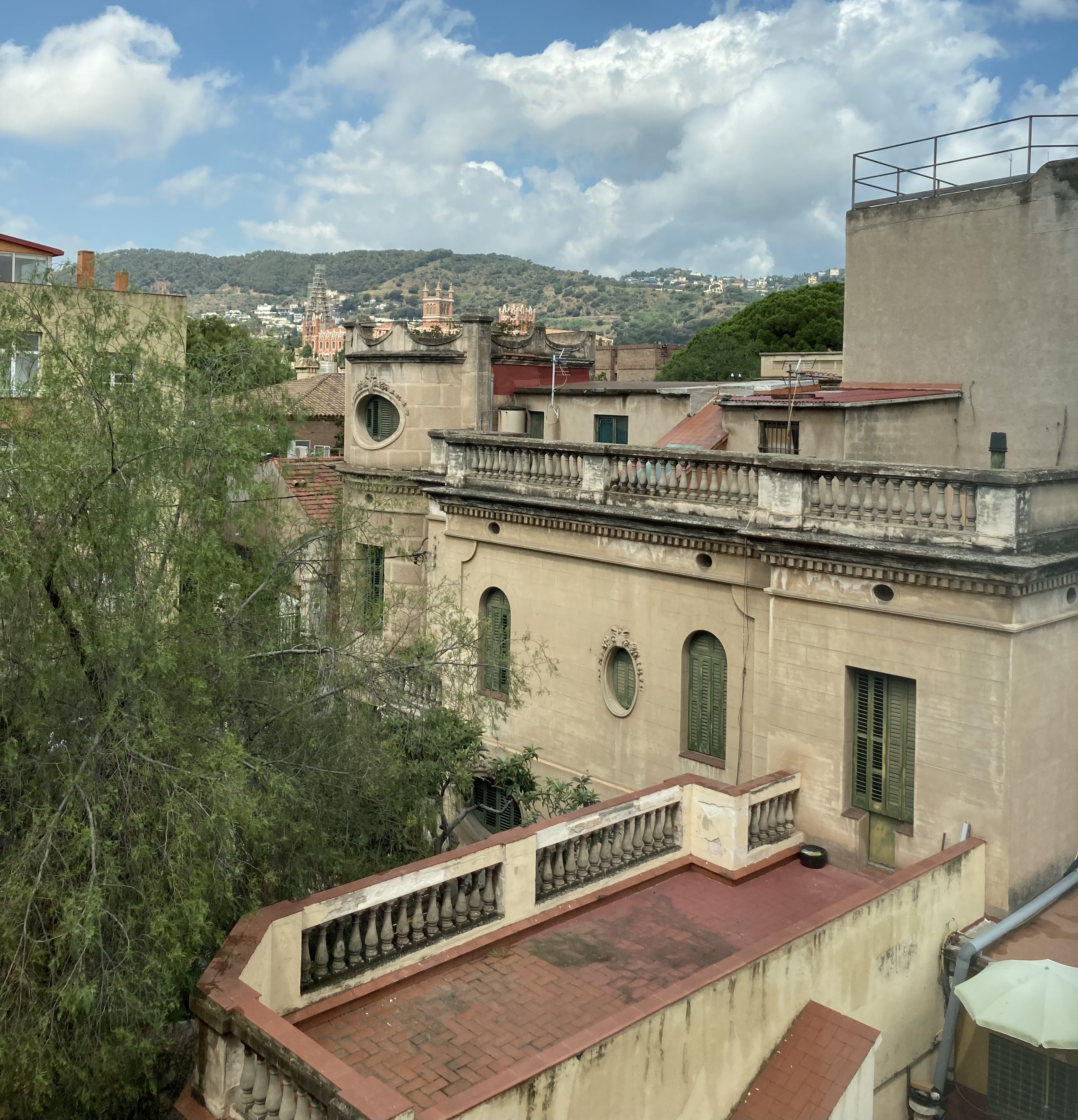
Hotel room view, Barcelona
I’m writing from a café in Barcelona, Spain, having spent the last week at the University of Barcelona Faculty of Law, attending and participating in the International Congress on Law and Mental Health. The Congress is a biennial conference organized by the International Academy of Law and Mental Health, held in different major cities. It attracts a global assemblage of scholars, practitioners, judges, and students, drawn heavily from fields such as law, psychology, psychiatry, and social work.
I’ll be flying back to Boston tomorrow morning. In the meantime, I’m sharing my three big takeaway reflections from this little sojourn.
First, among this historically literate group of conference goers, there was a strong sense that we are living in dangerous times. Although the Congress’s focus is not on large-scale politics and statecraft, its big-picture frame envelops the rule of law, human rights, individual and societal well-being, and psychological trauma. Attendees from around the world shared deep concerns about the rise of authoritarian leaders, which frequently infused conversations during session breaks and over meals.
The U.S. presidential campaign loomed large. Indeed, a Canadian friend and fellow conference participant was the first to text me that President Biden had withdrawn as the presumptive Democratic nominee. People are paying attention to what happens, deeply concerned about the critical damage that a Trump presidency would do to democracy, freedom, and the environment on a global scale.
Second, the conference itself served as an important reminder that for academics and others whose work is enriched by sharing our latest research and analyses, in-person gatherings still matter. The people drawn to this conference are doing compelling work in the broad intersections of law, public policy, mental health, and psychology. (For more on that, go here to read a short piece I posted to my professional blog.) While the pandemic, especially, has taught us that presentations can be delivered effectively via Zoom, in-person conferences and workshops create better space for informal conversations that stoke ideas, research, and practice and can lead to future collaborations.
And if the gathering is a good one, meaningful human connections emerge. Through this conference, I have met, and become friends with, so many remarkable individuals.
Finally, on a more personal level, I see changes in how I’m now regarding travel, especially the long-distance variety. This conference marks my first overseas journey since the 2019 International Congress held in Rome. Although the Congress is one of my favorite events, I opted not to attend the 2022 offering in Lyon, France, still feeling uncertain about the COVID situation. But I told myself that the Barcelona conference was the time to get back into global travel mode.
When I was doing my price comparisons, I found that I could save a bit of money by paying for another hotel night in Barcelona to avoid a more expensive return plane ticket. The extra time to enjoy Barcelona would be a bonus. But with the conference having concluded two days ago, and – more importantly — the special people with whom I spent so much time having departed, suddenly this worldly, historic, beautiful city has felt rather empty to me. Indeed, as an unintended experiment, my briefly extended stay has confirmed that (1) my sense of wanderlust diminished during the heart of the pandemic; (2) now when I travel, it’s much more about the who and the why, and less about the where.
And so, instead of spending my last sunny afternoon here doing more sightseeing, I’m hanging out in this café, with my thoughts veering back across the ocean. I’m catching up on emails, looking ahead at my schedule for the coming week, and — at least in my head — morphing back into regular life.
Thirty years in Boston: A contemplation
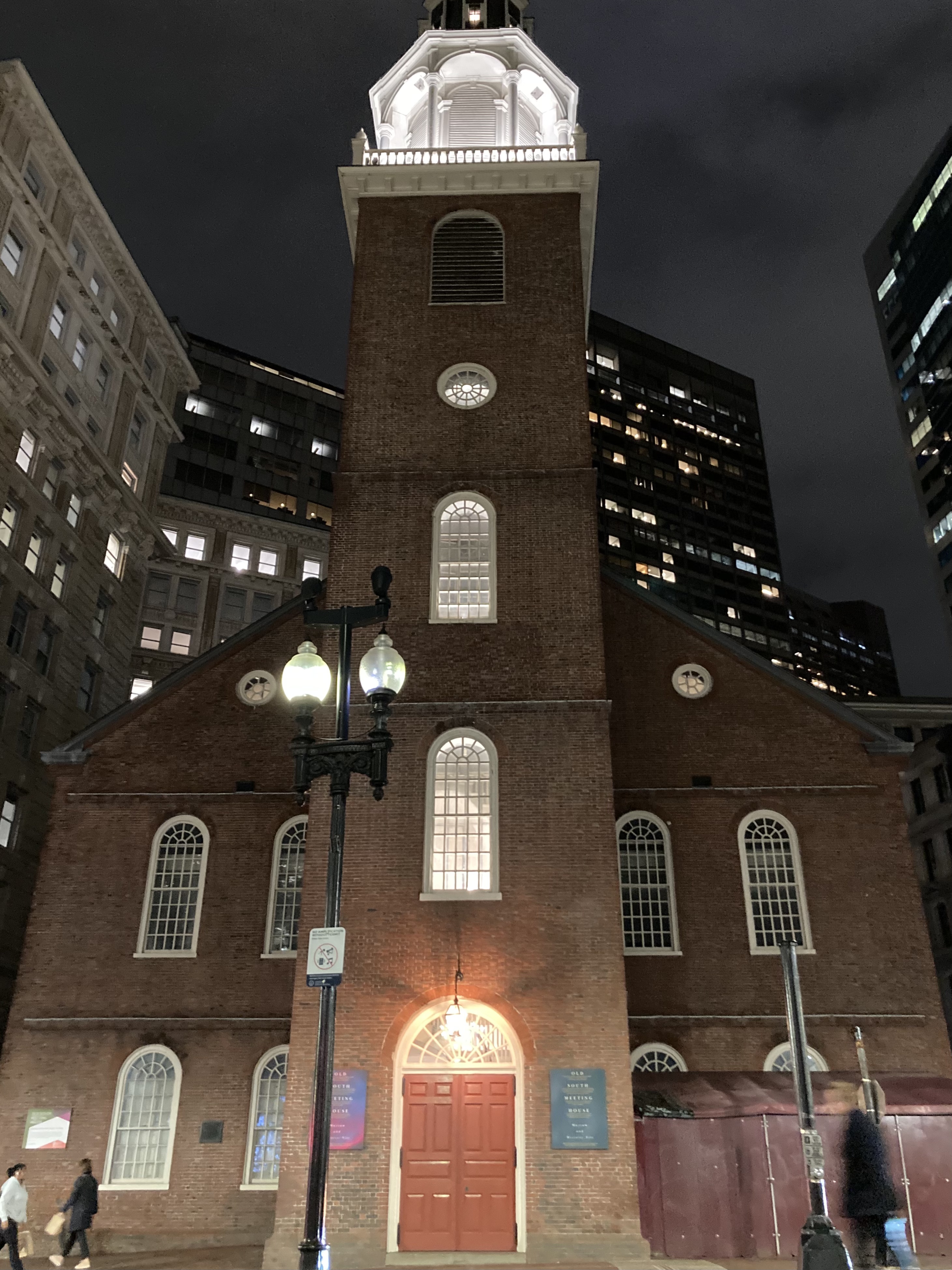
Old South Meeting House, Boston
Thirty summers ago, I packed my bags (and many dozen boxes — mostly books!) for a big move from New York City to Boston. The reason for my move was job-related. I had secured a tenure-track teaching appointment at Suffolk University Law School in downtown Boston.
This was the next step in what was turning out to be an unlikely academic career. In 1991, I returned to my legal alma mater, New York University, as an entry-level instructor in its first-year Lawyering program. That appointment came on the heels of six years of legal practice in the public interest sector. But I didn’t take the job because I thought of myself as an academic in the making. I just figured that it would be an engaging and fun opportunity.
However, I took to teaching immediately. It just clicked for me. Instructors in the Lawyering program were capped at three years, so during that time, I worked hard to make myself competitive for tenure-track appointments. I built a strong record of teaching and started publishing in the field of employment law. During the 1993-94 academic hiring cycle, I entered the tenure-track teaching market and eventually opted to take an offer from Suffolk. Located in the heart of Boston, and regarded as a law school with a historical legacy of opening doors to the area’s working class and emerging middle class populations, it looked like a good match for me.
I didn’t know much about Boston before I arrived here. Beyond a family trip to Boston during my early childhood, a few quick NYC-to-Boston trips to see baseball games at Fenway Park, and interviews at Suffolk Law, I had no on-site familiarity with the city. So, I assumed it was a sort of mash-up between a smaller version of New York City and a big university town, with a diverse, cosmopolitan look and feel.
Oh boy, was I in for a surprise.
Suffolk Law
You see, upon arriving in Boston, I quickly felt like I had moved to a city that seemed stuck in a time warp, characterized by a deep parochialism and struggles with issues of race. It was as if I had somehow traveled back in time some 20 years.
Unfortunately, the culture of Suffolk Law c.1994 was an insular one, very much embracing that regressive look and feel. It surely didn’t roll out the Welcome Wagon to newcomers — especially to those of us who weren’t part of its dominant demographic group.
Even as a pre-tenured professor, I openly confronted aspects of that culture, which led to some very stressful and lonely times. I won’t go into bloody detail here, other than to say that although my concerns were valid (or so agreed the American Bar Association, the Law School’s accrediting agency, in a scathing review of the school’s record of inclusion, prompted by a complaint I filed), they were not well-received by the institution. Accordingly, I knew that had to build a largely bulletproof tenure portfolio, and I did my best to make it so.
In 2000, I would earn tenure — only the second professor of color to do so at a law school that was then almost a century old. I certainly had some hard bruises to show for it. That’s why getting tenure felt more like a fist-pumping triumph over Suffolk than an achievement celebrated in partnership with it. The summer of my tenure year, I visited Maui, Hawaii, for a reunion of cousins. I came back with a large haul of Hawaiian shirts. I called them my “tenure wear” collection, a new wardrobe for teaching class. Out went the dress shirts and ties. I was making a statement: Hello, I’m baaaack!
To my surprise (and perhaps yours, dear reader), I have remained at Suffolk ever since. I still often wear my Hawaiian shirts to class, and my relationship with the institution has sloshed between pretty good and a Facebook-style “it’s complicated.” That said, Suffolk has served as my home base for a successful and satisfying academic career. I get to teach, write, and serve on terms over which I have a fair and appropriate say, protected and empowered by the tenets of academic freedom. That makes me very fortunate.
I hasten to add that there is plenty of good in the institution. Against the backdrop of its virtues and faults, Suffolk has an authentic quality. It is not a stuffy, ivory tower kind of place. It bridges and sometimes negotiates the human dimensions of older and newer Boston. The prototypical Suffolk law student is smart, hardworking, and grounded. Both the Law School and the rest of the university are closely in and of the legal, civic, business, and cultural landscapes of Massachusetts (and New England generally). For someone like me, a city dweller who enjoys operating at the line between research and ideas on one side, and action and application on the other, that makes for a good fit.
My teaching is centered on Employment Law, Employment Discrimination, and Law & Psychology. In three subject-matter areas — workplace bullying and abuse, unpaid internships, and therapeutic jurisprudence (a deep take on law and psychology) — I’ve made significant scholarly, advocacy, and service contributions. None of this was foreseeable when I started at Suffolk 30 years ago. I’ve been able to mature into my true calling during this time.
(For a closer look at some of my work, check out my faculty bio [click here] and my Minding the Workplace blog [click here].)
Boston
As for Boston generally, it has grown on me to a point where I now consider it more than simply an acquired taste. Although the city still exasperates me at times, today I better understand its many complexities. And there are aspects of it that I downright enjoy.
On a personal level, I find it notable that among my circles of friends, most of us grew up outside of Greater Boston — often well beyond Massachusetts. It remains the case that a lot of people born and bred here apparently do not recognize any naturalized paths to genuine Boston citizenship, if you get my drift. (As a Suffolk alumna who fled to the West Coast some 15 years ago quipped, the locals “aren’t taking applications.”)
The city’s challenges with inclusion, race, and tribalism have softened but persist. Boston’s neighborhoods remain fairly divided by their ethnic, racial, social class, and sexual identities. With women, people of color, and LGBTQ folks now asserting their political power, these tensions frequently play out in local elections. Although Boston has long been a solidly Democratic town, the left, liberal, and conservative factions often do battle in the party primaries. Politics remains a bloodsport here.
In keeping with its somewhat bifurcated nature, Boston’s insularity is matched by its intellectual and cultural worldliness. This remains a place where books, history, artistic expression, and innovative ideas still matter. Greater Boston abounds with colleges and universities, medical and scientific research centers, libraries and bookstores, theatre companies, concert halls, cultural and learned societies, and art, history, and science museums. It’s a nerdy place in the best of ways.
History, books, sports, music…and easy accessibility
Several of these intellectual and cultural qualities have a special, ongoing appeal to me.
First, history is ever-present here. In some parts of the city, one can walk on the same streets that Bostonians of the Colonial and Revolutionary eras traversed during their daily lives. Boston’s famous Freedom Trail features historic sites going back to the 1600s.
For a history geek like me, this is all very cool stuff. In fact, I recently joined the board of directors of Revolutionary Spaces, a non-profit organization that oversees two nationally significant historic buildings — the Old South Meeting House (pictured above) and the Old State House — and offers public education programs about freedom of expression, democracy, and the city’s history.
Second, there are books, tons of them. Greater Boston is home to leading public, private, and university libraries. Even in the retail era of online bookselling, the area offers great bookstores, new and used, general and specialized. Two of my favorite places are the central branch of the Boston Public Library, widely recognized as one of the world’s great public libraries, and the Brattle Book Shop, one of the nation’s oldest antiquarian book sellers.
Third, the current century has been a Golden Age for Boston’s professional sports teams. While I still celebrate my Chicago Bears pounding the New England Patriots in the 1985 season Super Bowl, I started following the Pats even before their remarkable run of NFL championships. And I enjoy rooting for the iconic Boston Celtics as well. (Sorry, but when it comes to baseball, I remain a Chicago Cubs fan. I’ve never warmed up to the Red Sox.)
And finally, Greater Boston makes a lot of music, of all varieties. You can go to prestigious conservatories to hone your vocal or instrumental skills. You can start or join a band. You can sing professionally or perform in local shows. If, like me, your music-making aspirations are more modest, then you can take voice lessons at an adult education center and croon tunes to friendly applause at a karaoke club or a piano bar.
These features are enhanced by a city that is both walkable and accessible — the latter via aging, but still decent subway, bus, and commuter rail systems. On this note, Boston has enabled a lifestyle that I discovered and embraced during a collegiate semester abroad in England: City living with a college town vibe, and no car to worry about because I could walk and take public transportation.
Looking ahead
And so, this city that I’ve cursed and struggled with, while coming to enjoy and appreciate, has become my home. Will I ever grow to love Boston? Maybe not, for we have too much of a history for that to happen. But I have come to be strongly “in like” with it, for sure. During my time here, I’ve grown into what I consider to be my best and most impactful self. These surroundings and experiences have contributed mightily to that.
Will the city remain my home for the duration? Well, you won’t see me retiring to a beachside community in Florida, or heading out to some Thoreauvian shack in the woods. But beyond those obvious “not in a million years” possibilities, who knows? For now, in any event, I’m settled in, with plenty more good works left to do, more books to read, and more songs to sing.
***
Editor’s note: This post was slightly revised in August 2025.
 Musings of a Gen Joneser
Recent Comments