Lost traditions: The Sunday newspaper

Not too long ago, a popular Sunday tradition was spending a good chunk of the day reading through the Sunday editions of the daily newspapers. Millions experienced the tactile delight of opening up a big Sunday paper, wondering what interesting stuff waited to be discovered. Even the advertising flyers were fun to page through, especially around holiday season.
The hefty Sunday newspaper has been a journalistic tradition for well over a century. One of my favorite coffee table books is Nicholson Baker & Margaret Brentano, The World on Sunday: Graphic Art in Joseph Pulitzer’s Newspaper (1898-1911) (2005), which celebrates Sunday newspapers published during the turn of the last century.
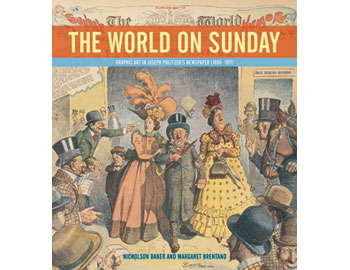
The World on Sunday and the tradition of Sunday newspaper reading represent an aspect of pre-digital culture that may be hard to understand for those weaned on an online world where wishes for news and commentary are instantly gratified. Fortunately, some of the major newspapers still land on doorsteps with a healthy thud on Sundays, containing some of their best in-depth reporting, feature articles, and opinion pieces.
Growing up in Chicagoland
My Sunday newspaper habit goes back to growing up in Northwest Indiana, where local papers and the Chicago dailies were readily available. Among the Sunday editions that regularly got my attention were the Chicago Tribune, Chicago Sun-Times, Hammond Times, and Gary Post-Tribune. The Tribune excelled at covering my beloved Chicago sports teams, and the Post-Tribune did a very good job with local news.
These papers deserve credit for turning me into a Sunday paper junkie. The Chicago influence was especially strong. The Windy City was a great, great newspaper town back in the day, fueled by the city’s colorful politicians, sports figures, and crime bosses. Beyond the headliners, however, the reporters and columnists who toiled for Chicago’s daily papers also had a knack for digging out the stories of everyday people. The human interest story had a regular place in the city’s newspapers.
Sundays in New York
When I lived in New York City (1982-1994), the Sunday papers were a special treat. The Sunday New York Times was an especially heavy load, a multi-pound door stopper packed with goodies and advertising circulars. The early edition of the Sunday Times would come out on late Saturday evening (and still does), and many a weekend night out included picking up a copy on the way home.
My personal favorite, however, was New York Newsday, the now gone NYC edition of the venerable Long Island daily. New York Newsday wasn’t as worldly as the Times, but it spoke more closely to the city’s middle class and did a superb job of covering local politics and sports. Its thick Sunday edition was chock full of extended features and commentaries. To this day, New York Newsday remains my favorite-ever newspaper.
And now in Boston
My Sunday paper of choice remains the New York Times. The Times has not abandoned the idea that the Sunday edition of a newspaper should be something special. I especially look forward to its Week in Review and Book Review sections.
The major daily here is the Boston Globe, and I have an online subscription. I have an on again, off again relationship with the Globe, and for now we are on digital terms only. In fact, despite a surfeit of subscriptions to printed periodicals, I increasingly get much of my news and commentary online.
And to be honest, I wouldn’t trade the remarkable world of information and news available online for the days of waiting for the paper to be delivered. I, too, have been spoiled by point and click access to news coverage from around the nation and the world. However, at a time when we can use more civilized, enjoyable, and affordable rituals in our lives, reading the Sunday newspaper remains a pretty good choice.
***
This is a revised version of a piece I wrote for another blog three years ago.
A geek’s inquiry: Can you own too many books?
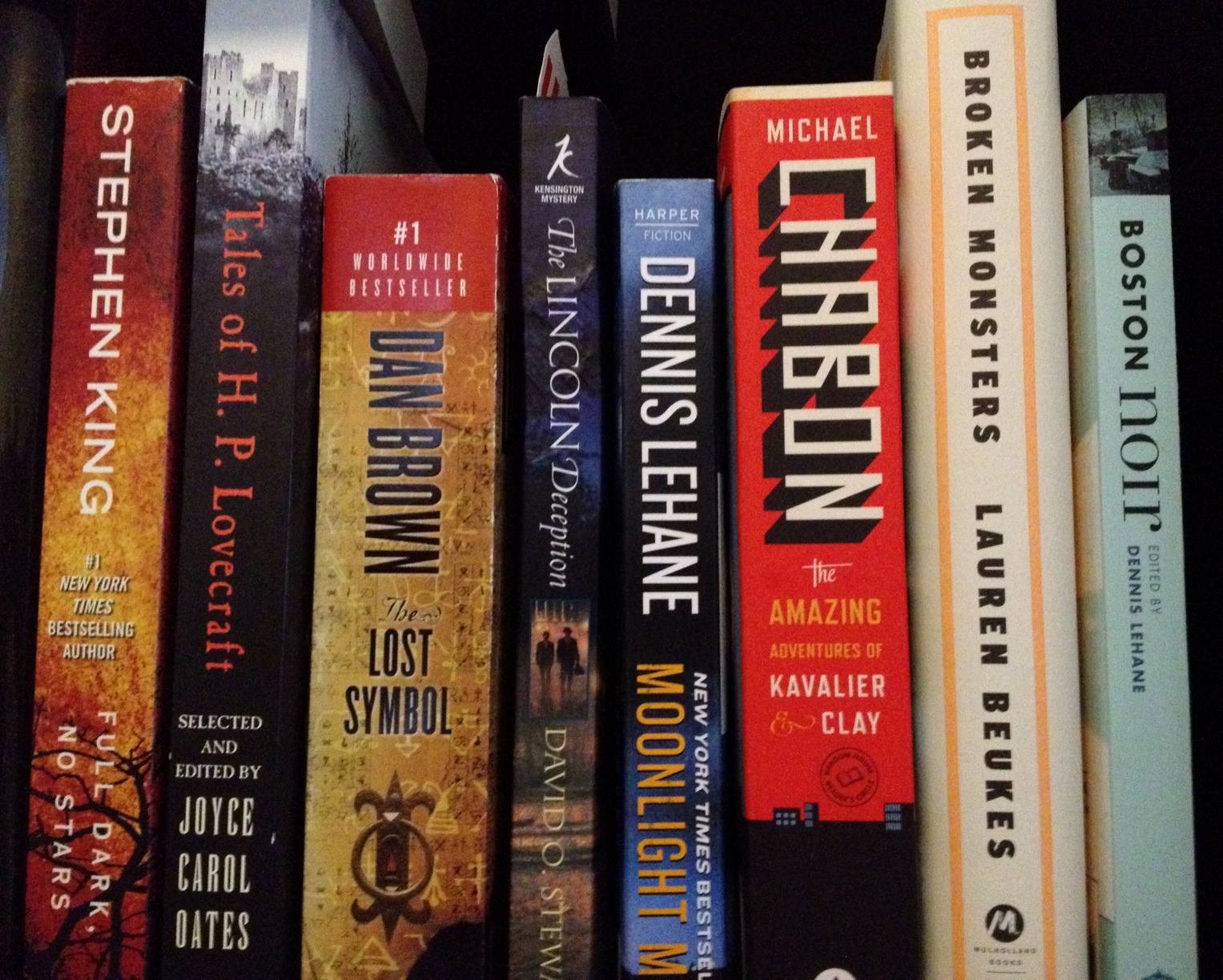
Some leisure reading
Some 12 years ago, when I was in the market to buy a condo in Boston, perhaps my biggest priority was that my new home had to accommodate bookshelves, as in every room save the bathroom and kitchen. My broker was amused. She had facilitated many sales in Greater Boston, but never before had she worked with someone who was so attentive to wall space for placing bookshelves.
During every one of my several moves over the years, more and more books seem to come along. Although I’ve given away many hundreds of books, the number of volumes in my personal library inevitably grows.
Concededly, I can’t keep up with my new treasures. My rate of acquisition outpaces my ability to read. As I wrote a few months ago, if I suddenly had to stop buying books, I would have enough unread volumes to keep me happily engaged for years.
Ken Kalfus and the laments of book buyers
In last week’s New Yorker, writer Ken Kalfus reflects upon the thoughts that swirl in the minds of mature book shoppers, including that mound of unread volumes at home:
I want to buy a book—perhaps it’s a specific book, identified in a review or mentioned by a friend, or perhaps simple intellectual restlessness has put me in the mood to browse a bookstore shelf and find something new. As I descend to the streets of the city where I live, I recall that many fine unread books remain on my overstocked shelves at home. I’m aware of them every hour of the day, even when I look up from the book I’m currently reading. They remind me of promises made to read them when they were bought; some of these promises are now decades old. My shelves also hold certain already-read volumes that deserve a careful, more mature rereading. I should turn back.
I sometimes wish I had that capacity to feel the smallest twinge of conscience about buying another book. But like a favorite dog or cat when it comes to food, I seem to be missing an “off” switch when I walk into a bookstore or shop online. I consider it an act of supreme willpower to walk away (or log off) empty-handed.
Returning to the question
Okay, so let’s get back to the question. Can you own too many books?
In terms of pure physics, I suppose the answer is yes. I mean, if you’re trying to fit 800 square feet of books into a 750 square foot apartment, then you’ve got a problem.
I’ve also read of apartment dwellers so loaded up with books that they’ve had to pay contractors to reinforce the floors, lest their library cause a collapse of epic and life-threatening proportions. Maybe it’s time to ease the burdens on the infrastructure instead.
Otherwise, well, umm, er…I’m not sure.
Ken Kalfus may feel some unease over his neglected purchases, but I find comfort in gazing at my bookshelves and seeing volumes both read and unread. They gently suggest that many old and new adventures await, and all I have to do is pull one off the shelf and open the cover.
Summer reading 2015

Wonderful caption to the Dennis Stock photo: “The great promise of summer reading is the pleasure of total absorption”
Summer reading is a term that catches my fancy every year. It calls to mind images of reading a good book on the beach or in a hammock, with a beverage at one’s side and without a care in the world. (Cue up Seals & Crofts, “Summer Breeze.”) Problem is, I don’t spend a lot of time on beaches, and the small yard of my three-unit condo building contains no hammock, at least the last time I looked.
Summer reading also conjures up a certain type of book, one that appears on erudite lists of, well, suggested summer reading. However, despite the photo above, I actually can’t tell you what staffers for The New Yorker have on their summer reading lists, because I took a quick look and realized that our tastes are, uh, different. But hey, it makes for a nice screenshot.
So what does summer reading mean to me? As an educator, it’s mostly about time to read books that I may put aside during a busy academic year, sometimes with a seasonal twist.
Earlier this week I finished David McCullough’s The Wright Brothers (2015). I’ve raved about it so many times to Facebook pals that probably half of them have unfriended me by now. It’s one of the most enjoyable books I’ve read in recent memory. (For more extended praise, see this piece from my Minding the Workplace blog).

Perhaps McCullough has triggered a summer leaning towards Americana. I’m now reading Hattie’s War (2014), by Hilda and Emily Demuth, a historical novel for younger readers set during the American Civil War. Here’s how the Demuth sisters describe their book:
In 1864 Milwaukee, eleven-year-old Hattie Bigelow, who is more interested in baseball than in sewing circles and other women’s efforts to support the Union cause, loses her back yard to a garden for the new Soldiers’ Home and rebels against her family’s expectations in a society transformed by the Civil War.
Hilda is a dear friend going back to our student days at Valparaiso University. A high school English teacher and novelist, she gave me a copy of her latest when I met up with her and her family during their recent pitstop in Boston. The first clue that I’d like Hattie’s War comes right in the opening scene, with kids playing baseball. It contains a neat little detail revealing that the Demuth gals did their homework in understanding the vintage rules of the game. I can’t claim to be a young reader, but I’m enjoying the book a lot.

The baseball theme continues as well, in the form of John Feinstein’s Where Nobody Knows Your Name: Life in the Minor Leagues of Baseball (2014). It profiles the lives of players, managers, and umpires in baseball’s highest level of minor leagues, called AAA or Triple-A.
Feinstein is one of our best sports chroniclers, and he’s done a great job of capturing both the ongoing draw of the game and the realities of professional baseball played one tantalizing, frustrating step short of the major leagues. So close, but yet so far certainly applies here.

Eventually my reading will break away from the North American continent. Later this summer, I’m presenting a paper at a law and mental health conference in Vienna, Austria. I’ll want to read up on a city that I haven’t seen since a quick visit during my collegiate semester abroad. In addition to a travel guidebook or two, I’m considering crime novels by Frank Tallis (A Death in Vienna, 2005) and J. Sydney Jones (The Empty Mirror, 2009), set in the turn of the last century.
Because I am somewhat undisciplined and impulsive when it comes to pleasure reading, this is not the last word on the matter. At least one of Stephen King’s recent books will likely enter the picture, and maybe one of Alan Furst’s atmospheric thrillers set in WWII-era Europe.
There’s one book, a big bestseller right now, that I’ve been carrying around but just can’t seem to crack: Marie Kondo’s The Life-Changing Magic of Tidying Up (2014). It’s about the “Japanese art of decluttering and organizing,” a talent that I’ve managed to avoid despite my Japanese heritage. Especially when it comes to work, I tend to be the type who creates order from, and makes sense of, what may appear to be cluttered pieces. Alas, this can produce ferocious piles of books and papers, and I’m not good at tossing. Whatever.

Once upon a time, in a New York City not too far in the future…
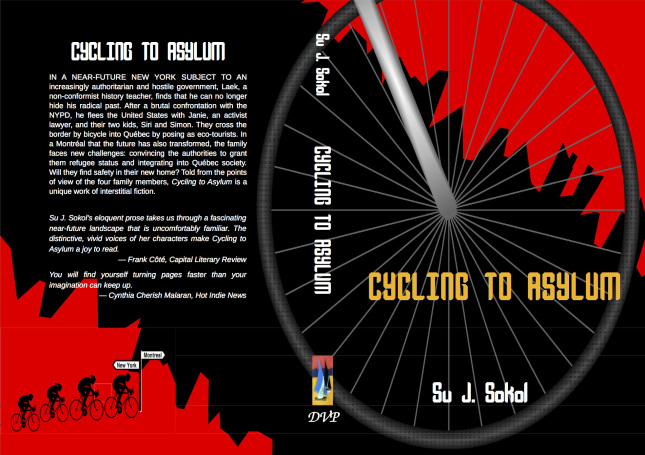
From sujsokol.com
I just finished a terrific novel, Su Sokol’s Cycling to Asylum (2014), described by the author as “the story of a family that flees a near-future New York City and crosses the border into Québec by bicycle to demand political asylum.” I’m going to be a bit lazy and let Su’s website synopsis do the work of describing its essence:
…[T]he novel is the story of a voyage, both an actual and personal/metaphorical one. This voyage is experienced differently by each protagonist and it is for this reason that it is told in alternating chapters, using the unique voice and perspective of each of the four main characters. These characters include Laek, a history teacher with a mysterious, radical past; Janie, an activist lawyer and musician; Siri, a tomboy with secrets; and Simon, a dreamy child addicted to violent screen games.
I’m pleased to report that Cycling for Asylum has drama and suspense, compelling characters sharing deep emotions, and a thought provoking political and social context, all sprinkled with clever detail and humor. I read the book slowly, over the course of many Boston subway rides. Its short chapters and compact, memorable story were perfect for that.
Concededly, I’m not an unbiased reader or reviewer. Su is a classmate of mine from NYU Law School, and many years ago she and her husband Glenn lived down the block from me in Brooklyn. During law school and throughout her career, Su has been a strong advocate for the disenfranchised and for social justice, a quality that informs her novel.
Su and I fell out of touch when I moved to Boston, but through Facebook we reconnected. I would learn that Su and Glenn moved their family from New York to Montreal about a decade ago. Earlier this year, Su was making a swing through the Boston area, and we enjoyed a delightful lunch along with her long-time friend (and book cover artist) Lin-Lin Mao. Here’s a photo that Lin-Lin took, with plenty of snow around us:

Photo: Lin-Lin Mao
During lunch, Su told me how important this kind of writing has become to her. That care is evident in Cycling to Asylum, her first published novel. For me, reading it was a fun little revelation. I’d long admired Su’s commitment as a public interest lawyer, a job that often requires the skills of a good story teller to put a client or cause in a favorable light. But a strong knack for advocacy doesn’t make one a novelist, as the world is besieged with wannabe writers holding law degrees! In Su’s case, however, I found myself taken by her ability to create interesting characters and to tell a story.
I’m not a literary critic; I either like a book or I don’t. I really liked this one. While riding on Boston’s Orange Line, it drew me into another world of interesting people and times, a journey for which I am very thankful.
 Musings of a Gen Joneser
Recent Comments