Spring training: It’s time for “Who’s Who in Baseball”

My ongoing mind-over-matter battle with the winter elements has been buoyed by the annual arrival of Who’s Who in Baseball, a collection of lifetime records of active major league baseball players, at bookstores and magazine stands. The appearance of Who’s Who means that no matter how bad the winter has been, spring and baseball are not far away.
In addition, Who’s Who has a much deeper meaning to guys (yes, mostly guys) who grew up following their favorite big league teams and players back in the day. As you can see from the cover of the current edition, Who’s Who has been around forever. The 1972 edition pictured next to it goes back to my junior high days, when we followed baseball religiously.
Although baseball statistics are now big business — practically everything about the game that can be measured with numbers appears in print or online somewhere these days — the basic format of Who’s Who hasn’t changed much over the decades. A devoted Who’s Who reader from the 1970s could look at the page below from the 2014 edition and instantly recognize where it came from.
And oh, how we’d study those pages! I’m not alone in saying that even if I can’t remember what I had for lunch yesterday, I can still rattle off baseball stats from 40+ years ago. Who’s Who had a lot to do with that.
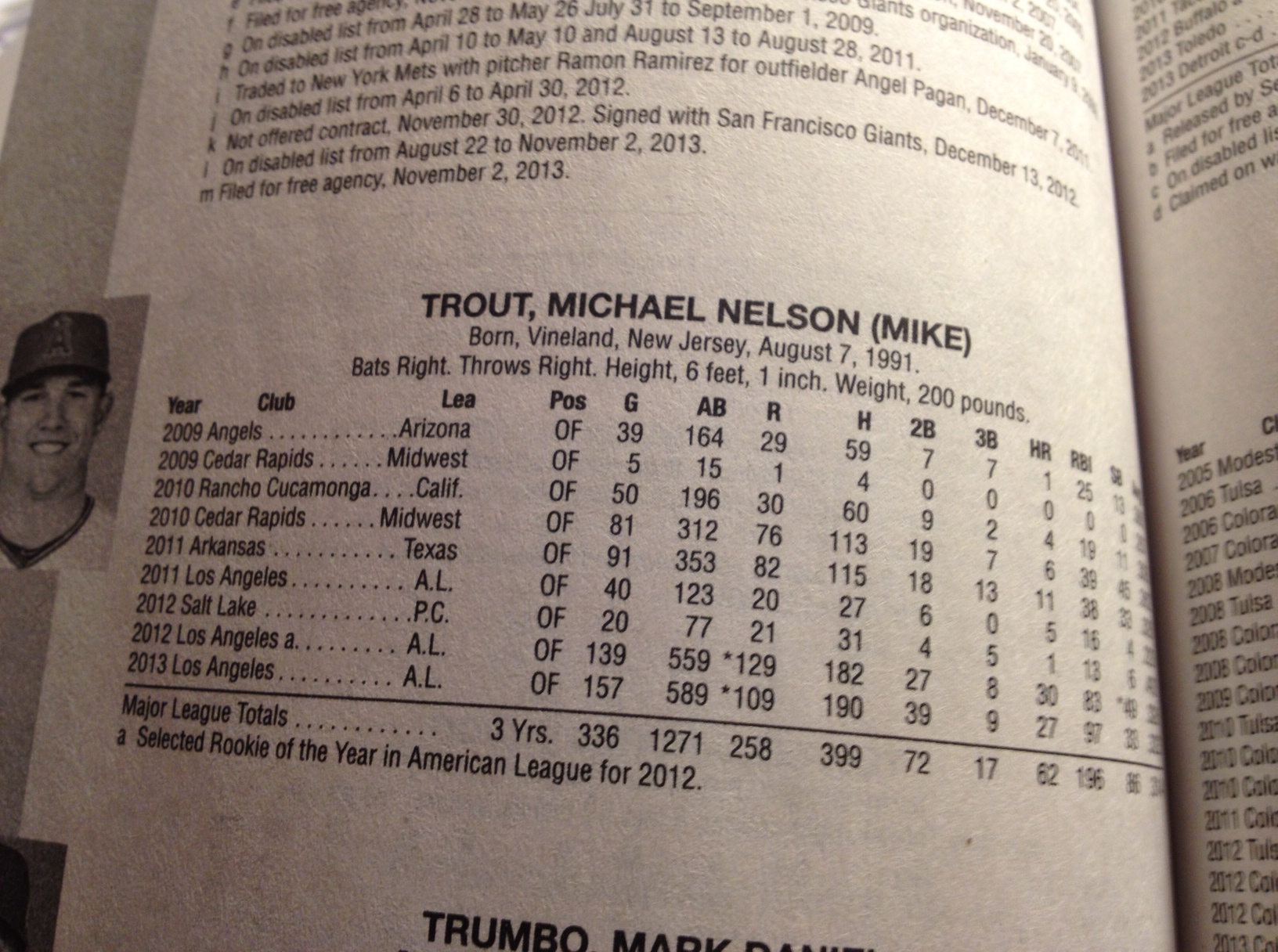
Fantasy baseball wasn’t around back in those days. But some of us played dice-and-charts statistical board games like APBA, Strat-O-Matic, Statis-Pro, Extra Innings, and Gil Hodges Pennant Fever, which allowed us to recreate player performances on our tabletops. These games were the precursors to computer and video sports simulation games today, and Who’s Who in Baseball was a key source toward informing us which players to draft for our pre-digital fantasy baseball squads.
The baseball stats explosion notwithstanding, I don’t need to know, say, how many times a guy grounded into a double play with two strikes on him. Hey, I’m a fan, not a big league manager. Instead, it’s more fun to flip through the pages of Who’s Who to trace players’ careers and to immerse myself in old-fashioned, plain vanilla stats like home runs, batting averages, wins, and ERA.
Enough snow. Play ball!
***
APBA and Strat-O-Matic are still in business, offering both board and computer versions of their baseball games. Even in this digital era, sports board game devotees form a hardy bunch, featuring a lot of Generation Jones members! I’ll have more to say about that hobby in a future post.
Earthy, historic, mysterious, delicious New Orleans

New Orleans has a mythology, a personality, a soul, that is large, that has touched people around the world. It has its own music (many of its own musics), its own cuisine, its own way of talking, its own architecture, its own smell, its own look and feel.
-Tom Piazza, Why New Orleans Matters (2005)
At least during those five months of the year when it isn’t unbearably hot and humid, I can’t think of a more fascinating American city to visit than New Orleans.
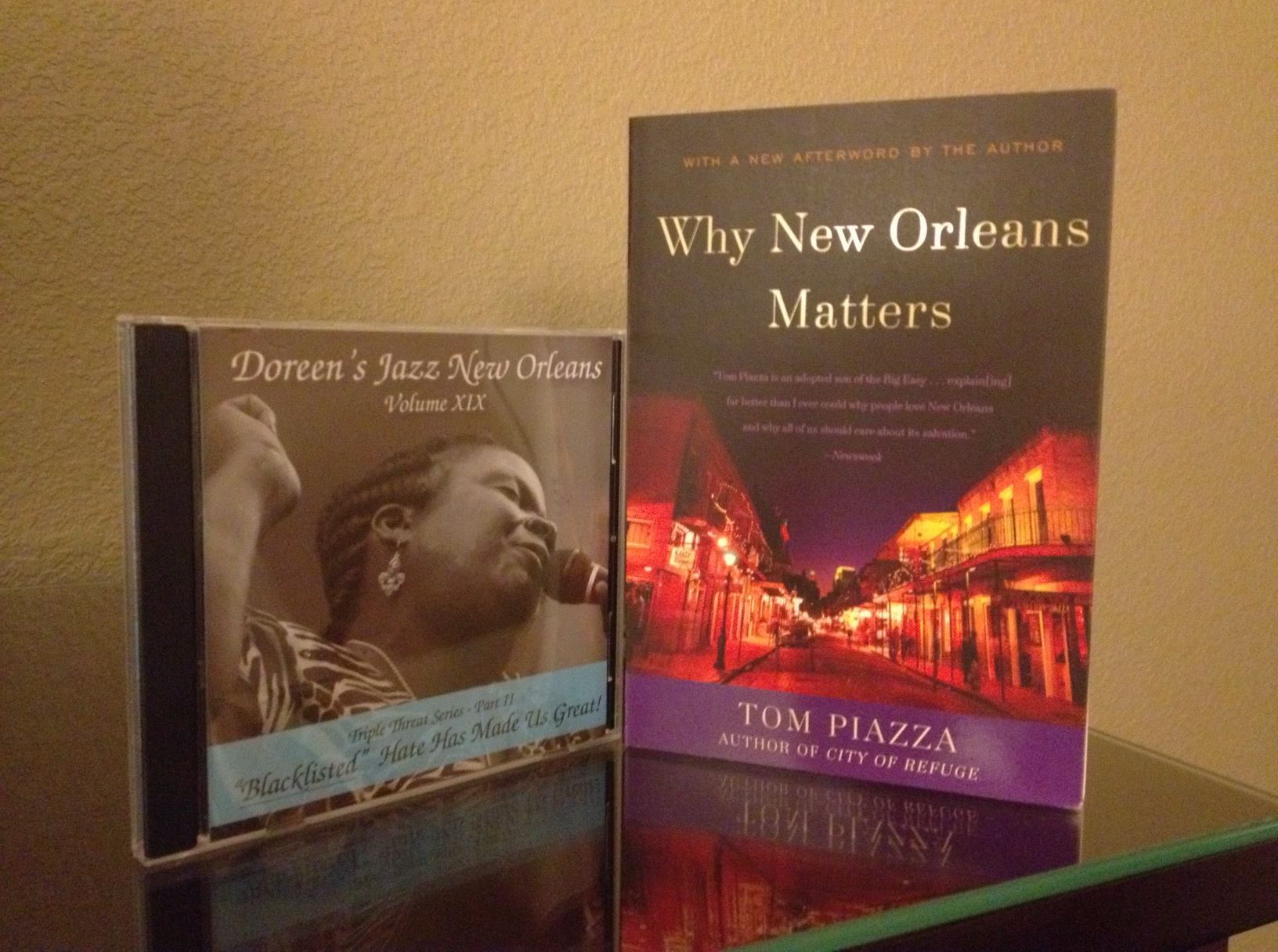
I’ve been in New Orleans for a conference, and it’s my first trip to the city in 15 years. Obviously NOLA (as they call it) has been through a lot in the post-Katrina years, but it retains the unique look and feel that Tom Piazza wrote about in his eloquent tribute to the city as it struggled to recover from the storm and flooding.
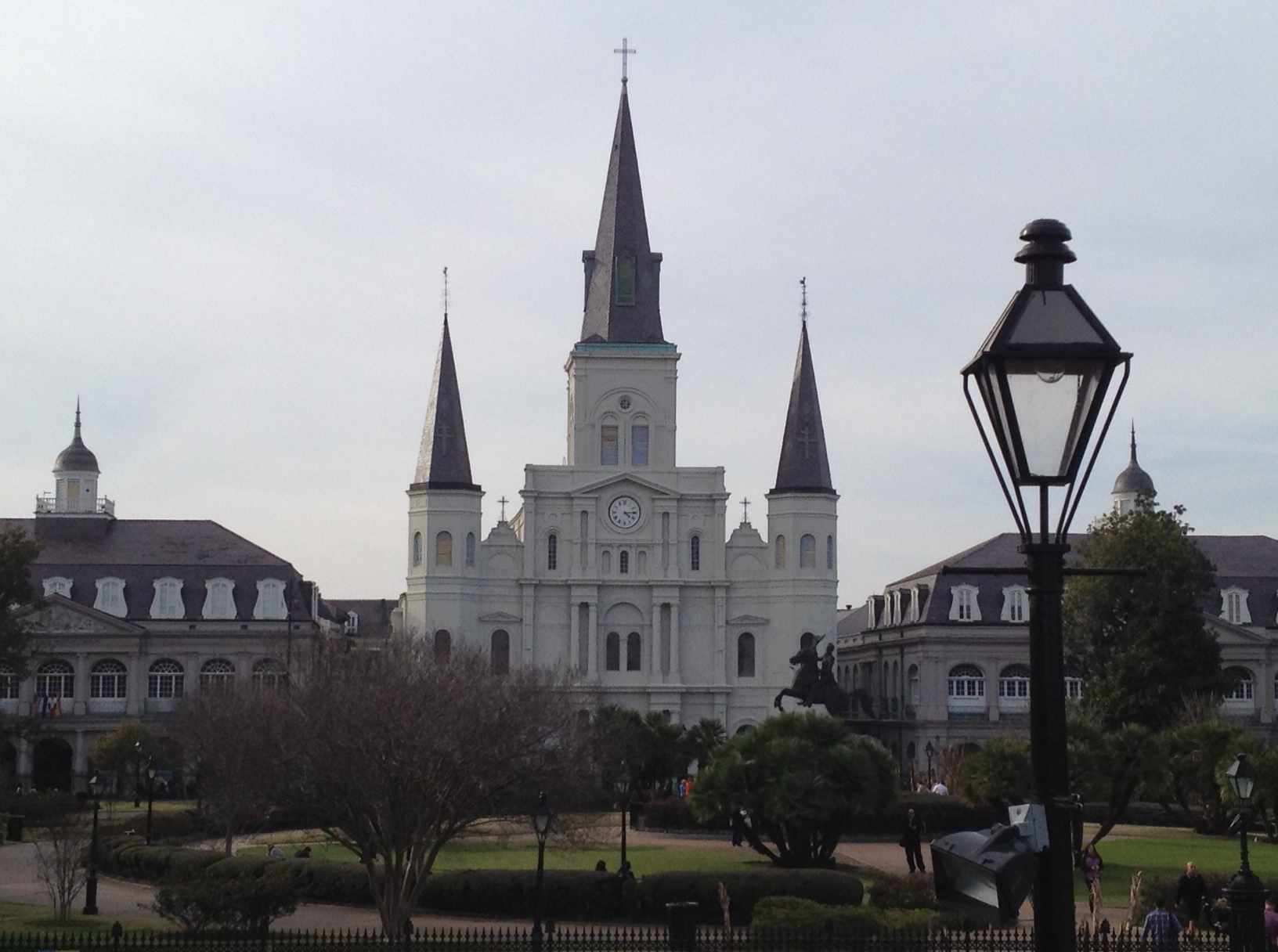
Lately my vacations have been limited to extended weekend trips and add-on days to work-related travel, and thus I tend to explore places I visit in short stretches. Fortunately I can dig into a city like New Orleans, especially its historic French Quarter, even if I have only a couple of days to do so. For starters, I took a great walking tour of the Quarter sponsored by Friends of the Cabildo, a non-profit organization dedicated to preserving Louisiana’s history. From that tour, here’s a shot of the St. Louis Cathedral, the oldest operating cathedral in North America:
Some of my college pals who read this blog know all-too-well how much our semester abroad in England and accompanying post-semester sojourns imprinted themselves on me. Ever since, I’ve welcomed opportunities to re-experience the adventure of youthful European travel, however briefly, and New Orleans allows me to do just that without need of a passport! Seeing artists displaying their work in Jackson Square reminded me of my first visit to Paris over 30 years ago.

Being the bookstore hound that I am, I had to seek out a few of the city’s bookstores. Here’s Beckham’s Bookstore on Decatur Street, a great used bookstore with piles of books next to filled-up shelves that, well, sorta reminded me of my condo!

Beckham’s comes replete with its own resident cat, who apparently commandeers whatever space is convenient in order to get in a well-earned nap.

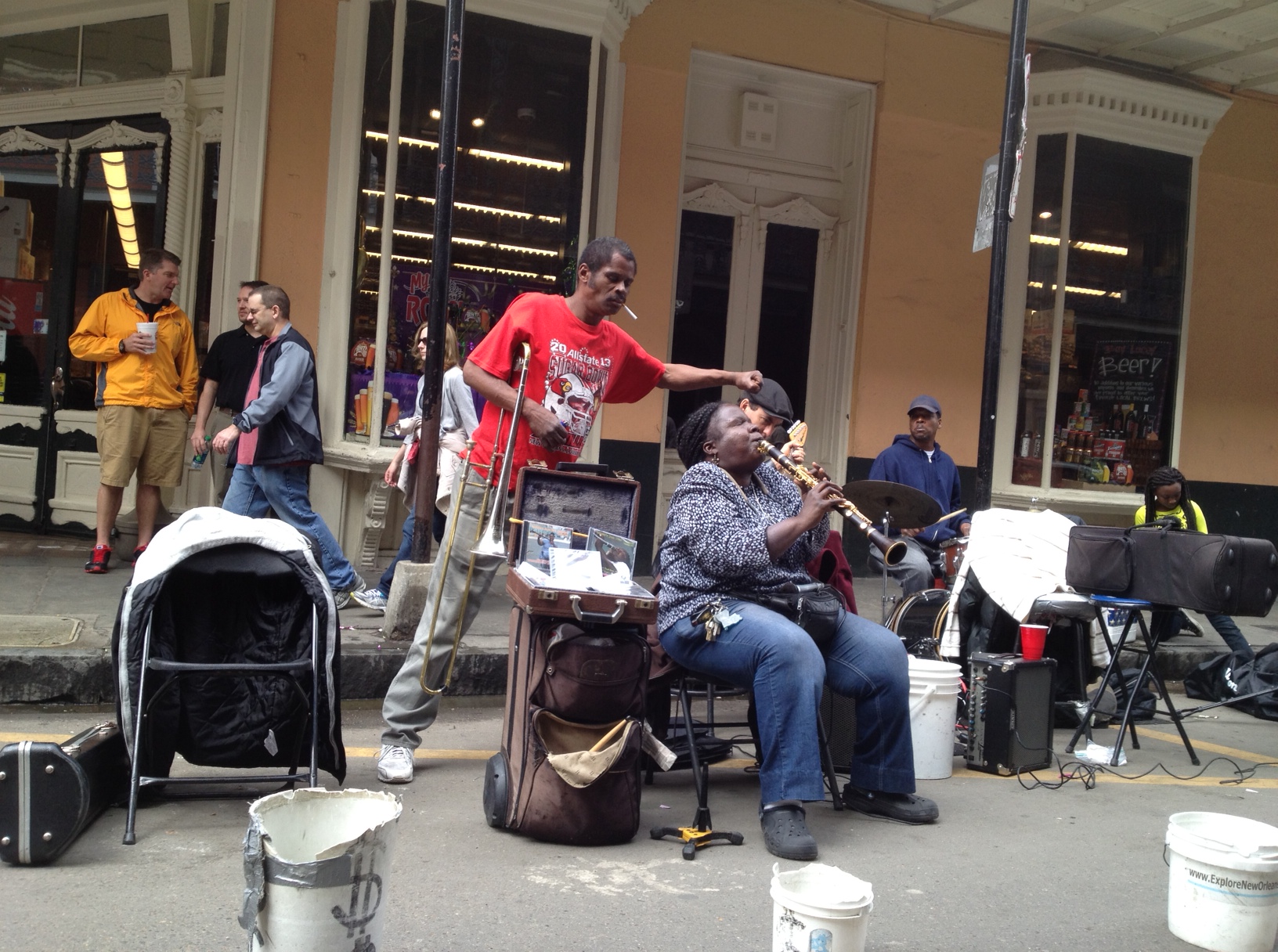
NOLA is home to some incredibly talented musicians. Here’s a great jazz band playing on Royal Street.
They’re so good, I picked up one of their CDs, pictured here with the Piazza book:
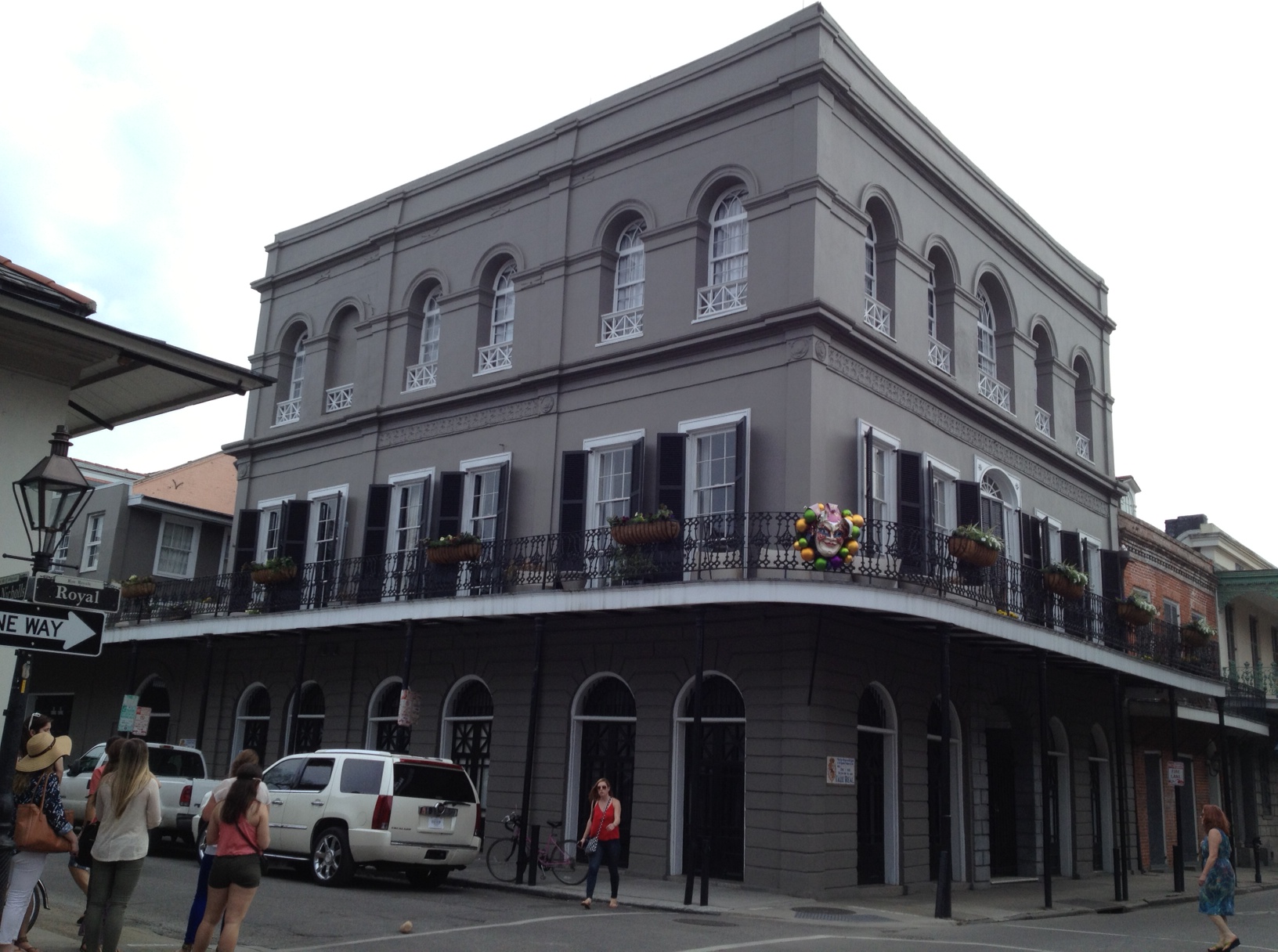
NOLA’s history has its ghastly side that, not surprisingly, sometimes turns ghostly. For example, pictured here is the house of Madame Delphine Lalaurie, who is said to have committed horrific acts of torture on her slaves during the 1830s. Though some claim that she has been unfairly indicted in the court of history, the most authoritative book that I’ve encountered on the topic, Carolyn Morrow Long’s Madame Lalaurie, Mistress of the Haunted House (2012), sides with the accusers. Naturally, the house is a favorite stop on the countless French Quarter ghost tours, and though I didn’t encounter anything supernatural when I was clicking away with my camera, I wouldn’t be eager to spend a night there.
Not all of the historical offerings are uniquely local. New Orleans also is home to the impressive National World War II Museum, co-founded by noted historian Stephen Ambrose, who taught at the University of New Orleans and whose books about D-Day and the European Theatre inspired the HBO series “Band of Brothers.” The museum, which continues to expand, includes a large hall containing vintage aircraft. Here is a B-17 “Flying Fortress,” an iconic U.S. bomber plane of the era.

Of course, a visit to New Orleans typically involves good food. The city has a collection of fancy restaurants, but I ended up being a repeat customer at less expensive eateries, including The Grill, pictured here…
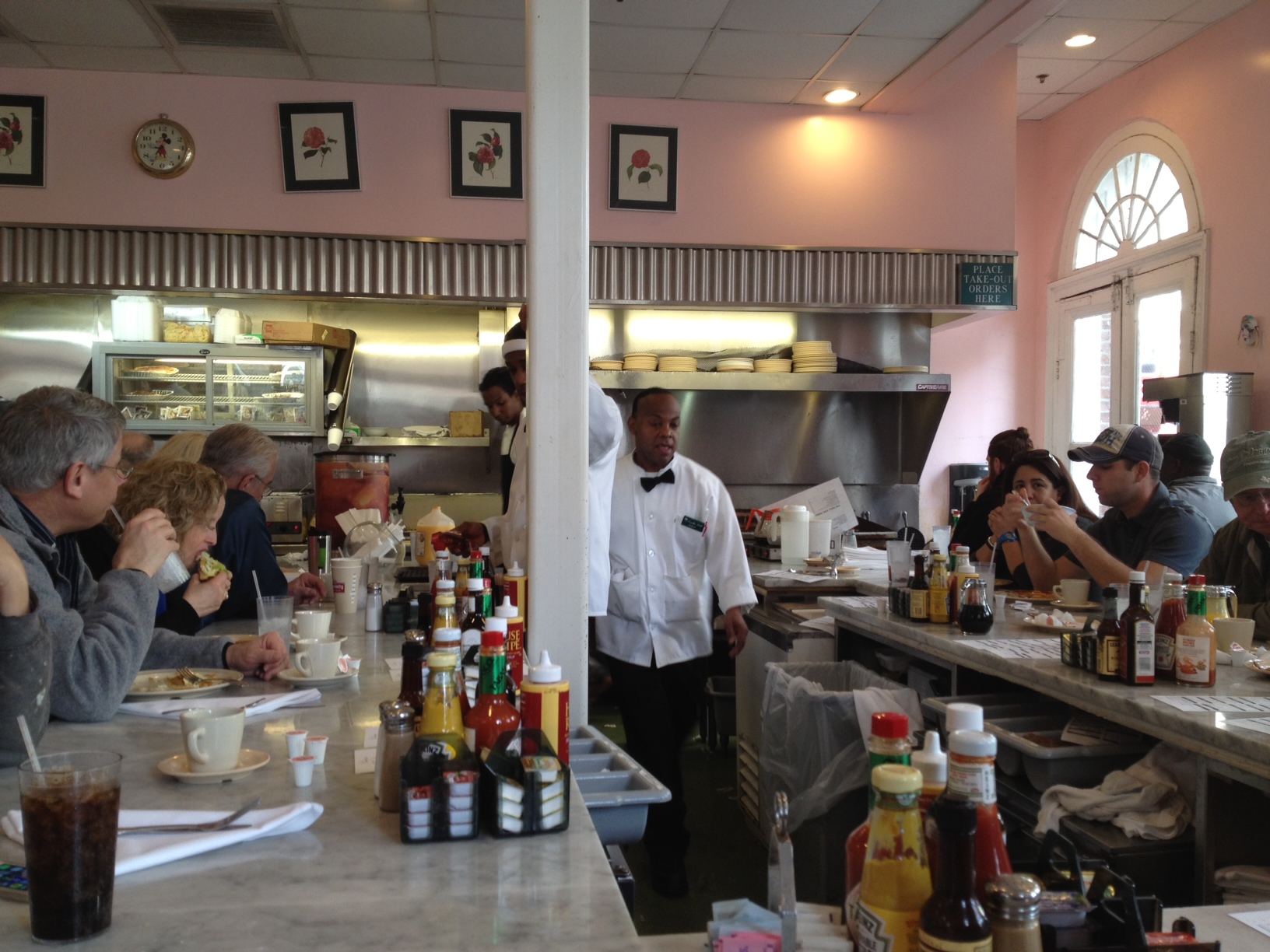
…and Jimmy J’s Cafe, whose wonderful cinnamon French toast is pictured here.

I think an order of French toast is a good way to conclude this blog post. Enjoy!
***
For a short piece on the psychology & law conference that brought me to New Orleans, go here.
All photos: DY, 2014
A bookstore visit triggers memories of meeting an intellectual hero
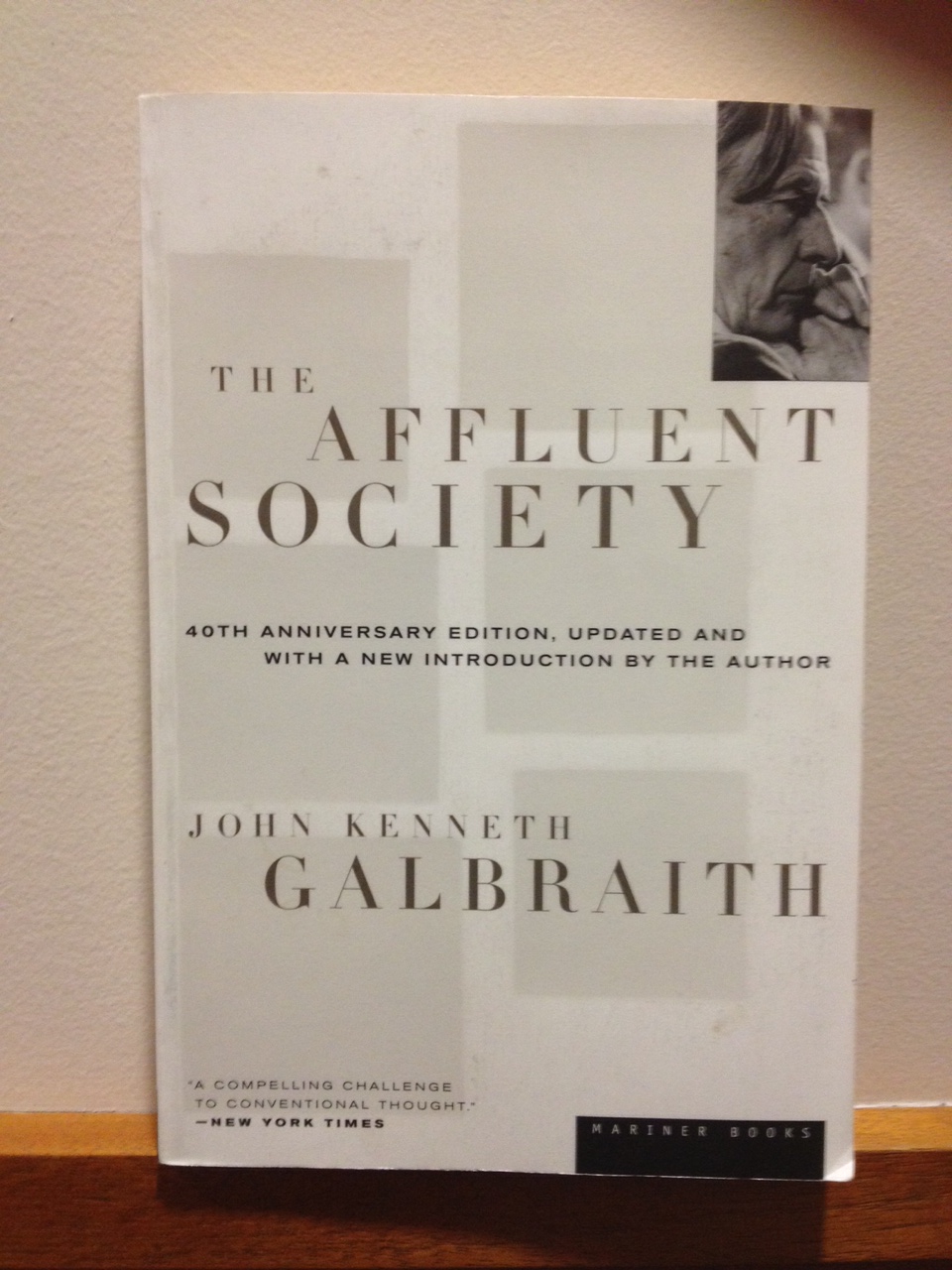
This afternoon I stopped by the venerable Brattle Book Shop, my favorite used bookstore in Boston and one of the nation’s oldest booksellers. The frequent turnover of their stock means that new discoveries await with each visit. Today’s brief sojourn introduced me to a newly-arrived row of books authored by John Kenneth Galbraith (1908-2006), the renowned Harvard University economist, public intellectual, and bestselling author of books on public affairs.
Galbraith cared passionately about economic society, but he never lost sight of the bigger picture. He understood that smart, sensible liberalism was not about advancing single issues to the exclusion of all others, but rather embraced a broader, inclusive agenda covering many priorities. He valued intelligent discussion over cheap slogans and didn’t hesitate to exchange ideas with those who disagreed with him.
Among the titles available at the Brattle were his most well-known works, including The Affluent Society (1958), The New Industrial State (1967), and The Great Crash, 1929 (1954). Many were signed by him, and when I opened the volumes I saw a signature that looked familiar to me. And herein lies a story…
I discovered Galbraith’s writings as an undergraduate during a semester abroad in Cambridge, England. There I attended a debate featuring Galbraith waxing eloquent about economic policy. Suitably impressed, I devoured several of his books during that overseas semester, and he quickly became one of my intellectual heroes. For years I thought to myself, gee, it sure would be great to meet the guy someday.
My assignment
Galbraith was a co-founder, leader, and ongoing supporter of Americans for Democratic Action (ADA), a longstanding liberal advocacy group based in Washington, D.C. In 2001, I joined the ADA’s board of directors. I became active in the organization’s fundraising efforts, and in 2006 I was dispatched in this role to visit with him at his Cambridge, Massachusetts home to solicit his statement of support for a fundraising campaign. He replied promptly to my letter requesting a meeting, and I arranged to meet with him at his Cambridge family residence.
On the appointed day I arrived at his home, where he was confined to his bed. I had not known that his health was in a sharp state of decline. It quickly became apparent that he was in the final chapter of his long journey. My nerves about this first-ever private chat with a man I had admired for so long were exacerbated by my awkwardness over meeting him in this condition. But I gathered myself, explained why I was visiting, and asked for his support for ADA. Although his attention waned at times during our talk, he promised to provide me with a testimonial for ADA and added that he’d send me a copy of the latest edition of The Affluent Society.
Several weeks later, Galbraith passed away. I hadn’t heard from him, and I realized that his condition did not allow him to follow up on our conversation. Nonetheless, I was enormously grateful for the opportunity to finally meet him.
In the mail
But I was in for a stunner: A few days after his death, I checked my mailbox at work, and there was a package with Galbraith’s Harvard University return address.
Hands shaking, I opened it, and on top was a note from his assistant, apologizing for the delay in following up on our meeting and explaining that mailing the package was delayed by his passing. Underneath was a dictated letter from John Kenneth Galbraith, dated 12 days before his death, which included his eloquent testimonial in support of ADA’s fundraising campaign.
There was one other item in the parcel. It was a copy of The Affluent Society, inscribed to me with a much scratchier version of the signature I saw in those books today at the Brattle Book Shop.
Years later, it still gives me goosebumps to think about it.
Libraries are a geek’s paradise

Bates Hall reading room, 2nd floor, Boston Public Library, Central Branch (photo: DY, 2011)
I love libraries. Over the years they have served as both workshop and sanctuary for me, and the most beautiful libraries embody an almost sacred quality.
The Central Branch of the Boston Public Library, located in the city’s Back Bay neighborhood on Copley Square, is one of my favorite places. The McKim building of the Central Branch, the site of the photos here, is deservedly a tourist attraction.

The gorgeous Abbey Room, used for book readings and other events, 2nd floor. (Photo: DY, 2011)
You might think that my affinity for libraries is all about my being an academic. However, in my experience most professors prefer to work in their offices or homes, rather than join the masses in a public or university library.
In fact, when I peer around the stunning Bates Hall reading room of the McKim building, few of the denizens “look” like professors — that is, assuming that profs have a giveaway appearance! Instead, I see a lot of young folks and adults from varying walks of life, at least based on the books, papers, and gadgets they have piled about them.

John Singer Sargent Gallery, 3rd floor (Photo: DY, 2011)
You won’t see many books in these pictures! The McKim building houses the research collection, which for the most part can be accessed only by request. The lending library adjoins the McKim building — it is big and serviceable but not nearly as architecturally appealing.

The library’s Italianate courtyard, peaceful and lovely. (Photo: DY, 2011)
Today’s lending libraries are a multimedia treat for borrowers. Books, DVDs, audiotapes, and even e-books are now part of the treasure trove. Especially for folks on a tight budget, a library card can be a ticket to adventure, enlightenment, and entertainment. That $25 bestseller at the bookstore? It’s free to read from the library! (And if you read the first chapter and find that the book doesn’t float your boat, it doesn’t cost a cent to return it — unless you’re like me and return it overdue.)
And at some libraries, you can even refuel with some coffee and a morsel, though it’ll cost you.
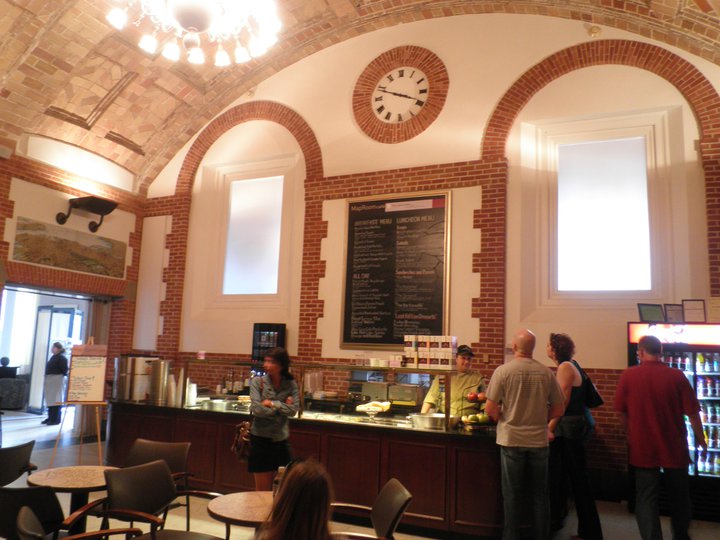
Map Room cafe, serving tasty sandwiches, soups, and pastries. And, of course, lots of coffee. (Photo: DY, 2011)
For researchers and writers working on their latest articles and books, libraries are repositories of accumulated knowledge. Even if one isn’t doing research at the library, it provides a place of solitude to contemplate the task at hand. When I sit at the long tables at the Boston Public Library and imagine what other patrons are working on, I feel a quiet sense of shared purpose among our diversity of projects.
When I depart from the library and step out into the heart of the city, it feels like I’ve left a contemplative, cloistered space to rejoin the hurly-burly of urban society. I happen to like cities, so that’s not a bad thing for me. But it does make me look forward to my next visit to the library.

McKim building’s Copley Square entrance (Photo: DY, 2011)
Has the Kindle Paperwhite pushed e-reading devices over a tipping point?

Kindle Paperwhite, e-book cover
Over the years, I’ve owned several incarnations of the Amazon Kindle e-reader, and though I’ve found it especially useful while traveling, ultimately I’ve been happy to return to the real things. However, the latest Kindle offering, dubbed the “Paperwhite,” has crossed a major technological line in terms of clarity and lighting. It won’t replace the books in my library, but it’s a darn good Plan B.
Basically, it boils down to the reading experience. The Paperwhite stands out with the sharp clarity of its text and its excellent lighting feature, the latter so good that you can read in bed with all the lights off. This photo of the text screen doesn’t do it justice, but maybe it’ll give you an idea:

Kindle Paperwhite e-text
Currently the most inexpensive version of the Paperwhite is selling for $119. That’s not exactly a cheap initial investment, even for an avid reader. But this is the first Kindle upgrade that, at least for me, provides a reading experience good enough not to make me long to have a book in hand. And with all the traveling I sometimes find myself doing, it’s a treat to be able to bring a few dozen books with me via an e-reader that makes reading a pleasure.
I know that many regard the printed book as sacred and the e-book as a sacrilege. I’m not out to change anyone’s mind on this question, other than to say that all things being equal, I’d still rather have an actual book at my side. Nevertheless, I’m currently on an extended out-of-town visit with some friends, and the new Kindle has proven to be very handy.
Plus, it is pretty cool to turn the lights off and still be able to read. It’s sort of the grown up edition of reading a book under the covers with a flashlight.
What are your geeky indulgences?

I’m not a wild spender, but I do have some geeky vices. One of them is books, and lately I’ve been seeking out volumes published by the Folio Society.
The Folio Society identifies classics of non-fiction and fiction and then produces them in beautiful hardcover editions, replete with slipcase. It also creates its own titles, such as the one pictured above, in the same handsome presentations.
The rub, as you might guess, is the price. The Folio Society offers a book club-style membership package, giving new members a choice among deeply discounted boxed sets, in return for an agreement to buy four more volumes. Unlike, say, the Book of the Month Club, these editions are very expensive, usually ranging between $60 and $100. Premium volumes and sets can run well into the hundreds of dollars.

Buying these lovely books at full price is a bit beyond my spending comfort zone. So I do the next best thing: I look for Folio volumes in used bookstores and on Amazon and eBay. There I’ll find Folio editions priced as low as $5, and averaging around $15-$30 — or about as much as I’d pay for a new hardcover book.
Over the past year or so, I’ve picked up about a dozen Folio volumes in this way, at a fraction of their original cost. And they look great on my personal library shelves.
So, do you have any geeky indulgences? Perhaps hobbies or collectibles made more affordable by smart spending and a little searching around? Feel free to share here or on Facebook where I’ll be linking this!
Celebrating books and authors: Boston Book Festival, 2013
I spent Thursday evening and a good chunk of Saturday at the Boston Book Festival, an annual event in the city’s Back Bay neighborhood. Since 2009, the BBF has been a big draw for avid readers and book lovers in the area.
Thursday’s opening night program, “Writing Terror: An Exploration of Fear,” captured what is so enjoyable about the BBF. It featured former CIA agent Valerie Plame Wilson (Blowback), journalist and intelligence expert Mary Louise Kelly (Anonymous Sources), terrorism expert Jessica Stern (Denial), and film producer/director Wes Craven (Nightmare on Elm Street), moderated by journalist Joe Klein.

Opening night of the Boston Book Festival, awaiting panelists
This eclectic panel engaged in a wide-ranging exchange on fear & terror in real-life and in fiction. Some snippets: Plame and Kelly, authors of new international suspense novels, concurred that when it comes to the most frightening aspects of global terrorism, all roads lead to Pakistan. Stern told us that unfortunately we likely will have to live with the ongoing specter of low-level terrorism, as exemplified by the Boston Marathon bombings. Craven said his biggest fears are grounded in America’s ugly domestic politics and global climate change.
I bought books by each of the authors and one of Craven’s films, and then went to the author signing tables. The line for Craven was by far the longest, with mostly young folks posing for pictures with him and requesting his autograph on a variety of movie memorabilia. (Sigh, even at a book festival, the scary movie guy is getting much of the love…)
On Saturday, the BBF went into full gear, with dozens of programs featuring leading authors and booths of publishers, literary journals, bookstores, and other vendors ringing Copley Square. I bought Vincent McCaffrey’s Hound, the first entry of a mystery series set in Boston (featuring, ta da, a bookseller protagonist) at the Small Beer Press booth:
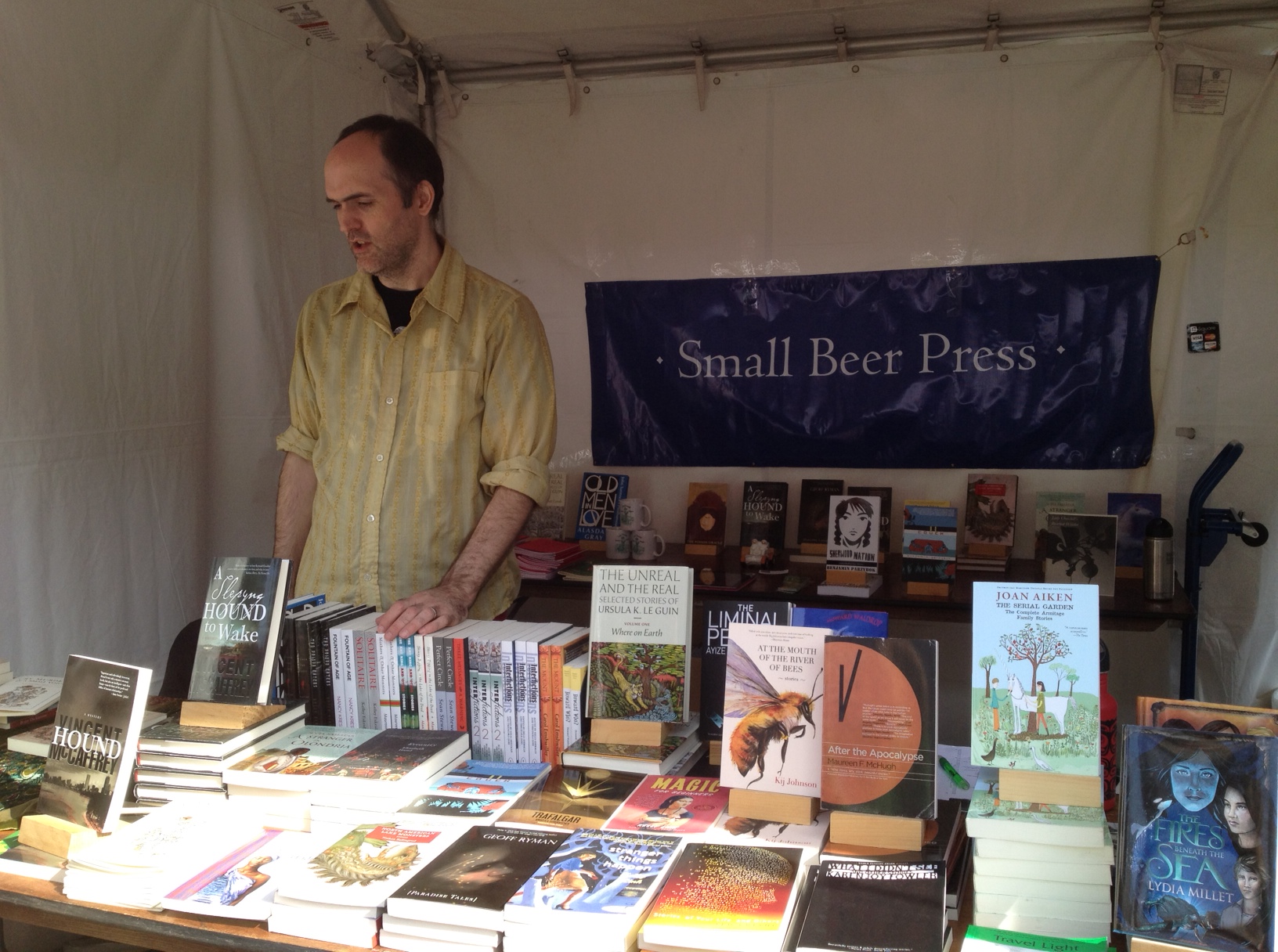
Small presses and indie publishing increasingly are the wave of the future for quality work overlooked or not regarded as sufficiently commercial by mainstream publishers, especially niche fiction and non-fiction books. I hope that such presses will have an even greater presence at future BBFs.
The Brattle Book Shop is my favorite used bookstore in Greater Boston and one of the oldest in the nation. I was happy to see its booth attracting a lot of interest:
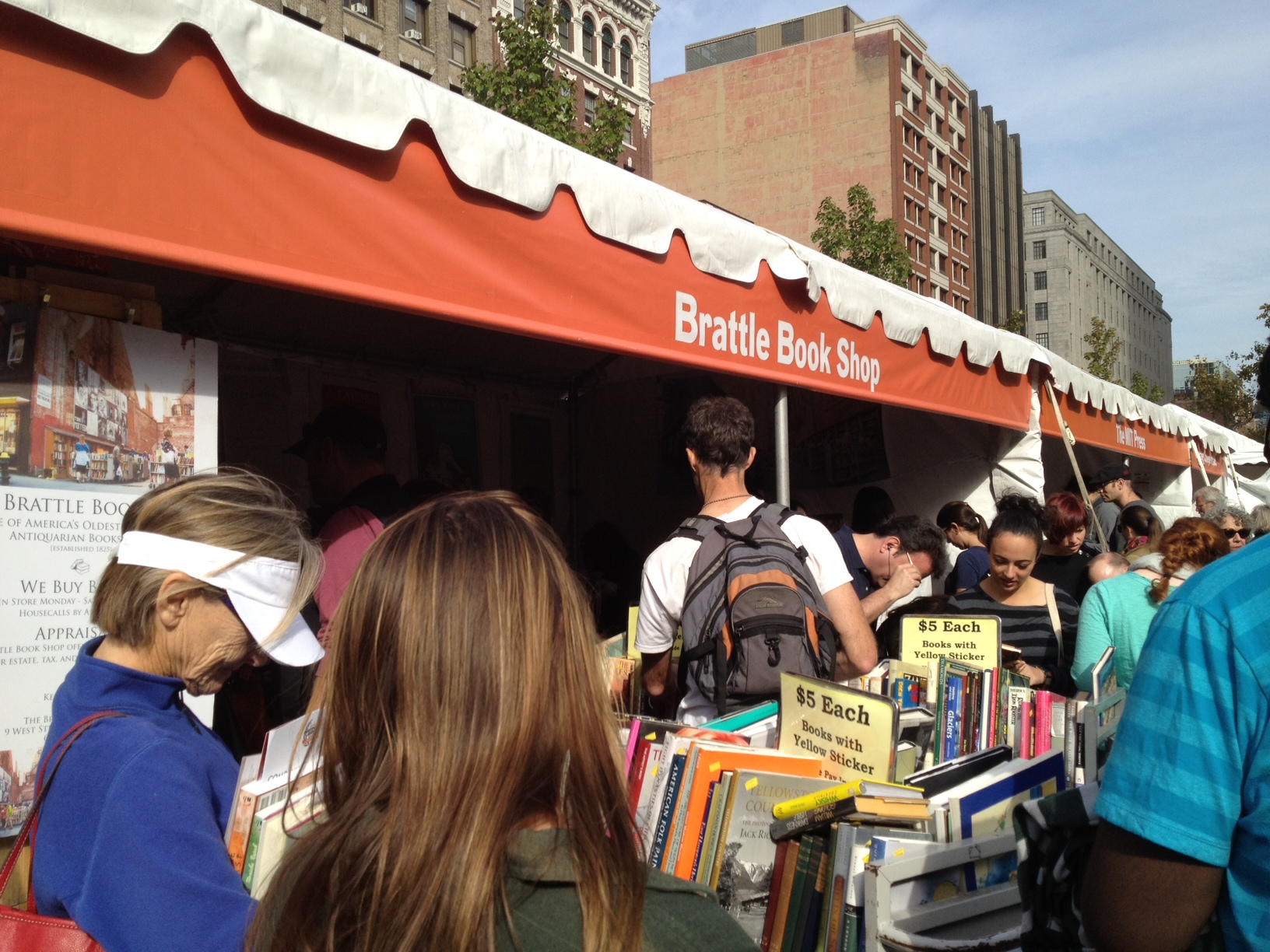
I love used bookstores. Whenever I walk into one, I am filled with a sense of anticipation over possible discoveries awaiting me. Brick-and-mortar used bookstores are in decline, but stalwarts like Brattle remain. It joins my favorites in other cities, such as the legendary Strand in Manhattan and Powell’s in Chicago’s Hyde Park.
You may not know that Dunkin’ Donuts originated in Greater Boston! They were handing out free samples of their pumpkin spice latte, a welcomed little treat on a perfect fall day. After all, books and coffee are a natural match.
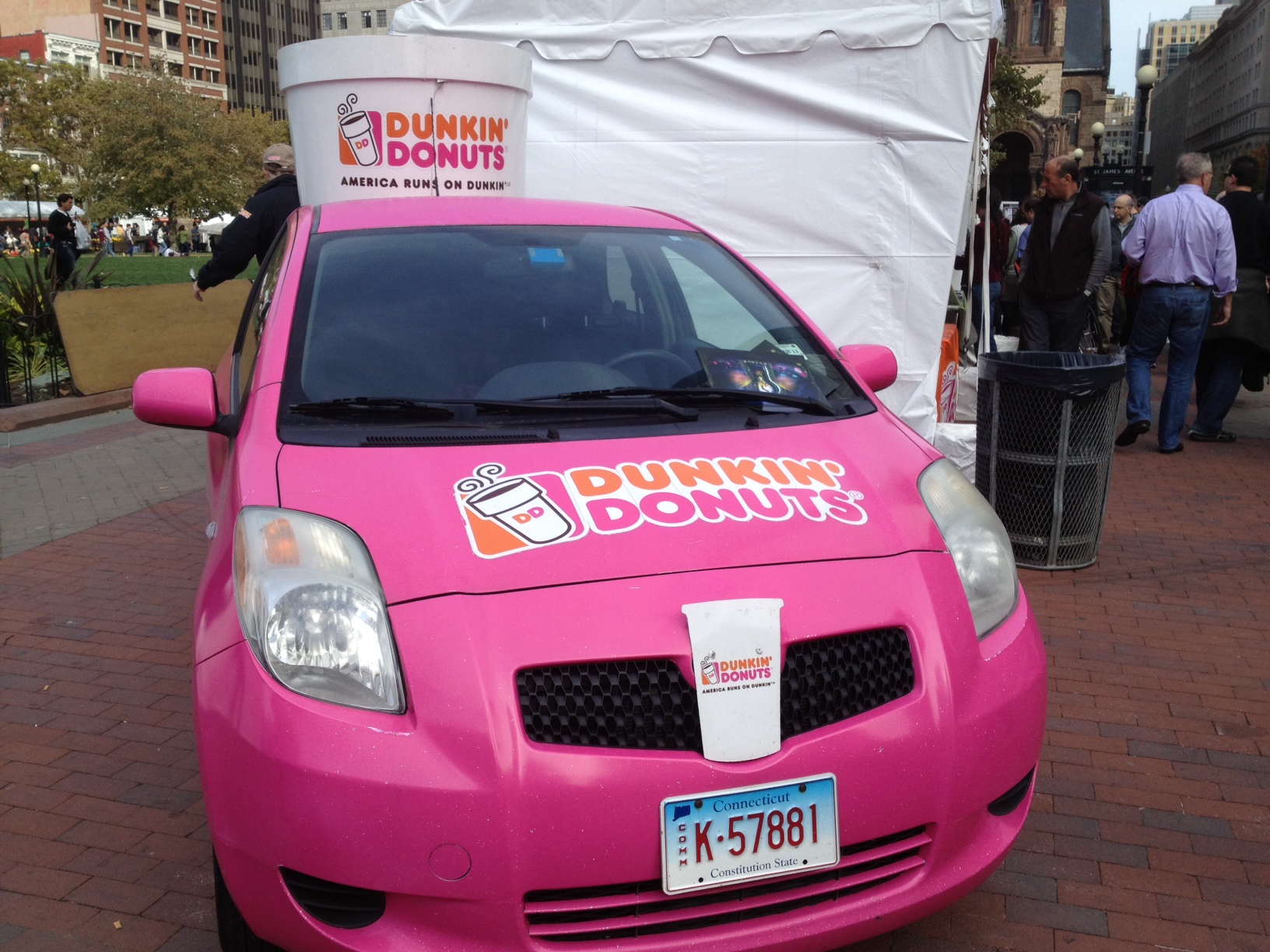
Greater Boston has experienced a sad decline in the number of bookstores, as have most other parts of the country. But this still remains a place where books and reading are given due respect and affection. Events like the Boston Book Festival are a welcomed reminder of that.
***
Photos: DY, 2013
 Musings of a Gen Joneser
Recent Comments